WRONGFUL TERMINATION DEMAND LETTER
STATE OF NEW JERSEY
[ATTORNEY/FIRM LETTERHEAD]
[Firm Name]
[Address Line 1]
[City, New Jersey ZIP]
Tel: [Phone Number]
Fax: [Fax Number]
[Attorney Email]
[New Jersey Attorney ID Number]
VIA CERTIFIED MAIL, RETURN RECEIPT REQUESTED
AND VIA EMAIL TO: [recipient_email]
[Date]
[Employer Contact Name]
[Title]
[Company Legal Name]
[Company Address]
[City, State ZIP]
Re: Wrongful Termination of [Client Full Name]
Former Position: [Job Title]
Dates of Employment: [Start Date] through [Termination Date]
CONFIDENTIAL SETTLEMENT COMMUNICATION PURSUANT TO N.J.R.E. 408
Dear [Mr./Ms./Mx. Last Name]:
This firm represents [Client Full Name] ("our client" or "[Mr./Ms./Mx. Client Last Name]") regarding [his/her/their] wrongful termination from employment with [Company Legal Name] ("[Company Short Name]" or "the Company") on or about [Termination Date]. Please direct all further communications regarding this matter to our office and refrain from any direct contact with our client.
We write to demand immediate action to remedy the unlawful termination of our client and to resolve this matter short of litigation. As detailed below, [Company Short Name] terminated our client in violation of New Jersey law, exposing the Company to substantial liability for compensatory damages, punitive damages, and attorney's fees.
I. NEW JERSEY-SPECIFIC LEGAL FRAMEWORK
A. At-Will Employment and Exceptions
New Jersey follows the employment-at-will doctrine but has developed robust exceptions through both common law and comprehensive statutory protections. Pierce v. Ortho Pharmaceutical Corp., 84 N.J. 58, 417 A.2d 505 (1980).
New Jersey provides exceptionally strong employee protections through:
- Public Policy Exception - Pierce v. Ortho Pharmaceutical Corp. (landmark case)
- Implied Contract Exception - Woolley v. Hoffmann-La Roche, Inc., 99 N.J. 284 (1985)
- New Jersey Law Against Discrimination (NJLAD) - One of the strongest state anti-discrimination laws
- Conscientious Employee Protection Act (CEPA) - Comprehensive whistleblower protection
B. Statute of Limitations
| Claim Type | Limitations Period | Citation |
|---|---|---|
| NJLAD claims | 2 years | N.J. Stat. Ann. Section 2A:14-2; Montells v. Haynes, 133 N.J. 282 (1993) |
| CEPA claims | 1 year | N.J. Stat. Ann. Section 34:19-5 |
| Common law tort | 2 years | N.J. Stat. Ann. Section 2A:14-2 |
| Contract claims | 6 years | N.J. Stat. Ann. Section 2A:14-1 |
C. New Jersey Law Against Discrimination (NJLAD)
The NJLAD, N.J. Stat. Ann. Sections 10:5-1 to 10:5-49, is one of the most comprehensive anti-discrimination statutes in the nation. It prohibits discrimination based on:
- Race, creed, color, national origin, ancestry
- Age
- Marital status, civil union status, domestic partnership status
- Affectional or sexual orientation
- Gender identity or expression
- Sex (including pregnancy)
- Disability
- Atypical hereditary cellular or blood trait
- Genetic information
- Military service or status
- Nationality
Key NJLAD Features:
- Applies to ALL employers regardless of size (no minimum employee threshold)
- No administrative exhaustion required - may file directly in court
- No cap on compensatory or punitive damages
- Prevailing plaintiffs recover attorney's fees
- Individual supervisors may be held personally liable
D. Conscientious Employee Protection Act (CEPA)
New Jersey's CEPA, N.J. Stat. Ann. Sections 34:19-1 to 34:19-14, provides comprehensive whistleblower protection. Under CEPA, an employer may not take retaliatory action against an employee who:
-
Discloses or threatens to disclose to a supervisor or public body an activity, policy, or practice that the employee reasonably believes violates a law, rule, or regulation
-
Provides information to or testifies before any public body conducting an investigation, hearing, or inquiry
-
Objects to or refuses to participate in any activity, policy, or practice that the employee reasonably believes violates a law, constitutes fraudulent or criminal activity, or is incompatible with a clear mandate of public policy
N.J. Stat. Ann. Section 34:19-3.
CEPA Notice Requirement: Before bringing a CEPA claim, an employee must give written notice to the employer identifying the alleged violation (unless the employee reasonably fears physical harm or unless the employer already knows of the violation). N.J. Stat. Ann. Section 34:19-12.
E. Administrative Exhaustion
NJLAD: No administrative exhaustion is required. Plaintiffs may file directly in the New Jersey Superior Court. Alternatively, complaints may be filed with the New Jersey Division on Civil Rights.
CEPA: No administrative exhaustion required.
II. FACTUAL BACKGROUND
A. Employment History and Performance
[Client Full Name] was employed by [Company Short Name] from [Start Date] through [Termination Date], a period of approximately [X years/months]. [He/She/They] most recently held the position of [Job Title] in the [Department], reporting to [Supervisor Name and Title].
Throughout [his/her/their] tenure, our client was a dedicated, high-performing employee:
- [Describe positive performance reviews, ratings, or commendations]
- [Describe any promotions, raises, or increased responsibilities]
- [Describe any awards, recognition, or special achievements]
- [Describe positive feedback from supervisors, clients, or colleagues]
At no time prior to [Date of First Adverse Action or Termination Date] did our client receive any disciplinary action or warning.
B. The Protected Activity / Triggering Event
On or about [Date], our client [describe the protected activity or triggering event]:
- [ ] Disclosed or threatened to disclose activity violating law (CEPA)
- [ ] Refused to participate in activity violating law or public policy (CEPA)
- [ ] Objected to discriminatory practices under NJLAD
- [ ] Complained about harassment or hostile work environment
- [ ] Filed a workers' compensation claim
- [ ] Exercised rights under New Jersey SAFE Act (domestic violence leave)
- [ ] Exercised rights under New Jersey Family Leave Act
- [ ] Exercised statutory rights (FMLA, jury duty, military leave)
- [ ] Reported safety violations under New Jersey OSHA
- [ ] Other protected activity: [Describe]
[If CEPA claim:] Written Notice to Employer:
Our client provided written notice to [Company Short Name] on [Date] identifying the following violation: [Describe the violation disclosed in the written notice]. [If no notice given, explain exception that applies.]
Specifically, our client [provide detailed narrative of the protected activity].
C. Adverse Employment Actions and Termination
Following our client's protected activity, [Company Short Name] engaged in a pattern of retaliatory conduct:
Timeline of Adverse Actions:
| Date | Adverse Action | Responsible Party |
|---|---|---|
| [Date] | [Describe adverse action] | [Name/Title] |
| [Date] | [Describe adverse action] | [Name/Title] |
| [Termination Date] | Termination of employment | [Name/Title] |
On [Termination Date], our client was terminated purportedly for [state employer's reason]. This pretext is belied by:
- [Explain why the stated reason is false or pretextual]
- [Describe temporal proximity between protected activity and termination]
- [Describe disparate treatment compared to similarly situated employees]
- [Describe any statements or evidence of retaliatory motive]
III. LEGAL ANALYSIS
A. Violation of CEPA - Whistleblower Retaliation
Our client's termination violates the Conscientious Employee Protection Act, N.J. Stat. Ann. Sections 34:19-1 to 34:19-14.
Under CEPA, a plaintiff must demonstrate:
- A reasonable belief that the employer's conduct was violating law, rule, regulation, or public policy
- Whistleblowing activity (disclosure, objection, or refusal to participate)
- An adverse employment action
- A causal connection between the whistleblowing and the adverse action
Kolb v. Burns, 320 N.J. Super. 467, 476 (App. Div. 1999); Dzwonar v. McDevitt, 177 N.J. 451 (2003).
Our client reasonably believed that [Company Short Name]'s [describe conduct] violated [identify specific law, rule, regulation, or public policy]. Our client [disclosed/objected to/refused to participate in] this conduct and was terminated as a result.
B. Violation of NJLAD - Discrimination/Retaliation
[If applicable:] Our client's termination also violates the New Jersey Law Against Discrimination, N.J. Stat. Ann. Sections 10:5-1 to 10:5-49.
The NJLAD prohibits discrimination and retaliation in employment. N.J. Stat. Ann. Section 10:5-12(d). Our client was subjected to unlawful [discrimination/retaliation] based on [his/her/their] [protected characteristic or protected activity].
The NJLAD is "remedial legislation that should be liberally construed to accomplish its purpose of eradicating the cancer of discrimination." Fuchilla v. Layman, 109 N.J. 319, 334 (1988).
Individual Liability: Under the NJLAD, individual supervisors and managers who participate in or enable discrimination may be held personally liable. Lehmann v. Toys 'R' Us, Inc., 132 N.J. 587 (1993). We have identified [Name(s)] as potentially personally liable for their role in our client's termination.
C. Public Policy Exception - Pierce v. Ortho Pharmaceutical
The New Jersey Supreme Court recognized the public policy exception to at-will employment in the landmark case Pierce v. Ortho Pharmaceutical Corp., 84 N.J. 58, 417 A.2d 505 (1980).
Under Pierce, an employee may have a cause of action for wrongful discharge when termination violates a clear mandate of public policy derived from:
- Legislation
- Administrative rules and regulations
- Judicial decisions
- Professional codes of ethics (in appropriate cases)
Id. at 72.
Here, our client's termination violates the public policy established by [identify source of public policy].
D. Implied Contract - Woolley v. Hoffmann-La Roche
[If applicable:] Under Woolley v. Hoffmann-La Roche, Inc., 99 N.J. 284, 491 A.2d 1257 (1985), employee handbooks may create implied contracts regarding termination procedures.
[Company Short Name]'s Employee Handbook provides: [Quote relevant provisions]. The Company failed to follow these procedures, constituting breach of implied contract.
IV. DAMAGES
A. Economic Damages
1. Lost Wages (Back Pay)
| Category | Calculation | Amount |
|---|---|---|
| Base salary lost | [Annual salary] x [months since termination] / 12 | $[Amount] |
| Bonus/incentive compensation lost | [Expected bonus] x [period] | $[Amount] |
| Commission income lost | [Average commissions] x [period] | $[Amount] |
| Subtotal Back Pay | $[Amount] |
2. Lost Benefits
| Benefit | Monthly Value | Months | Amount |
|---|---|---|---|
| Health insurance | $[Amount] | [X] | $[Amount] |
| Retirement/401(k) match | $[Amount] | [X] | $[Amount] |
| Other benefits | $[Amount] | [X] | $[Amount] |
| Subtotal Benefits | $[Amount] |
3. Front Pay / Future Lost Earnings
| Category | Calculation | Amount |
|---|---|---|
| Future salary differential | [Salary differential] x [years] | $[Amount] |
| Future benefits differential | [Benefits differential] x [years] | $[Amount] |
| Subtotal Front Pay | $[Amount] |
B. Non-Economic Damages
Our client has suffered severe emotional distress including:
- [Describe emotional distress symptoms]
- [Describe impact on physical health]
- [Describe impact on personal relationships]
Under New Jersey law, emotional distress damages are available under both CEPA and NJLAD without proof of physical manifestation. Tarr v. Ciasulli, 181 N.J. 70 (2004).
Estimated non-economic damages: $[Amount]
C. Punitive Damages
Punitive damages are available under both NJLAD and CEPA where the employer's conduct is especially egregious. Rendine v. Pantzer, 141 N.J. 292 (1995); Catalane v. Gilian Instrument Corp., 271 N.J. Super. 476 (App. Div. 1994).
New Jersey applies the Punitive Damages Act, N.J. Stat. Ann. Sections 2A:15-5.9 to 2A:15-5.17, which requires proof by clear and convincing evidence that the harm was the result of actual malice or wanton disregard.
[Company Short Name]'s conduct demonstrates willful indifference warranting punitive damages.
D. Attorney's Fees and Costs
Under NJLAD, a prevailing plaintiff is entitled to reasonable attorney's fees. N.J. Stat. Ann. Section 10:5-27.1.
Under CEPA, a prevailing plaintiff may recover reasonable attorney's fees. N.J. Stat. Ann. Section 34:19-5(e).
E. Summary of Damages
| Category | Amount |
|---|---|
| Back Pay | $[Amount] |
| Lost Benefits | $[Amount] |
| Front Pay | $[Amount] |
| Emotional Distress | $[Amount] |
| Punitive Damages | $[Amount] |
| Attorney's Fees | $[Amount] |
| TOTAL | $[Amount] |
V. SETTLEMENT DEMAND
Based on the foregoing, we hereby demand that [Company Short Name] pay our client the sum of $[Settlement Demand Amount] in full and final settlement of all claims.
In addition to monetary compensation, we require:
- [ ] A neutral employment reference
- [ ] Expungement of negative information from personnel file
- [ ] Agreement not to contest unemployment benefits
- [ ] Non-disparagement provisions (mutual)
- [ ] Confidentiality provisions
VI. RESPONSE DEADLINE
Please respond in writing within twenty-one (21) calendar days, no later than [Response Deadline Date].
If we do not receive a satisfactory response, we are prepared to file suit in the Superior Court of New Jersey, including claims for:
- Violation of CEPA (N.J. Stat. Ann. Sections 34:19-1 to 34:19-14)
- Violation of NJLAD (N.J. Stat. Ann. Sections 10:5-1 to 10:5-49)
- Wrongful Discharge in Violation of Public Policy (Pierce)
- Breach of Implied Contract (Woolley)
- [Additional causes of action as applicable]
We may also name individual defendants who participated in the unlawful conduct.
VII. PRESERVATION OF EVIDENCE
This letter serves as formal notice to preserve all relevant documents and electronically stored information.
VIII. CONFIDENTIALITY
This letter constitutes a confidential settlement communication protected under New Jersey Rule of Evidence 408.
Sincerely,
[Attorney Name]
[Title]
[Firm Name]
Enclosures:
- [ ] Authorization to Represent
- [ ] [Relevant documents]
cc: [Client Name] (via email)
File
NEW JERSEY-SPECIFIC PRACTICE NOTES (Do Not Include in Final Letter)
Key New Jersey Cases
- Pierce v. Ortho Pharmaceutical Corp., 84 N.J. 58, 417 A.2d 505 (1980) - Public policy exception
- Woolley v. Hoffmann-La Roche, Inc., 99 N.J. 284, 491 A.2d 1257 (1985) - Implied contract from handbook
- Lehmann v. Toys 'R' Us, Inc., 132 N.J. 587 (1993) - Hostile work environment standards; individual liability
- Rendine v. Pantzer, 141 N.J. 292 (1995) - Attorney's fee calculations
- Dzwonar v. McDevitt, 177 N.J. 451 (2003) - CEPA standards
- Tarr v. Ciasulli, 181 N.J. 70 (2004) - Emotional distress damages
New Jersey-Specific Considerations
- [ ] CEPA's 1-year SOL: Very short - calendar carefully
- [ ] CEPA notice requirement: Must give written notice to employer before filing (with exceptions)
- [ ] No NJLAD size threshold: NJLAD applies to ALL employers, even with one employee
- [ ] No administrative exhaustion: Can file NJLAD directly in court
- [ ] Individual liability: Supervisors can be personally liable under NJLAD
- [ ] No damage caps: New Jersey has no caps on compensatory or punitive damages
- [ ] Strong precedent: New Jersey courts are generally employee-friendly
Do more with Ezel
This free template is just the beginning. See how Ezel helps legal teams draft, research, and collaborate faster.
AI that drafts while you watch
Tell the AI what you need and watch your document transform in real-time. No more copy-pasting between tools or manually formatting changes.
- Natural language commands: "Add a force majeure clause"
- Context-aware suggestions based on document type
- Real-time streaming shows edits as they happen
- Milestone tracking and version comparison
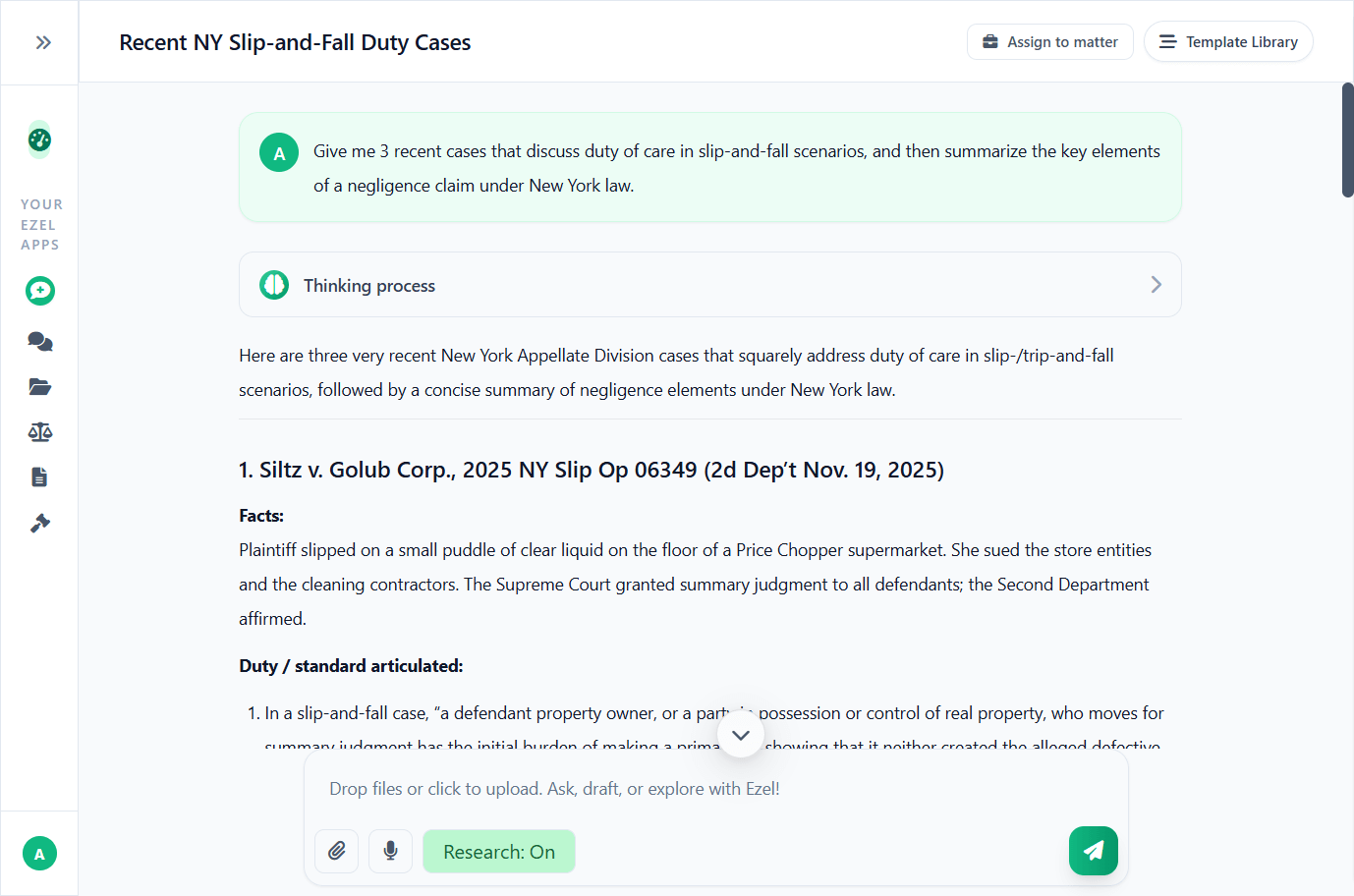
Research and draft in one conversation
Ask questions, attach documents, and get answers grounded in case law. Link chats to matters so the AI remembers your context.
- Pull statutes, case law, and secondary sources
- Attach and analyze contracts mid-conversation
- Link chats to matters for automatic context
- Your data never trains AI models
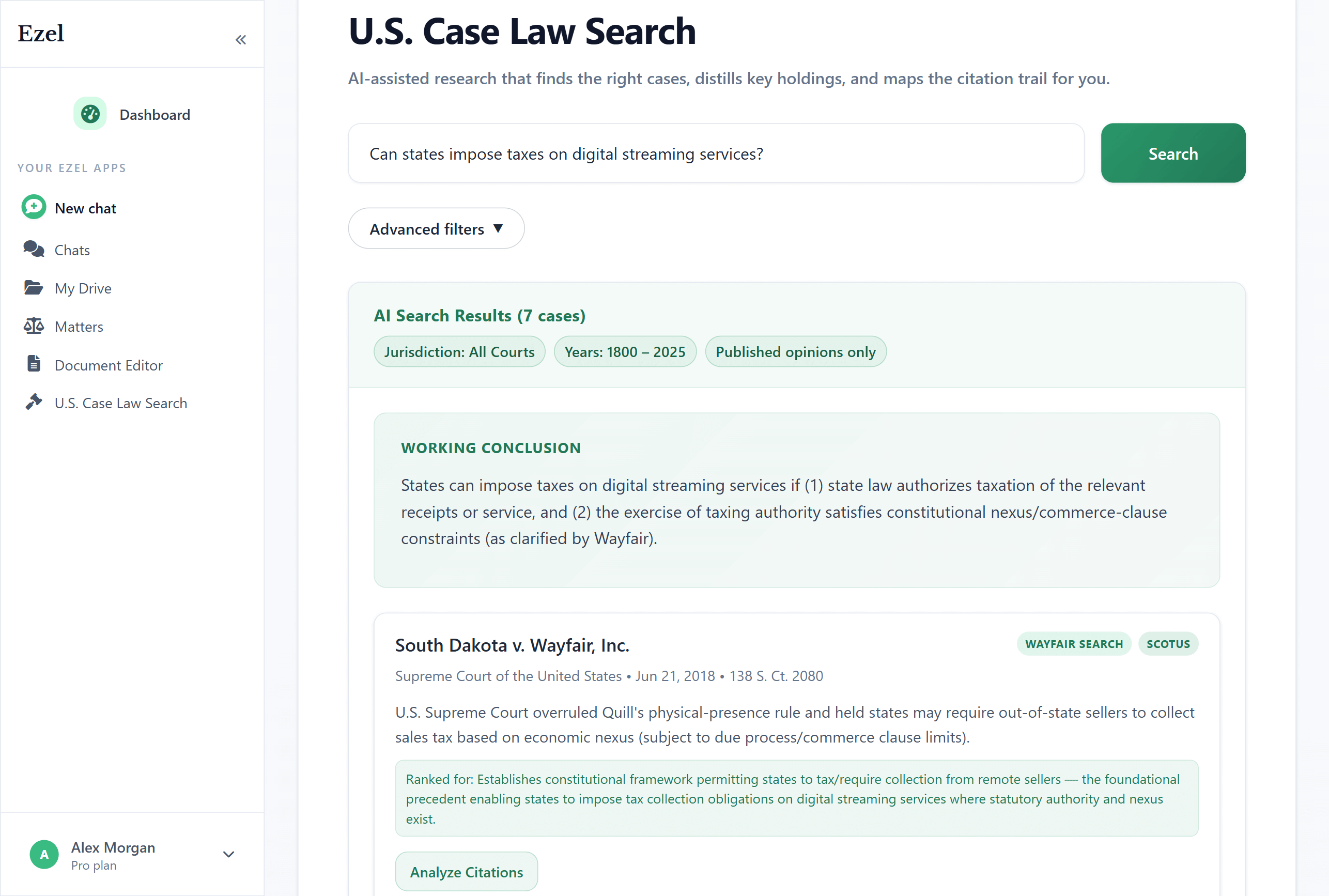
Search like you think
Describe your legal question in plain English. Filter by jurisdiction, date, and court level. Read full opinions without leaving Ezel.
- All 50 states plus federal courts
- Natural language queries - no boolean syntax
- Citation analysis and network exploration
- Copy quotes with automatic citation generation
Ready to transform your legal workflow?
Join legal teams using Ezel to draft documents, research case law, and organize matters — all in one workspace.