WRONGFUL TERMINATION DEMAND LETTER
Kansas Law
[ATTORNEY/FIRM LETTERHEAD]
[Firm Name]
[Address Line 1]
[City, State ZIP]
Tel: [Phone Number]
Fax: [Fax Number]
[Attorney Email]
[Kansas Attorney Registration No.]
VIA CERTIFIED MAIL, RETURN RECEIPT REQUESTED
AND VIA EMAIL TO: [recipient_email]
[Date]
[Employer Contact Name]
[Title]
[Company Legal Name]
[Company Address]
[City, State ZIP]
Re: Wrongful Termination of [Client Full Name]
Former Position: [Job Title]
Dates of Employment: [Start Date] through [Termination Date]
CONFIDENTIAL SETTLEMENT COMMUNICATION - K.S.A. 60-452
Dear [Mr./Ms./Mx. Last Name]:
This firm represents [Client Full Name] ("our client") regarding [his/her/their] wrongful termination from employment with [Company Legal Name] ("[Company Short Name]") on [Termination Date]. Please direct all further communications to our office.
We write to demand immediate action to remedy the unlawful termination and to resolve this matter short of litigation. [Company Short Name]'s termination of our client violates Kansas law and exposes the Company to substantial liability.
I. KANSAS EMPLOYMENT LAW FRAMEWORK
A. At-Will Employment and Its Exceptions
Kansas follows the employment-at-will doctrine. See Morriss v. Coleman Co., 241 Kan. 501, 738 P.2d 841 (1987). However, Kansas courts recognize important exceptions:
1. Public Policy Exception
Kansas recognizes the public policy exception to at-will employment. See Palmer v. Brown, 242 Kan. 893, 752 P.2d 685 (1988); Murphy v. City of Topeka-Shawnee County Dept. of Labor Services, 6 Kan. App. 2d 488, 630 P.2d 186 (1981).
Protected activities under Kansas public policy include:
- Filing workers' compensation claims (Murphy v. City of Topeka)
- Refusing to violate a law or regulation
- Reporting illegal employer conduct ("whistleblowing")
- Exercising statutory rights
- Performing important public duties
2. Implied Contract Exception
Kansas recognizes implied employment contracts based on employer handbooks, policies, and oral representations. See Morriss v. Coleman Co., 241 Kan. 501, 738 P.2d 841 (1987).
3. Promissory Estoppel
Kansas recognizes promissory estoppel in employment contexts when an employer makes specific promises upon which the employee reasonably relies. See Morriss v. Coleman Co., 241 Kan. 501, 738 P.2d 841 (1987).
4. Statutory Protections
Kansas provides specific statutory protections:
- Kansas Act Against Discrimination (KAAD): K.S.A. 44-1001 et seq.
- Workers' Compensation Retaliation: K.S.A. 44-5a01 (abolished direct cause of action, but common law remains)
- Public Employee Whistleblower: K.S.A. 75-2973
- Jury Service Protection: K.S.A. 43-173
- Military Leave: K.S.A. 48-222
B. Kansas Administrative Procedures
Kansas Human Rights Commission (KHRC):
- File within 6 months (180 days) of alleged discriminatory act
- KHRC investigates and issues determination
- Dual-filing with EEOC available (300 days for EEOC in deferral state)
- Right to sue after KHRC determination or 6 months without action
II. FACTUAL BACKGROUND
A. Employment History
[Client Full Name] was employed by [Company Short Name] from [Start Date] through [Termination Date] as a [Job Title] in [City], Kansas.
Employment Summary:
| Category | Details |
|---|---|
| Start Date | [Date] |
| Final Position | [Title] |
| Final Salary | $[Amount] per [year/hour] |
| Supervisor | [Name, Title] |
| Work Location | [Address] |
| Termination Date | [Date] |
Our client was a dedicated employee with an excellent performance record:
- [Describe positive performance history]
- [Describe promotions, raises, commendations]
- [Describe any relevant achievements]
B. The Protected Activity / Triggering Event
On or about [Date], our client [describe protected activity]:
- Filed a workers' compensation claim
- Filed a discrimination complaint with KHRC
- Refused to violate Kansas or federal law by [describe illegal act requested]
- Reported illegal employer conduct
- Served on jury duty as required by law
- [Other protected activity]
C. The Wrongful Termination
On [Termination Date], [Company Short Name] terminated our client, purportedly for [stated reason]. This stated reason is pretextual, as evidenced by:
- Temporal proximity: The termination occurred just [X days/weeks] after the protected activity
- Prior positive treatment: Our client had [no prior discipline / positive reviews / recent promotion]
- Disparate treatment: Similarly situated employees who did not engage in protected activity were [not terminated / treated more favorably]
- Shifting explanations: [Describe any inconsistent reasons given]
- Direct evidence: [Describe any statements indicating true motive]
III. LEGAL CLAIMS UNDER KANSAS LAW
A. Wrongful Discharge in Violation of Public Policy
Under Palmer v. Brown, 242 Kan. 893, 752 P.2d 685 (1988), Kansas recognizes a cause of action for wrongful discharge when termination violates public policy.
Elements of Claim:
1. Employer-employee relationship
2. Termination of employment
3. Termination violated a clearly defined public policy
4. Causal connection between protected activity and termination
5. Damages
Public Policy Violated: [Company Short Name] terminated our client for [describe conduct that violated public policy], which violates [cite specific Kansas statute, regulation, or case law].
See also Coleman v. Safeway Stores, Inc., 242 Kan. 804, 752 P.2d 645 (1988); Brigham v. Dillon Cos., 262 Kan. 12, 935 P.2d 1054 (1997).
B. Retaliatory Discharge - Workers' Compensation
[If applicable:] Kansas common law recognizes a cause of action for retaliatory discharge when an employee is terminated for filing a workers' compensation claim.
See Murphy v. City of Topeka-Shawnee County Dept. of Labor Services, 6 Kan. App. 2d 488, 630 P.2d 186 (1981); Coleman v. Safeway Stores, Inc., 242 Kan. 804, 752 P.2d 645 (1988).
Our client filed a workers' compensation claim on [Date] for [injury]. [Company Short Name] terminated our client in retaliation for exercising this statutory right.
Remedies:
- Lost wages and benefits
- Compensatory damages
- Potential punitive damages in egregious cases
- Attorney's fees
C. Violation of Kansas Act Against Discrimination (K.S.A. 44-1001 et seq.)
[If applicable:] [Company Short Name]'s termination of our client constitutes unlawful [discrimination/retaliation] under the KAAD based on [protected characteristic/protected activity].
The KAAD prohibits discrimination based on:
- Race, color, religion, national origin, ancestry
- Sex (including pregnancy)
- Age (40 and over)
- Disability
- Military status
- Genetic information
KAAD Remedies (K.S.A. 44-1005):
- Back pay and benefits
- Compensatory damages
- Reasonable attorney's fees and costs
- Injunctive relief
D. Breach of Implied Contract
[Company Short Name]'s Employee Handbook and representations created an implied contract limiting termination to "just cause" and/or requiring specific progressive discipline procedures.
Evidence of implied contract:
- Employee Handbook provisions stating [quote relevant language]
- Personnel policies requiring [describe procedures]
- Oral representations by [Name] that [describe assurances]
See Morriss v. Coleman Co., 241 Kan. 501, 738 P.2d 841 (1987).
E. Promissory Estoppel
[Company Short Name] made specific promises regarding [continued employment / termination procedures / job security] upon which our client reasonably relied to [his/her/their] detriment.
See Morriss v. Coleman Co., 241 Kan. 501, 738 P.2d 841 (1987).
IV. DAMAGES
A. Economic Damages
1. Back Pay
| Category | Calculation | Amount |
|---|---|---|
| Lost base salary | $[Annual] x [months] / 12 | $[Amount] |
| Lost overtime | [Calculation] | $[Amount] |
| Lost bonuses | [Calculation] | $[Amount] |
| Subtotal | $[Amount] |
2. Lost Benefits
| Benefit | Monthly Value | Months | Amount |
|---|---|---|---|
| Health insurance | $[Amount] | [X] | $[Amount] |
| 401(k) match | $[Amount] | [X] | $[Amount] |
| Other benefits | $[Amount] | [X] | $[Amount] |
| Subtotal | $[Amount] |
3. Front Pay
| Category | Calculation | Amount |
|---|---|---|
| Future lost wages | [X years] x $[salary] | $[Amount] |
| Future lost benefits | [Calculation] | $[Amount] |
| Subtotal | $[Amount] |
B. Compensatory Damages (Non-Economic)
Our client has suffered severe emotional distress:
- [Describe anxiety, depression, humiliation]
- [Describe impact on health and relationships]
- [Describe medical treatment sought]
Emotional distress damages: $[Amount]
C. Punitive Damages
[Company Short Name]'s conduct was willful, wanton, and in reckless disregard of our client's rights, warranting punitive damages under Kansas common law.
Note: Punitive damages may be available for common law wrongful discharge claims in egregious cases.
D. Attorney's Fees
Under K.S.A. 44-1005 (KAAD), our client is entitled to reasonable attorney's fees.
Estimated fees through trial: $[Amount]
E. Summary of Damages
| Category | Amount |
|---|---|
| Back Pay | $[Amount] |
| Lost Benefits | $[Amount] |
| Front Pay | $[Amount] |
| Emotional Distress | $[Amount] |
| Punitive Damages | $[Amount] |
| Attorney's Fees | $[Amount] |
| TOTAL | $[Amount] |
V. SETTLEMENT DEMAND
We demand that [Company Short Name] pay $[Settlement Demand Amount] in full settlement of all claims.
Additional Terms:
- Neutral reference (dates and position only)
- No contest to unemployment benefits
- Expungement of personnel file
- Mutual non-disparagement
- Confidentiality (terms to be negotiated)
VI. RESPONSE DEADLINE
Please respond within fourteen (14) calendar days, no later than [Response Deadline Date].
If we do not receive a satisfactory response, we are authorized to file suit in the [District Court of [County] County, Kansas / United States District Court for the District of Kansas] without further notice.
Causes of Action:
1. Wrongful Discharge in Violation of Public Policy
2. Retaliatory Discharge for Workers' Compensation Claim
3. Violation of Kansas Act Against Discrimination (K.S.A. 44-1001 et seq.)
4. Breach of Implied Contract
5. Promissory Estoppel
VII. DOCUMENT PRESERVATION
Immediately implement a litigation hold to preserve all relevant documents and ESI regarding our client's employment, performance, and termination.
VIII. CONFIDENTIALITY
This letter is protected by K.S.A. 60-452 and constitutes a confidential settlement communication.
Sincerely,
[Attorney Name]
[Title]
[Firm Name]
[Kansas Attorney Registration No.]
Enclosures:
- Authorization to Represent
cc: [Client Name]
[File]
KANSAS-SPECIFIC PRACTICE NOTES (Do Not Include in Final Letter)
Key Kansas Considerations
- Kansas recognizes public policy exception under Palmer v. Brown
- Implied contract claims are viable with proper handbook language under Morriss
- 6-month (180-day) KHRC filing deadline is SHORT
- Kansas is a deferral state for EEOC purposes - 300-day EEOC deadline
- Workers' compensation retaliation claim is common law based (Murphy, Coleman)
- KAAD provides attorney's fees but punitive damages are limited
- Public employee whistleblower statute (K.S.A. 75-2973) does not cover private sector
Venue Options
- Kansas District Court (general jurisdiction)
- Federal Court (if federal claims or diversity jurisdiction)
Statute of Limitations
| Claim | SOL | Citation |
|---|---|---|
| KAAD (KHRC filing) | 6 months | K.S.A. 44-1005 |
| KAAD (court) | 90 days after right-to-sue | K.S.A. 44-1005 |
| WC Retaliation | 2 years | K.S.A. 60-513 |
| Public Policy Tort | 2 years | K.S.A. 60-513 |
| Contract (written) | 5 years | K.S.A. 60-511 |
| Contract (oral) | 3 years | K.S.A. 60-512 |
| Tort | 2 years | K.S.A. 60-513 |
Key Kansas Cases
- Palmer v. Brown, 242 Kan. 893, 752 P.2d 685 (1988)
- Morriss v. Coleman Co., 241 Kan. 501, 738 P.2d 841 (1987)
- Murphy v. City of Topeka-Shawnee County Dept. of Labor Services, 6 Kan. App. 2d 488, 630 P.2d 186 (1981)
- Coleman v. Safeway Stores, Inc., 242 Kan. 804, 752 P.2d 645 (1988)
- Brigham v. Dillon Cos., 262 Kan. 12, 935 P.2d 1054 (1997)
Do more with Ezel
This free template is just the beginning. See how Ezel helps legal teams draft, research, and collaborate faster.
AI that drafts while you watch
Tell the AI what you need and watch your document transform in real-time. No more copy-pasting between tools or manually formatting changes.
- Natural language commands: "Add a force majeure clause"
- Context-aware suggestions based on document type
- Real-time streaming shows edits as they happen
- Milestone tracking and version comparison
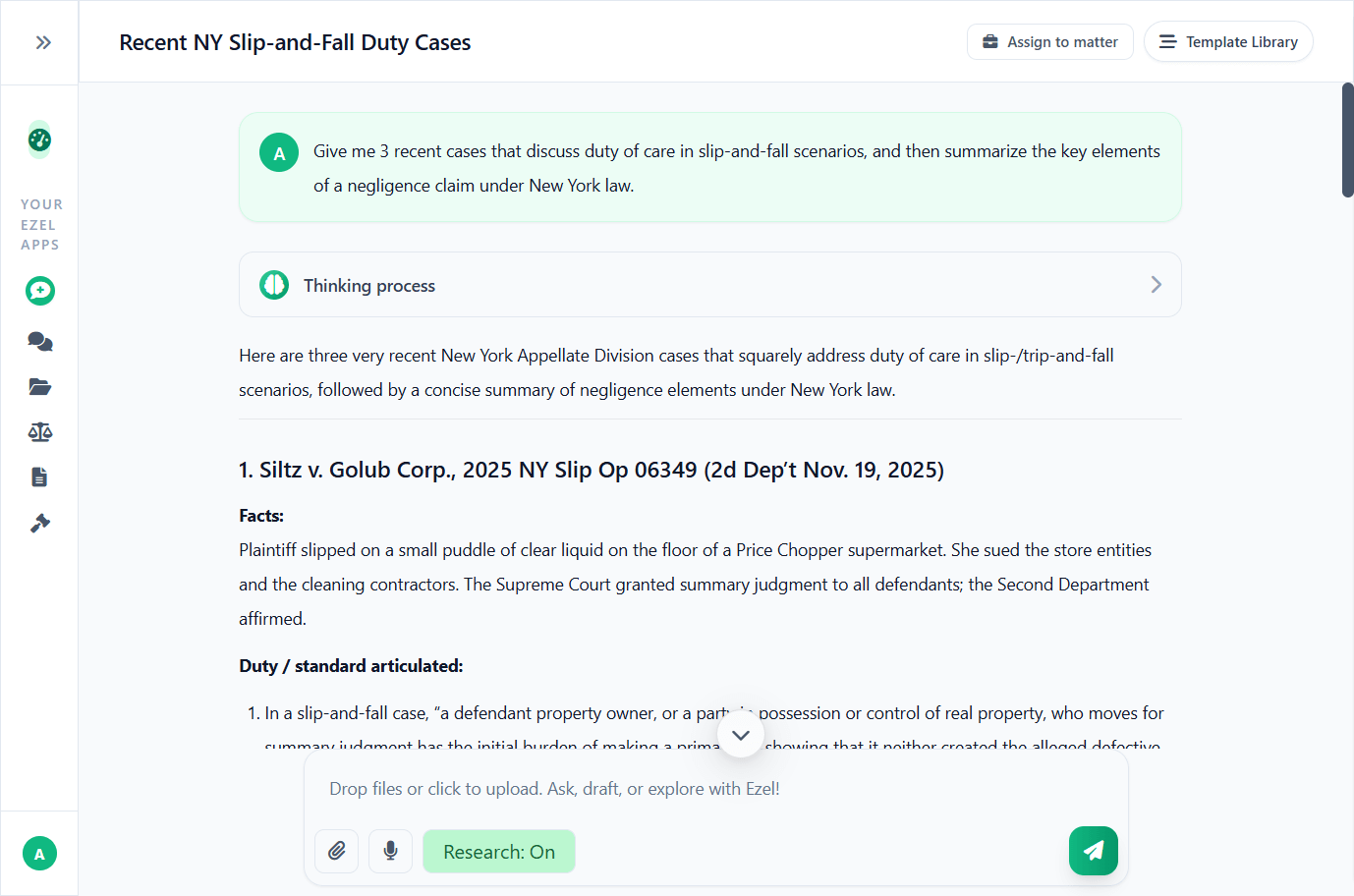
Research and draft in one conversation
Ask questions, attach documents, and get answers grounded in case law. Link chats to matters so the AI remembers your context.
- Pull statutes, case law, and secondary sources
- Attach and analyze contracts mid-conversation
- Link chats to matters for automatic context
- Your data never trains AI models
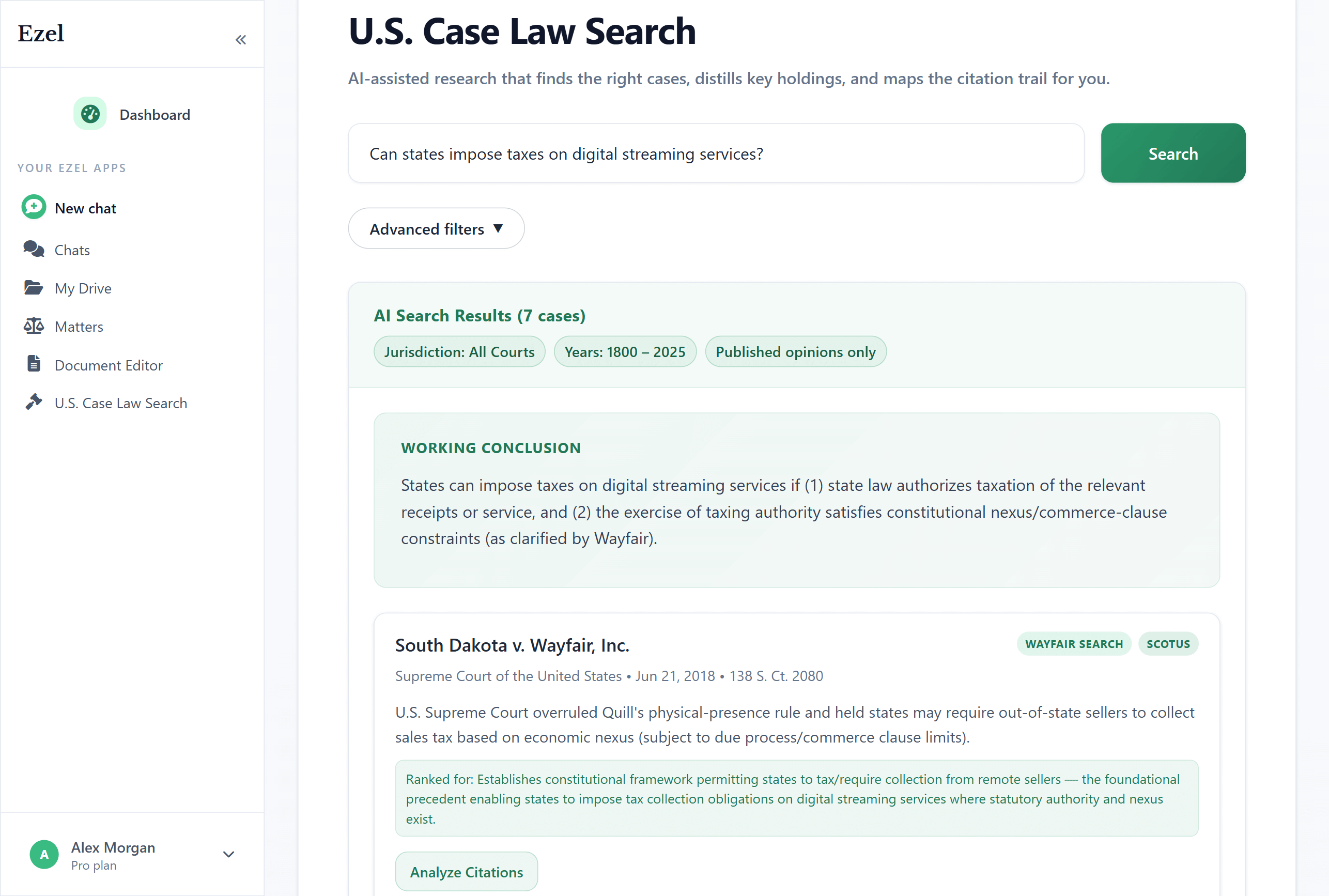
Search like you think
Describe your legal question in plain English. Filter by jurisdiction, date, and court level. Read full opinions without leaving Ezel.
- All 50 states plus federal courts
- Natural language queries - no boolean syntax
- Citation analysis and network exploration
- Copy quotes with automatic citation generation
Ready to transform your legal workflow?
Join legal teams using Ezel to draft documents, research case law, and organize matters — all in one workspace.