ADDENDUM IN SUPPORT OF APPLICATIONS FOR WITHHOLDING OF REMOVAL AND PROTECTION UNDER THE CONVENTION AGAINST TORTURE
CAPTION
U.S. Department of Justice
Executive Office for Immigration Review
Immigration Court -- [________________________________]
In the Matter of:
[________________________________] (Respondent)
A#: [________________________________]
In Removal Proceedings
Next Hearing Date: [__/__/____]
Hearing Type: ☐ Master Calendar / ☐ Individual / Merits Hearing
Immigration Judge: The Honorable [________________________________]
RESPONDENT'S ADDENDUM IN SUPPORT OF APPLICATIONS FOR WITHHOLDING OF REMOVAL UNDER INA § 241(b)(3) AND PROTECTION UNDER THE CONVENTION AGAINST TORTURE
TABLE OF CONTENTS
I. Introduction and Relief Sought
II. Procedural History and Basis for Addendum
III. Factual Narrative -- Expanded Declaration Summary
IV. Withholding of Removal -- Legal Standard and Application
V. Convention Against Torture -- Legal Standard and Application
VI. Comparison of Available Relief
VII. Country Conditions Analysis
VIII. Internal Relocation Analysis
IX. Corroboration and Evidence Summary
X. Conclusion and Prayer for Relief
Exhibit Index
Certificate of Service
I. INTRODUCTION AND RELIEF SOUGHT
Respondent, [________________________________], a native and citizen of [________________________________], respectfully submits this addendum in support of [his/her/their] applications for:
☐ Withholding of Removal under INA § 241(b)(3), 8 U.S.C. § 1231(b)(3)
☐ Withholding of Removal under the Convention Against Torture ("CAT"), 8 C.F.R. § 1208.16(c)
☐ Deferral of Removal under the Convention Against Torture, 8 C.F.R. § 1208.17
This addendum supplements the Form I-589 previously filed on [__/__/____] and provides an expanded factual narrative, legal analysis, and evidence index specifically addressing the elements required for withholding of removal and CAT protection. This addendum is necessary because:
☐ The I-589 form does not provide sufficient space for a detailed analysis of the withholding and CAT claims
☐ Respondent is barred from asylum (reason: [________________________________]) and is proceeding on withholding and CAT claims only
☐ The Court has requested a supplemental filing addressing the withholding and/or CAT claims
☐ Significant new evidence or country conditions have become available since the I-589 was filed
☐ Other: [________________________________]
II. PROCEDURAL HISTORY AND BASIS FOR ADDENDUM
A. Procedural History
| Event | Date |
|---|---|
| NTA issued | [__/__/____] |
| NTA served | [__/__/____] |
| Charges under INA § | [________________________________] |
| Master Calendar Hearing(s) | [__/__/____]; [__/__/____] |
| I-589 filed with Court | [__/__/____] |
| Designations of relief | [________________________________] |
| Country of removal designated | [________________________________] |
| Individual hearing scheduled | [__/__/____] |
| This addendum filed | [__/__/____] |
B. Why Asylum May Be Unavailable
[If applicable, explain why Respondent is proceeding on withholding and CAT claims rather than or in addition to asylum. Common reasons include:]
☐ One-Year Filing Bar: The I-589 was filed more than one year after Respondent's last arrival in the United States, and no exception applies. INA § 208(a)(2)(B).
☐ Firm Resettlement Bar: Respondent was firmly resettled in a third country prior to arrival. INA § 208(a)(2)(A).
☐ Safe Third Country Bar: Respondent may be removed to a safe third country under a bilateral agreement. INA § 208(a)(2)(A).
☐ Prior Asylum Denial: Respondent's prior asylum application was denied on the merits by an Immigration Judge or the BIA, and no changed circumstances justify a new application. INA § 208(a)(2)(C)-(D).
☐ Criminal Bar -- Particularly Serious Crime (Asylum): Respondent has been convicted of a particularly serious crime under INA § 208(b)(2)(A)(ii). [Note: The particularly serious crime threshold differs for withholding under INA § 241(b)(3)(B).]
☐ Aggravated Felony Bar (Asylum): Respondent has been convicted of an aggravated felony under INA § 101(a)(43). [Note: For withholding, an aggravated felony with an aggregate sentence of 5+ years is a per se particularly serious crime under INA § 241(b)(3)(B).]
☐ Not applicable -- Respondent is pursuing all forms of relief including asylum.
Note: Even where asylum is barred, withholding of removal under INA § 241(b)(3) and CAT protection remain available (subject to their own bars). Deferral of removal under CAT has no bars based on criminal history or other conduct.
III. FACTUAL NARRATIVE -- EXPANDED DECLARATION SUMMARY
A. Respondent's Background
Respondent is a [____]-year-old [male/female/non-binary] native and citizen of [________________________________]. Respondent was born on [__/__/____] in [________________________________].
Relevant Personal Characteristics:
| Characteristic | Detail |
|---|---|
| Ethnicity / Tribal Affiliation | [________________________________] |
| Religion | [________________________________] |
| Political Opinion / Affiliation | [________________________________] |
| Particular Social Group | [________________________________] |
| Gender / Sexual Orientation / Gender Identity | [________________________________] |
| Occupation | [________________________________] |
| Family Status | [________________________________] |
B. Detailed Factual Narrative
Note to Practitioner: This section should provide a comprehensive, chronological narrative of all harm experienced, threats received, and the factual basis for both the withholding and CAT claims. Cross-reference the Respondent's sworn declaration throughout. For withholding, emphasize the nexus between the harm and a protected ground. For CAT, emphasize the severity of harm, the intentional infliction of severe pain or suffering, and government involvement or acquiescence.
1. Harm Experienced in Country of Origin
[Provide a detailed, chronological account of all harm suffered. Include dates, locations, identity and affiliation of the persecutors/torturers, nature and severity of the harm, and the circumstances surrounding each incident.]
Incident 1: [__/__/____]
[________________________________]
[________________________________]
[________________________________]
[________________________________]
Incident 2: [__/__/____]
[________________________________]
[________________________________]
[________________________________]
Incident 3: [__/__/____]
[________________________________]
[________________________________]
[________________________________]
[Continue as needed.]
2. Persecutor / Torturer Identification
| Persecutor / Torturer | Affiliation | Government Connection |
|---|---|---|
| [________________________________] | [________________________________] | [________________________________] |
| [________________________________] | [________________________________] | [________________________________] |
| [________________________________] | [________________________________] | [________________________________] |
3. Statements Made by Persecutors (Establishing Nexus and Intent)
[Document any statements made by persecutors during or before the harm that reveal their motivation. For withholding claims, these statements help establish that the harm was "on account of" a protected ground. For CAT claims, these statements help establish the intentional infliction of pain or suffering for a prohibited purpose.]
[________________________________]
[________________________________]
[________________________________]
4. Efforts to Seek Government Protection
[Describe all efforts to report the harm to authorities and the government's response. For CAT claims, this evidence is critical to establishing government acquiescence or inability/unwillingness to protect.]
☐ Report filed with police on [__/__/____] -- Outcome: [________________________________]
☐ Report filed with [other government authority] on [__/__/____] -- Outcome: [________________________________]
☐ No report filed because: [________________________________]
☐ Government officials were the perpetrators
☐ Government officials directed or instructed the perpetrators
☐ Government officials were aware of the harm but failed to intervene
☐ Other: [________________________________]
See Respondent's Declaration at ¶¶ [____]-[____]; Exhibit [____].
5. Ongoing Risk and Current Threats
[Describe any ongoing threats, continued persecution of similarly situated persons, and evidence demonstrating that the risk persists.]
[________________________________]
[________________________________]
[________________________________]
IV. WITHHOLDING OF REMOVAL -- LEGAL STANDARD AND APPLICATION
A. Legal Standard
Withholding of removal under INA § 241(b)(3), 8 U.S.C. § 1231(b)(3), prohibits the removal of an alien to a country where the alien's "life or freedom would be threatened" on account of race, religion, nationality, membership in a particular social group, or political opinion.
Burden of Proof: The applicant must demonstrate that it is "more likely than not" (a "clear probability") that he or she would be persecuted on account of a protected ground. INS v. Stevic, 467 U.S. 407, 429-30 (1984); 8 C.F.R. § 1208.16(b).
This burden is higher than the "well-founded fear" standard for asylum (which requires only a reasonable possibility, or approximately a 10% chance, of persecution). However, withholding is mandatory and nondiscretionary if the standard is met, unlike asylum which is discretionary.
B. Past Persecution Presumption
An applicant who establishes past persecution on account of a protected ground is entitled to a presumption that the applicant's life or freedom would be threatened upon removal to the country of persecution. 8 C.F.R. § 1208.16(b)(1)(i).
DHS may rebut this presumption by establishing, by a preponderance of the evidence, that:
(i) There has been a fundamental change in circumstances such that the applicant's life or freedom would not be threatened; or
(ii) The applicant could avoid a future threat to life or freedom by relocating to another part of the country, and it would be reasonable to expect the applicant to do so. 8 C.F.R. § 1208.16(b)(1)(i)(A)-(B).
Application to Respondent's Case:
[Demonstrate that Respondent suffered past persecution on account of a protected ground and that the presumption has not been rebutted.]
[________________________________]
[________________________________]
[________________________________]
[________________________________]
C. Independent Showing of Clear Probability
Even without the past persecution presumption, an applicant may establish eligibility for withholding by demonstrating a clear probability of future persecution. 8 C.F.R. § 1208.16(b)(2). In evaluating this claim, the adjudicator should consider:
☐ The applicant's past experience
☐ The experiences of similarly situated persons in the country of proposed removal
☐ Conditions in the country of proposed removal
☐ Evidence of a pattern or practice of persecution against the group to which the applicant belongs
Application to Respondent's Case:
[________________________________]
[________________________________]
[________________________________]
D. Protected Ground and Nexus Analysis
1. Protected Ground
Respondent claims persecution on account of:
☐ Race: [________________________________]
☐ Religion: [________________________________]
☐ Nationality: [________________________________]
☐ Membership in a Particular Social Group ("PSG"): [________________________________]
☐ Political Opinion (actual or imputed): [________________________________]
2. Particular Social Group Articulation (If Applicable)
Proposed PSG: [________________________________]
(a) Immutability / Fundamental Characteristic:
The members of this group share a common characteristic that they either cannot change or should not be required to change because it is fundamental to their identities or consciences. Matter of Acosta, 19 I&N Dec. 211, 233 (BIA 1985).
[________________________________]
[________________________________]
(b) Particularity:
The group is defined with sufficient particularity that it can be perceived as a discrete class of persons, rather than being defined in an overly broad or subjective manner. Matter of W-G-R-, 26 I&N Dec. 208, 214 (BIA 2014).
[________________________________]
[________________________________]
(c) Social Distinction:
The group is recognized as a distinct social group by the society in question. Members of the group are set apart or distinguished in some significant way from the rest of society. Matter of M-E-V-G-, 26 I&N Dec. 227, 238 (BIA 2014).
[________________________________]
[________________________________]
Alternative PSG Formulations:
[If appropriate, provide one or more alternative PSG formulations in case the primary formulation is not accepted.]
☐ Alternative PSG 1: [________________________________]
☐ Alternative PSG 2: [________________________________]
☐ Alternative PSG 3: [________________________________]
3. Nexus -- "On Account Of"
The nexus requirement for withholding mirrors the asylum standard: the applicant must demonstrate that the protected ground was or will be "at least one central reason" for the persecution. INA § 241(b)(3)(C) (incorporating INA § 208(b)(1)(B)(i)); see also Matter of J-B-N- & S-M-, 24 I&N Dec. 208 (BIA 2007).
Evidence of Nexus:
[Describe the evidence establishing that the persecutor was or would be motivated by the protected ground. Consider the persecutor's statements, the context of the harm, the treatment of similarly situated individuals, and country conditions evidence.]
[________________________________]
[________________________________]
[________________________________]
[________________________________]
E. Bars to Withholding of Removal
Under INA § 241(b)(3)(B), withholding is unavailable where the applicant:
☐ Ordered, incited, assisted, or otherwise participated in the persecution of another -- Persecutor Bar
☐ Was convicted of a "particularly serious crime" constituting a danger to the community -- Criminal Bar (aggregate sentence of 5+ years for aggravated felony = per se particularly serious crime)
☐ Committed a serious nonpolitical crime outside the United States -- Serious Nonpolitical Crime Bar
☐ Poses a danger to the security of the United States -- National Security Bar
Applicability to Respondent:
☐ No bars to withholding apply
☐ A potential bar is addressed as follows: [________________________________]
IMPORTANT: Even where withholding under INA § 241(b)(3) is barred, deferral of removal under CAT (8 C.F.R. § 1208.17) remains available and has no criminal conduct, persecutor, or national security bars.
V. CONVENTION AGAINST TORTURE -- LEGAL STANDARD AND APPLICATION
A. Legal Standard
An applicant is entitled to CAT protection where the applicant demonstrates that it is "more likely than not" that he or she would be tortured if removed to the proposed country of removal. 8 C.F.R. § 1208.16(c)(2).
B. Definition of Torture -- 8 C.F.R. § 1208.18(a)
Torture is defined as any act by which severe pain or suffering, whether physical or mental, is intentionally inflicted on a person for such purposes as:
(i) Obtaining from the person or a third person information or a confession;
(ii) Punishing the person for an act he or she or a third person has committed or is suspected of having committed;
(iii) Intimidating or coercing the person or a third person; or
(iv) For any reason based on discrimination of any kind;
when such pain or suffering is inflicted by, or at the instigation of, or with the consent or acquiescence of, a public official acting in an official capacity or other person acting in an official capacity. 8 C.F.R. § 1208.18(a)(1).
C. Key Elements of a CAT Claim
1. Severe Pain or Suffering
"Torture is an extreme form of cruel and inhuman treatment and does not include lesser forms of cruel, inhuman or degrading treatment or punishment that do not amount to torture." 8 C.F.R. § 1208.18(a)(2).
Application to Respondent's Case:
[Describe how the harm suffered or feared rises to the level of severe pain or suffering, whether physical or mental. Mental suffering includes threats of imminent death, being subjected to mock executions, being forced to watch harm to family members, and other acts causing extreme psychological suffering.]
[________________________________]
[________________________________]
[________________________________]
2. Intentional Infliction
The pain or suffering must be intentionally inflicted. 8 C.F.R. § 1208.18(a)(5). Noncompliance with applicable legal procedural standards does not, per se, constitute torture. 8 C.F.R. § 1208.18(a)(8).
Application to Respondent's Case:
[Demonstrate that the harm was or would be intentionally inflicted, rather than accidental or incidental.]
[________________________________]
[________________________________]
3. Prohibited Purpose
The torture must be inflicted for one of the enumerated purposes: obtaining information or a confession, punishment, intimidation or coercion, or discrimination.
Application to Respondent's Case:
[Identify the purpose for which the torture was or would be inflicted.]
[________________________________]
[________________________________]
4. Government Involvement -- Consent or Acquiescence
This is typically the most critical and contested element of a CAT claim. The applicant must demonstrate that the torture would be inflicted by, at the instigation of, or with the consent or acquiescence of a public official acting in an official capacity.
"Acquiescence" Defined (8 C.F.R. § 1208.18(a)(7)): Acquiescence requires that the public official, prior to the activity constituting torture, have awareness of such activity and thereafter breach his or her legal responsibility to intervene to prevent such activity.
"Awareness" Defined: Awareness requires a finding of either:
(a) Actual Knowledge: The government official actually knew about the torture or the risk of torture; or
(b) Willful Blindness: The government official was willfully blind to the torture or the risk of torture -- that is, the official deliberately avoided learning about the activity.
Application to Respondent's Case:
[Demonstrate government involvement using one or more of the following theories:]
☐ Direct Government Action: The torture was or would be inflicted directly by government officials (military, police, security forces, prison officials).
- [________________________________]
- [________________________________]
☐ Government Instigation: Government officials directed, ordered, or encouraged private actors to commit the torture.
- [________________________________]
- [________________________________]
☐ Government Consent: Government officials expressly approved of or gave permission for the torture.
- [________________________________]
- [________________________________]
☐ Government Acquiescence: Government officials were aware of the torture (actual knowledge or willful blindness) and breached their legal responsibility to intervene.
- Evidence of awareness: [________________________________]
- Evidence of failure to intervene: [________________________________]
- Evidence of systemic failure: [________________________________]
5. Exclusion of Lawful Sanctions
"Torture does not include pain or suffering arising only from, inherent in, or incidental to, lawful sanctions." 8 C.F.R. § 1208.18(a)(3). Lawful sanctions include judicially imposed sanctions and other enforcement actions authorized by law, including the death penalty, but do not include sanctions that defeat the object and purpose of the Convention Against Torture. 8 C.F.R. § 1208.18(a)(3).
☐ Not applicable -- the harm feared does not involve lawful sanctions
☐ The harm involves nominally lawful sanctions that defeat the object and purpose of the CAT: [________________________________]
D. Evidence to Be Considered -- 8 C.F.R. § 1208.16(c)(3)
In assessing a CAT claim, the adjudicator shall consider all evidence relevant to the possibility of future torture, including but not limited to:
☐ (i) Evidence of past torture inflicted upon the applicant
☐ (ii) Evidence that the applicant could relocate to a part of the country of removal where he or she is not likely to be tortured
☐ (iii) Evidence of gross, flagrant, or mass violations of human rights within the country of removal
☐ (iv) Other relevant information regarding conditions in the country of removal
Application to Respondent's Case:
[Address each factor as applicable.]
(i) Past Torture:
[________________________________]
[________________________________]
(ii) Internal Relocation:
[See Section VIII below.]
(iii) Gross, Flagrant, or Mass Human Rights Violations:
[________________________________]
[________________________________]
(iv) Other Relevant Country Conditions:
[________________________________]
[________________________________]
E. Forms of CAT Protection
| Form of Relief | Standard | Bars | Benefits | Terminability |
|---|---|---|---|---|
| CAT Withholding (§ 1208.16(c)) | More likely than not to be tortured | Persecutor bar, particularly serious crime, serious nonpolitical crime, national security | Cannot be removed to designated country; no derivative relief; no travel document; no path to LPR | Can be terminated upon showing that torture is no longer more likely than not |
| CAT Deferral (§ 1208.17) | More likely than not to be tortured | None -- available even with criminal bars, persecutor bar, national security concerns | Cannot be removed to designated country while deferral remains in effect | Can be terminated upon showing that torture is no longer more likely than not; subject to periodic review |
Respondent seeks:
☐ CAT Withholding under 8 C.F.R. § 1208.16(c)
☐ CAT Deferral under 8 C.F.R. § 1208.17 (in the alternative, or if bars to CAT withholding apply)
VI. COMPARISON OF AVAILABLE RELIEF
| Factor | Asylum (INA § 208) | Withholding (INA § 241(b)(3)) | CAT Withholding (§ 1208.16(c)) | CAT Deferral (§ 1208.17) |
|---|---|---|---|---|
| Burden | Well-founded fear (~10%) | Clear probability (>50%) | More likely than not (>50%) | More likely than not (>50%) |
| Discretionary? | Yes | No (mandatory) | No (mandatory) | No (mandatory) |
| Protected Ground Required? | Yes | Yes | No | No |
| Nexus Required? | Yes | Yes | No (purpose element instead) | No (purpose element instead) |
| One-Year Bar? | Yes | No | No | No |
| Criminal Bars? | Yes (lower threshold) | Yes (higher threshold) | Yes | No |
| Derivative Relief? | Yes (spouse/children) | No | No | No |
| Travel Document? | Yes | No | No | No |
| Path to LPR? | Yes (after 1 year) | No | No | No |
| Country-Specific? | No | Yes | Yes | Yes |
| Terminable? | Only by changed circumstances | Only by changed circumstances | Changed circumstances | Changed circumstances; periodic review |
VII. COUNTRY CONDITIONS ANALYSIS
A. General Country Conditions
[Provide a targeted analysis of country conditions relevant to the withholding and CAT claims. Focus on conditions specific to the Respondent's profile and claimed grounds.]
Country of Removal: [________________________________]
Summary of Relevant Conditions:
[________________________________]
[________________________________]
[________________________________]
[________________________________]
[________________________________]
B. Government Human Rights Record
[Address the government's record on human rights, including treatment of the specific group to which the Respondent belongs, rule of law, judicial independence, police conduct, prison conditions, and any pattern or practice of persecution or torture.]
[________________________________]
[________________________________]
[________________________________]
C. Treatment of Similarly Situated Individuals
[Provide evidence of how individuals with the same protected characteristics as the Respondent are treated in the country of removal. Cite specific cases, reports, and documented incidents.]
[________________________________]
[________________________________]
[________________________________]
D. Pattern or Practice of Persecution / Torture
[If applicable, demonstrate a "pattern or practice" of persecution or torture of the group to which the Respondent belongs. 8 C.F.R. § 1208.16(b)(2)(i) (withholding); 8 C.F.R. § 1208.16(c)(3) (CAT).]
[________________________________]
[________________________________]
E. Country Conditions Exhibits
| Exhibit | Description | Date | Source |
|---|---|---|---|
| [____] | U.S. Department of State Country Report on Human Rights Practices | [____] | DOS |
| [____] | U.S. Department of State International Religious Freedom Report | [____] | DOS |
| [____] | [________________________________] | [____] | [____] |
| [____] | [________________________________] | [____] | [____] |
| [____] | [________________________________] | [____] | [____] |
| [____] | [________________________________] | [____] | [____] |
| [____] | [________________________________] | [____] | [____] |
VIII. INTERNAL RELOCATION ANALYSIS
A. Standard
For withholding of removal, DHS may rebut the past persecution presumption by demonstrating that the applicant could avoid future threats to life or freedom by relocating within the country, and it would be reasonable to expect the applicant to do so. 8 C.F.R. § 1208.16(b)(1)(i)(B), (b)(3).
For CAT claims, the adjudicator considers whether the applicant could relocate to a part of the country where he or she is not likely to be tortured. 8 C.F.R. § 1208.16(c)(3)(ii).
B. Application to Respondent's Case
Internal relocation is not reasonable because:
☐ The government is the persecutor / torturer, and its reach is nationwide
☐ The non-state persecutor / torturer has nationwide reach or connections
☐ The Respondent has already attempted to relocate internally and was found by the persecutor
☐ Country conditions evidence demonstrates that the group to which Respondent belongs faces persecution / torture throughout the country
☐ Relocation would impose unreasonable hardship: [________________________________]
☐ Other factors: [________________________________]
[________________________________]
[________________________________]
[________________________________]
IX. CORROBORATION AND EVIDENCE SUMMARY
A. Credibility Standards
Under the REAL ID Act, INA § 208(b)(1)(B)(iii) (applicable to withholding claims by reference through INA § 241(b)(3)(C)), credibility determinations are based on the totality of the circumstances, including demeanor, candor, responsiveness, plausibility, consistency, and other relevant factors.
Note: For CAT claims, the REAL ID Act credibility provisions also apply. The applicant's testimony alone may suffice if credible, but corroborating evidence strengthens the claim.
B. Corroborating Evidence Submitted
[List all corroborating evidence with brief descriptions.]
☐ Respondent's sworn declaration (dated [__/__/____]) -- Exhibit [____]
☐ Family member / witness affidavits -- Exhibit [____]
☐ Medical records documenting injuries -- Exhibit [____]
☐ Psychological or psychiatric evaluation -- Exhibit [____]
☐ Forensic medical evaluation (Istanbul Protocol) -- Exhibit [____]
☐ Police reports / complaints -- Exhibit [____]
☐ Photographs of injuries or property damage -- Exhibit [____]
☐ Threat letters / messages / social media -- Exhibit [____]
☐ News articles about incidents involving Respondent -- Exhibit [____]
☐ Expert affidavit(s) on country conditions -- Exhibit [____]
☐ Country conditions reports (DOS, NGO, UNHCR) -- Exhibit [____]
☐ Court records, arrest warrants, or legal documents from country of origin -- Exhibit [____]
☐ Identity documents (passport, national ID, birth certificate) -- Exhibit [____]
☐ Additional evidence: [________________________________] -- Exhibit [____]
C. Unavailable Evidence and Explanation
[If expected corroborating evidence is unavailable, explain why and demonstrate that reasonable efforts were made to obtain it. Under the REAL ID Act and Matter of L-A-C-, 26 I&N Dec. 516 (BIA 2015), the adjudicator should consider whether it is reasonable to expect the evidence and whether the applicant has explained its unavailability.]
☐ Police reports unavailable because: [________________________________]
☐ Medical records unavailable because: [________________________________]
☐ Witness affidavits unavailable because: [________________________________]
☐ Identity documents unavailable because: [________________________________]
☐ Other evidence unavailable because: [________________________________]
X. CONCLUSION AND PRAYER FOR RELIEF
For all of the foregoing reasons, Respondent respectfully requests that this Honorable Court grant [his/her/their] applications for:
-
Withholding of Removal under INA § 241(b)(3), 8 U.S.C. § 1231(b)(3), to [________________________________] (country of removal);
-
In the alternative, Withholding of Removal under the Convention Against Torture, 8 C.F.R. § 1208.16(c), to [________________________________]; and/or
-
In the alternative, Deferral of Removal under the Convention Against Torture, 8 C.F.R. § 1208.17, to [________________________________].
Respectfully submitted,
_________________________________________
[________________________________]
Attorney for Respondent
[________________________________]
Firm Name
[________________________________]
Address
[________________________________]
City, State, ZIP
Telephone: [________________________________]
Email: [________________________________]
Bar Number: [________________________________]
EOIR ID Number: [________________________________]
Date: [__/__/____]
EXHIBIT INDEX
| Exhibit | Description | Pages |
|---|---|---|
| A | Form I-589, Application for Asylum and Withholding of Removal | [____] |
| B | Respondent's sworn declaration (signed and dated) | [____] |
| C | Supplemental or updated declaration (if applicable) | [____] |
| D | Family member / witness affidavits | [____] |
| E | Medical records and/or forensic medical evaluation | [____] |
| F | Psychological or psychiatric evaluation | [____] |
| G | Police reports, complaints, or explanation of absence | [____] |
| H | Photographs of injuries, property damage, or other physical evidence | [____] |
| I | Threat letters, messages, social media evidence (with translations) | [____] |
| J | Expert affidavit(s) on country conditions / PSG / torture risk | [____] |
| K | U.S. Department of State Country Report on Human Rights Practices | [____] |
| L | Additional country conditions reports (NGO, UNHCR, human rights organizations) | [____] |
| M | News articles and media reports (with translations) | [____] |
| N | Court records, arrest warrants, or legal documents from country of origin | [____] |
| O | Identity documents (passport, national ID, birth certificate) and translations | [____] |
| P | Internal relocation analysis / maps | [____] |
| Q | [Additional exhibits as needed] | [____] |
CERTIFICATE OF SERVICE
I, [________________________________], attorney for Respondent, hereby certify that on [__/__/____], I served a true and correct copy of this Addendum, together with all exhibits listed in the Exhibit Index, upon the Office of the Chief Counsel, U.S. Department of Homeland Security, Immigration and Customs Enforcement, at:
[________________________________]
[________________________________]
[________________________________]
by the following method:
☐ Personal delivery / hand delivery
☐ U.S. Mail, postage prepaid
☐ Electronic filing (ECAS) per Court procedures
☐ Other: [________________________________]
_________________________________________
Signature of Attorney
Date: [__/__/____]
PRACTITIONER TIPS AND COMMON PITFALLS
Withholding-Specific Tips
-
Higher Burden, Mandatory Relief. Emphasize that while the burden for withholding is higher than asylum (clear probability vs. well-founded fear), the relief is mandatory and nondiscretionary. If the applicant meets the burden, the Court must grant withholding regardless of any negative equities.
-
Past Persecution Presumption. Establishing past persecution triggers a presumption that shifts the burden to DHS to rebut. This is a powerful procedural advantage. Focus on establishing past persecution clearly and comprehensively.
-
Pattern or Practice. Under 8 C.F.R. § 1208.16(b)(2)(i), a pattern or practice of persecution against similarly situated persons can support a withholding claim even without individual targeting. Document systemic conditions thoroughly.
-
PSG Articulation. Ensure that the PSG is clearly articulated in all filings and that the Respondent can testify about it. Provide alternative formulations. The BIA in Matter of L-A-L-T-, 29 I&N Dec. 269 (BIA 2025), requires respondents to identify their PSG.
-
Limitations of Withholding. Counsel the client that withholding does not provide a path to lawful permanent residence, does not allow derivative relief for family members, does not permit travel outside the United States, and is country-specific only.
CAT-Specific Tips
-
No Nexus to Protected Ground Required. Unlike withholding, CAT does not require a nexus to a protected ground. The claim is based on the likelihood of torture regardless of the reason, as long as the torture is inflicted for a prohibited purpose and involves government action or acquiescence.
-
Acquiescence Is the Key Issue. Most CAT cases turn on whether the government consented to or acquiesced in the torture. Focus on documenting: (a) the government's awareness of the risk (actual knowledge or willful blindness); and (b) the government's failure to intervene despite a legal duty to do so.
-
Country Conditions Are Critical. CAT claims heavily depend on country conditions evidence showing government involvement in or acquiescence to torture. Use U.S. Department of State reports, UNHCR guidance, NGO reports, and expert affidavits to build a comprehensive picture.
-
Severity Threshold. Not all harm rises to the level of torture. The harm must involve "severe" pain or suffering and must be an "extreme form" of cruel and inhuman treatment. 8 C.F.R. § 1208.18(a)(2). Address the severity element explicitly.
-
Deferral as Last Resort. CAT deferral under 8 C.F.R. § 1208.17 is the most limited form of relief but has no bars. It is available even to those convicted of aggravated felonies, those who participated in persecution, and those deemed national security risks. Always plead deferral as an alternative.
General Tips
-
Consistency with I-589 and Declaration. Ensure this addendum is fully consistent with the I-589, the Respondent's declaration, and any prior statements. Address any discrepancies proactively.
-
Prepare for Cross-Examination. The Respondent must be prepared to testify about every fact alleged in this addendum and the declaration. Review potential areas of cross-examination, including omissions, inconsistencies, and details of harm.
-
Interpreter and Witness List. Confirm interpreter needs and file a witness list per the Court's standing orders and local rules. Notify the Court of any expert witnesses.
-
Filing Deadlines and Service. File the addendum and all exhibits in accordance with the Immigration Judge's scheduling order and local rules. Serve DHS counsel simultaneously. Retain proof of filing and service.
-
Country Conditions Should Be Current. File updated country conditions reports as close to the individual hearing as possible. If conditions have changed since the addendum was filed, supplement the record.
This template is provided for informational purposes only and does not constitute legal advice. You must have this template reviewed and customized by a qualified attorney licensed in your jurisdiction before use.
Do more with Ezel
This free template is just the beginning. See how Ezel helps legal teams draft, research, and collaborate faster.
AI that drafts while you watch
Tell the AI what you need and watch your document transform in real-time. No more copy-pasting between tools or manually formatting changes.
- Natural language commands: "Add a force majeure clause"
- Context-aware suggestions based on document type
- Real-time streaming shows edits as they happen
- Milestone tracking and version comparison
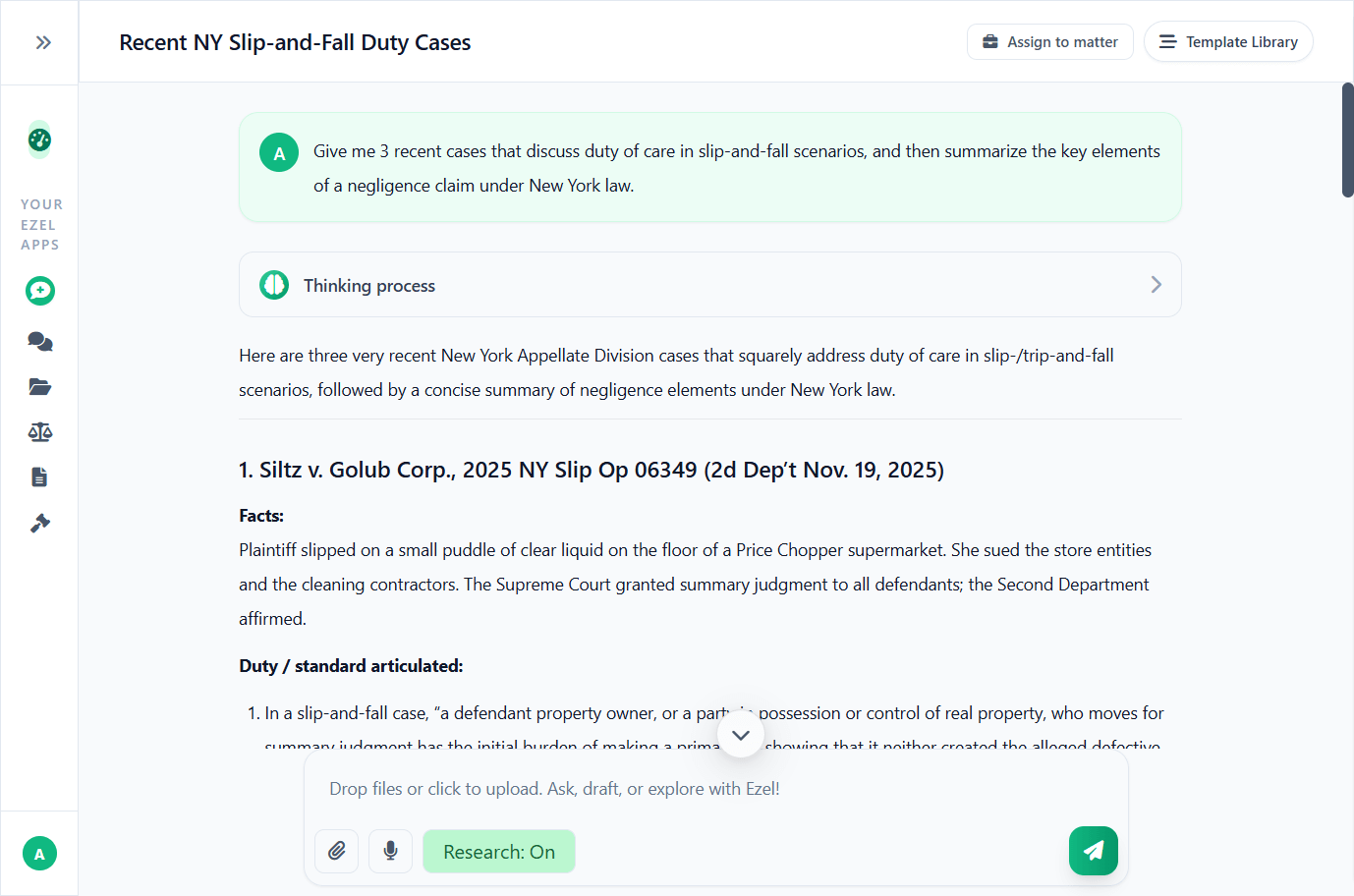
Research and draft in one conversation
Ask questions, attach documents, and get answers grounded in case law. Link chats to matters so the AI remembers your context.
- Pull statutes, case law, and secondary sources
- Attach and analyze contracts mid-conversation
- Link chats to matters for automatic context
- Your data never trains AI models

Search like you think
Describe your legal question in plain English. Filter by jurisdiction, date, and court level. Read full opinions without leaving Ezel.
- All 50 states plus federal courts
- Natural language queries - no boolean syntax
- Citation analysis and network exploration
- Copy quotes with automatic citation generation
Ready to transform your legal workflow?
Join legal teams using Ezel to draft documents, research case law, and organize matters — all in one workspace.