WAGE CLAIM DEMAND LETTER
STATE OF ILLINOIS
SENDER INFORMATION
| Field | Details |
|---|---|
| Attorney/Sender Name: | [________________________________] |
| Firm Name (if applicable): | [________________________________] |
| Illinois ARDC Number: | [________________________________] |
| Street Address: | [________________________________] |
| City, State, ZIP: | [________________________________] |
| Telephone: | [________________________________] |
| Facsimile: | [________________________________] |
| Email: | [________________________________] |
RECIPIENT INFORMATION
| Field | Details |
|---|---|
| Employer/Company Name: | [________________________________] |
| Attention: | [________________________________] |
| Title/Department: | [________________________________] |
| Street Address: | [________________________________] |
| City, State, ZIP: | [________________________________] |
| Telephone: | [________________________________] |
| Email: | [________________________________] |
| Registered Agent (if known): | [________________________________] |
Date: [__/__/____]
Via: ☐ Certified Mail, Return Receipt Requested (No. [________________________________])
☐ Regular U.S. Mail
☐ Electronic Mail to [________________________________]
☐ Hand Delivery
☐ Facsimile to [________________________________]
RE: FORMAL DEMAND FOR PAYMENT OF UNPAID WAGES PURSUANT TO THE ILLINOIS WAGE PAYMENT AND COLLECTION ACT (820 ILCS 115/)
Employee Name: [________________________________]
Employee Address: [________________________________]
Social Security Number (last four digits): XXX-XX-[____]
Date of Hire: [__/__/____]
Date of Separation (if applicable): [__/__/____]
Job Title/Position: [________________________________]
Department: [________________________________]
Work Location: [________________________________]
Employment Status: ☐ Full-Time ☐ Part-Time ☐ Temporary ☐ Seasonal
Compensation Type: ☐ Hourly ☐ Salaried (Exempt) ☐ Salaried (Non-Exempt) ☐ Commission ☐ Piece Rate
Hourly Rate / Salary: $[________________________________]
I. INTRODUCTION AND PURPOSE
Dear [________________________________]:
This firm represents [________________________________] ("Employee" or "Claimant") in connection with a claim for unpaid wages, final compensation, and/or other compensation owed by [________________________________] ("Employer") arising from the employment relationship between the parties. This letter constitutes a formal demand for payment of all wages due and owing under the Illinois Wage Payment and Collection Act ("IWPCA" or "the Act"), 820 ILCS 115/1 et seq.
This demand is further made pursuant to the Illinois Minimum Wage Law, 820 ILCS 105/1 et seq.; the Fair Labor Standards Act, 29 U.S.C. § 201 et seq. ("FLSA"); and all other applicable federal and state laws, rules, and regulations governing the payment of wages in the State of Illinois.
PLEASE BE ADVISED that the IWPCA imposes significant penalties for the failure to timely pay wages, including:
- 5% of the underpayment per month that wages remain unpaid (820 ILCS 115/14(a));
- 1% of the amount found owing per calendar day of delay after failure to comply with a Department or court order (820 ILCS 115/14(a)); and
- 20% penalty payable to the Illinois Department of Labor for failure to comply with a Department demand or order (820 ILCS 115/14(a)).
Additionally, individual corporate officers and agents who knowingly permit violations of the IWPCA may be held personally liable as employers under 820 ILCS 115/13.
We urge Employer to treat this matter with the utmost seriousness and to remit payment promptly.
II. FACTUAL BACKGROUND AND EMPLOYMENT HISTORY
A. Employment Relationship
[________________________________] ("Employee") was employed by [________________________________] ("Employer") from [__/__/____] through [__/__/____] in the position of [________________________________]. During the period of employment, Employee performed work at the following location(s):
Primary Work Location: [________________________________]
Additional Work Location(s): [________________________________]
B. Terms of Employment
At the time of hire, Employee was promised and agreed to compensation at the rate of $[________________________________] per [☐ hour / ☐ week / ☐ bi-weekly period / ☐ semi-monthly period / ☐ month / ☐ year].
The terms of compensation were established by:
☐ Written employment agreement dated [__/__/____]
☐ Offer letter dated [__/__/____]
☐ Collective bargaining agreement
☐ Verbal agreement on or about [__/__/____]
☐ Employer's published compensation policy or pay schedule
☐ Course of dealing / established practice
☐ Other: [________________________________]
Employee's regular work schedule was approximately [________________________________] hours per week, [________________________________] days per week, typically from [________________________________] to [________________________________].
Employee's regular pay period was: ☐ Weekly ☐ Bi-weekly ☐ Semi-monthly ☐ Monthly
Employee's regular payday was: [________________________________]
C. Manner of Separation
Employee's employment terminated on [__/__/____] under the following circumstances:
☐ Employee was discharged/terminated by Employer
☐ Employee voluntarily resigned, with notice provided on [__/__/____]
☐ Employee was laid off / position eliminated
☐ Employee was constructively discharged
☐ Employment relationship is ongoing; wages remain unpaid during active employment
Reason for Separation (if applicable): [________________________________]
D. Description of Wage Violation(s)
The following describes the nature of the violation(s) of the IWPCA and other applicable laws:
☐ Failure to pay wages earned during the course of employment (820 ILCS 115/3)
☐ Failure to pay final compensation upon separation (820 ILCS 115/5)
☐ Failure to pay wages within the required time after the end of the pay period (820 ILCS 115/4)
☐ Failure to pay minimum wage ($15.00/hr as of January 1, 2025) (820 ILCS 105/4)
☐ Failure to pay overtime compensation at 1.5x the regular rate (820 ILCS 105/4a)
☐ Unauthorized deductions from wages in violation of 820 ILCS 115/9
☐ Failure to pay all hours worked (off-the-clock work)
☐ Failure to pay earned commissions
☐ Failure to pay earned and vested bonuses
☐ Failure to pay earned vacation pay / PTO (classified as wages under IWPCA)
☐ Failure to pay wage supplements (fringe benefits) as agreed
☐ Tip credit violations
☐ Misclassification as exempt employee
☐ Misclassification as independent contractor
☐ Other: [________________________________]
Detailed narrative of the violation(s):
[________________________________]
[________________________________]
[________________________________]
III. STATEMENT OF WAGES OWED
A. Unpaid Regular Wages
| Pay Period | Hours Worked | Rate of Pay | Gross Wages Due | Amount Paid | Balance Owed |
|---|---|---|---|---|---|
| [__/__/____] to [__/__/____] | [____] | $[____]/hr | $[________] | $[________] | $[________] |
| [__/__/____] to [__/__/____] | [____] | $[____]/hr | $[________] | $[________] | $[________] |
| [__/__/____] to [__/__/____] | [____] | $[____]/hr | $[________] | $[________] | $[________] |
| [__/__/____] to [__/__/____] | [____] | $[____]/hr | $[________] | $[________] | $[________] |
| [__/__/____] to [__/__/____] | [____] | $[____]/hr | $[________] | $[________] | $[________] |
| [__/__/____] to [__/__/____] | [____] | $[____]/hr | $[________] | $[________] | $[________] |
| SUBTOTAL | $[________] |
B. Unpaid Overtime Wages
| Pay Period | Total Hours | OT Hours (>40/wk) | Regular Rate | OT Rate (1.5x) | OT Wages Due | Paid | Balance |
|---|---|---|---|---|---|---|---|
| [__/__/____] to [__/__/____] | [____] | [____] | $[____] | $[____] | $[________] | $[________] | $[________] |
| [__/__/____] to [__/__/____] | [____] | [____] | $[____] | $[____] | $[________] | $[________] | $[________] |
| [__/__/____] to [__/__/____] | [____] | [____] | $[____] | $[____] | $[________] | $[________] | $[________] |
| [__/__/____] to [__/__/____] | [____] | [____] | $[____] | $[____] | $[________] | $[________] | $[________] |
| SUBTOTAL | $[________] |
C. Unpaid Final Compensation (820 ILCS 115/5)
If Employee has separated from employment, the following final compensation remains unpaid:
| Component | Amount Owed |
|---|---|
| Wages for final pay period worked | $[________] |
| Accrued and unused vacation pay | $[________] |
| Accrued and unused PTO | $[________] |
| Earned commissions | $[________] |
| Earned bonuses | $[________] |
| Wage supplements / fringe benefits | $[________] |
| SUBTOTAL | $[________] |
Note: Under the IWPCA, earned vacation time and PTO are classified as wages when the employer has a policy or practice of providing such benefits. See 820 ILCS 115/2. Vacation pay that has been earned cannot be forfeited through a "use it or lose it" policy if such policy was not clearly communicated at the time of hire.
D. Other Unpaid Compensation
| Category | Description | Amount Owed |
|---|---|---|
| Unauthorized Deductions (820 ILCS 115/9) | [________________________________] | $[________] |
| Tip Credit Shortfall | [________________________________] | $[________] |
| Shift Differential Owed | [________________________________] | $[________] |
| Expense Reimbursement | [________________________________] | $[________] |
| Other | [________________________________] | $[________] |
| SUBTOTAL | $[________] |
E. Summary of Total Wages Owed
| Category | Amount |
|---|---|
| Unpaid Regular Wages | $[________] |
| Unpaid Overtime Wages | $[________] |
| Unpaid Final Compensation | $[________] |
| Other Unpaid Compensation | $[________] |
| TOTAL UNPAID WAGES | $[________] |
IV. LEGAL BASIS FOR CLAIM
A. Illinois Wage Payment and Collection Act (IWPCA), 820 ILCS 115/
The IWPCA is Illinois's comprehensive wage payment statute. It governs the timing, method, and manner of wage payments and provides substantial remedies for employees who are not timely paid. The key provisions are as follows:
Section 115/2 — Definitions
Under the IWPCA, "wages" are broadly defined to include:
- All compensation owed to an employee by an employer pursuant to an employment contract or agreement;
- Salaries, earned commissions, earned bonuses;
- Earned vacation and PTO (when the employer has a policy or practice of providing such benefits);
- Any other compensation owed under an employment agreement; and
- Wage supplements, including but not limited to health insurance premiums, retirement plan contributions, and other fringe benefits.
The IWPCA defines "employer" broadly to include any individual, partnership, association, corporation, business trust, or other entity acting directly or indirectly in the interest of an employer in relation to an employee.
Section 115/3 — Duty to Pay Wages
Every employer shall pay the full amount of wages due to its employees on the regularly scheduled payday. No employer may withhold any part of the wages due to an employee except as permitted by law or with the express written consent of the employee.
Section 115/4 — Pay Period Requirements
The IWPCA establishes the following deadlines for wage payment:
| Pay Period Type | Payment Deadline |
|---|---|
| Semi-monthly or Bi-weekly | Not later than 13 days after the end of the pay period |
| Weekly | Not later than 7 days after the end of the pay period |
| Daily | Same day as earned, or not later than 24 hours after |
Commissions earned during a pay period may be paid within 13 days after the end of the semi-monthly period in which they were earned if the employer cannot reasonably calculate the amount during the pay period.
Executive, administrative, and professional employees may be paid once per month.
Section 115/5 — Final Compensation for Separated Employees
Every employer shall pay the final compensation of separated employees in full, at the time of separation if possible, but in no case later than the next regularly scheduled payday for such employee.
If the employee requests in writing that final compensation be paid by check and mailed, the employer must comply.
This section applies regardless of whether the separation was voluntary or involuntary.
Section 115/9 — Deductions from Wages
No employer may make any deduction from an employee's wages unless:
- The deduction is required by law (taxes, garnishments, etc.);
- The deduction is for the benefit of the employee and the employee has given express written consent that is freely given at the time the deduction is made; or
- The deduction is authorized by a collective bargaining agreement.
Deductions for lost or damaged property, cash shortages, or cost of tools are prohibited unless the employee gives written consent after the loss has occurred and the amount is determined.
Section 115/13 — Personal Liability of Officers and Agents
Any officers of a corporation or agents of an employer who knowingly permit the employer to violate the provisions of this Act shall be deemed to be the employers of the employees of the corporation. This means individual corporate officers, directors, managers, and agents may be held personally liable for IWPCA violations.
This is a significant provision that distinguishes Illinois from many other states and creates substantial personal risk for decision-makers within the employer organization.
B. IWPCA Penalties — 820 ILCS 115/14
The penalty provisions of the IWPCA are among the most employee-favorable in the nation:
5% Per Month Penalty
Any employee not timely paid wages, final compensation, or wage supplements is entitled to recover:
- The amount of underpayment; PLUS
- Damages of 5% of the underpayment for each month following the date of payment during which the underpayment remains unpaid.
This penalty is cumulative and continues to accrue until the wages are paid. There is no statutory cap on the total penalty amount.
1% Per Day Penalty (Post-Order)
Any employer who has been demanded or ordered by the Department of Labor or ordered by a court to pay wages and who fails to comply within 15 calendar days of a Department demand or within 35 days of an administrative or court order shall also be liable for:
- 1% of the amount found owing per calendar day of delay, payable to the employee; PLUS
- 20% of the amount found owing as a penalty payable to the Illinois Department of Labor.
Triple Damages Under the Illinois Minimum Wage Law (820 ILCS 105/12)
For violations of the Illinois Minimum Wage Law (separate from the IWPCA), the employee may recover:
- Underpaid wages; PLUS
- Damages up to triple (3x) the underpayment if the violation was willful.
Penalty Calculation Example
| Item | Calculation | Amount |
|---|---|---|
| Unpaid Wages | Base amount owed | $[________] |
| 5% Per Month Penalty ([____] months unpaid) | $[________] x 5% x [____] months | $[________] |
| Total with Penalties (Pre-Litigation) | $[________] |
C. Illinois Minimum Wage Law (820 ILCS 105/)
Current Minimum Wage Rates
| Category | Rate (Effective Jan. 1, 2025) |
|---|---|
| Standard Minimum Wage (18+ years) | $15.00/hour |
| Youth Minimum Wage (under 18, <650 hours/year) | $13.00/hour |
| Tipped Employee Cash Wage (60% of minimum) | $9.00/hour |
The Illinois minimum wage applies to all employers with four (4) or more employees, excluding government and certain nonprofit organizations. See 820 ILCS 105/3.
Overtime Compensation (820 ILCS 105/4a)
Employers must pay non-exempt employees one and one-half (1.5) times the regular rate of pay for all hours worked in excess of 40 hours in a workweek.
Illinois follows the federal FLSA framework for determining overtime exemptions (executive, administrative, professional, outside sales, computer employee). See 29 C.F.R. Part 541.
D. One Day Rest in Seven Act (ODRISA), 820 ILCS 140/
Every employer shall allow every employee at least twenty-four (24) consecutive hours of rest in every calendar week in addition to the regular period of rest allowed at the close of each working day. Additionally, employers must provide employees working 7.5 hours or more with at least 20 minutes for a meal break beginning no later than 5 hours after the start of the shift.
Violations of ODRISA may give rise to penalties assessed by IDOL and may support a claim for additional compensation owed.
E. Fair Labor Standards Act (FLSA), 29 U.S.C. § 201 et seq.
The FLSA provides additional federal protections:
Minimum Wage (29 U.S.C. § 206)
The federal minimum wage is $7.25 per hour, but the higher Illinois minimum wage of $15.00/hour applies.
Overtime (29 U.S.C. § 207)
Non-exempt employees must receive overtime at 1.5 times the regular rate for hours over 40 in a workweek.
Liquidated Damages (29 U.S.C. § 216(b))
Under the FLSA, employees may recover unpaid wages plus an equal amount as liquidated damages (double the unpaid wages). Attorney's fees and costs are also recoverable.
Statute of Limitations (29 U.S.C. § 255)
- Two (2) years for non-willful violations.
- Three (3) years for willful violations.
F. Applicable Statute of Limitations Summary
| Legal Basis | Limitations Period | Citation |
|---|---|---|
| IWPCA — IDOL Administrative Claim | 1 year from date wages were due | 820 ILCS 115/14(a) |
| IWPCA — Civil Court Action | 10 years (contract statute of limitations) | 735 ILCS 5/13-206 |
| Illinois Minimum Wage Law | 3 years | 820 ILCS 105/12(a) |
| FLSA — Non-willful violation | 2 years | 29 U.S.C. § 255(a) |
| FLSA — Willful violation | 3 years | 29 U.S.C. § 255(a) |
| Breach of Written Contract (Illinois) | 10 years | 735 ILCS 5/13-206 |
| Breach of Oral Contract (Illinois) | 5 years | 735 ILCS 5/13-205 |
Practice Tip: The IWPCA administrative claim with IDOL must be filed within one (1) year of the date wages were due, but a civil action in circuit court may be subject to the ten (10) year written contract statute of limitations (or five years for oral contracts), making court filing advantageous when the violation occurred more than one year ago.
V. PENALTY PROVISIONS AND ENHANCED DAMAGES — DETAILED ANALYSIS
A. IWPCA 5% Per Month Penalty (820 ILCS 115/14(a))
The 5% monthly penalty is:
- Calculated on the total amount of the underpayment;
- Accrues from the date payment was due (not from the date of demand or filing);
- Continues each month the underpayment remains outstanding;
- Uncapped — there is no statutory maximum on the total penalty;
- Available through both IDOL administrative claims and civil court actions.
B. IWPCA 1% Per Day Penalty (820 ILCS 115/14(a))
The 1% daily penalty applies when the employer:
- Has been demanded or ordered by IDOL to pay wages; AND
- Fails to seek timely review of the Department's determination; AND
- Fails to comply within 15 calendar days of a Department demand; OR
- Fails to comply within 35 calendar days of an administrative or court order.
The 1% daily penalty is payable to the employee.
C. 20% Penalty to IDOL (820 ILCS 115/14(a))
In addition to the 1% per day employee penalty, the employer faces a 20% penalty on the amount found owing, payable to the Illinois Department of Labor (not the employee).
D. Triple Damages Under the Minimum Wage Law (820 ILCS 105/12)
For willful violations of the Illinois Minimum Wage Law:
- The employee may recover underpaid wages plus damages of up to three (3) times the underpayment;
- The court may also award reasonable attorney's fees, costs, and injunctive relief;
- Criminal penalties may apply: a fine of $100 to $500 for a first offense, $500 to $1,000 and/or up to 30 days imprisonment for subsequent offenses.
E. FLSA Liquidated Damages (29 U.S.C. § 216(b))
FLSA liquidated damages equal the amount of unpaid wages, effectively doubling the recovery. These may be recovered in addition to IWPCA penalties for different aspects of the same claim.
F. Pre-Judgment Interest
Illinois courts may award pre-judgment interest at the statutory rate of 5% per annum (815 ILCS 205/2) on unpaid wages from the date each payment was due.
G. Attorney's Fees and Costs
- IWPCA: The employee shall recover costs and all reasonable attorney's fees in a civil action. See 820 ILCS 115/14(a).
- FLSA: The court shall allow reasonable attorney's fees and costs. See 29 U.S.C. § 216(b).
- Illinois Minimum Wage Law: The court may award reasonable attorney's fees and costs. See 820 ILCS 105/12(a).
H. Comprehensive Potential Liability Calculation
| Category | Amount |
|---|---|
| Total Unpaid Wages | $[________] |
| IWPCA 5% Per Month Penalty ([____] months x 5%) | $[________] |
| FLSA Liquidated Damages (Equal to Unpaid Wages) | $[________] |
| Pre-Judgment Interest (estimated at 5% per annum) | $[________] |
| Attorney's Fees (estimated) | $[________] |
| Court Costs (estimated) | $[________] |
| TOTAL POTENTIAL LIABILITY (PRE-LITIGATION) | $[________] |
WARNING TO EMPLOYER: If this matter proceeds through IDOL or the courts and Employer fails to comply with an order to pay, the additional 1% per day penalty and 20% IDOL penalty will apply, substantially increasing the total liability. Prompt resolution is strongly advised.
VI. ADMINISTRATIVE AND JUDICIAL REMEDIES AVAILABLE IN ILLINOIS
A. Illinois Department of Labor (IDOL) — Administrative Claim
The IDOL provides a formal administrative process for wage claims:
Illinois Department of Labor
160 North LaSalle Street, Suite C-1300
Chicago, IL 60601
Telephone: (312) 793-2800
Springfield Office:
900 South Spring Street
Springfield, IL 62704
Telephone: (217) 782-6206
Website: https://labor.illinois.gov
Filing Process
- File a signed, completed wage claim application on the form provided by IDOL, accompanied by copies of all supporting documentation;
- IDOL has launched an online wage claim application at https://labor.illinois.gov;
- The claim must be filed within one (1) year after wages were due;
- IDOL will investigate the claim and may attempt to mediate a resolution;
- If the matter cannot be resolved informally, IDOL will issue a determination;
- If the employer is found to owe wages, IDOL may issue a demand for payment;
- Failure to comply with the demand triggers the 1% per day penalty and 20% IDOL penalty.
Advantages of IDOL Filing
- No cost to file;
- No attorney required;
- IDOL conducts the investigation;
- IDOL has subpoena power to obtain employer records;
- IDOL may assess the 5% per month penalty and additional penalties.
Disadvantages of IDOL Filing
- Must be filed within one (1) year (shorter than the civil court limitations period);
- Filing with IDOL precludes filing a separate civil action for the same wages;
- No jury trial;
- Limited discovery available compared to civil litigation.
B. Civil Action in Illinois Circuit Court
Employees may file suit in the circuit court of Illinois without regard to exhaustion of administrative remedies. See 820 ILCS 115/14(a).
Filing Location
The action may be filed in the county where:
- The alleged violation occurred; OR
- Any employee who is party to the action resides.
Available Remedies in Court
- All unpaid wages;
- 5% per month penalty;
- Pre-judgment interest;
- Attorney's fees and costs;
- Injunctive relief; and
- For minimum wage violations, up to triple damages.
Class Action / Collective Action
Actions may be brought by one or more employees for and on behalf of themselves and other employees similarly situated under the IWPCA. See 820 ILCS 115/14(a). Additionally, FLSA claims may proceed as collective actions under 29 U.S.C. § 216(b).
C. Election of Remedies
IMPORTANT: An employee may recover through either an IDOL administrative claim or a civil action, but not both. See 820 ILCS 115/14(a). The decision about which forum to use has significant strategic implications and should be made in consultation with legal counsel.
D. U.S. Department of Labor — FLSA Claims
For FLSA-specific claims, employees may also file a complaint with the WHD:
U.S. Department of Labor — Wage and Hour Division
Chicago District Office
230 South Dearborn Street, Room 412
Chicago, IL 60604
Telephone: 1-866-4-US-WAGE (1-866-487-9243)
VII. DEMAND FOR PAYMENT
Based upon the foregoing, demand is hereby made upon [________________________________] ("Employer") for the following:
A. Immediate Payment of Wages
-
Payment of all unpaid wages, final compensation, and wage supplements in the total amount of $[________], as detailed in Section III above.
-
Payment of the statutory penalty of 5% per month on the underpayment for each month during which wages have remained unpaid, currently totaling an estimated $[________].
-
Payment of pre-judgment interest accrued on unpaid wages from the date(s) each payment was due.
B. Additional Demands
-
Provision of complete and accurate wage and employment records, including:
- All time records, attendance records, and scheduling records;
- All payroll records and registers;
- All pay stubs or earnings statements;
- Records of all deductions taken, with written authorizations;
- Employment agreements, offer letters, and compensation plans;
- Employee handbook or policy manual provisions regarding compensation, vacation, PTO, and benefits; and
- Any other records pertaining to Employee's compensation. -
Written confirmation that no retaliation will be taken against Employee or any other person for asserting rights under the IWPCA, the Illinois Minimum Wage Law, the FLSA, or any other applicable law.
-
Correction of any employment and payroll records to accurately reflect all wages paid and owed.
C. Payment Instructions
Payment shall be made by certified check or wire transfer payable to:
Payee: [________________________________]
Mailing Address: [________________________________]
Wire Transfer Instructions (if applicable): [________________________________]
VIII. DEADLINE FOR COMPLIANCE
Employer must remit full payment on or before [__/__/____], which is fourteen (14) calendar days from the date of this letter.
Time is of the essence. For every month that passes without payment, Employer's liability increases by 5% of the unpaid amount. Prompt payment will minimize Employer's total exposure.
If full payment is not received by the deadline, Employee will:
- File a complaint with the Illinois Department of Labor; AND/OR
- File a civil action in the Circuit Court of [________________________________] County, Illinois, and/or the United States District Court for the [________________________________] District of Illinois.
IX. CONSEQUENCES OF NON-PAYMENT
A. IDOL Administrative Claim
Filing of a claim with the Illinois Department of Labor, which may result in:
- IDOL investigation of Employer's payroll practices;
- IDOL demand for payment of wages plus 5% per month penalty;
- If Employer fails to comply with IDOL demand within 15 days: 1% per day penalty (payable to Employee) and 20% penalty (payable to IDOL);
- Subpoena of Employer's records;
- Public record of the violation.
B. Circuit Court Litigation
Filing of a civil action in the Circuit Court of [________________________________] County, Illinois, seeking:
- All unpaid wages and final compensation;
- 5% per month statutory penalty under 820 ILCS 115/14;
- Up to triple damages for willful minimum wage violations under 820 ILCS 105/12;
- Pre-judgment and post-judgment interest;
- Attorney's fees and costs;
- Injunctive relief; and
- Class-wide relief for similarly situated employees.
C. Federal Court Litigation
Filing of a complaint under the FLSA in the United States District Court, seeking:
- Back wages;
- Liquidated damages (equal to back wages);
- Attorney's fees and costs; and
- Collective action relief.
D. Personal Liability of Officers and Agents
Pursuant to 820 ILCS 115/13, individual claims against corporate officers, directors, managers, or agents who knowingly permitted the wage violations, seeking personal liability for all wages and penalties owed.
E. Criminal Referral
For willful violations of the Illinois Minimum Wage Law, referral for criminal prosecution under 820 ILCS 105/12, which may result in fines and imprisonment.
F. Impact on Business
- Litigation becomes a matter of public record;
- IDOL violations may affect licensing, government contracts, and bonding;
- Wage claims may attract additional claimants from among current and former employees;
- Reputational harm in the market and industry.
X. PERSONAL LIABILITY WARNING FOR CORPORATE OFFICERS AND AGENTS
820 ILCS 115/13 provides that any officers of a corporation or agents of an employer who knowingly permit such employer to violate the provisions of this Act shall be deemed to be the employers of the employees of the corporation.
This means that the following individuals may be held personally liable for the unpaid wages and all penalties described herein:
☐ CEO / President: [________________________________]
☐ CFO / Treasurer: [________________________________]
☐ Owner / Managing Member: [________________________________]
☐ HR Director / Manager: [________________________________]
☐ Payroll Manager: [________________________________]
☐ Other officer/agent: [________________________________]
Personal liability under 820 ILCS 115/13 extends to all remedies available under the IWPCA, including the 5% per month penalty, attorney's fees, and costs.
XI. PRESERVATION OF EVIDENCE — LITIGATION HOLD
This letter serves as formal notice that litigation is anticipated. Employer and all responsible officers and agents are directed to immediately preserve all documents and electronically stored information relevant to Employee's claims, including:
☐ All payroll records, time sheets, attendance records, and scheduling records
☐ All employment agreements, offer letters, and compensation plans
☐ All employee handbooks, policies, and procedures regarding compensation, vacation, PTO, deductions, and timekeeping
☐ All communications (email, text, instant message, voicemail, Teams, Slack) regarding Employee's wages, schedule, or compensation
☐ All financial records, bank statements, and cancelled checks related to wage payments
☐ All records of deductions from wages and written authorizations
☐ All records of Employee's job duties, hours, schedule, and exempt/non-exempt classification
☐ All documents relating to Employee's separation from employment
☐ All HRIS, payroll software, and timekeeping system data (including metadata and audit trails)
☐ All electronic access records (badge swipes, login records, GPS data)
☐ All IDOL correspondence, filings, and investigation records
☐ All tax records (W-2s, W-4s, 1099s, quarterly tax filings) for Employee
☐ All records relating to other employees performing similar work
☐ All IT backup tapes and archived data containing relevant information
Failure to preserve relevant evidence may result in spoliation sanctions, adverse inference instructions, and monetary penalties.
XII. DOCUMENTATION CHECKLIST FOR EMPLOYEE
The following documents should be gathered and preserved in support of this wage claim:
☐ All pay stubs or earnings statements received during employment
☐ Employment offer letter, contract, or written agreement
☐ Employee handbook or policy manual (particularly compensation, vacation, PTO, and deduction policies)
☐ Personal records of hours worked (handwritten logs, calendars, timesheets, mobile apps)
☐ Direct deposit statements or bank records showing wage payments received
☐ Written communications with employer regarding wages, pay, scheduling, or compensation
☐ Text messages, emails, or instant messages discussing hours, pay, or work schedule
☐ W-2 forms for all relevant tax years
☐ 1099 forms (if misclassified as independent contractor)
☐ Photographs of posted workplace notices and labor law posters
☐ Contact information for co-workers who may serve as witnesses
☐ Records of employer's pay policies, pay schedules, and published compensation information
☐ Records of all deductions from wages with any written authorizations signed
☐ Documentation of any retaliation experienced after raising pay concerns
☐ Personal calendar or journal entries documenting hours worked and duties performed
☐ Screenshots from electronic scheduling or timekeeping systems
☐ Performance reviews reflecting job duties (relevant to exempt/non-exempt classification)
☐ Copies of any prior written or verbal complaints to employer regarding pay
☐ Records of any overtime worked, including supervisory requests or directives
☐ Records of meal breaks missed or interrupted
☐ IDOL complaint forms or correspondence (if any filed previously)
☐ Unemployment insurance records filed with the Illinois Department of Employment Security (IDES)
XIII. SETTLEMENT AND RESOLUTION
Employee is willing to resolve this matter without litigation upon receipt of the full amount of unpaid wages and accrued statutory penalties as set forth in this letter. In the interest of minimizing costs and achieving a prompt resolution, Employee will consider a reasonable settlement proposal, provided it includes:
- Payment of no less than the full amount of unpaid wages owed;
- Payment of a significant portion of the accrued 5% per month statutory penalty;
- Payment of reasonable attorney's fees and costs incurred in connection with this demand;
- Execution of a written settlement agreement;
- Non-retaliation provisions;
- Completion within the deadline specified in Section VIII; and
- Correction of payroll records as applicable.
Any counteroffer or settlement proposal should be directed to the undersigned in writing on or before the deadline specified above.
XIV. SIGNATURE BLOCK
This demand letter is submitted on behalf of [________________________________] ("Employee") and reflects Employee's good-faith calculation of wages and penalties owed. Employee reserves all rights and remedies available under the IWPCA, the Illinois Minimum Wage Law, the FLSA, and all other applicable federal and state laws.
Nothing in this letter shall be construed as a waiver of any right, claim, or defense. This letter is written in anticipation of litigation and is protected by attorney-client privilege and the work product doctrine.
Respectfully submitted,
________________________________________
[Attorney Name]
[Firm Name]
[Illinois ARDC Number]
[Street Address]
[City, State, ZIP]
[Telephone]
[Email]
Attorney for [________________________________], Claimant
Date: [__/__/____]
XV. EMPLOYEE VERIFICATION
I, [________________________________], hereby verify under penalty of perjury that the information contained in this demand letter is true and correct to the best of my knowledge, information, and belief. I have reviewed the calculations in Section III and confirm they accurately reflect the wages owed to me by [________________________________].
________________________________________
[Employee Name]
Date: [__/__/____]
XVI. CERTIFICATE OF SERVICE
I HEREBY CERTIFY that a true and correct copy of this Wage Claim Demand Letter was served upon the above-named Employer on [__/__/____] by the following method(s):
☐ Certified Mail, Return Receipt Requested
Tracking Number: [________________________________]
Addressed to: [________________________________]
☐ Regular U.S. Mail
Addressed to: [________________________________]
☐ Electronic Mail
Sent to: [________________________________]
Date and Time Sent: [________________________________]
☐ Hand Delivery
Delivered to: [________________________________]
Date and Time of Delivery: [________________________________]
☐ Facsimile Transmission
Fax Number: [________________________________]
Date and Time Sent: [________________________________]
Confirmation Number: [________________________________]
________________________________________
[Name of Person Effectuating Service]
Date: [__/__/____]
XVII. ILLINOIS-SPECIFIC NOTES AND PRACTICE CONSIDERATIONS
A. Illinois Has One of the Strongest Wage Protection Regimes in the Nation
The combination of the IWPCA and the Illinois Minimum Wage Law provides Illinois employees with among the most robust wage protections in the United States:
- 5% per month penalty with no cap (IWPCA);
- 1% per day penalty for noncompliance with orders (IWPCA);
- 20% penalty to IDOL for noncompliance (IWPCA);
- Triple damages for willful minimum wage violations (Minimum Wage Law);
- Personal liability for corporate officers (IWPCA);
- Mandatory attorney's fees for prevailing employees;
- Class action authority for similarly situated employees.
B. Vacation Pay is Wages Under Illinois Law
Illinois is one of the states that treats earned vacation time as wages. Under the IWPCA:
- Earned vacation pay cannot be forfeited through a "use it or lose it" policy if such policy was not properly communicated;
- Unused earned vacation must be paid upon separation;
- Failure to pay earned vacation upon separation is treated the same as failure to pay wages.
C. Deduction Rules Are Strict
The IWPCA places strict limitations on wage deductions:
- Deductions require express written consent freely given at the time of the deduction;
- Consent given at the time of hire for future deductions may not be enforceable;
- Deductions for cash shortages, breakage, or equipment damage require employee consent after the incident;
- Unilateral deductions from final pay are generally prohibited.
D. Chicago and Cook County Additional Protections
Employees working in Chicago and Cook County may have additional protections:
- Chicago Minimum Wage Ordinance (MCC 1-24): Chicago's minimum wage may exceed the state minimum wage;
- Cook County Minimum Wage Ordinance: Cook County has its own minimum wage;
- Chicago Fair Workweek Ordinance (MCC 1-25): Scheduling protections for certain industries;
- Chicago Paid Leave and Paid Sick and Safe Leave Ordinance: Mandating paid leave.
Verify current local rates and requirements as they are updated annually.
E. IDOL Filing vs. Court Filing — Strategic Considerations
| Factor | IDOL Filing | Court Filing |
|---|---|---|
| Filing Deadline | 1 year | Up to 10 years (written contract) |
| Cost to File | Free | Filing fees required |
| Attorney Required | No | Recommended |
| Discovery | Limited | Full |
| Jury Trial | No | Yes |
| Class/Collective Action | Limited | Yes |
| 5% Penalty Available | Yes | Yes |
| 1% Per Day Post-Order Penalty | Yes | Yes |
| FLSA Claims | No | Yes |
| Personal Liability (115/13) | Yes | Yes |
F. Retaliation Protections
It is unlawful for an employer to discriminate or retaliate against any employee because the employee:
- Filed a complaint under the IWPCA or Minimum Wage Law;
- Testified or is about to testify in a proceeding;
- Exercised any right under the Act;
- Reported a suspected violation.
Violations of the anti-retaliation provisions may give rise to separate claims for damages.
G. Recordkeeping Requirements
Illinois employers are required to maintain payroll records for a minimum of three (3) years under the Illinois Minimum Wage Law (820 ILCS 105/8). Failure to maintain adequate records creates a presumption in favor of the employee's claimed hours and wages.
XVIII. SOURCES AND REFERENCES
-
820 ILCS 115/ — Illinois Wage Payment and Collection Act (Full Text)
- https://www.ilga.gov/legislation/ilcs/ilcs3.asp?ActID=2402&ChapterID=68 -
820 ILCS 115/14 — Penalties (5% Per Month, 1% Per Day, 20% IDOL)
- https://ilga.gov/Documents/legislation/ilcs/documents/082001150K14.htm -
820 ILCS 115/5 — Final Compensation for Separated Employees
- https://www.ilga.gov/legislation/ilcs/fulltext.asp?DocName=082001150K5 -
820 ILCS 115/13 — Personal Liability of Officers and Agents
- https://www.ilga.gov/legislation/ilcs/fulltext.asp?DocName=082001150K13 -
820 ILCS 105/ — Illinois Minimum Wage Law
- https://www.ilga.gov/legislation/ilcs/ilcs3.asp?ActID=2400&ChapterID=68 -
820 ILCS 140/ — One Day Rest in Seven Act
- https://www.ilga.gov/legislation/ilcs/ilcs3.asp?ActID=2407&ChapterID=68 -
Illinois Department of Labor — Wage Payment and Collection Act
- https://labor.illinois.gov/laws-rules/fls/wage-payment-collection.html -
Illinois Department of Labor — Wage Payment FAQ
- https://labor.illinois.gov/faqs/wage-payment-faq.html -
Illinois Department of Labor — Online Wage Claim Application
- https://labor.illinois.gov -
Fair Labor Standards Act (FLSA), 29 U.S.C. § 201 et seq.
- https://www.dol.gov/agencies/whd/flsa -
29 U.S.C. § 216(b) — FLSA Penalties and Remedies
- https://www.law.cornell.edu/uscode/text/29/216 -
735 ILCS 5/13-206 — Ten-Year Statute of Limitations (Written Contracts)
- https://www.ilga.gov/legislation/ilcs/fulltext.asp?DocName=073500050K13-206
This template is provided for informational purposes only and does not constitute legal advice. The information contained herein is based on federal and Illinois law as of the date indicated above and is subject to change. This template must be reviewed, customized, and approved by a qualified attorney licensed in the State of Illinois before use. Neither the authors nor the distributor assume any liability for the use of this template. Use of this template does not create an attorney-client relationship.
© 2026 — For use on ezel.ai legal template platform.
Do more with Ezel
This free template is just the beginning. See how Ezel helps legal teams draft, research, and collaborate faster.
AI that drafts while you watch
Tell the AI what you need and watch your document transform in real-time. No more copy-pasting between tools or manually formatting changes.
- Natural language commands: "Add a force majeure clause"
- Context-aware suggestions based on document type
- Real-time streaming shows edits as they happen
- Milestone tracking and version comparison
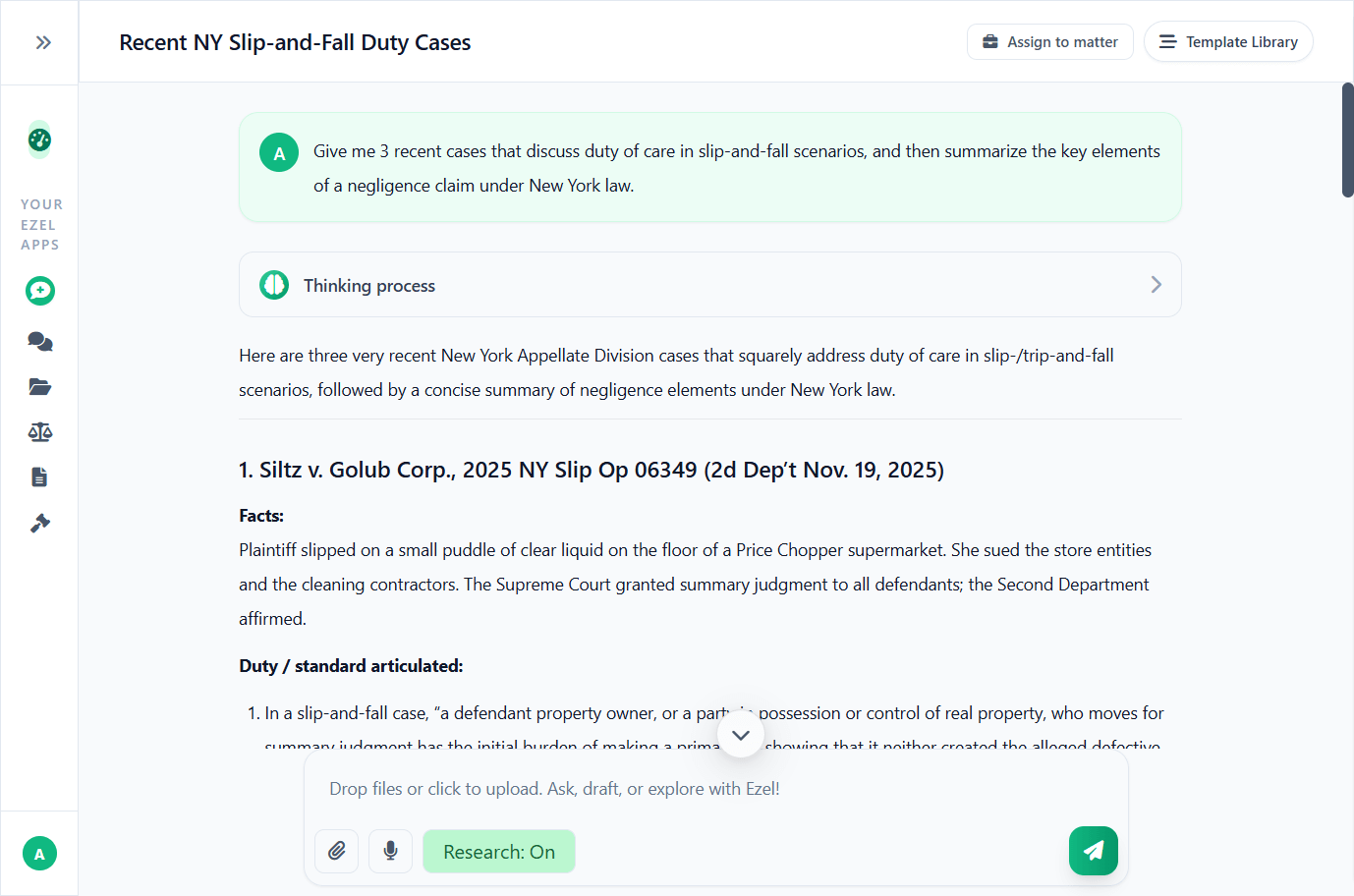
Research and draft in one conversation
Ask questions, attach documents, and get answers grounded in case law. Link chats to matters so the AI remembers your context.
- Pull statutes, case law, and secondary sources
- Attach and analyze contracts mid-conversation
- Link chats to matters for automatic context
- Your data never trains AI models
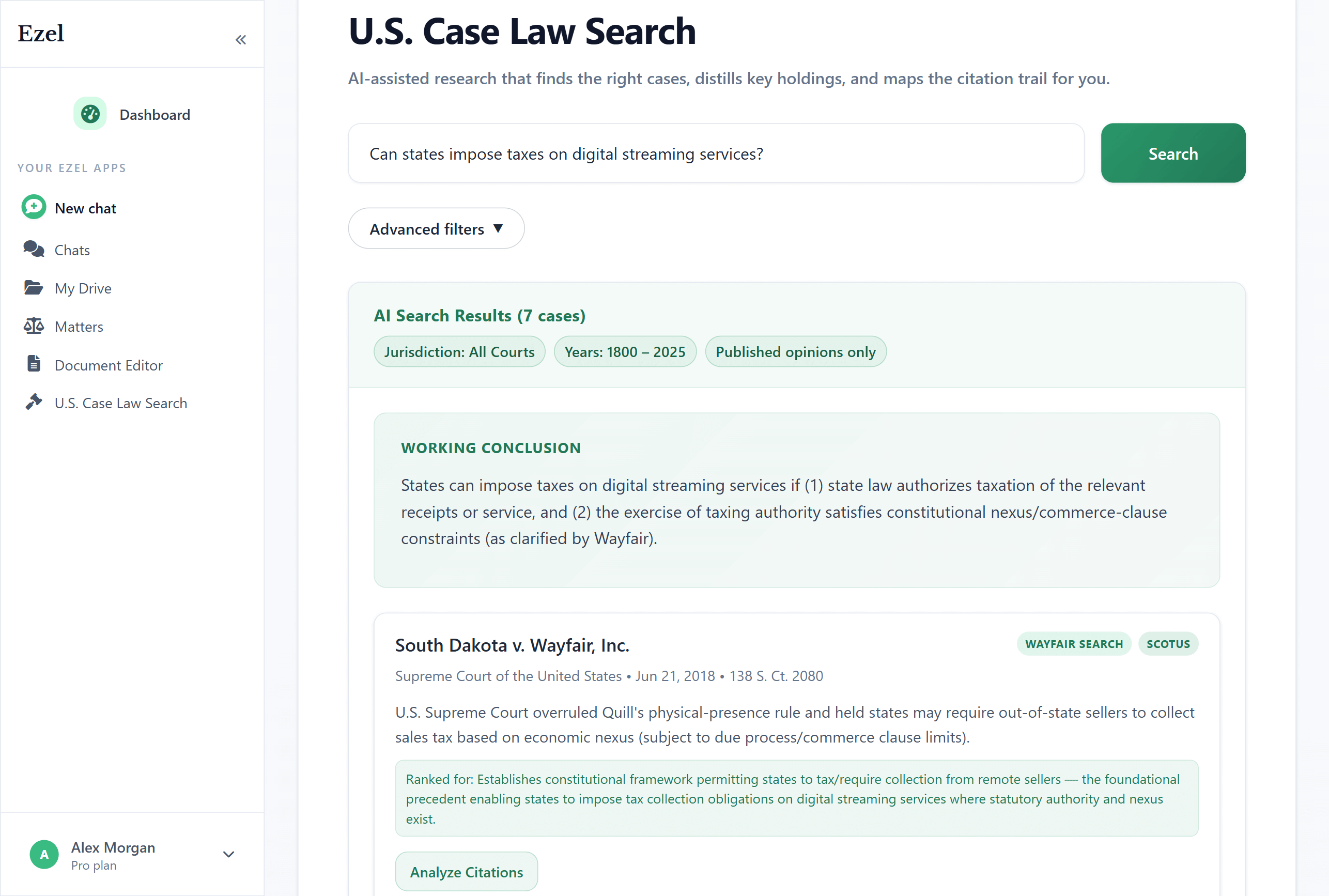
Search like you think
Describe your legal question in plain English. Filter by jurisdiction, date, and court level. Read full opinions without leaving Ezel.
- All 50 states plus federal courts
- Natural language queries - no boolean syntax
- Citation analysis and network exploration
- Copy quotes with automatic citation generation
Ready to transform your legal workflow?
Join legal teams using Ezel to draft documents, research case law, and organize matters — all in one workspace.