) before final execution.
7. Have this document reviewed by qualified legal counsel before filing.
JURISDICTION: United States (TTAB — Administrative Tribunal of the USPTO)
LAST UPDATED: 2026-02-26
-->
NOTICE OF OPPOSITION BEFORE THE TRADEMARK TRIAL AND APPEAL BOARD
UNITED STATES PATENT AND TRADEMARK OFFICE
TRADEMARK TRIAL AND APPEAL BOARD
PART I: TTAB OVERVIEW AND JURISDICTION
1.1 About the Trademark Trial and Appeal Board
The Trademark Trial and Appeal Board (TTAB) is an administrative tribunal within the United States Patent and Trademark Office (USPTO) that adjudicates inter partes proceedings involving trademarks. The TTAB has authority to determine:
- Whether a mark may be registered (opposition proceedings)
- Whether a registration should be cancelled (cancellation proceedings)
- Questions of priority and likelihood of confusion (concurrent use proceedings)
- Appeals from final refusals of trademark applications by examining attorneys (ex parte appeals)
The TTAB does NOT have authority to:
- Award monetary damages or injunctive relief
- Determine trademark infringement claims
- Order a party to stop using a mark
- Adjudicate unfair competition claims beyond registration questions
Important: A TTAB decision is binding on the parties with respect to registrability but does not preclude subsequent litigation in federal court regarding use of the mark. See B&B Hardware, Inc. v. Hargis Industries, Inc., 575 U.S. 138 (2015) (TTAB findings may have preclusive effect in federal court).
1.2 Statutory Authority for Opposition
An opposition is authorized by Section 13 of the Lanham Act, 15 U.S.C. § 1063, which provides:
"Any person who believes that he would be damaged by the registration of a mark upon the principal register... may, upon payment of the prescribed fee, file an opposition in the Patent and Trademark Office, stating the grounds therefor, within thirty days after the publication... of the mark sought to be registered."
1.3 Governing Regulations
| Source | Citation | Subject |
|---|---|---|
| Lanham Act § 13 | 15 U.S.C. § 1063 | Authorization for opposition |
| Lanham Act § 2 | 15 U.S.C. § 1052 | Grounds for refusal/opposition |
| Lanham Act § 43(c) | 15 U.S.C. § 1125(c) | Dilution |
| TTAB Rules | 37 C.F.R. §§ 2.101–2.107 | Opposition procedures |
| Discovery Rules | 37 C.F.R. §§ 2.116–2.128 | Discovery and trial |
| TBMP | Chapters 100–1100 | Comprehensive procedural manual |
| Federal Rules | Fed. R. Civ. P. (applicable portions) | Discovery and evidence |
PART II: OPPOSITION TIMELINE AND DEADLINES
2.1 Publication and the 30-Day Opposition Period
When the USPTO examining attorney approves a trademark application for registration, the mark is published in the Official Gazette. Publication triggers a 30-day opposition period during which any person who believes they would be damaged by the registration may file:
- A Notice of Opposition (commencing the proceeding), or
- A Request for Extension of Time to Oppose (extending the deadline to file)
2.2 Extensions of Time to Oppose
Under 37 C.F.R. § 2.102, a potential opposer may request extensions of the opposition period as follows:
| Extension | Duration | Requirements | Fee |
|---|---|---|---|
| First Extension | 30 days (to 60 days total) | Filed before expiration of initial 30-day period; no fee required; may be filed without showing cause | $0 |
| Second Extension | 60 days (to 120 days total) | Must show good cause; filed before expiration of first extension | $200 per application |
| Final Extension | 60 days (to 180 days total) | Must show good cause; filed before expiration of second extension | $400 per application |
Notes on Extensions:
- All extension requests must be filed through ESTTA.
- The first 30-day extension is available as of right and does not require a showing of good cause.
- Subsequent extensions require a showing of good cause, such as ongoing settlement negotiations.
- Extensions for applications under Section 66(a) of the Trademark Act (Madrid Protocol) must be filed through ESTTA and may NOT be filed on paper under any circumstances.
- The maximum total extension period is 180 days from the date of publication.
2.3 Key Deadlines After Filing
| Event | Deadline |
|---|---|
| Filing of Notice of Opposition | Within 30 days of publication (or during extension period) |
| Service of Notice on Applicant | Automatic upon TTAB institution |
| Answer by Applicant | 40 days from date of institution order |
| Discovery Conference | Within 30 days after answer is filed |
| Discovery Period | 180 days from opening of discovery |
| Plaintiff's (Opposer's) Pretrial Disclosures | 15 days before opening of testimony period |
| Opposer's Testimony Period | 30 days |
| Applicant's Testimony Period | 30 days |
| Opposer's Rebuttal Testimony Period | 15 days |
| Trial Briefs | 60 days after close of rebuttal testimony |
PART III: STANDING REQUIREMENTS
3.1 Two-Part Standing Test
To maintain an opposition, the opposer must demonstrate both elements of the standing test established in Ritchie v. Simpson, 170 F.3d 1092 (Fed. Cir. 1999) and codified in subsequent TTAB decisions:
Element 1 — Real Interest: The opposer must have a direct and personal stake in the outcome of the proceeding. This is typically shown by:
☐ Ownership of a prior trademark registration for a similar mark
☐ Prior use of a similar mark in commerce
☐ A pending application for a similar mark with an earlier filing or priority date
☐ A legitimate commercial interest that would be affected by the registration
☐ Ownership of rights in a trade name, trade dress, or other source identifier
Element 2 — Reasonable Basis for Belief of Damage: The opposer must have a reasonable basis for believing that registration of the applicant's mark would cause damage. This may be shown by:
☐ The marks are sufficiently similar to create a likelihood of confusion
☐ The goods or services are related or overlap
☐ The opposer operates in the same channels of trade
☐ Registration would dilute the distinctiveness of the opposer's famous mark
☐ The applicant's mark is descriptive or generic and its registration would harm competitors
3.2 Standing Is a Threshold Issue
Standing must be pleaded in the Notice of Opposition and proven at trial. If the opposer fails to establish standing, the opposition will be dismissed regardless of the merits of the substantive claims. The burden of proving standing is lower than the burden of proving the substantive grounds for opposition.
3.3 Entities That May Have Standing
☐ Owner of a prior federal registration
☐ Owner of prior common-law trademark rights
☐ Competitor whose ability to use descriptive or generic terms would be impaired
☐ Trade association acting on behalf of its members
☐ Individual whose name, likeness, or identity is implicated (§ 2(a) claims)
☐ Party with a bona fide intent to use a mark and a prior filing date
PART IV: NOTICE OF OPPOSITION — FILLABLE FORM
4.1 ESTTA Cover Sheet Information
The following information must be entered into the ESTTA electronic filing system:
Proceeding Type: ☐ Opposition
Filing Party (Opposer) Information:
| Field | Entry |
|---|---|
| Opposer Name | [________________________________] |
| Entity Type | ☐ Individual ☐ Corporation ☐ LLC ☐ Partnership ☐ Trust ☐ Other: [____] |
| State/Country of Organization | [________________________________] |
| Street Address | [________________________________] |
| City, State, ZIP | [________________________________] |
| Country | [________________________________] |
| Phone | [________________________________] |
| [________________________________] |
Attorney/Correspondent Information:
| Field | Entry |
|---|---|
| Attorney Name | [________________________________] |
| Bar Membership(s) | [________________________________] |
| Firm Name | [________________________________] |
| Street Address | [________________________________] |
| City, State, ZIP | [________________________________] |
| Phone | [________________________________] |
| Fax | [________________________________] |
| Email (for TTAB correspondence) | [________________________________] |
| Docket/Reference No. | [________________________________] |
Application Under Opposition:
| Field | Entry |
|---|---|
| Application Serial Number | [________________________________] |
| Mark | [________________________________] |
| International Class(es) | [________________________________] |
| Filing Date | [__/__/____] |
| Publication Date | [__/__/____] |
| Applicant Name | [________________________________] |
| Applicant Address | [________________________________] |
| Filing Basis | ☐ 1(a) Use in Commerce ☐ 1(b) Intent to Use ☐ 44(d)/(e) Foreign ☐ 66(a) Madrid Protocol |
Fee Calculation:
| Item | Amount |
|---|---|
| Number of Classes Opposed | [____] |
| Fee per Class (electronic via ESTTA) | $600.00 |
| Total Filing Fee | $[________] |
4.2 Caption
IN THE UNITED STATES PATENT AND TRADEMARK OFFICE
BEFORE THE TRADEMARK TRIAL AND APPEAL BOARD
[OPPOSER NAME], )
)
Opposer, )
)
v. ) Opposition No. ___________
)
[APPLICANT NAME], ) Application Serial No. [________]
)
Applicant. ) Mark: [________________]
)
) Published: [__/__/____]
)
) International Class(es): [____]
4.3 Notice of Opposition
NOTICE OF OPPOSITION
[________________________________] ("Opposer"), by and through its attorneys, [________________________________], hereby opposes registration of the mark [________________________________] (the "Opposed Mark"), identified in Application Serial No. [________________________________], filed on [__/__/____] by [________________________________] ("Applicant"), and published for opposition in the Official Gazette on [__/__/____]. In support of this opposition, Opposer states as follows:
THE PARTIES
1. Opposer is a [________________________________] (entity type) organized and existing under the laws of [________________________________], with its principal place of business at [________________________________].
2. Opposer is the owner of the following trademark(s) and/or service mark(s) (collectively, the "Opposer's Marks"):
| Registration/Application No. | Mark | Registration Date | Int'l Class(es) | Goods/Services |
|---|---|---|---|---|
| [________________] | [________________] | [__/__/____] | [____] | [________________________________] |
| [________________] | [________________] | [__/__/____] | [____] | [________________________________] |
| [________________] | [________________] | [__/__/____] | [____] | [________________________________] |
3. Opposer has used its Marks continuously in interstate commerce since at least as early as [__/__/____] in connection with [________________________________].
4. On information and belief, Applicant is a [________________________________] (entity type) located at [________________________________].
STANDING
5. Opposer has standing to bring this opposition because Opposer has a real interest in the proceeding and a reasonable basis for its belief that it would be damaged by registration of the Opposed Mark, based on the following:
[________________________________]
[________________________________]
[________________________________]
GROUNDS FOR OPPOSITION
Opposer opposes registration of the Opposed Mark on the following ground(s):
(Select all applicable grounds:)
☐ Likelihood of Confusion — Lanham Act § 2(d), 15 U.S.C. § 1052(d)
6. The Opposed Mark so resembles Opposer's Marks, which were previously used in commerce and/or registered, as to be likely, when used on or in connection with Applicant's identified goods/services, to cause confusion, to cause mistake, or to deceive.
7. Opposer's Marks and the Opposed Mark are similar in [________________________________] (appearance, sound, meaning, and/or commercial impression).
8. The goods/services identified in Applicant's application are [________________________________] (identical to, closely related to, or overlapping with) the goods/services offered by Opposer under its Marks.
9. The trade channels and classes of consumers for the respective goods/services [________________________________] (overlap, are identical, or are closely related).
☐ Merely Descriptive — Lanham Act § 2(e)(1), 15 U.S.C. § 1052(e)(1)
10. The Opposed Mark is merely descriptive of the goods/services identified in the application because it directly describes [________________________________] (an ingredient, quality, characteristic, function, feature, purpose, or use) of Applicant's goods/services.
11. The Opposed Mark has not acquired distinctiveness (secondary meaning) as required for registration on the Principal Register.
☐ Geographically Descriptive — Lanham Act § 2(e)(2), 15 U.S.C. § 1052(e)(2)
12. The Opposed Mark is primarily geographically descriptive of the goods/services because [________________________________].
☐ Primarily Merely a Surname — Lanham Act § 2(e)(4), 15 U.S.C. § 1052(e)(4)
13. The primary significance of the Opposed Mark to the purchasing public is as a surname, and the mark has not acquired distinctiveness under Section 2(f).
☐ Functional — Lanham Act § 2(e)(5), 15 U.S.C. § 1052(e)(5)
14. The Opposed Mark, or elements thereof, comprise matter that is functional and therefore cannot serve as a trademark. The claimed mark [________________________________] (is essential to the use or purpose of the article / affects the cost or quality of the article).
☐ Dilution — Lanham Act § 43(c), 15 U.S.C. § 1125(c)
15. Opposer's Mark is famous within the meaning of 15 U.S.C. § 1125(c)(2)(A), having achieved widespread recognition among the general consuming public as a designation of source of Opposer's goods/services.
16. Registration and/or use of the Opposed Mark would be likely to cause dilution by [________________________________] (blurring / tarnishment) of Opposer's famous mark.
☐ False Suggestion of a Connection — Lanham Act § 2(a), 15 U.S.C. § 1052(a)
17. The Opposed Mark falsely suggests a connection with Opposer, a person or institution, because [________________________________].
☐ Deceptive — Lanham Act § 2(a), 15 U.S.C. § 1052(a)
18. The Opposed Mark is deceptive because it misdescribes the goods/services in a manner that would materially affect consumers' purchasing decisions: [________________________________].
☐ Fraud on the USPTO
19. Applicant knowingly made false, material representations of fact to the USPTO with the intent to deceive the Office, including but not limited to: [________________________________].
20. The false statement was material to the USPTO's decision to approve the application for publication. Applicant knew or should have known the statement was false at the time it was made.
(Note: Fraud must be pleaded with particularity. See In re Bose Corp., 580 F.3d 1240 (Fed. Cir. 2009).)
☐ Lack of Bona Fide Intent to Use — Lanham Act § 1(b), 15 U.S.C. § 1051(b)
21. Applicant did not have a bona fide intention to use the Opposed Mark in commerce on or in connection with the identified goods/services as of the filing date of the application.
☐ Other Ground(s): [________________________________]
22. [________________________________]
FACTUAL ALLEGATIONS
23. [________________________________]
[Set forth specific factual allegations supporting each ground for opposition, including dates of first use, evidence of priority, marketplace overlap, evidence of actual confusion if available, and any other relevant facts.]
24. [________________________________]
25. [________________________________]
PRAYER FOR RELIEF
WHEREFORE, Opposer respectfully requests that the Board:
(a) Sustain this Opposition;
(b) Refuse registration of the Opposed Mark identified in Application Serial No. [________________________________]; and
(c) Grant such other and further relief as the Board may deem just and proper.
4.4 Signature Block
Respectfully submitted,
Date: [__/__/____]
________________________________________
[Attorney Name]
[Firm Name]
[Street Address]
[City, State, ZIP]
Telephone: [________________________________]
Facsimile: [________________________________]
Email: [________________________________]
Bar Admission(s): [________________________________]
Attorney for Opposer
[Opposer Name]
4.5 Verification / Declaration (if applicable)
Under 37 C.F.R. § 2.20 and 28 U.S.C. § 1746, the following declaration may accompany the Notice of Opposition:
I, [________________________________], being an authorized representative of Opposer, do hereby declare under penalty of perjury that the statements made in this Notice of Opposition are true and correct to the best of my knowledge, information, and belief, formed after reasonable inquiry.
Executed on [__/__/____], at [________________________________].
Signature: ________________________________________
Name: [________________________________]
Title: [________________________________]
PART V: LIKELIHOOD OF CONFUSION ANALYSIS — THE DU PONT FACTORS
5.1 Overview
The principal test for likelihood of confusion in TTAB proceedings is the thirteen-factor analysis established in In re E.I. du Pont de Nemours & Co., 476 F.2d 1357, 177 USPQ 563 (CCPA 1973). Not all factors are relevant in every case, but the TTAB must consider all factors for which there is evidence of record. See In re Guild Mortgage Co., 912 F.3d 1376 (Fed. Cir. 2019).
The two most important factors are typically Factor 1 (similarity of the marks) and Factor 2 (similarity of the goods/services).
5.2 The Thirteen Du Pont Factors
Factor 1: Similarity of the Marks
Analysis of the marks in their entireties as to appearance, sound, connotation, and commercial impression.
| Element | Opposer's Mark | Opposed Mark | Analysis |
|---|---|---|---|
| Appearance | [________________________________] | [________________________________] | [________________________________] |
| Sound | [________________________________] | [________________________________] | [________________________________] |
| Connotation | [________________________________] | [________________________________] | [________________________________] |
| Commercial Impression | [________________________________] | [________________________________] | [________________________________] |
Notes:
- Marks must be compared in their entireties, but the dominant or most distinctive element may be given more weight.
- Side-by-side comparison is not the standard; rather, the test is whether the marks create similar overall commercial impressions.
- If the marks share a common dominant element, minor differences in surrounding matter may be insufficient to avoid confusion.
Factor 2: Similarity of the Goods/Services
The relatedness of the goods/services as described in the application/registration or in connection with which the prior mark is used.
| Element | Opposer's Goods/Services | Applicant's Goods/Services | Analysis |
|---|---|---|---|
| Description | [________________________________] | [________________________________] | [________________________________] |
| Relationship | [________________________________] | [________________________________] | [________________________________] |
| Complementary Nature | [________________________________] | [________________________________] | [________________________________] |
Notes:
- The goods/services need not be identical; it is sufficient that they are related in a manner that would lead consumers to believe they emanate from the same source.
- The comparison is based on the goods/services as identified in the application and registration, not on real-world limitations. See Hewlett-Packard Co. v. Packard Press, Inc., 281 F.3d 1261 (Fed. Cir. 2002).
Factor 3: Similarity of Trade Channels
The similarity or dissimilarity of established, likely-to-continue trade channels.
| Opposer's Trade Channels | Applicant's Trade Channels | Analysis |
|---|---|---|
| [________________________________] | [________________________________] | [________________________________] |
Factor 4: Conditions of Purchase / Consumer Sophistication
The conditions under which and buyers to whom sales are made (e.g., impulse vs. careful, sophisticated purchasing).
☐ Consumers exercise a high degree of care in purchasing the goods/services
☐ Consumers exercise ordinary care (general consumer goods)
☐ Goods/services are inexpensive and subject to impulse purchasing
☐ Purchasers include both sophisticated and unsophisticated consumers
Analysis: [________________________________]
Factor 5: Fame of the Prior Mark
The fame of the prior mark, considering sales, advertising, and length of use.
| Indicator | Evidence |
|---|---|
| Annual Sales Revenue | [________________________________] |
| Advertising Expenditures | [________________________________] |
| Duration of Use | Since [__/__/____] |
| Market Share | [________________________________] |
| Consumer Recognition/Surveys | [________________________________] |
| Media Coverage | [________________________________] |
| Unsolicited Media References | [________________________________] |
Notes: A famous mark is accorded a broader scope of protection. Fame must be proven; mere assertion is insufficient.
Factor 6: Number and Nature of Similar Marks on Similar Goods
The number and nature of similar marks in use on similar goods/services.
| Third-Party Mark | Goods/Services | Source |
|---|---|---|
| [________________________________] | [________________________________] | [________________________________] |
| [________________________________] | [________________________________] | [________________________________] |
| [________________________________] | [________________________________] | [________________________________] |
Notes: Extensive third-party use of similar marks on similar goods may suggest that consumers are conditioned to distinguish between such marks, weakening a likelihood of confusion finding. However, mere third-party registrations, without evidence of use, are generally accorded limited weight.
Factor 7: Nature and Extent of Actual Confusion
Evidence of actual confusion among consumers.
☐ Instances of actual confusion documented (describe): [________________________________]
☐ Consumer survey evidence available: [________________________________]
☐ No evidence of actual confusion (explain significance): [________________________________]
Notes: Evidence of actual confusion is strong proof of likelihood of confusion, but is not required. The absence of actual confusion is not dispositive, especially when concurrent use has been limited.
Factor 8: Length of Concurrent Use Without Actual Confusion
The length of time during and conditions under which there has been concurrent use without evidence of actual confusion.
| Period of Concurrent Use | Conditions | Evidence |
|---|---|---|
| [________________________________] | [________________________________] | [________________________________] |
Notes: A lengthy period of concurrent use without confusion may weigh against a finding of likelihood of confusion, but only if the concurrent use was under conditions that would provide a meaningful opportunity for confusion to occur.
Factor 9: Variety of Goods on Which the Mark Is Used
The variety of goods on which a mark is or is not used (bridging the gap).
Analysis: [________________________________]
Factor 10: Market Interface Between the Parties
The market interface between the applicant and the owner of a prior mark, including any agreements or dealings.
Analysis: [________________________________]
Factor 11: Opposer's Right to Exclude Others
The extent to which the opposer has a right to exclude others from use of its mark on its goods.
Analysis: [________________________________]
Factor 12: Extent of Potential Confusion
The extent of potential confusion — whether it would be de minimis or substantial.
Analysis: [________________________________]
Factor 13: Any Other Probative Facts
Any other established fact probative of the effect of use.
Analysis: [________________________________]
5.3 Du Pont Factor Summary Table
| Factor | Favors Opposer | Neutral | Favors Applicant |
|---|---|---|---|
| 1. Similarity of Marks | ☐ | ☐ | ☐ |
| 2. Similarity of Goods/Services | ☐ | ☐ | ☐ |
| 3. Similarity of Trade Channels | ☐ | ☐ | ☐ |
| 4. Consumer Sophistication | ☐ | ☐ | ☐ |
| 5. Fame of Prior Mark | ☐ | ☐ | ☐ |
| 6. Third-Party Marks | ☐ | ☐ | ☐ |
| 7. Actual Confusion | ☐ | ☐ | ☐ |
| 8. Concurrent Use Without Confusion | ☐ | ☐ | ☐ |
| 9. Variety of Goods | ☐ | ☐ | ☐ |
| 10. Market Interface | ☐ | ☐ | ☐ |
| 11. Right to Exclude | ☐ | ☐ | ☐ |
| 12. Extent of Potential Confusion | ☐ | ☐ | ☐ |
| 13. Other Facts | ☐ | ☐ | ☐ |
PART VI: DISCOVERY PLAN AND SCHEDULE
6.1 TTAB Standard Schedule
Upon institution of the opposition, the TTAB issues a standard scheduling order. The parties may stipulate to modifications or move the Board for a modified schedule. The standard schedule is approximately as follows:
| Phase | Event | Deadline |
|---|---|---|
| Pleading | Answer due | 40 days from institution |
| Discovery | Discovery conference | 30 days after answer |
| Discovery | Discovery opens | 30 days after answer |
| Discovery | Discovery closes | 210 days after answer |
| Pre-Trial | Opposer's pretrial disclosures | Per scheduling order |
| Trial | Opposer's 30-day testimony period | Per scheduling order |
| Trial | Applicant's pretrial disclosures | Per scheduling order |
| Trial | Applicant's 30-day testimony period | Per scheduling order |
| Trial | Opposer's 15-day rebuttal testimony | Per scheduling order |
| Post-Trial | Opposer's trial brief | 60 days after close of all testimony |
| Post-Trial | Applicant's trial brief | 60 days after Opposer's brief |
| Post-Trial | Opposer's reply brief (optional) | 25 days after Applicant's brief |
6.2 Discovery Methods Available
The following discovery methods are available in TTAB proceedings under 37 C.F.R. § 2.120 and applicable Federal Rules of Civil Procedure:
☐ Initial Disclosures (required under 37 C.F.R. § 2.120(a))
- Name and contact information of individuals likely to have discoverable information
- Copy or description of documents, ESI, and tangible things relevant to claims or defenses
- Computation of damages (not typically applicable in TTAB proceedings)
☐ Interrogatories (Fed. R. Civ. P. 33)
- Limited to 75 interrogatories, including subparts
- Must be answered within 30 days of service
☐ Requests for Production of Documents (Fed. R. Civ. P. 34)
- Limited to 75 requests, including subparts
- Response due within 30 days of service
☐ Requests for Admission (Fed. R. Civ. P. 36)
- Limited to 75 requests, including subparts
- Response due within 30 days of service
- Failure to respond results in deemed admissions
☐ Depositions (Fed. R. Civ. P. 30)
- Oral depositions allowed
- Deposition upon written questions also available (Fed. R. Civ. P. 31)
6.3 Standard Protective Order
The TTAB Standard Protective Order is automatically imposed on all inter partes proceedings. The parties may stipulate to an alternative protective order or move the Board for modifications. Key provisions include:
- Designation of documents and testimony as "Confidential" or "Trade Secret/Commercially Sensitive"
- Restrictions on use of confidential materials to the Board proceeding only
- Requirements for handling and return of confidential materials
6.4 Discovery Conference Checklist
The discovery conference must address the following topics:
☐ Settlement possibilities
☐ Modifications to the discovery/trial calendar
☐ Stipulation for declaration vs. deposition testimony
☐ Expert testimony and scheduling
☐ Preservation of discoverable information
☐ Development of a discovery plan
☐ Issues concerning electronically stored information (ESI)
☐ Form of document production
☐ Changes to the TTAB Standard Protective Order
PART VII: FILING INSTRUCTIONS
7.1 ESTTA Electronic Filing
All opposition filings must be submitted through the Electronic System for Trademark Trials and Appeals (ESTTA) at https://estta.uspto.gov.
Step-by-Step Filing Process:
Step 1: Navigate to ESTTA at https://estta.uspto.gov
Step 2: Select "File a new proceeding"
Step 3: Select "Opposition" as the proceeding type
Step 4: Enter the application serial number of the mark being opposed
Step 5: Complete the cover sheet with the following information:
- Opposer's name, entity type, and contact information
- Attorney/correspondent information
- Grounds for opposition
- Classes being opposed
Step 6: Upload the Notice of Opposition as a PDF attachment
Step 7: Calculate and pay the filing fee:
- $600 per class (electronic filing)
- $700 per class (paper filing, if permitted)
Step 8: Submit the filing and retain the electronic confirmation receipt
Filing Checklist:
☐ Notice of Opposition document prepared and converted to PDF
☐ ESTTA cover sheet information compiled
☐ Application serial number verified
☐ Classes to be opposed identified
☐ Filing fee calculated
☐ Payment method ready (credit card, deposit account, or EFT)
☐ Attorney email address for TTAB correspondence confirmed
☐ Copy of Notice retained for records
7.2 Fee Schedule (Effective January 1, 2026)
| Filing | Electronic Fee | Paper Fee |
|---|---|---|
| Notice of Opposition (per class) | $600.00 | $700.00 |
| Petition for Cancellation (per class) | $600.00 | $700.00 |
| First Extension of Time to Oppose | $0.00 | N/A |
| Second Extension of Time to Oppose (per application) | $200.00 | N/A |
| Final Extension of Time to Oppose (per application) | $400.00 | N/A |
| Ex Parte Appeal (per class) | $225.00 | $325.00 |
7.3 Service Requirements
- Service of Notice of Opposition: Service on the applicant is effected automatically by the TTAB upon institution of the proceeding. The Board will send a copy of the notice to the applicant (or applicant's attorney of record).
- Subsequent Filings: All papers filed after institution must be served on the opposing party and must include a certificate of service. See 37 C.F.R. § 2.119.
- Methods of Service: Service may be made by email (preferred), first-class mail, or hand delivery.
PART VIII: PRACTICE TIPS AND STRATEGIC CONSIDERATIONS
8.1 Pre-Filing Strategy
☐ Conduct a comprehensive trademark search before filing to confirm priority and identify all relevant registrations, applications, and common-law uses.
☐ Evaluate the strength of your grounds by analyzing each Du Pont factor and assessing the evidence available to support each claim.
☐ Consider sending a cease-and-desist letter before filing the opposition. Settlement is often more efficient and cost-effective than full TTAB litigation.
☐ Assess the business objectives — determine whether the goal is to prevent registration entirely, narrow the goods/services, or obtain a consent agreement.
☐ Consider concurrent federal court litigation — if infringement is ongoing, it may be more efficient to pursue both a TTAB opposition and a federal court action simultaneously, or to seek a stay of the TTAB proceeding pending the court action.
8.2 Pleading Strategy
☐ Plead multiple grounds where supported by facts. If one ground fails, others may succeed.
☐ Include specific factual allegations rather than conclusory statements. Although notice pleading applies, detailed allegations strengthen the pleading and frame the issues for discovery.
☐ Attach key exhibits to the Notice of Opposition, such as copies of the opposer's registrations and specimens of use.
☐ Plead fraud with particularity if asserting fraud on the USPTO. Under In re Bose Corp., 580 F.3d 1240 (Fed. Cir. 2009), fraud requires proof that the applicant made a knowingly false, material misrepresentation with intent to deceive the USPTO. This is a high standard requiring specific factual allegations.
8.3 Settlement Considerations
☐ Explore early settlement — the majority of TTAB proceedings settle before trial.
☐ Types of settlements:
- Consent agreement (allowing both marks to coexist with limitations)
- Application amendment (narrowing goods/services or adding a disclaimer)
- Voluntary abandonment of the application
- Licensing arrangement
- Coexistence agreement with geographic or channel restrictions
☐ Suspension for settlement negotiations — the Board will suspend proceedings upon stipulation of the parties for settlement discussions. See TBMP § 605.
☐ Settlement agreements should be in writing and filed with the Board to avoid future disputes.
8.4 Trial Strategy
☐ TTAB trials are conducted on the written record — there is no live testimony before the Board. Evidence is submitted through testimony declarations or deposition transcripts, along with documentary exhibits.
☐ Use declarations (stipulated testimony) where possible to reduce costs. Under 37 C.F.R. § 2.123(b), the parties may stipulate to submit testimony by declaration in lieu of oral deposition.
☐ Notice of reliance (37 C.F.R. § 2.122(e)) allows a party to introduce certain types of evidence (e.g., official records, printed publications, internet evidence) without the need for a testifying witness.
☐ Accelerated Case Resolution (ACR) — consider requesting ACR for expedited resolution. ACR procedures include summary judgment-style briefing and reduced discovery.
8.5 Common Pitfalls to Avoid
☐ Missing the 30-day opposition period — once the period expires without a filing or extension request, the mark will proceed to registration and you must pursue cancellation instead.
☐ Failing to answer discovery — failure to respond to discovery requests may result in sanctions, including entry of judgment against the non-responding party.
☐ Failing to prosecute — if the opposer fails to take action for an extended period, the Board may dismiss the opposition for failure to prosecute.
☐ Insufficient evidence of priority — the opposer must prove prior use or registration. Mere allegations without supporting evidence are insufficient.
☐ Ignoring the answer deadline — if Applicant fails to file a timely answer, the opposition may be sustained by default. Conversely, if Opposer fails to monitor the proceeding, opportunities may be lost.
8.6 Costs Estimate
| Phase | Estimated Attorney Fees | Filing Fees |
|---|---|---|
| Pre-filing investigation and strategy | $2,000 – $5,000 | — |
| Filing Notice of Opposition | $3,000 – $7,000 | $600/class |
| Discovery (if fully litigated) | $10,000 – $30,000 | — |
| Trial (testimony and briefing) | $15,000 – $40,000 | — |
| Total (fully litigated) | $30,000 – $80,000+ | Varies |
Note: Many proceedings settle during the discovery phase, significantly reducing total costs.
SOURCES AND REFERENCES
Statutes
- 15 U.S.C. § 1052 (Lanham Act § 2) — Grounds for refusal of registration
- 15 U.S.C. § 1063 (Lanham Act § 13) — Opposition to registration
- 15 U.S.C. § 1125(c) (Lanham Act § 43(c)) — Dilution
- 28 U.S.C. § 1746 — Unsworn declarations under penalty of perjury
Regulations
- 37 C.F.R. §§ 2.101–2.107 — Opposition proceedings
- 37 C.F.R. § 2.116 — Commencement of inter partes proceeding
- 37 C.F.R. §§ 2.120–2.128 — Discovery and trial procedures
- 37 C.F.R. § 2.119 — Service of papers
Key Case Law
- In re E.I. du Pont de Nemours & Co., 476 F.2d 1357, 177 USPQ 563 (CCPA 1973) — Thirteen-factor likelihood of confusion test
- B&B Hardware, Inc. v. Hargis Industries, Inc., 575 U.S. 138 (2015) — Preclusive effect of TTAB decisions
- In re Bose Corp., 580 F.3d 1240 (Fed. Cir. 2009) — Standard for fraud on the USPTO
- Ritchie v. Simpson, 170 F.3d 1092 (Fed. Cir. 1999) — Standing requirements
- In re Guild Mortgage Co., 912 F.3d 1376 (Fed. Cir. 2019) — Obligation to consider all Du Pont factors
- Hewlett-Packard Co. v. Packard Press, Inc., 281 F.3d 1261 (Fed. Cir. 2002) — Comparison of goods as identified
USPTO Resources
- ESTTA Filing System: https://estta.uspto.gov
- Trademark Trial and Appeal Board Manual of Procedure (TBMP): https://www.uspto.gov/trademarks/ttab/tbmp
- USPTO Fee Schedule: https://www.uspto.gov/learning-and-resources/fees-and-payment/uspto-fee-schedule
- TTAB FAQs: https://www.uspto.gov/trademarks/ttab/trademark-trial-and-appeal-board-ttab
- Official Gazette: https://www.uspto.gov/learning-and-resources/official-gazette
This template is provided by ezel.ai for informational purposes only. It does not constitute legal advice and should not be used as a substitute for consultation with a qualified trademark attorney. TTAB proceedings involve complex procedural and substantive requirements; errors in filing or prosecution may result in loss of rights. Always consult with a licensed attorney before filing any proceeding with the TTAB.
Last Updated: February 26, 2026
Do more with Ezel
This free template is just the beginning. See how Ezel helps legal teams draft, research, and collaborate faster.
AI that drafts while you watch
Tell the AI what you need and watch your document transform in real-time. No more copy-pasting between tools or manually formatting changes.
- Natural language commands: "Add a force majeure clause"
- Context-aware suggestions based on document type
- Real-time streaming shows edits as they happen
- Milestone tracking and version comparison
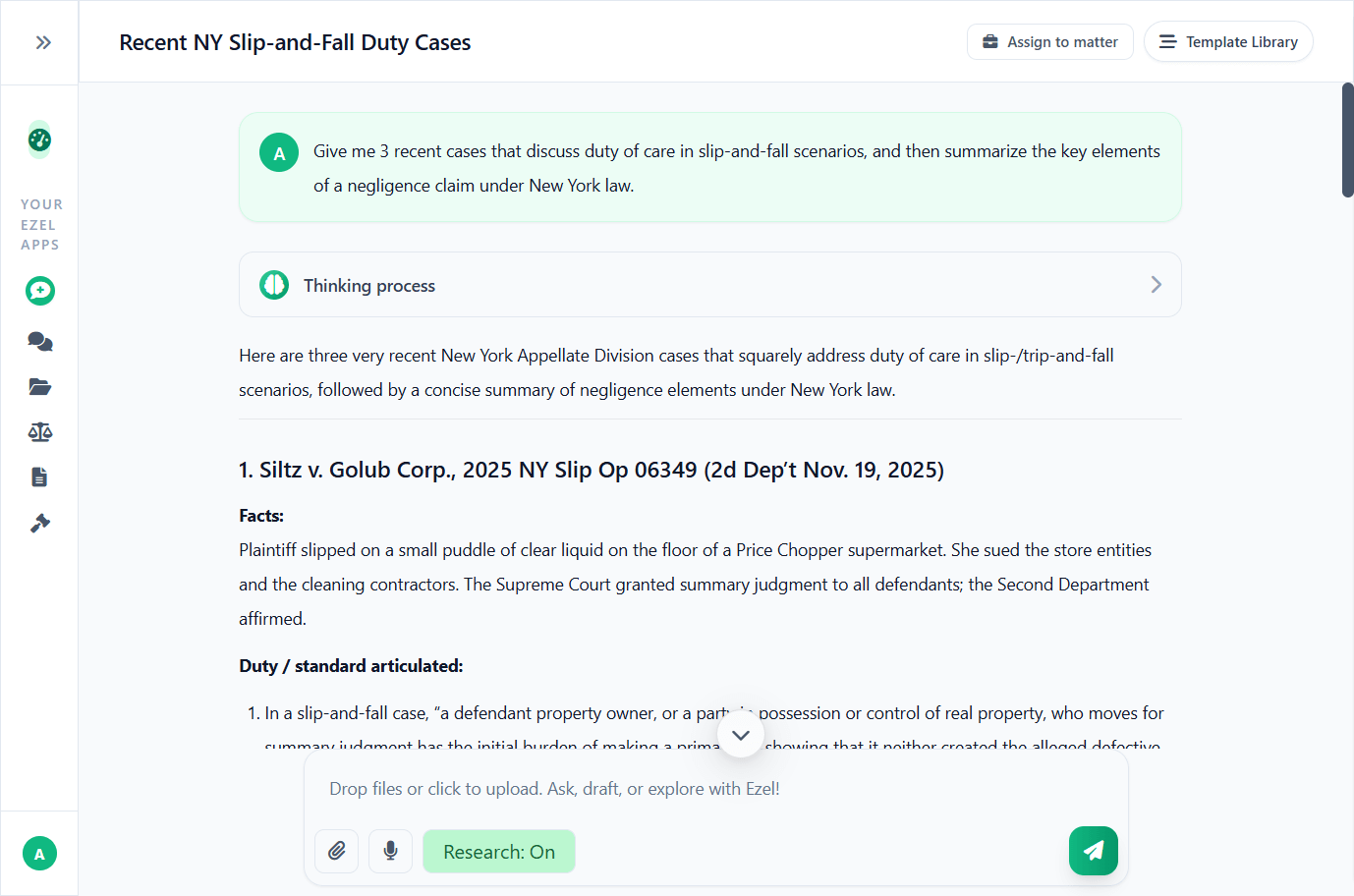
Research and draft in one conversation
Ask questions, attach documents, and get answers grounded in case law. Link chats to matters so the AI remembers your context.
- Pull statutes, case law, and secondary sources
- Attach and analyze contracts mid-conversation
- Link chats to matters for automatic context
- Your data never trains AI models
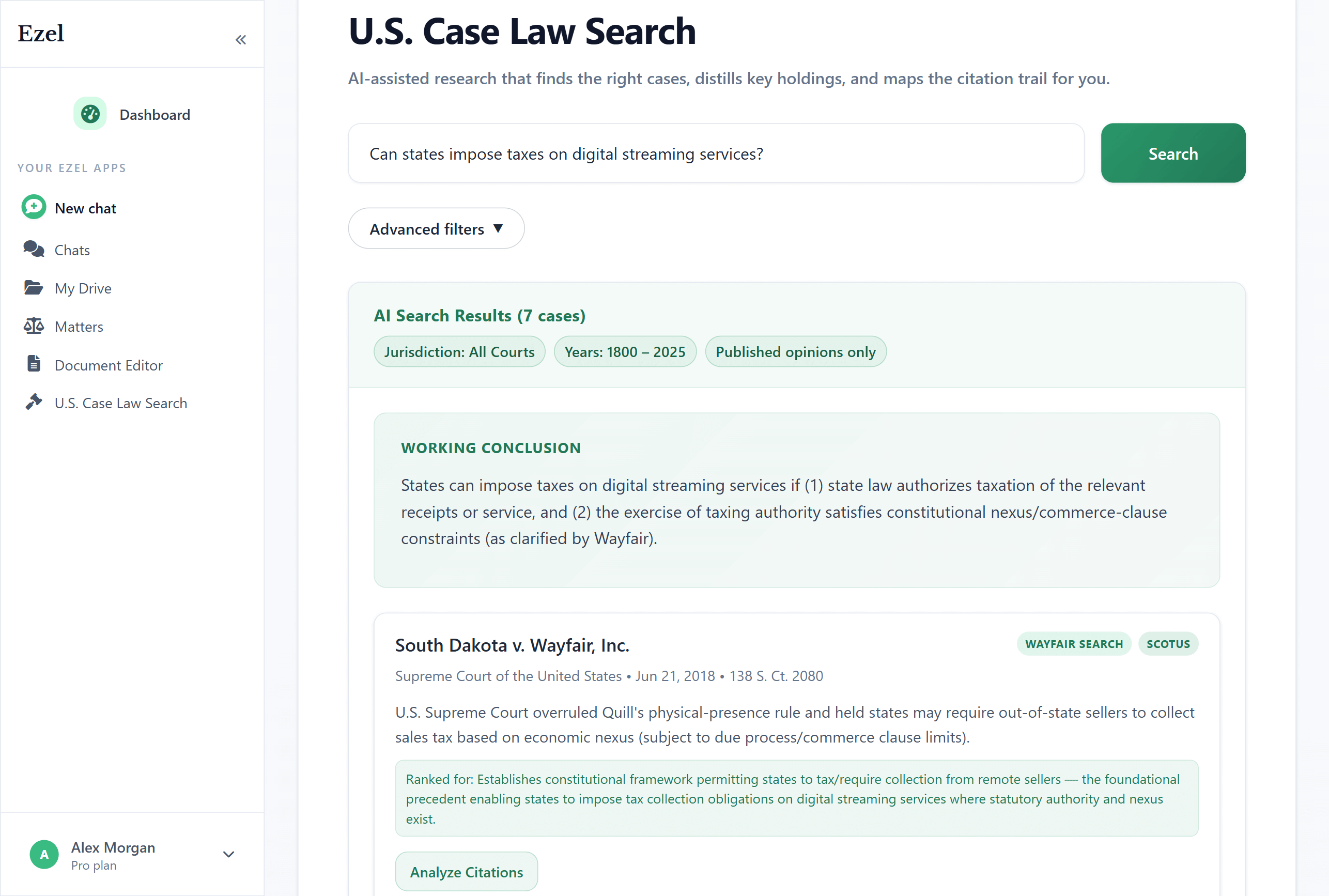
Search like you think
Describe your legal question in plain English. Filter by jurisdiction, date, and court level. Read full opinions without leaving Ezel.
- All 50 states plus federal courts
- Natural language queries - no boolean syntax
- Citation analysis and network exploration
- Copy quotes with automatic citation generation
Ready to transform your legal workflow?
Join legal teams using Ezel to draft documents, research case law, and organize matters — all in one workspace.