PETITION FOR CANCELLATION BEFORE THE TRADEMARK TRIAL AND APPEAL BOARD
UNITED STATES PATENT AND TRADEMARK OFFICE
TRADEMARK TRIAL AND APPEAL BOARD
PART I: TTAB CANCELLATION OVERVIEW
1.1 Purpose of Cancellation Proceedings
A cancellation proceeding is an inter partes action before the Trademark Trial and Appeal Board (TTAB) in which a petitioner seeks to cancel an existing federal trademark registration. Cancellation proceedings are authorized by Section 14 of the Lanham Act, 15 U.S.C. § 1064, which provides that:
"A petition to cancel a registration of a mark... may, upon payment of the prescribed fee, be filed... by any person who believes that he is or will be damaged... by the registration of a mark on the principal register."
Unlike an opposition (which seeks to prevent registration), a cancellation proceeding challenges a mark that has already been registered. The TTAB has authority to order cancellation of a registration but does NOT have authority to:
- Award monetary damages
- Issue injunctive relief
- Determine infringement claims
- Order a party to stop using a mark in commerce
1.2 Cancellation vs. Opposition vs. Federal Court
| Feature | Opposition | Cancellation | Federal Court |
|---|---|---|---|
| Timing | Before registration | After registration | Any time |
| Forum | TTAB | TTAB | District court |
| Remedy | Refusal of registration | Cancellation of registration | Damages, injunction, cancellation |
| Monetary Damages | No | No | Yes |
| Injunctive Relief | No | No | Yes |
| Filing Fee | $600/class | $600/class | ~$402 |
| Discovery | Limited (TTAB rules) | Limited (TTAB rules) | Full federal rules |
| Appeal | Fed. Circuit or district court | Fed. Circuit or district court | Circuit court |
1.3 Governing Authority
| Source | Citation | Subject |
|---|---|---|
| Lanham Act § 14 | 15 U.S.C. § 1064 | Authorization for cancellation |
| Lanham Act § 2 | 15 U.S.C. § 1052 | Grounds for refusal (applicable to cancellation) |
| Lanham Act § 8 | 15 U.S.C. § 1058 | Maintenance requirements |
| Lanham Act § 15 | 15 U.S.C. § 1065 | Incontestability |
| Lanham Act § 45 | 15 U.S.C. § 1127 | Definitions (abandonment, use in commerce) |
| TTAB Rules | 37 C.F.R. §§ 2.111–2.114 | Cancellation procedures |
| Discovery/Trial | 37 C.F.R. §§ 2.116–2.128 | Discovery and trial procedures |
| TBMP | Chapters 300–800 | Comprehensive procedural manual |
PART II: CANCELLATION TYPES AND TIMING
2.1 The Five-Year Rule and Incontestability
Under 15 U.S.C. § 1064, the timing of the cancellation petition determines which grounds are available:
Grounds Available Within Five Years of Registration
Any ground that could have been raised as a basis for refusing registration may be asserted in a cancellation proceeding filed within five years of the date of registration:
☐ Likelihood of confusion (§ 2(d))
☐ Merely descriptive without secondary meaning (§ 2(e)(1))
☐ Geographically descriptive (§ 2(e)(2))
☐ Geographically deceptively misdescriptive (§ 2(e)(3))
☐ Primarily merely a surname (§ 2(e)(4))
☐ Matter that, as a whole, is functional (§ 2(e)(5))
☐ Immoral, deceptive, or scandalous matter (§ 2(a))
☐ False suggestion of connection (§ 2(a))
☐ Flag, coat of arms, or insignia (§ 2(b))
☐ Name, portrait, or signature of a living individual without consent (§ 2(c))
☐ Registration obtained contrary to §§ 1, 2, 3, or 4 of the Lanham Act
Grounds Available at Any Time (Even After Five Years)
Certain grounds may be asserted at any time, regardless of how long the mark has been registered, including marks that have achieved incontestable status under Section 15:
☐ Genericness — the registered mark has become the generic name for the goods/services (§ 14(3))
☐ Abandonment — the mark has been abandoned through nonuse or loss of trademark significance (§ 14(3))
☐ Fraud on the USPTO — the registration was obtained fraudulently (§ 14(3))
☐ Functionality — the mark is functional (§ 14(3))
☐ The mark is being used to misrepresent the source of goods/services (§ 14(3))
☐ The mark was registered in violation of § 2(a), (b), or (c) and the registrant is not the owner (§ 14(3))
☐ The registration was granted under § 4 to a mark used by an applicant that has since ceased use (§ 14(3))
2.2 Timing Summary Table
| Ground | Within 5 Years | After 5 Years | Against Incontestable Mark |
|---|---|---|---|
| Likelihood of confusion (§ 2(d)) | ☐ Yes | ☐ No | ☐ No |
| Descriptiveness (§ 2(e)(1)) | ☐ Yes | ☐ No | ☐ No |
| Surname (§ 2(e)(4)) | ☐ Yes | ☐ No | ☐ No |
| Geographic descriptiveness (§ 2(e)(2)) | ☐ Yes | ☐ No | ☐ No |
| Genericness (§ 14(3)) | ☐ Yes | ☐ Yes | ☐ Yes |
| Abandonment (§ 14(3)) | ☐ Yes | ☐ Yes | ☐ Yes |
| Fraud (§ 14(3)) | ☐ Yes | ☐ Yes | ☐ Yes |
| Functionality (§ 14(3)) | ☐ Yes | ☐ Yes | ☐ Yes |
| Misrepresentation of source (§ 14(3)) | ☐ Yes | ☐ Yes | ☐ Yes |
2.3 Incontestability — What It Means
Under Section 15 of the Lanham Act (15 U.S.C. § 1065), a registration becomes "incontestable" after:
- Five consecutive years of continuous use in commerce after the date of registration
- Filing of a Section 15 affidavit/declaration with the USPTO
- No final adverse decision regarding the registrant's ownership or right to register
Important: Incontestability does NOT make a registration immune from cancellation. It limits the grounds on which cancellation may be sought but does not foreclose the "at any time" grounds listed in § 14(3). See Park 'N Fly, Inc. v. Dollar Park and Fly, Inc., 469 U.S. 189 (1985).
PART III: STANDING REQUIREMENTS
3.1 Two-Part Standing Test
To maintain a cancellation proceeding, the petitioner must demonstrate both elements of standing under Ritchie v. Simpson, 170 F.3d 1092 (Fed. Cir. 1999):
Element 1 — Real Interest: A direct and personal stake in the outcome.
☐ Ownership of a prior trademark registration for a similar mark
☐ Prior use of a similar mark in commerce
☐ A legitimate commercial interest that would be affected by the continued registration
☐ Status as a competitor in the same market
☐ Interest as a potential user of a generic or descriptive term
Element 2 — Reasonable Basis for Belief of Damage: A reasonable belief that the continued registration causes damage.
☐ The marks are sufficiently similar to create a likelihood of confusion
☐ The registrant's mark is generic, preventing fair competition
☐ The registration improperly blocks the petitioner from using descriptive terms
☐ The registrant has abandoned the mark, yet the registration remains on the register
☐ The registration was fraudulently obtained
3.2 Standing for Different Grounds
| Ground | Typical Petitioner | Standing Basis |
|---|---|---|
| Likelihood of confusion | Prior mark owner | Confusion damages business |
| Abandonment | Competitor, prospective user | Registration blocks legitimate use |
| Genericness | Competitor, industry member | Cannot use common term |
| Fraud | Any damaged party | Fraudulent registration damages fair competition |
| Functionality | Competitor | Registration impedes competition |
PART IV: PETITION FOR CANCELLATION — FILLABLE FORM
4.1 ESTTA Cover Sheet Information
Proceeding Type: ☐ Cancellation
Filing Party (Petitioner) Information:
| Field | Entry |
|---|---|
| Petitioner Name | [________________________________] |
| Entity Type | ☐ Individual ☐ Corporation ☐ LLC ☐ Partnership ☐ Trust ☐ Other: [____] |
| State/Country of Organization | [________________________________] |
| Street Address | [________________________________] |
| City, State, ZIP | [________________________________] |
| Country | [________________________________] |
| Phone | [________________________________] |
| [________________________________] |
Attorney/Correspondent Information:
| Field | Entry |
|---|---|
| Attorney Name | [________________________________] |
| Bar Membership(s) | [________________________________] |
| Firm Name | [________________________________] |
| Street Address | [________________________________] |
| City, State, ZIP | [________________________________] |
| Phone | [________________________________] |
| Fax | [________________________________] |
| Email (for TTAB correspondence) | [________________________________] |
| Docket/Reference No. | [________________________________] |
Registration Under Challenge:
| Field | Entry |
|---|---|
| Registration Number | [________________________________] |
| Mark | [________________________________] |
| International Class(es) | [________________________________] |
| Registration Date | [__/__/____] |
| Registrant Name | [________________________________] |
| Registrant Address | [________________________________] |
| Goods/Services | [________________________________] |
| Filing Basis | ☐ 1(a) Use in Commerce ☐ 1(b) Intent to Use ☐ 44(d)/(e) Foreign ☐ 66(a) Madrid Protocol |
| Section 15 Declaration Filed? | ☐ Yes ☐ No ☐ Unknown |
| Most Recent § 8/§ 9 Filing | [__/__/____] |
Fee Calculation:
| Item | Amount |
|---|---|
| Number of Classes Challenged | [____] |
| Fee per Class (electronic via ESTTA) | $600.00 |
| Total Filing Fee | $[________] |
4.2 Caption
IN THE UNITED STATES PATENT AND TRADEMARK OFFICE
BEFORE THE TRADEMARK TRIAL AND APPEAL BOARD
[PETITIONER NAME], )
)
Petitioner, )
)
v. ) Cancellation No. ___________
)
[REGISTRANT NAME], ) Registration No. [________]
)
Registrant. ) Mark: [________________]
)
) Registered: [__/__/____]
)
) International Class(es): [____]
4.3 Petition for Cancellation
PETITION FOR CANCELLATION
[________________________________] ("Petitioner"), by and through its attorneys, [________________________________], hereby petitions for cancellation of Registration No. [________________________________] for the mark [________________________________] (the "Registered Mark"), issued on [__/__/____] to [________________________________] ("Registrant"), in International Class(es) [________________________________] for [________________________________] (goods/services). In support of this petition, Petitioner states as follows:
THE PARTIES
1. Petitioner is a [________________________________] (entity type) organized and existing under the laws of [________________________________], with its principal place of business at [________________________________].
2. Petitioner is the owner of the following trademark(s) and/or service mark(s) (collectively, "Petitioner's Marks"):
| Registration/Application No. | Mark | Registration Date | Int'l Class(es) | Goods/Services |
|---|---|---|---|---|
| [________________] | [________________] | [__/__/____] | [____] | [________________________________] |
| [________________] | [________________] | [__/__/____] | [____] | [________________________________] |
| [________________] | [________________] | [__/__/____] | [____] | [________________________________] |
3. Petitioner has used its Marks continuously in interstate commerce since at least as early as [__/__/____] in connection with [________________________________].
4. On information and belief, Registrant is a [________________________________] (entity type) located at [________________________________].
STANDING
5. Petitioner has standing to bring this proceeding because Petitioner has a real interest in the cancellation of the Registered Mark and a reasonable basis for its belief that it is or will be damaged by the continued registration of the Registered Mark, based on the following:
[________________________________]
[________________________________]
[________________________________]
GROUNDS FOR CANCELLATION
Petitioner seeks cancellation of the Registered Mark on the following ground(s):
(Select all applicable grounds:)
☐ Likelihood of Confusion — Lanham Act § 2(d), 15 U.S.C. § 1052(d)
[Available only within five years of registration, or if registration has not achieved incontestable status.]
6. The Registered Mark so resembles Petitioner's Marks, which were previously used in commerce and/or registered, as to be likely, when used on or in connection with Registrant's identified goods/services, to cause confusion, to cause mistake, or to deceive.
7. Petitioner's Marks and the Registered Mark are similar in [________________________________] (appearance, sound, meaning, and/or commercial impression).
8. The goods/services identified in the registration are [________________________________] (identical to, closely related to, or overlapping with) the goods/services offered by Petitioner under its Marks.
☐ Abandonment / Nonuse — Lanham Act § 14(3), 15 U.S.C. § 1064(3)
[Available at any time, including against incontestable registrations.]
9. Registrant has abandoned the Registered Mark by discontinuing use of the mark with no intent to resume use. Specifically:
(a) Registrant has not used the Registered Mark in commerce in connection with the identified goods/services since at least [__/__/____], a period of [____] years.
(b) Three consecutive years of nonuse constitutes prima facie evidence of abandonment under 15 U.S.C. § 1127.
(c) The following facts demonstrate Registrant's intent not to resume use: [________________________________]
☐ Fraud on the USPTO
[Available at any time, including against incontestable registrations.]
10. Registrant obtained the registration by fraud on the USPTO. Specifically, Registrant knowingly made the following false, material representation(s) to the USPTO with the intent to deceive:
(a) [________________________________]
(b) The false statement was material to the USPTO's decision to register the mark.
(c) Registrant knew or should have known the statement was false at the time it was made.
(Note: Fraud must be pleaded with particularity under In re Bose Corp., 580 F.3d 1240 (Fed. Cir. 2009). The burden is clear and convincing evidence.)
☐ Genericness — Lanham Act § 14(3), 15 U.S.C. § 1064(3)
[Available at any time, including against incontestable registrations.]
11. The Registered Mark is or has become the generic name for the goods/services identified in the registration. The primary significance of the term to the relevant public is as the name of a type or category of goods/services, rather than as a designation of source.
12. The following evidence demonstrates that the Registered Mark is generic: [________________________________]
☐ Functionality — Lanham Act § 2(e)(5), 15 U.S.C. § 1052(e)(5)
[Available at any time, including against incontestable registrations.]
13. The Registered Mark, or elements thereof, comprise matter that is functional and therefore not registrable as a trademark. The claimed mark [________________________________] (is essential to the use or purpose of the article / affects the cost or quality of the article / exclusive use would put competitors at a significant non-reputation-related disadvantage).
☐ Descriptiveness Without Secondary Meaning — Lanham Act § 2(e)(1), 15 U.S.C. § 1052(e)(1)
[Available only within five years of registration.]
14. The Registered Mark is merely descriptive of the goods/services identified in the registration because it directly describes [________________________________] (an ingredient, quality, characteristic, function, feature, purpose, or use) of Registrant's goods/services.
15. The Registered Mark has not acquired distinctiveness (secondary meaning).
☐ Registration Obtained Contrary to §§ 1, 2, 3, or 4 of the Lanham Act
[Available only within five years of registration.]
16. The registration was obtained contrary to the provisions of [________________________________] (specify section(s)) because: [________________________________]
☐ Misrepresentation of Source — Lanham Act § 14(3)
[Available at any time.]
17. The Registered Mark is being used by or with the permission of the registrant so as to misrepresent the source of the goods/services on or in connection with which the mark is used.
☐ False Suggestion of Connection — Lanham Act § 2(a), 15 U.S.C. § 1052(a)
18. The Registered Mark falsely suggests a connection with Petitioner because: [________________________________]
☐ Other Ground(s): [________________________________]
19. [________________________________]
FACTUAL ALLEGATIONS
20. [________________________________]
[Set forth specific factual allegations supporting each ground for cancellation, including dates, evidence of nonuse/abandonment, evidence of genericness, marketplace analysis, and any other relevant facts.]
21. [________________________________]
22. [________________________________]
PRAYER FOR RELIEF
WHEREFORE, Petitioner respectfully requests that the Board:
(a) Cancel Registration No. [________________________________] in its entirety;
(Or, if seeking partial cancellation:)
(a) Cancel Registration No. [________________________________] as to International Class(es) [________________________________];
(b) Grant such other and further relief as the Board may deem just and proper.
4.4 Signature Block
Respectfully submitted,
Date: [__/__/____]
________________________________________
[Attorney Name]
[Firm Name]
[Street Address]
[City, State, ZIP]
Telephone: [________________________________]
Facsimile: [________________________________]
Email: [________________________________]
Bar Admission(s): [________________________________]
Attorney for Petitioner
[Petitioner Name]
4.5 Verification / Declaration
Under 37 C.F.R. § 2.20 and 28 U.S.C. § 1746:
I, [________________________________], being an authorized representative of Petitioner, do hereby declare under penalty of perjury that the statements made in this Petition for Cancellation are true and correct to the best of my knowledge, information, and belief, formed after reasonable inquiry.
Executed on [__/__/____], at [________________________________].
Signature: ________________________________________
Name: [________________________________]
Title: [________________________________]
PART V: ABANDONMENT ANALYSIS
5.1 Statutory Framework
Under Section 45 of the Lanham Act (15 U.S.C. § 1127), a mark is deemed "abandoned" when:
(a) Discontinuance of use: "Its use has been discontinued with intent not to resume such use. Intent not to resume may be inferred from circumstances. Nonuse for 3 consecutive years shall be prima facie evidence of abandonment."
(b) Loss of significance: The mark has become "the generic name for the goods or services, or otherwise... its significance as a mark" has been lost through the registrant's acts or omissions.
5.2 Elements of Abandonment by Nonuse
The petitioner must prove two elements:
Element 1: Discontinuance of Use
☐ No bona fide use of the mark in commerce on any of the identified goods/services
☐ No specimens of current use available (e.g., product packaging, advertisements, website)
☐ The mark does not appear on the registrant's current website or marketing materials
☐ The mark is not listed in product catalogs or commercial databases
☐ Third-party retailers do not carry goods/services under the mark
☐ The registrant has not filed specimens of use with the USPTO
Element 2: Intent Not to Resume Use
Intent not to resume use may be inferred from circumstances, including:
☐ The registrant has ceased business operations entirely
☐ The registrant has adopted a new mark for the same goods/services
☐ The registrant has allowed the domain name associated with the mark to expire
☐ The registrant has not advertised or promoted the mark for an extended period
☐ The registrant's bankruptcy or dissolution proceedings
☐ Statements by registrant's employees or officers regarding discontinuation
☐ The registrant has licensed or assigned the mark without quality control
5.3 The Three-Year Presumption
Nonuse for three consecutive years creates a rebuttable presumption of abandonment. Once the petitioner establishes three years of nonuse, the burden shifts to the registrant to produce evidence of either:
- Continued use in commerce, or
- Intent to resume use (and not merely a "residual intent" — the intent must be supported by concrete plans and actions)
See Rivard v. Linville, 133 F.3d 1446 (Fed. Cir. 1998).
5.4 Evidence Gathering Checklist for Abandonment Claims
☐ TESS and TSDR records — check maintenance filings (§ 8 and § 9 declarations)
☐ Internet Archive / Wayback Machine — historical website snapshots
☐ Current website review — is the mark displayed? Are goods offered?
☐ Social media profiles — active or dormant?
☐ State business entity filings — is the registrant still active?
☐ E-commerce platforms — is the mark used on Amazon, eBay, Shopify, etc.?
☐ Google searches — any recent commercial activity under the mark?
☐ Industry publications — any mentions of the mark?
☐ Physical marketplace investigation — are products available in retail locations?
☐ Correspondence with registrant — any admissions of nonuse?
☐ SEC filings or financial reports (if applicable) — any references to the mark?
☐ Domain name status — is the mark's associated domain still active?
5.5 Abandonment Analysis Table
| Factor | Evidence | Assessment |
|---|---|---|
| Last known use in commerce | [________________________________] | [________________________________] |
| Duration of nonuse | [________________________________] | [________________________________] |
| § 8/§ 9 filings current? | ☐ Yes ☐ No | [________________________________] |
| Website active? | ☐ Yes ☐ No | [________________________________] |
| Goods/services available? | ☐ Yes ☐ No | [________________________________] |
| Intent to resume use? | ☐ Yes ☐ No ☐ Unknown | [________________________________] |
| Business entity still active? | ☐ Yes ☐ No | [________________________________] |
| New mark adopted? | ☐ Yes ☐ No | [________________________________] |
PART VI: GENERICNESS ANALYSIS
6.1 Statutory Framework
Under Section 14(3) of the Lanham Act (15 U.S.C. § 1064(3)), a registration may be cancelled at any time if the registered mark becomes "the generic name for the goods or services, or a portion thereof, for which it is registered."
A generic term is one that refers to the genus or class of goods/services rather than identifying a particular source. Generic terms are incapable of functioning as trademarks.
6.2 The Primary Significance Test
The test for genericness is the "primary significance" test: What is the primary significance of the term to the relevant purchasing public?
- If the primary significance is as a product or service category (the "what"), the term is generic.
- If the primary significance is as a source indicator (the "who"), the term is not generic.
See Kellogg Co. v. National Biscuit Co., 305 U.S. 111 (1938); Filipino Yellow Pages, Inc. v. Asian Journal Publications, Inc., 198 F.3d 1143 (9th Cir. 1999).
6.3 USPTO v. Booking.com — The Generic.com Rule
In USPTO v. Booking.com B.V., 591 U.S. ___, 140 S. Ct. 2298 (2020), the Supreme Court held that adding a top-level domain (e.g., ".com") to a generic term does NOT automatically render the combination generic. Instead, the primary significance test governs:
A "generic.com" term "is a generic name for a class of goods or services only if the term has that meaning to consumers."
Key Implications:
- There is no per se rule that "generic + .com = generic"
- Consumer perception is determinative
- Survey evidence is important (though not dispositive)
- Registration of "generic.com" marks may afford only narrow protection
6.4 Evidence of Genericness
The following types of evidence may establish genericness:
☐ Dictionary definitions showing the term as a common noun or adjective for the goods/services
☐ Media usage — newspapers, magazines, and websites using the term generically
☐ Competitor usage — other businesses in the industry using the term to describe the category
☐ Consumer surveys — Teflon-type surveys showing consumer perception
☐ Registrant's own usage — the registrant using the term generically in advertising or communications
☐ Industry publications — trade journals and industry reports using the term generically
☐ Patent and scientific literature — technical publications using the term as a category descriptor
☐ Online usage — search engine results showing generic use
☐ Legislative or regulatory use — statutes or regulations using the term generically
6.5 Historical Examples of Genericized Marks
| Former Trademark | Generic Use | Product Category |
|---|---|---|
| Aspirin | aspirin | Pain reliever (in the U.S.) |
| Escalator | escalator | Moving staircase |
| Thermos | thermos | Insulated container |
| Cellophane | cellophane | Transparent wrapping |
| Zipper | zipper | Slide fastener |
| Trampoline | trampoline | Rebound tumbling device |
| Linoleum | linoleum | Floor covering |
6.6 Genericness Analysis Framework
| Factor | Evidence | Assessment |
|---|---|---|
| Dictionary definitions | [________________________________] | ☐ Generic ☐ Not generic ☐ Unclear |
| Media/press usage | [________________________________] | ☐ Generic ☐ Not generic ☐ Unclear |
| Competitor usage | [________________________________] | ☐ Generic ☐ Not generic ☐ Unclear |
| Consumer perception | [________________________________] | ☐ Generic ☐ Not generic ☐ Unclear |
| Registrant's own usage | [________________________________] | ☐ Generic ☐ Not generic ☐ Unclear |
| Industry standards | [________________________________] | ☐ Generic ☐ Not generic ☐ Unclear |
| Overall Assessment | ☐ Generic ☐ Not generic ☐ Mixed |
PART VII: DISCOVERY PLAN AND SCHEDULE
7.1 TTAB Standard Schedule for Cancellation Proceedings
The standard schedule for cancellation proceedings is substantially similar to the opposition schedule:
| Phase | Event | Deadline |
|---|---|---|
| Pleading | Answer due | 40 days from institution |
| Discovery | Discovery conference | 30 days after answer |
| Discovery | Discovery opens | 30 days after answer |
| Discovery | Discovery closes | 210 days after answer |
| Pre-Trial | Petitioner's pretrial disclosures | Per scheduling order |
| Trial | Petitioner's 30-day testimony period | Per scheduling order |
| Trial | Registrant's pretrial disclosures | Per scheduling order |
| Trial | Registrant's 30-day testimony period | Per scheduling order |
| Trial | Petitioner's 15-day rebuttal testimony | Per scheduling order |
| Post-Trial | Petitioner's trial brief | 60 days after close of all testimony |
| Post-Trial | Registrant's trial brief | 60 days after Petitioner's brief |
| Post-Trial | Petitioner's reply brief (optional) | 25 days after Registrant's brief |
7.2 Discovery Methods
The following discovery methods are available under 37 C.F.R. § 2.120:
☐ Initial Disclosures (required within 30 days after answer)
☐ Interrogatories (limited to 75, including subparts; response due within 30 days)
☐ Requests for Production of Documents (limited to 75; response due within 30 days)
☐ Requests for Admission (limited to 75; response due within 30 days)
☐ Depositions (oral or upon written questions)
7.3 Key Discovery Topics for Cancellation Claims
For Abandonment Claims:
☐ All products or services sold under the mark for the past [____] years
☐ Sales figures, invoices, and purchase orders bearing the mark
☐ Advertising and promotional materials for the mark
☐ Business plans referencing the mark
☐ Internal communications about discontinuing use of the mark
☐ Specimens submitted to the USPTO with § 8/§ 9 declarations
☐ Licensing agreements for the mark
☐ Website analytics for the mark's associated domain
☐ Third-party distribution agreements
For Genericness Claims:
☐ All advertising materials showing use of the term
☐ Style guides or trademark usage guidelines
☐ Communications with media regarding proper use of the mark
☐ Enforcement actions against generic use by third parties
☐ Market research and consumer surveys
☐ Industry publications referencing the term
☐ Registrant's policies on policing the mark
For Fraud Claims:
☐ All documents submitted to the USPTO in connection with the registration
☐ Internal communications about the application and registration
☐ Knowledge of third-party rights at the time of filing
☐ All specimens of use submitted with the application or maintenance filings
☐ Evidence of use (or nonuse) at the time of filing the declaration of use
7.4 Standard Protective Order
The TTAB Standard Protective Order is automatically imposed on all cancellation proceedings. The parties may modify it by stipulation or motion. Key designations include:
- Confidential: Available only to counsel, the parties, and their experts
- Trade Secret/Commercially Sensitive: Additional restrictions on access and disclosure
- Attorneys' Eyes Only: Most restrictive designation (if agreed to by the parties)
7.5 Discovery Conference Checklist
☐ Settlement possibilities and timeline
☐ Modifications to discovery/trial schedule
☐ Stipulation for declaration vs. deposition testimony
☐ Expert testimony needs and scheduling
☐ Preservation of discoverable information
☐ ESI protocols and form of production
☐ Modifications to TTAB Standard Protective Order
☐ Identification of key custodians and document sources
PART VIII: FILING INSTRUCTIONS AND FEES
8.1 ESTTA Electronic Filing
All cancellation petitions must be filed through ESTTA at https://estta.uspto.gov.
Step-by-Step Filing Process:
Step 1: Navigate to ESTTA at https://estta.uspto.gov
Step 2: Select "File a new proceeding"
Step 3: Select "Cancellation" as the proceeding type
Step 4: Enter the registration number of the mark to be cancelled
Step 5: Complete the cover sheet with Petitioner and attorney information
Step 6: Upload the Petition for Cancellation as a PDF attachment
Step 7: Calculate and pay the filing fee ($600 per class)
Step 8: Submit and retain the electronic confirmation receipt
Filing Checklist:
☐ Petition for Cancellation prepared and converted to PDF
☐ Registration number verified in TSDR
☐ Registration status confirmed as active (not already cancelled or expired)
☐ Classes to be challenged identified
☐ Filing fee calculated ($600 per class)
☐ Payment method ready (credit card, deposit account, or EFT)
☐ Attorney email address for TTAB correspondence confirmed
☐ Copy of Petition retained for records
☐ Verification/declaration executed (if applicable)
8.2 Fee Schedule (Effective January 1, 2026)
| Filing | Electronic Fee | Paper Fee |
|---|---|---|
| Petition for Cancellation (per class) | $600.00 | $700.00 |
| Notice of Opposition (per class) | $600.00 | $700.00 |
| Ex Parte Appeal (per class) | $225.00 | $325.00 |
| Request for Oral Hearing (per class) | $500.00 | $500.00 |
8.3 Service Requirements
- Service of Petition: Upon filing, the TTAB will serve the Petition for Cancellation on the registrant (or registrant's attorney of record).
- Subsequent Filings: All papers filed after institution must include a certificate of service and be served on the opposing party.
- Methods of Service: Email (preferred), first-class mail, or hand delivery. See 37 C.F.R. § 2.119.
8.4 Post-Filing Procedures
| Event | What Happens |
|---|---|
| Filing accepted | TTAB issues institution order with scheduling dates |
| Answer due | 40 days from institution order |
| Default judgment | If registrant fails to answer, Petitioner may move for default |
| Discovery conference | Must occur within 30 days after answer |
| Motions | Dispositive motions (summary judgment) may be filed at any time after answer |
PART IX: PRACTICE TIPS AND STRATEGIC CONSIDERATIONS
9.1 Pre-Filing Strategy
☐ Confirm the registration is still active by checking TSDR (Trademark Status and Document Retrieval) at https://tsdr.uspto.gov. A cancelled, expired, or surrendered registration cannot be the subject of a cancellation proceeding.
☐ Check maintenance filing status — has the registrant timely filed Section 8 and Section 9 declarations? A registration that has been cancelled for failure to file maintenance documents does not need a cancellation proceeding.
☐ Evaluate the five-year limitation — determine whether the registration has been registered for more than five years and whether your grounds fall within the "at any time" category.
☐ Investigate incontestable status — determine whether the registrant has filed a Section 15 declaration. If so, certain grounds (e.g., likelihood of confusion, descriptiveness) are no longer available.
☐ Gather evidence before filing — unlike opposition proceedings where the mark has not yet registered, cancellation requires challenging an existing right. Ensure sufficient evidence exists to support each ground.
☐ Send a demand letter first — a pre-filing demand may lead to a voluntary cancellation or surrender, saving time and expense.
9.2 Pleading Strategy
☐ Plead all available grounds — asserting multiple grounds increases the chances of success.
☐ Plead fraud with extreme care — fraud requires clear and convincing evidence and must be pleaded with particularity. The standard under In re Bose Corp. is demanding; a false statement alone is insufficient without proof of intent to deceive.
☐ Include specific dates and facts — particularly for abandonment claims, identify the period of nonuse with specificity.
☐ Request partial cancellation if appropriate — if the registration covers multiple classes and the challenge applies to only some, specify which classes.
9.3 Summary Judgment
Summary judgment is available in TTAB proceedings under Fed. R. Civ. P. 56 (as adapted by 37 C.F.R. § 2.127). Consider filing a motion for summary judgment when:
☐ Abandonment is clear (e.g., business closed, mark unused for 3+ years)
☐ Genericness is well-established (e.g., dictionary definitions, widespread generic use)
☐ Fraud is documented (e.g., false specimens, false declarations of use)
☐ The registrant has admitted material facts (e.g., through requests for admission)
9.4 Settlement Strategies
☐ Voluntary cancellation — the registrant may agree to voluntarily cancel the registration
☐ Consent agreement — the parties agree to coexist under specified conditions
☐ Assignment — the registrant assigns the registration to the petitioner
☐ Partial surrender — the registrant limits the goods/services or adds restrictions
☐ Licensing arrangement — the parties enter into a trademark license
☐ Request suspension for settlement — the Board will suspend proceedings upon stipulation. See TBMP § 605.
9.5 Costs Estimate
| Phase | Estimated Attorney Fees | Filing Fees |
|---|---|---|
| Pre-filing investigation and strategy | $2,000 – $5,000 | — |
| Filing Petition for Cancellation | $3,000 – $7,000 | $600/class |
| Discovery (if fully litigated) | $10,000 – $30,000 | — |
| Summary judgment motion | $5,000 – $15,000 | — |
| Trial (testimony and briefing) | $15,000 – $40,000 | — |
| Total (fully litigated) | $35,000 – $95,000+ | Varies |
Note: The majority of cancellation proceedings settle before trial. Summary judgment is also frequently granted in straightforward abandonment and genericness cases.
9.6 Common Pitfalls to Avoid
☐ Filing against an expired or cancelled registration — verify the registration is active before filing.
☐ Asserting time-barred grounds — do not assert grounds limited to the five-year period if the registration is more than five years old.
☐ Insufficient fraud allegations — generic or conclusory fraud allegations will be dismissed. Plead specific facts with particularity.
☐ Failing to prove standing — standing is a threshold requirement. Ensure the Petition adequately pleads and supports standing.
☐ Ignoring the answer deadline — if Registrant fails to answer, move promptly for default judgment. If Petitioner fails to prosecute, the proceeding may be dismissed.
☐ Neglecting discovery — failure to conduct adequate discovery will leave the petitioner without sufficient evidence at trial.
☐ Underestimating maintenance filing evidence — the specimens and declarations filed with the USPTO in connection with §8/§9 maintenance filings are often critical evidence in both abandonment and fraud claims.
SOURCES AND REFERENCES
Statutes
- 15 U.S.C. § 1052 (Lanham Act § 2) — Grounds for refusal of registration
- 15 U.S.C. § 1058 (Lanham Act § 8) — Duration of registrations; affidavit or declaration of continued use
- 15 U.S.C. § 1059 (Lanham Act § 9) — Renewal of registration
- 15 U.S.C. § 1064 (Lanham Act § 14) — Cancellation of registration
- 15 U.S.C. § 1065 (Lanham Act § 15) — Incontestability
- 15 U.S.C. § 1127 (Lanham Act § 45) — Definitions (abandonment, use in commerce)
Regulations
- 37 C.F.R. §§ 2.111–2.114 — Cancellation proceedings
- 37 C.F.R. § 2.116 — Commencement of inter partes proceedings
- 37 C.F.R. §§ 2.120–2.128 — Discovery and trial procedures
- 37 C.F.R. § 2.119 — Service of papers
- 37 C.F.R. § 2.127 — Motions
Key Case Law
- Park 'N Fly, Inc. v. Dollar Park and Fly, Inc., 469 U.S. 189 (1985) — Incontestability limitations
- USPTO v. Booking.com B.V., 591 U.S. ___, 140 S. Ct. 2298 (2020) — Genericness of "generic.com" marks
- In re Bose Corp., 580 F.3d 1240 (Fed. Cir. 2009) — Standard for fraud on the USPTO
- Ritchie v. Simpson, 170 F.3d 1092 (Fed. Cir. 1999) — Standing requirements
- Rivard v. Linville, 133 F.3d 1446 (Fed. Cir. 1998) — Abandonment and intent not to resume use
- Kellogg Co. v. National Biscuit Co., 305 U.S. 111 (1938) — Genericness
- Filipino Yellow Pages, Inc. v. Asian Journal Publications, Inc., 198 F.3d 1143 (9th Cir. 1999) — Primary significance test
- B&B Hardware, Inc. v. Hargis Industries, Inc., 575 U.S. 138 (2015) — Preclusive effect of TTAB decisions
USPTO Resources
- ESTTA Filing System: https://estta.uspto.gov
- Trademark Status and Document Retrieval (TSDR): https://tsdr.uspto.gov
- TBMP: https://www.uspto.gov/trademarks/ttab/tbmp
- USPTO Fee Schedule: https://www.uspto.gov/learning-and-resources/fees-and-payment/uspto-fee-schedule
- TTAB FAQs: https://www.uspto.gov/trademarks/ttab/trademark-trial-and-appeal-board-ttab
This template is provided by ezel.ai for informational purposes only. It does not constitute legal advice and should not be used as a substitute for consultation with a qualified trademark attorney. TTAB cancellation proceedings involve complex procedural and substantive requirements; errors in filing or prosecution may result in loss of rights. Always consult with a licensed attorney before filing any proceeding with the TTAB.
Last Updated: February 26, 2026
Do more with Ezel
This free template is just the beginning. See how Ezel helps legal teams draft, research, and collaborate faster.
AI that drafts while you watch
Tell the AI what you need and watch your document transform in real-time. No more copy-pasting between tools or manually formatting changes.
- Natural language commands: "Add a force majeure clause"
- Context-aware suggestions based on document type
- Real-time streaming shows edits as they happen
- Milestone tracking and version comparison
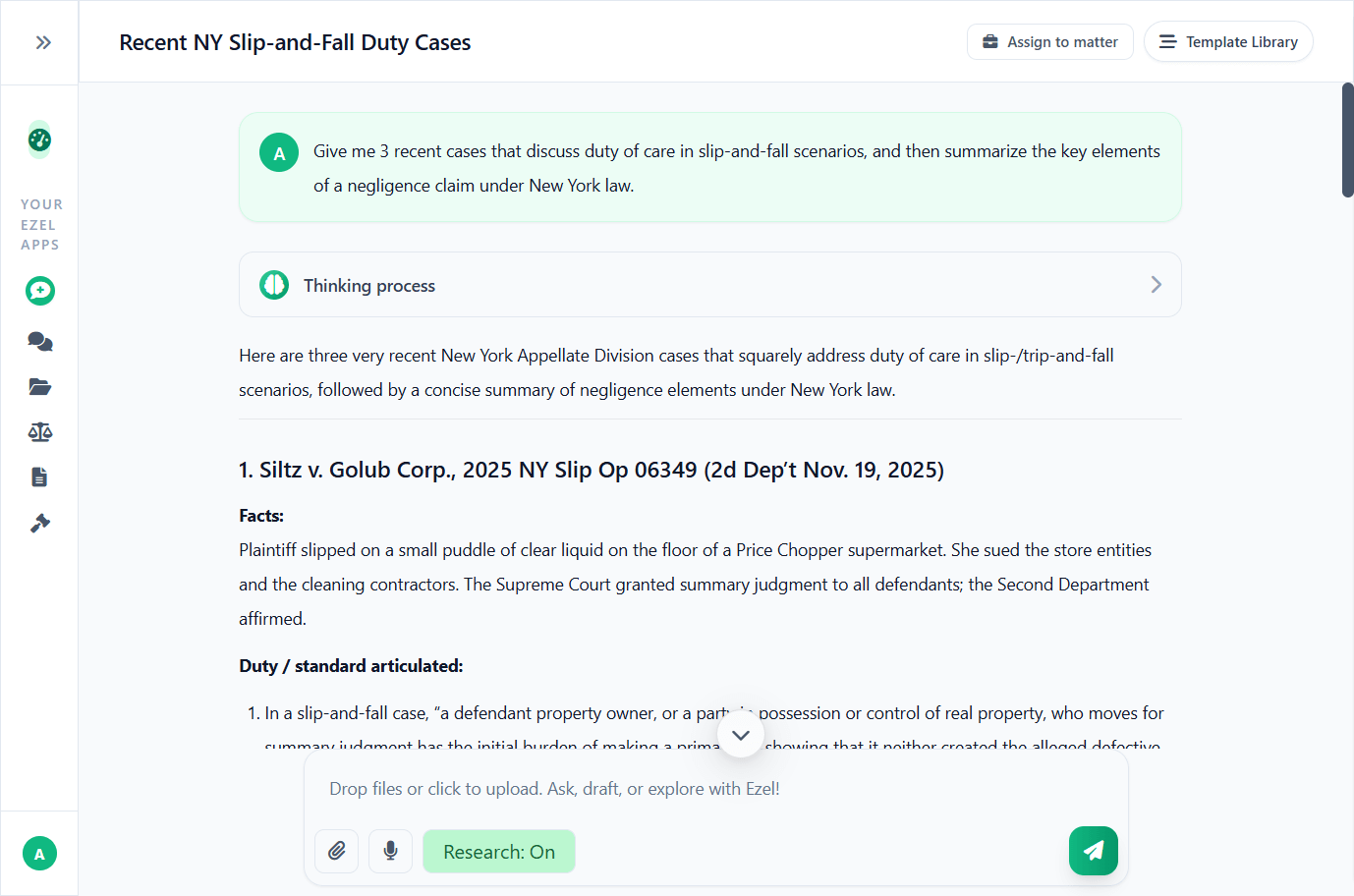
Research and draft in one conversation
Ask questions, attach documents, and get answers grounded in case law. Link chats to matters so the AI remembers your context.
- Pull statutes, case law, and secondary sources
- Attach and analyze contracts mid-conversation
- Link chats to matters for automatic context
- Your data never trains AI models
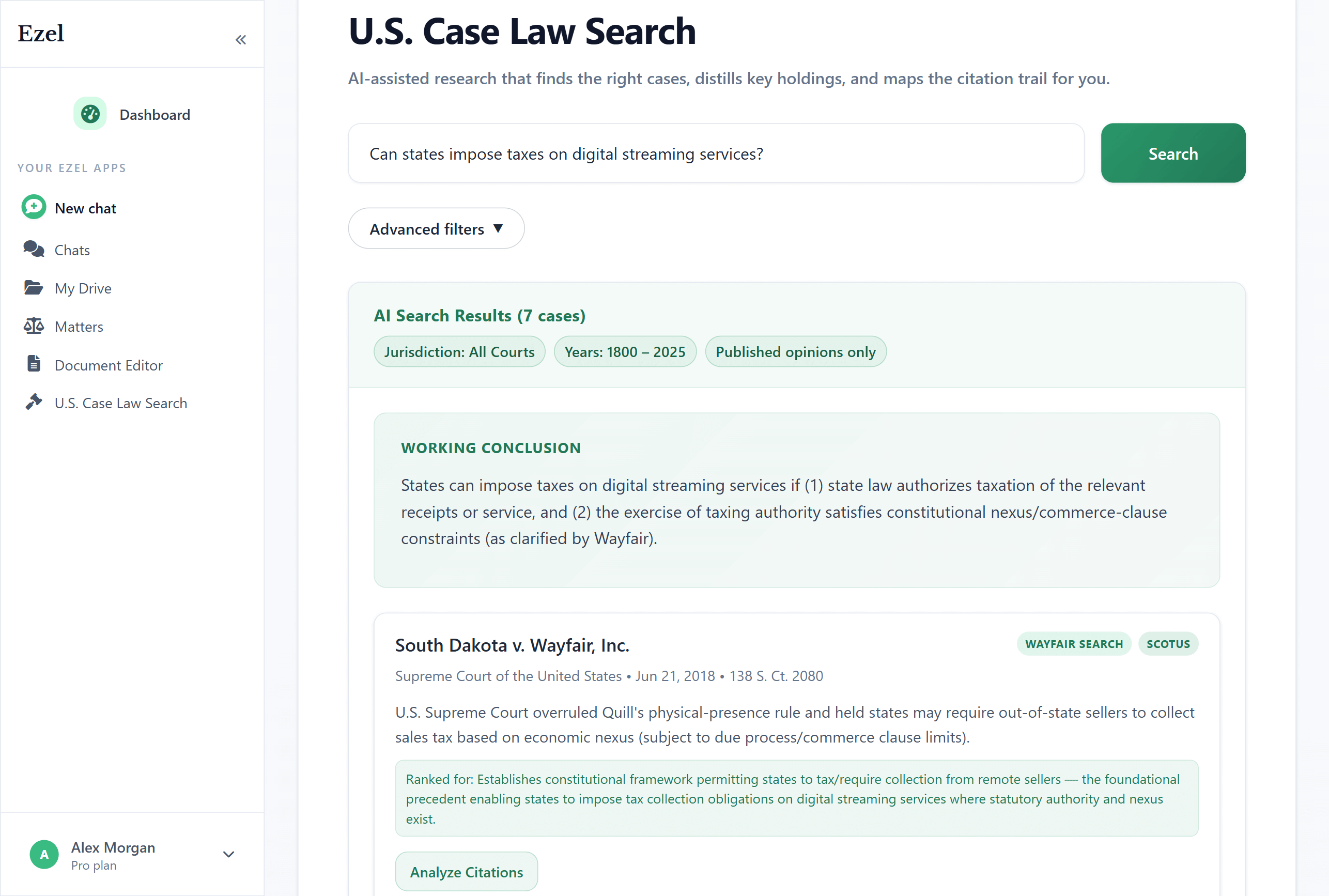
Search like you think
Describe your legal question in plain English. Filter by jurisdiction, date, and court level. Read full opinions without leaving Ezel.
- All 50 states plus federal courts
- Natural language queries - no boolean syntax
- Citation analysis and network exploration
- Copy quotes with automatic citation generation
Ready to transform your legal workflow?
Join legal teams using Ezel to draft documents, research case law, and organize matters — all in one workspace.