) before final execution.
JURISDICTION: Universal (with state securities law compliance table)
LAST UPDATED: 2026-02-26
-->
STOCK OPTION PLAN
PART I: PLAN OVERVIEW
1.1 Establishment of Plan
[________________________________] (the "Company") hereby establishes this Stock Option Plan (the "Plan"), effective as of [__/__/____] (the "Effective Date"), subject to the approval of the Company's stockholders within twelve (12) months before or after the date of adoption of the Plan by the Board of Directors.
1.2 Purpose
The purposes of this Plan are to:
(a) Attract, retain, and motivate talented employees, directors, and consultants by providing them with the opportunity to acquire an equity interest in the Company;
(b) Align the interests of such persons with those of the Company's stockholders by providing compensation opportunities tied to the value of the Company's common stock;
(c) Promote the success of the Company's business and enhance long-term stockholder value; and
(d) Provide flexibility to the Company in its ability to attract, reward, and retain the services of individuals critical to the Company's long-term success.
1.3 Types of Awards
The Plan authorizes the grant of two types of stock options:
(a) Incentive Stock Options ("ISOs") — Options that are intended to qualify as "incentive stock options" within the meaning of Section 422 of the Internal Revenue Code of 1986, as amended (the "Code"). ISOs may only be granted to Employees (as defined in Part II).
(b) Nonqualified Stock Options ("NSOs") — Options that are not intended to qualify as ISOs. NSOs may be granted to Employees, Directors, and Consultants.
1.4 Compliance Intent
The Plan is intended to comply with applicable provisions of the Code, including without limitation:
☐ Section 421 (General Rules for Certain Stock Options)
☐ Section 422 (Incentive Stock Options)
☐ Section 409A (Nonqualified Deferred Compensation)
☐ Section 83 (Property Transferred in Connection with Services)
The Plan is also intended to comply with applicable securities laws, including Rule 701 under the Securities Act of 1933, as amended, and applicable state blue sky laws.
PART II: DEFINITIONS
2.1 Definitions
Capitalized terms used in this Plan shall have the following meanings:
(a) "Administrator" means the Board, or the Committee, as applicable, in each case acting in its capacity as administrator of the Plan.
(b) "Applicable Law" means the requirements relating to the administration of equity-based awards under U.S. state corporate laws, U.S. federal and state securities laws, the Code, any stock exchange or quotation system on which the Company's Common Stock is listed or quoted, and the applicable laws of any foreign country or jurisdiction where Options have been or will be granted under the Plan.
(c) "Board" means the Board of Directors of the Company.
(d) "Cause" means, unless otherwise defined in an Award Agreement: (i) Participant's conviction of, or plea of guilty or nolo contendere to, a felony or crime involving moral turpitude; (ii) Participant's commission of an act of fraud, dishonesty, or gross misconduct against the Company; (iii) Participant's material breach of any written agreement with the Company or violation of Company policies; (iv) Participant's willful and continued failure to substantially perform Participant's duties; or (v) Participant's material violation of applicable law in connection with Participant's duties.
(e) "Change of Control" means:
(i) Any "person" or "group" (as such terms are used in Sections 13(d) and 14(d) of the Exchange Act) becomes the beneficial owner, directly or indirectly, of securities representing more than fifty percent (50%) of the combined voting power of the Company's then-outstanding voting securities;
(ii) During any period of twenty-four (24) consecutive months, individuals who at the beginning of such period constitute the Board (and any new director whose election was approved by a vote of at least a majority of the directors then in office who were directors at the beginning of such period) cease for any reason to constitute a majority of the Board;
(iii) Consummation of a merger, consolidation, or similar transaction involving the Company, unless immediately following such transaction more than fifty percent (50%) of the total voting power of the surviving entity is held by persons who were stockholders of the Company immediately prior to such transaction;
(iv) Consummation of the sale or disposition of all or substantially all of the Company's assets; or
(v) Approval by the Company's stockholders of a complete dissolution or liquidation of the Company.
(f) "Code" means the Internal Revenue Code of 1986, as amended from time to time, and the regulations and guidance promulgated thereunder.
(g) "Committee" means a committee of the Board appointed to administer the Plan, which shall consist of not fewer than two (2) members of the Board, each of whom shall be: (i) a "non-employee director" within the meaning of Rule 16b-3 under the Exchange Act; and (ii) an "independent director" under applicable stock exchange rules.
(h) "Common Stock" means the common stock of the Company, par value $[____] per share, or such other class or type of stock as may be substituted pursuant to Section 4.3.
(i) "Company" means [________________________________], a [________________________________] corporation, and any successor thereto.
(j) "Consultant" means any natural person (including an advisor) who provides bona fide services to the Company or any Subsidiary, provided that such services are not in connection with the offer or sale of securities in a capital-raising transaction and do not directly or indirectly promote or maintain a market for the Company's securities.
(k) "Continuous Service" means that the Participant's service with the Company or any Subsidiary, whether as an Employee, Director, or Consultant, is not interrupted or terminated. A change in the capacity in which the Participant renders service (e.g., from Employee to Consultant) shall not terminate Continuous Service, provided that there is no interruption.
(l) "Director" means a member of the Board who is not an Employee.
(m) "Disability" means, unless otherwise provided in an Award Agreement, that the Participant is unable to engage in any substantial gainful activity by reason of any medically determinable physical or mental impairment that can be expected to result in death or can be expected to last for a continuous period of not less than twelve (12) months, as determined by the Administrator.
(n) "Employee" means any person who is a common law employee of the Company or any Subsidiary. Service as a Director alone shall not be sufficient to constitute "employment" by the Company for purposes of the Plan.
(o) "Exchange Act" means the Securities Exchange Act of 1934, as amended, and the rules and regulations promulgated thereunder.
(p) "Exercise Price" means the per-share price at which a Participant may purchase shares of Common Stock upon exercise of an Option, as specified in the Award Agreement.
(q) "Fair Market Value" means, as of any date:
(i) If the Common Stock is listed on a national securities exchange, the closing sales price of a share of Common Stock as reported on the principal exchange on which such shares are listed on the date of determination (or, if no sales were reported on such date, the last date on which sales were reported);
(ii) If the Common Stock is regularly quoted by a recognized securities dealer but selling prices are not reported, the mean between the high bid and low asked prices for the Common Stock on the date of determination; or
(iii) In the absence of an established market for the Common Stock, the value determined in good faith by the Administrator, consistent with the requirements of Section 409A of the Code.
Practice Note (Section 409A Valuation). For private companies, the determination of Fair Market Value must satisfy one of the valuation methods under Treasury Regulation § 1.409A-1(b)(5)(iv), commonly referred to as a "409A valuation" or "independent appraisal." The safe harbor methods include: (A) an independent appraisal within 12 months of the grant date; (B) a formula-based valuation; or (C) a reasonable valuation method for start-up companies (the "illiquid start-up" safe harbor).
(r) "ISO" means an Incentive Stock Option, as defined in Section 1.3(a).
(s) "NSO" means a Nonqualified Stock Option, as defined in Section 1.3(b).
(t) "Option" means an ISO or NSO granted under the Plan.
(u) "Option Agreement" or "Award Agreement" means a written or electronic agreement between the Company and a Participant evidencing the terms and conditions of an individual Option grant, which shall be subject to and consistent with the terms and conditions of the Plan.
(v) "Participant" means any eligible individual who has been granted an Option under the Plan.
(w) "Securities Act" means the Securities Act of 1933, as amended, and the rules and regulations promulgated thereunder.
(x) "Subsidiary" means any corporation (other than the Company) in an unbroken chain of corporations beginning with the Company, if each corporation (other than the last corporation in the chain) owns stock possessing fifty percent (50%) or more of the total combined voting power of all classes of stock in one of the other corporations in the chain. For ISOs, "Subsidiary" has the meaning set forth in Section 424(f) of the Code.
(y) "Ten Percent Stockholder" means a Participant who, at the time of grant, owns stock possessing more than ten percent (10%) of the total combined voting power of all classes of stock of the Company or any Subsidiary, as determined in accordance with Section 422(b)(6) of the Code.
PART III: ADMINISTRATION
3.1 Administrator
The Plan shall be administered by the Administrator. The Board may designate the Committee to administer the Plan or may administer the Plan directly.
3.2 Powers of the Administrator
Subject to the provisions of the Plan and Applicable Law, the Administrator shall have the full power and authority to:
(a) Determine the persons to whom Options shall be granted;
(b) Determine the number of shares of Common Stock subject to each Option;
(c) Determine the Exercise Price, vesting schedule, and other terms and conditions of each Option, subject to the provisions of the Plan;
(d) Approve forms of Award Agreements;
(e) Determine whether an Option shall be designated as an ISO or NSO;
(f) Construe, interpret, and apply the terms of the Plan and any Award Agreement;
(g) Prescribe, amend, and rescind rules and procedures relating to the Plan;
(h) Modify or amend any outstanding Option (subject to Section 10.1 limitations);
(i) Authorize any person to execute any instrument required to effectuate the grant of an Option;
(j) Determine whether and the extent to which adjustments are required pursuant to Section 4.3; and
(k) Make all other determinations deemed necessary or advisable for the administration of the Plan.
3.3 Delegation
To the extent permitted by Applicable Law, the Administrator may delegate to one or more officers of the Company the authority to grant Options to Participants who are not subject to Section 16 of the Exchange Act or "covered employees" under Section 162(m) of the Code, subject to the following limitations:
(a) The Administrator shall fix the maximum number of shares subject to Options that any such officer may grant;
(b) Each such grant shall be subject to the terms and conditions of the Plan; and
(c) Each such officer shall report periodically to the Administrator regarding the nature and scope of Options granted.
3.4 Effect of Administrator's Decision
All determinations, interpretations, and decisions made by the Administrator shall be final, conclusive, and binding on all Participants and other persons claiming rights under the Plan. No member of the Board or Committee shall be personally liable for any action, determination, or interpretation taken or made in good faith with respect to the Plan.
PART IV: SHARES SUBJECT TO THE PLAN
4.1 Authorized Shares
(a) The maximum aggregate number of shares of Common Stock that may be issued pursuant to Options granted under the Plan is [________________________________] shares (the "Share Reserve").
(b) The maximum aggregate number of shares of Common Stock that may be issued pursuant to the exercise of ISOs granted under the Plan is [________________________________] shares.
(c) The maximum aggregate number of shares subject to Options granted during any one (1) fiscal year to any one Participant shall not exceed [________________________________] shares.
4.2 Share Counting
(a) Returned Shares. If any Option expires, terminates, or is cancelled without having been exercised in full, the unissued shares subject to such Option shall again become available for issuance under the Plan.
(b) Shares Not Returned. Shares of Common Stock that are: (i) tendered in payment of the Exercise Price; (ii) withheld for tax withholding purposes; or (iii) repurchased on the open market with Option exercise proceeds, shall NOT be returned to the Share Reserve.
(c) Substitute Awards. Options granted in assumption of, or in substitution for, outstanding awards previously granted by an entity acquired by the Company shall not reduce the Share Reserve.
4.3 Adjustments for Capital Changes
(a) Mandatory Adjustments. In the event of any stock split, reverse stock split, stock dividend, recapitalization, combination or reclassification of shares, spin-off, or other similar change in the capital structure of the Company, the Administrator shall make equitable and proportionate adjustments to:
(i) The number and class of shares subject to the Plan and the Share Reserve;
(ii) The number, class, and Exercise Price of shares subject to each outstanding Option; and
(iii) The per-Participant limits on Option grants.
(b) No Fractional Shares. No fractional shares shall be issued upon any such adjustment. The Administrator may, in its discretion, round down to the nearest whole share or make a cash payment in lieu of any fractional share.
(c) Section 409A Compliance. Any adjustment shall be made in a manner consistent with the requirements of Section 409A of the Code, and, with respect to ISOs, Section 424(a) of the Code.
PART V: ELIGIBILITY
5.1 Eligible Participants
(a) ISOs. ISOs may be granted only to Employees of the Company or a Subsidiary (as defined in Section 424(f) of the Code). No ISO may be granted to a Consultant or a Director who is not also an Employee.
(b) NSOs. NSOs may be granted to Employees, Directors, and Consultants.
5.2 Ten Percent Stockholder Limitation (ISOs)
An ISO may be granted to a Ten Percent Stockholder only if:
(a) The Exercise Price is at least one hundred ten percent (110%) of the Fair Market Value of a share of Common Stock on the date of grant; and
(b) The ISO is not exercisable after the expiration of five (5) years from the date of grant.
(Reference: 26 U.S.C. § 422(c)(5))
5.3 ISO Annual Limit
To the extent that the aggregate Fair Market Value (determined as of the date of grant) of shares of Common Stock with respect to which ISOs are exercisable for the first time by any Participant during any calendar year (under all plans of the Company and its Subsidiaries) exceeds $100,000, such excess Options shall be treated as NSOs.
(Reference: 26 U.S.C. § 422(d))
PART VI: OPTION TERMS AND CONDITIONS
6.1 Exercise Price
(a) Minimum Exercise Price. The Exercise Price per share of Common Stock subject to each Option shall be determined by the Administrator but shall not be less than one hundred percent (100%) of the Fair Market Value of a share of Common Stock on the date of grant.
(b) ISO Minimum for Ten Percent Stockholders. For ISOs granted to a Ten Percent Stockholder, the Exercise Price shall not be less than one hundred ten percent (110%) of the Fair Market Value on the date of grant.
(c) No Repricing. The Exercise Price of an outstanding Option may not be reduced (whether by amendment, cancellation and re-grant, exchange, or any other means) without the approval of the Company's stockholders.
Practice Note (Section 409A). Setting an Exercise Price below Fair Market Value on the date of grant will cause an NSO to be subject to Section 409A of the Code, potentially resulting in a 20% additional tax plus interest. A proper Fair Market Value determination is essential. See Treasury Regulation § 1.409A-1(b)(5)(iv) for valuation safe harbors.
6.2 Vesting Schedule
(a) General Vesting. Each Option shall vest and become exercisable in accordance with the vesting schedule set forth in the applicable Award Agreement. Common vesting schedules include:
☐ Four-Year with One-Year Cliff: [____]% of Option shares vest on the first anniversary of the Vesting Commencement Date, and [____]/[____] of the total Option shares vest monthly (or quarterly) thereafter over the remaining [____] years.
☐ Four-Year Monthly Vesting: 1/48th of the Option shares vest monthly following the Vesting Commencement Date.
☐ Three-Year Annual Vesting: 1/3 of the Option shares vest on each of the first, second, and third anniversaries of the Vesting Commencement Date.
☐ Performance-Based Vesting: Option shares vest upon achievement of specified performance milestones as set forth in the Award Agreement.
☐ Custom Vesting Schedule: As specified in the Award Agreement: [________________________________]
(b) Vesting Commencement Date. The Vesting Commencement Date shall be specified in the Award Agreement and shall typically be the date of the Participant's commencement of Continuous Service or the date of grant, as determined by the Administrator.
6.3 Option Term
(a) Maximum Term. No Option shall be exercisable after the expiration of ten (10) years from the date of grant (or five (5) years from the date of grant in the case of an ISO granted to a Ten Percent Stockholder).
(b) Specified Term. Each Award Agreement shall specify the term of the Option, which shall not exceed the maximum term set forth in this Section 6.3.
6.4 Termination of Continuous Service
(a) General Rule. Upon termination of a Participant's Continuous Service for any reason other than Cause, death, or Disability, the Participant may exercise any vested and unexercised Options for a period of [____] days (but not to exceed ninety (90) days for ISOs to maintain ISO treatment) following the date of termination.
(b) Termination for Cause. If a Participant's Continuous Service is terminated for Cause, all Options (whether vested or unvested) shall immediately terminate and be forfeited as of the date of such termination.
(c) Death. If a Participant dies during Continuous Service, the Participant's estate or the person(s) who acquired the right to exercise the Option by bequest or inheritance may exercise any vested Options for a period of [____] months following the date of death (not to exceed twelve (12) months for ISOs).
(d) Disability. If a Participant's Continuous Service terminates due to Disability, the Participant may exercise any vested Options for a period of [____] months following the date of termination (not to exceed twelve (12) months for ISOs).
(e) Unvested Options. Upon termination of Continuous Service for any reason, all unvested Options shall immediately terminate and be forfeited, unless otherwise provided in the Award Agreement or determined by the Administrator.
6.5 ISO-Specific Requirements
To qualify as an ISO under Section 422 of the Code, an Option must satisfy each of the following requirements:
(a) The Option must be granted pursuant to a plan approved by the stockholders within twelve (12) months before or after adoption (26 U.S.C. § 422(b)(1));
(b) The Option must be granted within ten (10) years from the earlier of the date the Plan was adopted or approved by stockholders (26 U.S.C. § 422(b)(2));
(c) The Option must be exercisable only by the Participant during his or her lifetime (26 U.S.C. § 422(b)(5));
(d) The Exercise Price must be at least 100% of Fair Market Value on the grant date (110% for Ten Percent Stockholders) (26 U.S.C. § 422(b)(4), (c)(5));
(e) The Option term must not exceed ten (10) years (five (5) years for Ten Percent Stockholders) (26 U.S.C. § 422(b)(3), (c)(5));
(f) The $100,000 annual limitation must be observed (26 U.S.C. § 422(d)); and
(g) The Option must not be transferable other than by will or the laws of descent and distribution (26 U.S.C. § 422(b)(5)).
6.6 Holding Period for ISO Shares (Disqualifying Disposition)
To receive favorable ISO tax treatment, a Participant must not dispose of shares acquired upon exercise of an ISO within: (a) two (2) years from the date the ISO was granted; or (b) one (1) year from the date the shares were transferred to the Participant upon exercise. A disposition that violates either holding period is a "disqualifying disposition" and results in ordinary income recognition under 26 U.S.C. § 421(b).
PART VII: EXERCISE PROCEDURES AND PAYMENT METHODS
7.1 Notice of Exercise
An Option may be exercised by delivery to the Company of a written or electronic notice of exercise specifying:
(a) The identity of the Participant;
(b) The number of shares of Common Stock with respect to which the Option is being exercised;
(c) The Exercise Price;
(d) The payment method elected; and
(e) Any representations required by the Company regarding investment intent or securities law matters.
7.2 Permitted Payment Methods
The Exercise Price shall be payable to the Company in full at the time of exercise by any of the following methods, or a combination thereof, as permitted by the Administrator:
☐ (a) Cash. Payment in U.S. dollars by check, wire transfer, or other form of cash payment acceptable to the Company.
☐ (b) Previously Owned Shares. Delivery of shares of Common Stock already owned by the Participant having a Fair Market Value on the date of exercise equal to the aggregate Exercise Price, provided such shares have been held for such period of time as may be required to avoid adverse accounting consequences.
☐ (c) Cashless Exercise (Broker-Assisted). Delivery of a properly executed exercise notice together with irrevocable instructions to a brokerage firm to sell a sufficient number of shares to cover the Exercise Price and applicable taxes, with the net proceeds delivered to the Company.
☐ (d) Net Exercise. Surrender to the Company of a number of shares of Common Stock otherwise issuable upon exercise of the Option having an aggregate Fair Market Value equal to the Exercise Price, resulting in the issuance of a net number of shares. Note: Net exercise may have adverse tax consequences for ISOs.
☐ (e) Promissory Note. Delivery of a full-recourse promissory note, subject to the restrictions of the Sarbanes-Oxley Act of 2002, Section 402 (which prohibits personal loans to directors and executive officers of public companies).
☐ (f) Other Methods. Any other method approved by the Administrator consistent with Applicable Law.
7.3 Tax Withholding
(a) Obligation. As a condition to the exercise of any Option and the issuance of shares, the Company shall be entitled to require the Participant to satisfy applicable federal, state, local, and foreign tax withholding obligations.
(b) Methods of Withholding. The Administrator may, in its discretion, permit the Participant to satisfy withholding obligations by:
(i) Cash payment to the Company;
(ii) Having the Company withhold shares of Common Stock otherwise issuable upon exercise;
(iii) Delivering previously owned shares; or
(iv) Any combination of the foregoing.
7.4 Issuance of Shares
Upon exercise of an Option in accordance with this Part VII, the Company shall issue to the Participant the number of shares of Common Stock subject to the exercised Option (less any shares withheld for tax purposes), subject to Applicable Law. Shares may be issued in book-entry form or by delivery of stock certificates, as determined by the Company.
PART VIII: CHANGE OF CONTROL PROVISIONS
8.1 Treatment of Options Upon Change of Control
In the event of a Change of Control, outstanding Options shall be treated as determined by the Administrator, which may include one or more of the following:
(a) Assumption or Substitution. Options may be assumed, continued, or substituted by the successor corporation (or a parent or subsidiary thereof). If Options are assumed or substituted, vesting shall continue in accordance with the original vesting schedule unless otherwise provided.
(b) Accelerated Vesting — Single Trigger. ☐ If elected: Upon a Change of Control, all outstanding unvested Options shall immediately vest and become exercisable in full.
(c) Accelerated Vesting — Double Trigger. ☐ If elected: If a Participant's Continuous Service is terminated by the successor corporation without Cause, or the Participant resigns for Good Reason (as defined below), within [____] months following a Change of Control, all outstanding unvested Options held by such Participant shall immediately vest and become exercisable in full.
(d) Cash-Out. The Administrator may cancel outstanding Options and pay each Participant an amount in cash equal to the excess, if any, of the per-share consideration received by the Company's stockholders in the Change of Control transaction over the Exercise Price, multiplied by the number of shares subject to the Option (both vested and unvested, if applicable).
(e) Termination of Underwater Options. The Administrator may cancel any Options for which the Exercise Price equals or exceeds the per-share consideration in the Change of Control transaction, without payment of any consideration.
8.2 Good Reason (for Double Trigger Provisions)
"Good Reason" means, without the Participant's written consent: (i) a material diminution in the Participant's base compensation; (ii) a material diminution in the Participant's authority, duties, or responsibilities; (iii) a material change in the geographic location at which the Participant must perform services (generally, a relocation of more than [____] miles); or (iv) any other action or inaction that constitutes a material breach by the successor corporation of any agreement with the Participant.
8.3 Administrator Discretion
The Administrator shall have sole discretion in determining the treatment of Options upon a Change of Control, subject to the terms of the Plan and any individual Award Agreements. Any such determination shall be made in a manner consistent with Section 409A of the Code.
PART IX: TAX PROVISIONS
9.1 Incentive Stock Options — Tax Treatment (IRC § 421, § 422)
(a) Grant. No taxable income is recognized by the Participant upon the grant of an ISO.
(b) Exercise. No regular income tax is recognized upon the exercise of an ISO. However, the excess of the Fair Market Value of the shares acquired on exercise over the Exercise Price (the "spread") is an item of adjustment for purposes of the alternative minimum tax ("AMT") under Section 56(b)(3) of the Code.
(c) Qualifying Disposition. If the Participant holds the shares acquired upon exercise for at least two (2) years from the date of grant and one (1) year from the date of exercise, any gain upon disposition is treated as long-term capital gain.
(d) Disqualifying Disposition. If the shares are disposed of before the holding period requirements are met, the Participant recognizes ordinary income equal to the lesser of: (i) the excess of the Fair Market Value on the date of exercise over the Exercise Price; or (ii) the excess of the amount realized on disposition over the Exercise Price. Any additional gain is capital gain.
(e) No Deduction for Company (Qualifying Disposition). The Company receives no compensation deduction for qualifying dispositions. For disqualifying dispositions, the Company is entitled to a deduction equal to the amount of ordinary income recognized by the Participant.
9.2 Nonqualified Stock Options — Tax Treatment
(a) Grant. No taxable income is recognized upon the grant of an NSO (provided the NSO has no readily ascertainable fair market value at grant, which is typically the case for privately held companies).
(b) Exercise. Upon exercise of an NSO, the Participant recognizes ordinary income equal to the excess of the Fair Market Value of the shares on the date of exercise over the Exercise Price. This amount is subject to income tax withholding and FICA/Medicare taxes.
(c) Company Deduction. The Company is entitled to a compensation deduction equal to the amount of ordinary income recognized by the Participant upon exercise, subject to any applicable limitations under Section 162(m) of the Code.
(d) Sale of Shares. Upon subsequent sale of the shares, the Participant recognizes capital gain or loss measured from the Fair Market Value of the shares on the exercise date.
9.3 Section 409A Compliance
(a) General. The Plan is intended to be exempt from or comply with the requirements of Section 409A of the Code. Options granted under the Plan shall not include any feature for the deferral of compensation other than the deferral of recognition of income until the later of exercise or disposition of the Option.
(b) Exercise Price Requirement. The Exercise Price of each NSO must be at least equal to the Fair Market Value of a share of Common Stock on the date of grant to avoid treatment as "deferred compensation" subject to Section 409A.
(c) Penalties for Noncompliance. If an NSO is subject to Section 409A and fails to comply with its requirements, the Participant may be subject to: (i) immediate inclusion of the deferred amount in gross income; (ii) an additional 20% federal income tax; and (iii) a premium interest tax computed based on the underpayment rate plus one percentage point.
(d) No Guarantee. Notwithstanding the Company's intent, the Company makes no representation or warranty that any Option will be exempt from or comply with Section 409A. Each Participant is solely responsible for the tax consequences of Options granted under the Plan.
9.4 Section 83(b) Election
(a) Applicability. If an Option is exercised before the shares are fully vested (i.e., the shares are subject to a substantial risk of forfeiture), the Participant may elect, under Section 83(b) of the Code, to include in gross income the Fair Market Value of the shares at the time of exercise (less any amount paid) for the taxable year in which the shares are transferred.
(b) Filing Requirement. A Section 83(b) election must be filed with the Internal Revenue Service within thirty (30) days after the date the shares are transferred to the Participant. The election is made using IRS Form 15620 or a written statement meeting the requirements of Treasury Regulation § 1.83-2(e). A copy must be provided to the Company.
(c) Effect. If a valid Section 83(b) election is made, subsequent appreciation in the value of the shares will be taxed as capital gain (rather than ordinary income) upon disposition, provided the applicable holding period is satisfied.
(d) Irrevocability. A Section 83(b) election, once made, is irrevocable except with the consent of the Internal Revenue Service.
(e) Company Notice. The Company shall inform Participants of the availability of a Section 83(b) election whenever Options are exercised for unvested shares.
PART X: AMENDMENT AND TERMINATION
10.1 Amendment
(a) Board Authority. The Board may amend, alter, suspend, or terminate the Plan at any time, provided that no amendment shall be made without stockholder approval if such approval is required by Applicable Law or applicable stock exchange rules.
(b) Stockholder Approval Required. Stockholder approval is required for any amendment that:
(i) Increases the total number of shares available under the Plan (other than through adjustments under Section 4.3);
(ii) Reduces the Exercise Price of any outstanding Option or cancels and re-grants Options at a lower Exercise Price (repricing);
(iii) Expands the class of individuals eligible to receive ISOs; or
(iv) Otherwise requires stockholder approval under Applicable Law.
(c) No Impairment. No amendment, suspension, or termination of the Plan shall materially impair the rights of any Participant under any outstanding Option without the written consent of such Participant, unless required by Applicable Law.
10.2 Termination
(a) Plan Term. The Plan shall terminate on the earliest of: (i) the date set by the Board pursuant to this Section 10.2; (ii) the date on which all shares available under the Plan have been issued; or (iii) the tenth (10th) anniversary of the Effective Date.
(b) Effect of Termination. Termination of the Plan shall not affect the terms and conditions of any outstanding Option previously granted under the Plan. All outstanding Options shall continue in accordance with their terms until exercised, expired, or otherwise terminated.
(c) ISO Grant Deadline. No ISO may be granted under the Plan after the tenth (10th) anniversary of the earlier of: (i) the date the Plan was adopted by the Board; or (ii) the date the Plan was approved by the stockholders. (Reference: 26 U.S.C. § 422(b)(2))
PART XI: TRANSFER RESTRICTIONS AND SECURITIES LAW COMPLIANCE
11.1 Non-Transferability
(a) General Rule. Options shall not be transferable by a Participant other than by will or by the laws of descent and distribution, and shall be exercisable during the lifetime of the Participant only by the Participant.
(b) ISO Restriction. ISOs may not be transferred other than by will or the laws of descent and distribution. This is a statutory requirement under 26 U.S.C. § 422(b)(5).
(c) Limited NSO Transferability. The Administrator may, in its discretion, permit the transfer of NSOs to a Participant's family members, trusts for the benefit of family members, or other entities approved by the Administrator, provided that any such transfer is without consideration and the transferee is subject to all terms and conditions applicable to the Option.
11.2 Securities Law Compliance
(a) Registration or Exemption. The Company shall not be obligated to issue any shares of Common Stock upon exercise of an Option unless the issuance and delivery of such shares comply with all Applicable Law, including the Securities Act, applicable state securities laws, and the requirements of any stock exchange on which the Common Stock may be listed.
(b) Investment Representations. As a condition to the exercise of any Option, the Company may require the Participant to make representations and warranties regarding the Participant's investment intent and the absence of a view to distribution of such shares in violation of the Securities Act.
(c) Legends. Shares issued upon exercise of Options may bear such restrictive legends as the Company deems necessary or advisable, including legends relating to transfer restrictions under applicable securities laws, lock-up agreements, and Company repurchase rights.
(d) Rule 701. The Company intends that Options granted under the Plan be exempt from registration under the Securities Act pursuant to Rule 701. The Company shall provide each Participant with a copy of the Plan and shall comply with the disclosure requirements of Rule 701(e) if the aggregate sales price or amount of securities sold during any consecutive 12-month period exceeds $10 million.
11.3 State Securities Law Compliance Table
The following table provides a general overview of state securities law (blue sky) exemptions for compensatory stock option plans. Counsel must verify current requirements for each applicable state.
| State | Exemption | Key Requirements | Statute/Rule |
|---|---|---|---|
| California | Rule 701 (federal); Cal. Corp. Code § 25102(o) | Notice filing (Form 25102(o)); applies to compensatory benefit plans; limited to employees, directors, consultants | Cal. Corp. Code § 25102(o); 10 CCR § 260.140.42 |
| New York | Martin Act exemption; Rule 701 (federal) | NY does not require registration for compensatory plans if exempt under federal law; attorney opinion may be needed | N.Y. Gen. Bus. Law Art. 23-A |
| Texas | Rule 139.16 (TX Securities Act) | Exemption for compensatory benefit plans; notice filing may be required | Tex. Rev. Civ. Stat. Ann. Art. 581-5.T |
| Delaware | DE Securities Act § 73-207(b)(10) | Exemption for offers to existing security holders; compensatory plan exemption | 6 Del. C. § 73-207 |
| Florida | Fla. Stat. § 517.061(11) | Exemption for employee benefit plans; no filing required for qualifying plans | Fla. Stat. § 517.061(11) |
| Massachusetts | 950 CMR 14.402(B)(4)(j) | Exemption for compensatory plans; conditions apply | 950 CMR 14.402 |
| Illinois | 815 ILCS 5/4(G) | Exemption for employee stock options issued under qualifying plans | 815 ILCS 5/4 |
| Washington | WAC 460-44A-504 | Notice filing for compensatory plans; applies to Rule 701-exempt offerings | RCW 21.20.310 |
General Practice Note: Most states provide exemptions from state securities registration for stock options granted under compensatory benefit plans to employees, directors, and consultants. However, requirements vary significantly. Some states require notice filings or have dollar-amount thresholds. Counsel should review the applicable state blue sky law for each state in which Participants reside.
PART XII: MISCELLANEOUS PROVISIONS
12.1 No Employment Rights
Nothing in the Plan or any Award Agreement shall confer upon any Participant the right to continue in the employment or service of the Company or any Subsidiary, or shall interfere with or restrict the rights of the Company or any Subsidiary to terminate a Participant's employment or service at any time, with or without cause.
12.2 Unfunded Plan
The Plan is intended to be an "unfunded" plan for incentive compensation. With respect to any payments or deliveries of shares not yet made to a Participant under the Plan, nothing contained in the Plan or any Award Agreement shall give the Participant any rights that are greater than those of a general unsecured creditor of the Company.
12.3 Governing Law
This Plan shall be governed by and construed in accordance with the laws of the State of [________________________________], without giving effect to the principles of conflicts of law thereof.
12.4 Severability
If any provision of this Plan is held to be illegal, invalid, or unenforceable, such provision shall be severed and the remaining provisions shall continue in full force and effect.
12.5 Clawback Policy
All Options and shares acquired under the Plan shall be subject to any compensation clawback or recoupment policy adopted by the Company or required by Applicable Law, including Section 10D of the Exchange Act and any applicable stock exchange listing rules.
12.6 Section 162(m) Considerations
The Plan is not intended to satisfy the requirements of the performance-based compensation exception under Section 162(m) of the Code, which was largely eliminated by the Tax Cuts and Jobs Act of 2017. Compensation in excess of $1,000,000 paid to "covered employees" (as defined in Section 162(m)) may not be deductible by the Company.
12.7 Lock-Up Agreement
As a condition to the exercise of any Option, the Company may require the Participant to agree not to sell, transfer, or otherwise dispose of shares acquired upon exercise for such period of time following an initial public offering as may be requested by the Company's underwriters (not to exceed 180 days).
12.8 Electronic Delivery and Participation
The Company may, in its sole discretion, deliver documents related to the Plan by electronic means. By accepting an Option under the Plan, the Participant consents to receive such documents by electronic delivery.
PART XIII: PLAN ADOPTION AND APPROVAL
13.1 Board Adoption
This Plan was adopted by the Board of Directors of the Company on [__/__/____].
Board Resolution:
RESOLVED, that the Stock Option Plan, as presented to the Board, is hereby adopted and approved, subject to stockholder approval within twelve (12) months.
RESOLVED FURTHER, that the officers of the Company are authorized and directed to take all actions necessary to implement the Plan, including the filing of any required securities law notices and the preparation of Award Agreements.
13.2 Stockholder Approval
This Plan was approved by the stockholders of the Company on [__/__/____], by a vote of:
☐ Shares in favor: [________________________________]
☐ Shares against: [________________________________]
☐ Shares abstaining: [________________________________]
PART XIV: SIGNATURES
IN WITNESS WHEREOF, the Company has caused this Stock Option Plan to be executed by its duly authorized officer.
COMPANY:
Name of Company: [________________________________]
By: [________________________________]
Name: [________________________________]
Title: [________________________________]
Date: [__/__/____]
EXHIBIT A — FORM OF INCENTIVE STOCK OPTION AGREEMENT
INCENTIVE STOCK OPTION AGREEMENT
This Incentive Stock Option Agreement ("Agreement") is entered into as of [__/__/____] (the "Grant Date"), between [________________________________] (the "Company") and [________________________________] (the "Participant").
1. Grant of Option. The Company hereby grants to the Participant an Incentive Stock Option (the "Option") to purchase [________________________________] shares of Common Stock at an Exercise Price of $[____] per share, subject to the terms and conditions of the Plan and this Agreement.
2. Option Type. ☐ Incentive Stock Option (ISO) under Section 422 of the Code.
3. Vesting Schedule.
☐ Four-Year with One-Year Cliff: [____]% of Option shares vest on [__/__/____], and [____]/[____] of the total Option shares vest monthly thereafter.
☐ Other: [________________________________]
4. Expiration Date. This Option expires on [__/__/____] (not to exceed ten (10) years from the Grant Date, or five (5) years for Ten Percent Stockholders).
5. Exercise. This Option may be exercised in accordance with Part VII of the Plan.
6. Termination of Service. Upon termination of Continuous Service, the terms of Section 6.4 of the Plan shall apply.
7. ISO Holding Period. Participant acknowledges that to receive favorable ISO tax treatment, the shares must be held for at least two (2) years from the Grant Date and one (1) year from the exercise date.
8. Acknowledgment. Participant acknowledges receipt of a copy of the Plan and agrees to be bound by its terms.
COMPANY:
By: [________________________________]
Title: [________________________________]
Date: [__/__/____]
PARTICIPANT:
Name: [________________________________]
Signature: ______________________________
Date: [__/__/____]
EXHIBIT B — FORM OF NONQUALIFIED STOCK OPTION AGREEMENT
NONQUALIFIED STOCK OPTION AGREEMENT
This Nonqualified Stock Option Agreement ("Agreement") is entered into as of [__/__/____] (the "Grant Date"), between [________________________________] (the "Company") and [________________________________] (the "Participant").
1. Grant of Option. The Company hereby grants to the Participant a Nonqualified Stock Option (the "Option") to purchase [________________________________] shares of Common Stock at an Exercise Price of $[____] per share, subject to the terms and conditions of the Plan and this Agreement.
2. Option Type. ☐ Nonqualified Stock Option (NSO).
3. Vesting Schedule.
☐ Four-Year with One-Year Cliff: [____]% of Option shares vest on [__/__/____], and [____]/[____] of the total Option shares vest monthly thereafter.
☐ Other: [________________________________]
4. Expiration Date. This Option expires on [__/__/____] (not to exceed ten (10) years from the Grant Date).
5. Exercise. This Option may be exercised in accordance with Part VII of the Plan.
6. Termination of Service. Upon termination of Continuous Service, the terms of Section 6.4 of the Plan shall apply.
7. Tax Withholding. Participant acknowledges that ordinary income will be recognized upon exercise and that applicable withholding taxes must be satisfied.
8. Section 409A. This Option is intended to be exempt from Section 409A of the Code as a stock right not providing for the deferral of compensation.
9. Acknowledgment. Participant acknowledges receipt of a copy of the Plan and agrees to be bound by its terms.
COMPANY:
By: [________________________________]
Title: [________________________________]
Date: [__/__/____]
PARTICIPANT:
Name: [________________________________]
Signature: ______________________________
Date: [__/__/____]
EXHIBIT C — FORM OF NOTICE OF EXERCISE
NOTICE OF EXERCISE
To: [________________________________] (the "Company")
From: [________________________________] (the "Participant")
Date: [__/__/____]
I hereby give notice that I elect to exercise Options granted to me under the Company's Stock Option Plan, as follows:
| Item | Detail |
|---|---|
| Grant Date | [__/__/____] |
| Number of Shares Being Exercised | [________________________________] |
| Exercise Price per Share | $[____] |
| Total Exercise Price | $[________________________________] |
| Type of Option | ☐ ISO ☐ NSO |
Payment Method:
☐ Cash/Check enclosed in the amount of $[________________________________]
☐ Wire transfer (confirmation attached)
☐ Cashless exercise via broker: [________________________________]
☐ Net exercise (surrender of shares)
☐ Previously owned shares (certificate(s) enclosed)
☐ Other: [________________________________]
Tax Withholding Method:
☐ Cash payment
☐ Share withholding
☐ Broker-assisted sale
Representations. I represent that the shares are being acquired for my own account, for investment purposes, and not with a view to distribution in violation of the Securities Act of 1933.
Section 83(b) Election (if applicable):
☐ I intend to file a Section 83(b) election within 30 days
☐ I do not intend to file a Section 83(b) election
☐ Not applicable (shares are fully vested)
Signature: ______________________________
Name: [________________________________]
Date: [__/__/____]
Sources and References
- 26 U.S.C. § 421 — General Rules for Certain Stock Options (https://www.law.cornell.edu/uscode/text/26/421)
- 26 U.S.C. § 422 — Incentive Stock Options (https://www.law.cornell.edu/uscode/text/26/422)
- 26 U.S.C. § 409A — Nonqualified Deferred Compensation Plans (https://www.law.cornell.edu/uscode/text/26/409A)
- 26 U.S.C. § 83 — Property Transferred in Connection with Performance of Services (https://www.law.cornell.edu/uscode/text/26/83)
- 26 C.F.R. § 1.422-2 — Incentive Stock Options Defined (https://www.law.cornell.edu/cfr/text/26/1.422-2)
- 26 C.F.R. § 1.409A-1 — Definitions and Coverage (https://www.ecfr.gov/current/title-26/chapter-I/subchapter-A/part-1/subject-group-ECFR2b7577e2af5412b/)
- IRS Topic No. 427 — Stock Options (https://www.irs.gov/taxtopics/tc427)
- IRS Form 15620 — Section 83(b) Election (https://www.irs.gov/pub/irs-pdf/f15620.pdf)
- SEC Rule 701 — Exemption for Compensatory Benefit Plans (https://www.sec.gov/rules/final/33-7645.htm)
- Cooley GO — Section 83(b) Election Guide (https://www.cooleygo.com/what-is-a-section-83b-election/)
This template is provided for informational purposes only and does not constitute legal advice. It must be reviewed and customized by a qualified attorney and tax professional. Securities law compliance is required before any stock option grants. Do not use without professional legal and tax review. Prepared for ezel.ai legal template platform.
Do more with Ezel
This free template is just the beginning. See how Ezel helps legal teams draft, research, and collaborate faster.
AI that drafts while you watch
Tell the AI what you need and watch your document transform in real-time. No more copy-pasting between tools or manually formatting changes.
- Natural language commands: "Add a force majeure clause"
- Context-aware suggestions based on document type
- Real-time streaming shows edits as they happen
- Milestone tracking and version comparison
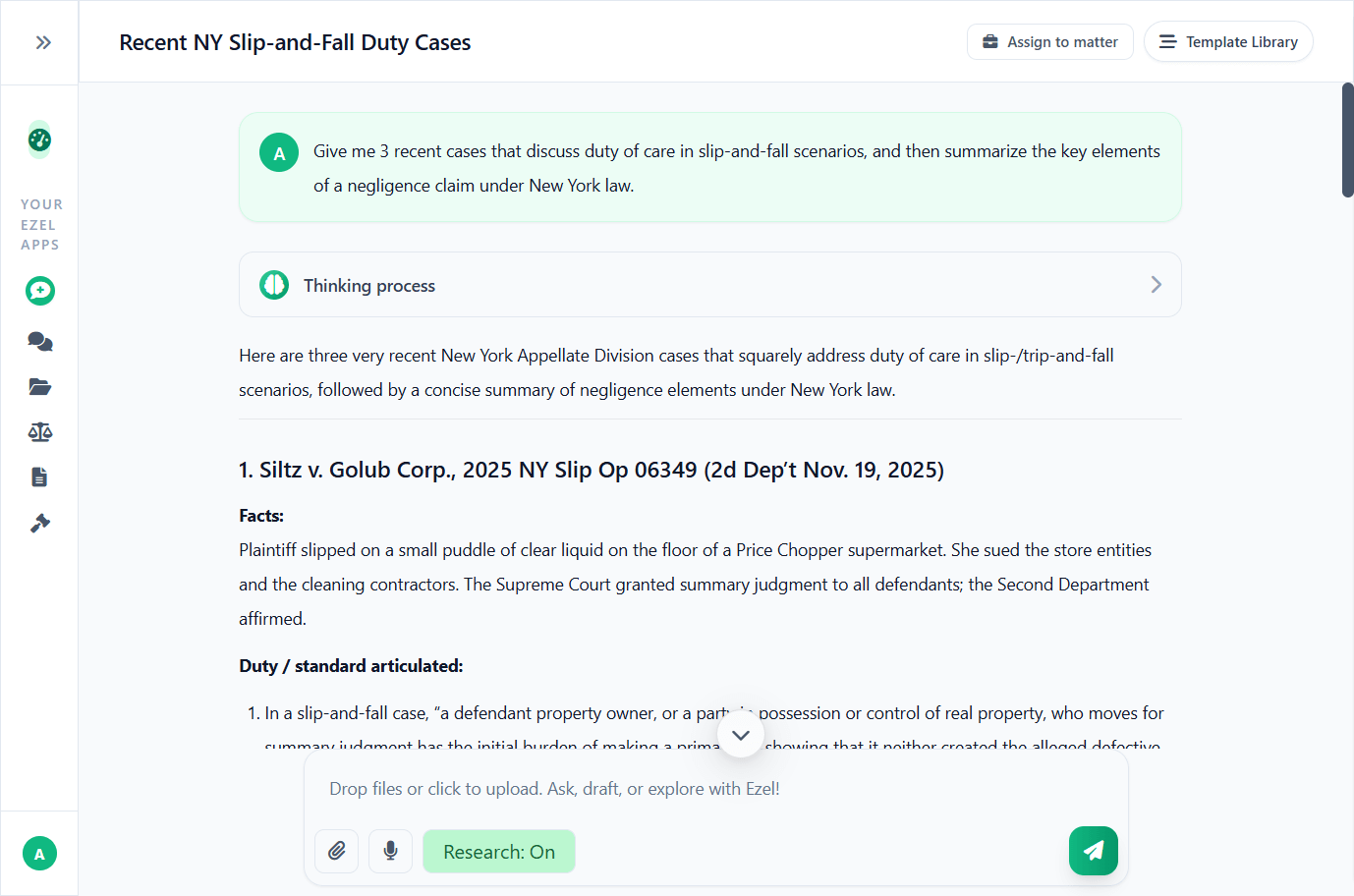
Research and draft in one conversation
Ask questions, attach documents, and get answers grounded in case law. Link chats to matters so the AI remembers your context.
- Pull statutes, case law, and secondary sources
- Attach and analyze contracts mid-conversation
- Link chats to matters for automatic context
- Your data never trains AI models
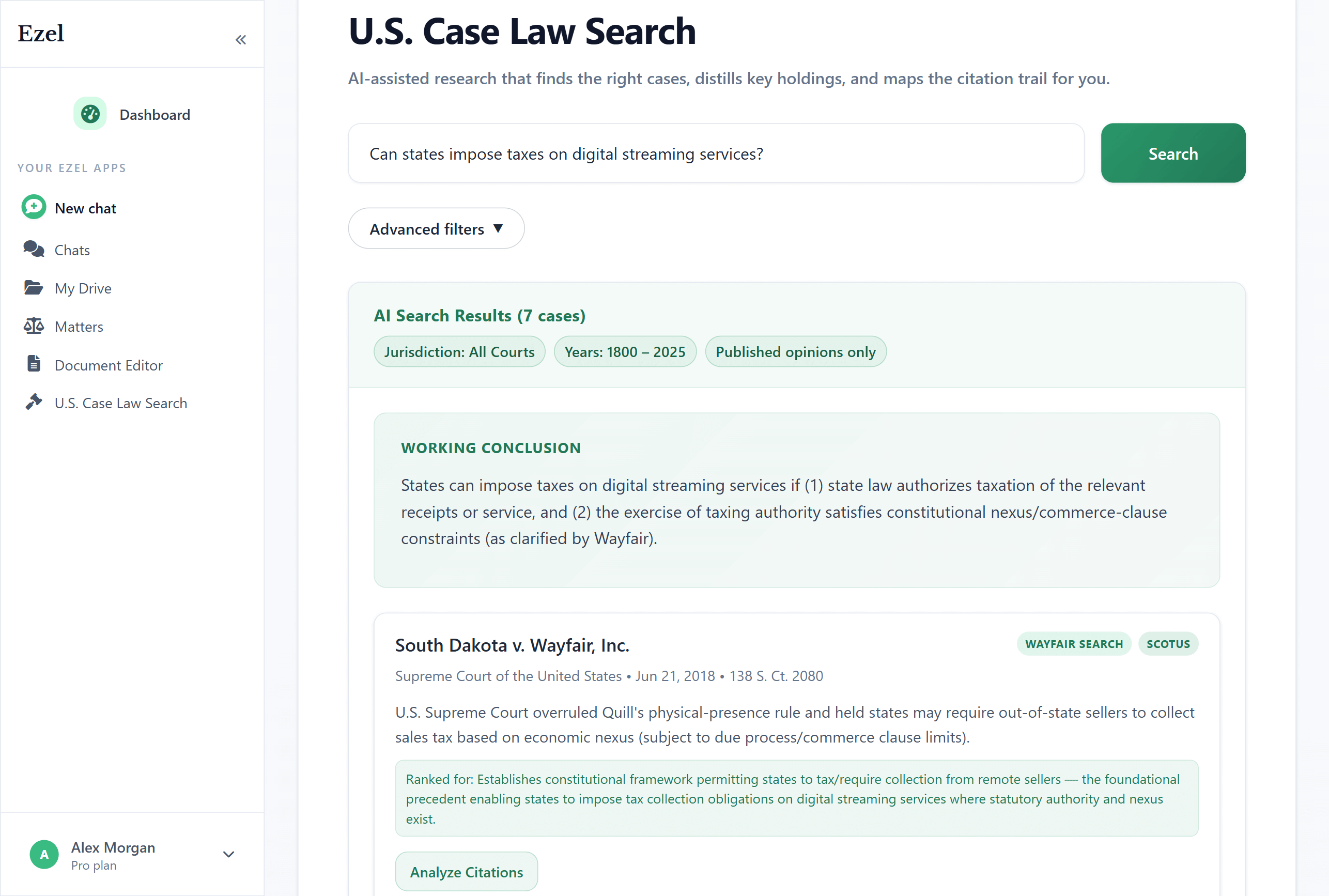
Search like you think
Describe your legal question in plain English. Filter by jurisdiction, date, and court level. Read full opinions without leaving Ezel.
- All 50 states plus federal courts
- Natural language queries - no boolean syntax
- Citation analysis and network exploration
- Copy quotes with automatic citation generation
Ready to transform your legal workflow?
Join legal teams using Ezel to draft documents, research case law, and organize matters — all in one workspace.