SOURCE CODE ESCROW AGREEMENT
State of Minnesota
Effective Date: [__/__/____]
TABLE OF CONTENTS
- Parties and Recitals
- Definitions
- Deposit Materials
- Deposit and Update Procedures
- Verification and Testing
- Release Conditions
- Release Procedures
- Post-Release License Rights
- Fees and Payment
- Confidentiality and Security
- Trade Secret Protections
- Intellectual Property
- Warranties and Disclaimers
- Indemnification
- Limitation of Liability
- Term and Termination
- Governing Law and Dispute Resolution
- Minnesota-Specific Provisions
- Miscellaneous
- Signatures
- Schedules
1. PARTIES AND RECITALS
This Source Code Escrow Agreement (this "Agreement") is entered into as of the Effective Date set forth above by and among:
LICENSOR: [________________________________] a [________________________________] organized under the laws of [________________________________], with its principal place of business at [________________________________] ("Licensor");
BENEFICIARY: [________________________________], a [________________________________] organized under the laws of [________________________________], with its principal place of business at [________________________________] ("Beneficiary"); and
ESCROW AGENT: [________________________________], a [________________________________] organized under the laws of [________________________________], with its principal place of business at [________________________________] ("Escrow Agent").
Licensor, Beneficiary, and Escrow Agent are each referred to herein individually as a "Party" and collectively as the "Parties."
WHEREAS, Licensor and Beneficiary have entered into that certain Software License Agreement dated [__/__/____] (the "License Agreement") pursuant to which Licensor has licensed to Beneficiary certain proprietary software known as [________________________________] (the "Software");
WHEREAS, Beneficiary desires to ensure continued access to the source code and related materials for the Software in the event that Licensor is unable or unwilling to continue to support, maintain, or make available the Software;
WHEREAS, Licensor is willing to deposit the source code and related materials for the Software with Escrow Agent pursuant to the terms and conditions set forth herein;
WHEREAS, Escrow Agent is willing to accept, hold, and release the Deposit Materials (as defined below) in accordance with the terms and conditions of this Agreement;
WHEREAS, this Agreement is governed by and shall be construed in accordance with the laws of the State of Minnesota, including but not limited to the Minnesota Uniform Trade Secrets Act (Minn. Stat. Sections 325C.01 to 325C.08), the Minnesota Uniform Electronic Transactions Act (Minn. Stat. Sections 325L.01 to 325L.19), and the Minnesota Consumer Data Privacy Act (Minn. Stat. Sections 325M.01 et seq.);
WHEREAS, the Parties intend that the Deposit Materials shall be treated as trade secrets and confidential information entitled to the highest degree of protection under Minnesota law; and
WHEREAS, the Parties desire to set forth their respective rights and obligations with respect to the escrow of such materials.
NOW, THEREFORE, in consideration of the mutual covenants and agreements contained herein, and for other good and valuable consideration, the receipt and sufficiency of which are hereby acknowledged, the Parties agree as follows:
2. DEFINITIONS
As used in this Agreement, the following terms shall have the meanings set forth below:
(a) "Acceptance Confirmation" means the written confirmation issued by Escrow Agent acknowledging receipt and acceptance of a Deposit or Deposit Update in conformity with this Agreement.
(b) "Beneficiary" has the meaning set forth in Section 1 of this Agreement.
(c) "Business Day" means any day other than a Saturday, Sunday, or a day on which banking institutions in the State of Minnesota are authorized or required by law to remain closed.
(d) "Confidential Information" means all non-public information disclosed by any Party to another Party in connection with this Agreement, including without limitation the Deposit Materials, trade secrets, proprietary data, technical information, business plans, customer lists, financial information, and any other information that is designated as confidential or that a reasonable person would understand to be confidential given the nature of the information and the circumstances of disclosure.
(e) "Cure Period" means the period of [____] ([____]) calendar days following receipt of written notice of a material breach during which the breaching party may cure such breach.
(f) "Deposit" or "Deposit Materials" means all source code, object code, build scripts, compilation instructions, configuration files, database schemas, API documentation, third-party component licenses, installation guides, user documentation, technical specifications, development environment requirements, test suites, and all other materials deposited by Licensor with Escrow Agent pursuant to this Agreement, as more particularly described in Schedule 2.
(g) "Deposit Update" means any update, revision, modification, enhancement, or new version of the Deposit Materials delivered by Licensor to Escrow Agent after the Initial Deposit.
(h) "Effective Date" means the date first written above.
(i) "Escrow Agent" has the meaning set forth in Section 1 of this Agreement.
(j) "Escrow Fee" means the fees payable to Escrow Agent as set forth in Schedule 1.
(k) "Hash Value" means the SHA-256 cryptographic hash value computed for each file or archive included in the Deposit Materials, used for integrity verification purposes.
(l) "Initial Deposit" means the first complete deposit of the Deposit Materials by Licensor with Escrow Agent pursuant to Section 4 of this Agreement.
(m) "Intellectual Property Rights" means all patents, copyrights, trademarks, trade secrets, trade dress, moral rights, rights of publicity, and all other intellectual property rights of any kind, whether registered or unregistered, and all applications, renewals, extensions, and restorations thereof, now or hereafter in force and effect worldwide.
(n) "License Agreement" means the software license agreement between Licensor and Beneficiary referenced in the Recitals.
(o) "Licensor" has the meaning set forth in Section 1 of this Agreement.
(p) "Material Breach" means a breach of the License Agreement by Licensor that is material in nature, including but not limited to failure to provide maintenance, support, or updates as required thereunder.
(q) "Objection Notice" means a written notice from Licensor to Escrow Agent and Beneficiary objecting to a Release Request, as provided in Section 7(c).
(r) "Release Conditions" means the conditions that must be satisfied before Escrow Agent is authorized to release the Deposit Materials to Beneficiary, as set forth in Section 6.
(s) "Release Request" means a written request from Beneficiary to Escrow Agent requesting the release of the Deposit Materials, as set forth in Section 7(a).
(t) "Term" means the period during which this Agreement is in effect, as set forth in Section 16.
(u) "Verification" means the process of testing and inspecting the Deposit Materials to confirm their completeness, accuracy, and functionality, as set forth in Section 5.
(v) "Verification Report" means the written report prepared by Escrow Agent or its designated independent technical expert documenting the scope, methodology, findings, and conclusions of a Verification conducted under Section 5.
(w) "Minnesota Uniform Trade Secrets Act" or "MUTSA" means the Minnesota Uniform Trade Secrets Act, Minn. Stat. Sections 325C.01 through 325C.08, as amended from time to time.
(x) "Minnesota UETA" means the Minnesota Uniform Electronic Transactions Act, Minn. Stat. Sections 325L.01 through 325L.19, as amended from time to time.
(y) "MCDPA" means the Minnesota Consumer Data Privacy Act, Minn. Stat. Sections 325M.01 et seq., effective July 31, 2025, as amended from time to time.
(z) "Force Majeure Event" means any event beyond the reasonable control of a Party that prevents or delays performance of its obligations, as described more fully in Section 19(f).
(aa) "Commercially Reasonable" means, with respect to security measures, those measures that are consistent with prevailing industry standards for the protection of source code and trade secret materials, taking into account the nature and sensitivity of the materials, the costs of implementation, and the potential consequences of a breach.
3. DEPOSIT MATERIALS
(a) Scope of Deposit. Licensor shall deposit with Escrow Agent a complete and accurate copy of all materials necessary to enable a reasonably skilled software developer to compile, build, install, configure, maintain, and operate the Software without reliance on Licensor. The Deposit Materials shall include, without limitation, the items described in Schedule 2 attached hereto.
(b) Source Code Requirements. The source code included in the Deposit Materials shall be the complete, current, compilable source code for the Software, including all modules, libraries, frameworks, and components necessary for a full build. The source code shall include inline comments sufficient for a qualified developer to understand the code structure and logic.
(c) Build Environment. The Deposit Materials shall include complete documentation of the build environment, including without limitation: (i) operating system and version requirements; (ii) compiler and interpreter versions; (iii) third-party library and dependency specifications with version numbers; (iv) environment variable configurations; (v) build scripts and makefiles; and (vi) step-by-step build instructions.
(d) Third-Party Components. Licensor shall include in the Deposit Materials a complete inventory of all third-party components, libraries, frameworks, and tools required to build and operate the Software, together with: (i) copies of all applicable license agreements for such third-party components; (ii) information regarding how to obtain such third-party components; and (iii) documentation of any restrictions or limitations on the use of such third-party components.
(e) Documentation. The Deposit Materials shall include comprehensive technical documentation, including without limitation: (i) system architecture documentation; (ii) database schemas and data dictionaries; (iii) API specifications; (iv) installation and configuration guides; (v) administrator guides; and (vi) any other documentation reasonably necessary for a skilled developer to maintain and support the Software.
(f) Media and Format. All Deposit Materials shall be delivered on media or through delivery mechanisms specified in Schedule 2, in industry-standard formats that are readable without proprietary tools not included in the Deposit Materials.
(g) Version Control Information. The Deposit Materials shall include a complete version history log identifying: (i) the current version number of the Software; (ii) the date of the most recent release or update; (iii) a summary of changes since the prior version; (iv) branch and tag information from the version control system; and (v) any known issues or bugs in the current version.
(h) Security and Cryptographic Materials. If the Software uses encryption, digital certificates, or other cryptographic materials, the Deposit Materials shall include: (i) all cryptographic keys, certificates, and signing credentials necessary to build, deploy, and operate the Software; (ii) documentation of the cryptographic algorithms and protocols used; and (iii) information regarding how to obtain or renew certificates from applicable certificate authorities.
4. DEPOSIT AND UPDATE PROCEDURES
(a) Initial Deposit. Licensor shall deliver the Initial Deposit to Escrow Agent within [____] ([____]) Business Days following the Effective Date. The Initial Deposit shall include all Deposit Materials identified in Schedule 2.
(b) Deposit Updates. Licensor shall deliver Deposit Updates to Escrow Agent: (i) within [____] ([____]) Business Days following each major or minor release of the Software; and (ii) in any event, no less frequently than [☐ quarterly / ☐ semi-annually / ☐ annually]. Each Deposit Update shall include all changes, modifications, additions, and enhancements to the Deposit Materials since the prior Deposit or Deposit Update.
(c) Delivery Method. All Deposits and Deposit Updates shall be delivered via [☐ secure electronic transfer / ☐ encrypted physical media / ☐ secure cloud repository] as specified in Schedule 2. Licensor shall use AES-256 encryption or equivalent for all electronic transmissions of Deposit Materials.
(d) Hash Value Verification. With each Deposit or Deposit Update, Licensor shall provide to Escrow Agent and Beneficiary a manifest listing all files included therein, together with the SHA-256 Hash Value for each file and for the complete archive. Escrow Agent shall verify the Hash Values upon receipt and shall notify Licensor and Beneficiary of any discrepancies within five (5) Business Days.
(e) Acceptance Confirmation. Within ten (10) Business Days following receipt of a Deposit or Deposit Update, Escrow Agent shall issue an Acceptance Confirmation to both Licensor and Beneficiary, confirming: (i) the date of receipt; (ii) the items received; (iii) Hash Value verification results; and (iv) any discrepancies or deficiencies noted.
(f) Cure of Deficiencies. If Escrow Agent identifies any deficiencies in a Deposit or Deposit Update, Licensor shall cure such deficiencies within fifteen (15) Business Days following receipt of written notice of such deficiencies. Failure to cure deficiencies within such period shall constitute a material breach of this Agreement by Licensor.
(g) Retention of Prior Deposits. Escrow Agent shall retain at least the two (2) most recent complete Deposits or Deposit Updates, unless otherwise agreed by the Parties in writing.
5. VERIFICATION AND TESTING
(a) Verification Levels. Beneficiary may, at its sole expense (unless otherwise agreed), request that Escrow Agent perform Verification of the Deposit Materials at one or more of the following levels:
(i) Level 1 — Inventory Verification. Escrow Agent shall verify that all items listed in Schedule 2 have been deposited and that the files are readable and not corrupted, including confirmation of file counts, file sizes, and Hash Values.
(ii) Level 2 — Compilation Verification. In addition to Level 1 verification, Escrow Agent or its designated independent technical expert shall attempt to compile and build the Software from the deposited source code using the build instructions and environment specifications included in the Deposit Materials.
(iii) Level 3 — Full Functional Verification. In addition to Levels 1 and 2, Escrow Agent or its designated independent technical expert shall attempt to install, configure, and operate the compiled Software and execute such test cases as may be provided with the Deposit Materials to verify basic functionality.
(b) Verification Schedule. Verification may be requested: (i) within thirty (30) days following the Initial Deposit; (ii) within thirty (30) days following any Deposit Update; or (iii) at any other time during the Term upon not less than thirty (30) days' prior written notice to Licensor and Escrow Agent.
(c) Verification Reports. Escrow Agent shall deliver a written verification report to both Licensor and Beneficiary within twenty (20) Business Days following completion of the requested verification level.
(d) Licensor Cooperation. Licensor shall cooperate in good faith with any verification process, including by providing reasonable access to technical personnel and responding promptly to questions. Licensor shall cure any deficiencies identified during verification within twenty (20) Business Days of receiving the verification report.
(e) Verification Costs. Unless otherwise agreed in writing or set forth in Schedule 1, the costs of verification shall be borne by the requesting party. If verification reveals material deficiencies attributable to Licensor's failure to comply with its deposit obligations, Licensor shall reimburse the requesting party for all verification costs.
(f) Independent Expert. Any independent technical expert engaged for Level 2 or Level 3 verification shall be subject to confidentiality obligations no less restrictive than those set forth in Section 10 and shall execute a non-disclosure agreement prior to accessing the Deposit Materials.
6. RELEASE CONDITIONS
(a) Release Trigger Events. Escrow Agent shall be authorized to release the Deposit Materials to Beneficiary upon the occurrence of any one or more of the following Release Conditions, subject to the procedures set forth in Section 7:
(i) Insolvency or Bankruptcy. Licensor files a voluntary petition in bankruptcy or is the subject of an involuntary petition in bankruptcy that is not dismissed within sixty (60) days, makes a general assignment for the benefit of creditors, has a receiver or trustee appointed for all or substantially all of its assets, or is otherwise adjudicated as insolvent, provided that Licensor fails to provide Beneficiary with reasonable assurance within thirty (30) days that support and maintenance shall continue.
(ii) Cessation of Business. Licensor ceases to conduct business in the ordinary course with respect to the Software, discontinues development or support, or announces that it will no longer support or maintain the Software.
(iii) Material Breach of Support or Maintenance. Licensor commits a Material Breach of its maintenance, support, or update obligations under the License Agreement and fails to cure within the Cure Period after receiving written notice from Beneficiary.
(iv) Service Unavailability. If the Software is provided as a service (SaaS), the Software becomes unavailable or materially impaired for [____] ([____]) consecutive calendar days, for reasons not attributable to force majeure, and Licensor fails to restore availability within [____] ([____]) additional calendar days following written notice from Beneficiary.
(v) Failure to Deposit. Licensor fails to deliver a required Deposit or Deposit Update within thirty (30) days following written notice from Beneficiary that such delivery is overdue, and such failure continues for an additional fifteen (15) days following a second written notice.
(b) Exclusions. The following events shall not, standing alone, constitute Release Conditions: (i) a change of control, merger, acquisition, or reorganization of Licensor, provided the surviving entity assumes Licensor's obligations; (ii) temporary service disruptions caused by scheduled maintenance or force majeure events; or (iii) disputes regarding fees or payment obligations subject to good-faith negotiation or dispute resolution.
(c) Federal Bankruptcy Protections. The Parties acknowledge that, in the event of Licensor's bankruptcy, Beneficiary's rights under this Agreement are subject to 11 U.S.C. Section 365(n). Beneficiary may elect to retain its rights as a licensee of intellectual property notwithstanding Licensor's rejection of the License Agreement in bankruptcy, subject to continued payment of royalties and compliance with the License Agreement.
7. RELEASE PROCEDURES
(a) Release Request. Beneficiary shall initiate a release by delivering a Release Request to Escrow Agent and Licensor. The Release Request shall: (i) identify the specific Release Condition(s) asserted; (ii) include a sworn statement executed by an authorized officer of Beneficiary; (iii) include supporting documentation; and (iv) be substantially in the form attached as Schedule 4.
(b) Notice to Licensor. Escrow Agent shall promptly forward the Release Request to Licensor. Licensor shall have [____] ([____]) Business Days from receipt (the "Objection Period") to deliver an Objection Notice.
(c) Objection Notice. If Licensor delivers an Objection Notice within the Objection Period, it shall: (i) state the specific grounds for objection; (ii) include a sworn statement by an authorized officer; and (iii) include supporting documentation.
(d) No Objection. If Licensor does not deliver an Objection Notice within the Objection Period, Escrow Agent shall release the Deposit Materials to Beneficiary within ten (10) Business Days.
(e) Disputed Release. If Licensor delivers a timely Objection Notice: (i) the Parties shall attempt good-faith negotiations for fifteen (15) Business Days; (ii) if unresolved, either Party may submit the dispute to arbitration or judicial resolution per Section 17; (iii) Escrow Agent shall not release until the dispute is resolved, except as provided in Section 7(f).
(f) Expedited Release. If the Release Request is based on Insolvency/Bankruptcy or Cessation of Business, and Beneficiary demonstrates immediate irreparable harm, Escrow Agent may release on an expedited basis subject to Beneficiary's indemnification of Escrow Agent.
(g) Escrow Agent Liability. Escrow Agent shall have no liability for releasing or refusing to release in good faith, except for its own gross negligence or willful misconduct.
8. POST-RELEASE LICENSE RIGHTS
(a) License Grant. Upon valid release, Beneficiary shall receive a non-exclusive, non-transferable (except as provided in Section 8(d)), irrevocable, royalty-bearing license to use, copy, modify, compile, and create derivative works of the Deposit Materials solely for: (i) continued use of the Software as permitted under the License Agreement; (ii) maintenance, support, and error correction; and (iii) modifications and enhancements for Beneficiary's internal use.
(b) Restrictions. Beneficiary shall not: (i) sublicense, distribute, sell, or make the Deposit Materials available to third parties, except to contractors providing maintenance support; (ii) use the Deposit Materials for unauthorized purposes; (iii) reverse engineer portions not included in the Deposit Materials; or (iv) remove proprietary notices.
(c) Ongoing Obligations. Following release, Beneficiary shall: (i) comply with confidentiality obligations; (ii) comply with third-party license agreements; (iii) pay ongoing royalties; and (iv) maintain access records.
(d) Limited Transfer Right. Beneficiary may transfer its rights to a successor in interest (by merger, acquisition, or asset sale), provided such successor agrees in writing to be bound by this Agreement.
(e) Duration. The license shall continue for the remaining License Agreement term or, if terminated, for [____] ([____]) years following release.
9. FEES AND PAYMENT
(a) Fee Schedule. The fees set forth in Schedule 1 shall include: (i) annual escrow maintenance fee; (ii) deposit processing fees; (iii) verification fees; and (iv) release processing fees.
(b) Payment Terms. All fees shall be due within thirty (30) days of invoice.
(c) Fee Allocation. Unless otherwise agreed: (i) annual maintenance fees paid by [☐ Licensor / ☐ Beneficiary / ☐ split equally]; (ii) deposit processing fees paid by Licensor; (iii) verification fees paid by the requesting party; (iv) release fees paid by Beneficiary.
(d) Late Payment. Any amount not paid when due shall accrue interest at the lesser of: (i) [____]% per annum; or (ii) eight percent (8%) per annum, which is the maximum general interest rate under Minn. Stat. Section 334.01. The Parties acknowledge that under Minnesota law, the legal rate of interest is six percent (6%) per annum (Minn. Stat. Section 334.01), and the maximum rate that may be charged is eight percent (8%) per annum for loans under one hundred thousand dollars ($100,000). For business or agricultural loans under one hundred thousand dollars ($100,000), parties may agree to a rate not exceeding four and one-half percent (4.5%) above the Federal Reserve discount rate on ninety-day commercial paper (Minn. Stat. Section 334.011). All interest provisions in this Agreement are intended to comply with Minnesota usury laws, and any interest found to exceed the permitted maximum shall be reduced to the maximum permitted by law.
(e) Usurious Contracts. The Parties acknowledge that under Minn. Stat. Section 334.02, all contracts containing interest rates exceeding prescribed limits shall be void, except as to a holder in due course. Accordingly, the Parties intend that no interest rate under this Agreement shall violate Minnesota law.
(f) Fee Adjustments. Escrow Agent may adjust fees no more than once per calendar year, upon sixty (60) days' prior written notice. Fee increases shall not exceed the greater of three percent (3%) or the CPI-U increase over the preceding twelve months.
(g) Taxes. All fees are exclusive of applicable taxes. The paying Party shall be responsible for all taxes other than taxes on Escrow Agent's net income.
10. CONFIDENTIALITY AND SECURITY
(a) Confidentiality Obligations. Each Party agrees to hold in strict confidence all Confidential Information of the other Parties. No Party shall disclose Confidential Information except: (i) to employees, agents, and advisors with a need to know who are bound by written confidentiality obligations; (ii) as required by law, with prompt notice to the disclosing Party; or (iii) as necessary to enforce rights under this Agreement.
(b) Escrow Agent Security Requirements. Escrow Agent shall maintain commercially reasonable security measures, including: (i) AES-256 encryption; (ii) access controls; (iii) intrusion detection systems; (iv) annual security audits; (v) off-site backup; and (vi) disaster recovery plans.
(c) Data Breach Notification — Minnesota. In the event of a breach of security, Escrow Agent shall comply with Minn. Stat. Sections 325E.61 and 325E.64 (Minnesota data breach notification statutes), including: (i) conducting a good-faith investigation; (ii) notifying affected individuals without unreasonable delay; (iii) notifying the Parties within twenty-four (24) hours of discovery of any breach affecting the Deposit Materials; and (iv) where applicable, complying with the Minnesota Consumer Data Privacy Act (Minn. Stat. Sections 325M.01 et seq.).
(d) Return or Destruction. Upon termination, Escrow Agent shall return or securely destroy all Deposit Materials and certify such action in writing.
(e) Survival. Confidentiality obligations shall survive for five (5) years; provided that trade secret obligations under Minn. Stat. Sections 325C.01 to 325C.08 shall survive as long as the information remains a trade secret.
11. TRADE SECRET PROTECTIONS
(a) Trade Secret Status. The Parties acknowledge that the Deposit Materials may constitute trade secrets under the Minnesota Uniform Trade Secrets Act ("MUTSA"), Minn. Stat. Sections 325C.01 to 325C.08. MUTSA defines a trade secret as information that: (i) derives independent economic value from not being generally known to, and not being readily ascertainable by proper means by, other persons who can obtain economic value from its disclosure or use; and (ii) is the subject of efforts that are reasonable under the circumstances to maintain its secrecy.
(b) Reasonable Measures. Each Party shall take reasonable measures to maintain trade secret status, including: (i) limiting access; (ii) requiring written confidentiality agreements; (iii) maintaining physical and electronic security; (iv) applying proprietary legends; and (v) enforcing internal policies regarding handling.
(c) Injunctive Relief. In the event of actual or threatened misappropriation, the aggrieved party may seek injunctive relief pursuant to Minn. Stat. Section 325C.02, which authorizes a court to issue an injunction for actual or threatened misappropriation. The Parties acknowledge that injunctive relief may be granted without proof of actual damages and without the necessity of posting a bond (to the extent permitted by law).
(d) Damages. Pursuant to Minn. Stat. Section 325C.03, a party injured by misappropriation may recover: (i) actual loss; (ii) unjust enrichment not taken into account in computing actual loss; or (iii) in lieu of other measures, a reasonable royalty. If willful and malicious misappropriation is shown, the court may award exemplary damages not exceeding twice the compensatory award.
(e) Attorney's Fees. Pursuant to Minn. Stat. Section 325C.04, a court may award reasonable attorney's fees to the prevailing party if: (i) a claim is made in bad faith; (ii) a motion to terminate an injunction is made or resisted in bad faith; or (iii) willful and malicious misappropriation exists.
(f) Statute of Limitations. Under Minn. Stat. Section 325C.06, an action for misappropriation must be brought within three (3) years after the misappropriation is discovered or by the exercise of reasonable diligence should have been discovered.
(g) Preservation of Secrecy. Pursuant to Minn. Stat. Section 325C.05, courts shall preserve trade secret secrecy by reasonable means, including protective orders, in-camera hearings, and sealed records.
12. INTELLECTUAL PROPERTY
(a) Ownership. Nothing herein transfers ownership of the Deposit Materials or Intellectual Property Rights. Licensor retains all right, title, and interest.
(b) Licensor Representations. Licensor represents that: (i) it owns or has sufficient rights in the Deposit Materials; (ii) the Deposit Materials do not infringe third-party rights; and (iii) no conflicting grants exist.
(c) No Implied Rights. Except as expressly stated, no license or right is granted or implied.
(d) Third-Party Components. Licensor represents that it has all necessary rights to include third-party components and that applicable licenses permit Beneficiary's post-release use.
13. WARRANTIES AND DISCLAIMERS
(a) Licensor Warranties. Licensor warrants that: (i) the Deposit Materials are complete and accurate; (ii) they are sufficient for a skilled developer to compile and operate the Software; (iii) they contain no intentionally inserted malicious code; (iv) Licensor has authority to deposit; and (v) Licensor will maintain currency.
(b) Escrow Agent Warranties. Escrow Agent warrants that: (i) it will maintain commercially reasonable security; (ii) it will not access Deposit Materials except as authorized; (iii) it maintains adequate insurance; and (iv) it will perform professionally and competently.
(c) Disclaimers. EXCEPT AS EXPRESSLY PROVIDED, ESCROW AGENT MAKES NO WARRANTIES OF ANY KIND, EXPRESS, IMPLIED, OR STATUTORY, INCLUDING WARRANTIES OF MERCHANTABILITY OR FITNESS FOR A PARTICULAR PURPOSE. UPON RELEASE, DEPOSIT MATERIALS ARE PROVIDED "AS IS."
14. INDEMNIFICATION
(a) Licensor Indemnification. Licensor shall indemnify, defend, and hold harmless Beneficiary and Escrow Agent from claims arising from: (i) breach of Licensor's representations or warranties; (ii) IP infringement claims; (iii) Licensor's negligence or willful misconduct; or (iv) breach of obligations.
(b) Beneficiary Indemnification. Beneficiary shall indemnify Licensor and Escrow Agent from claims arising from: (i) unauthorized use of Deposit Materials; (ii) modifications causing third-party damage; or (iii) breach of obligations.
(c) Escrow Agent Indemnification. Escrow Agent shall indemnify Licensor and Beneficiary for claims arising from Escrow Agent's gross negligence or willful misconduct.
(d) Procedures. The Indemnified Party shall: (i) promptly notify the Indemnifying Party; (ii) grant sole defense control (subject to consent requirements for settlements imposing liability); and (iii) provide reasonable cooperation at the Indemnifying Party's expense.
(e) Failure to Notify. Failure to provide prompt notice shall not relieve the Indemnifying Party except to the extent of material prejudice.
15. LIMITATION OF LIABILITY
(a) Aggregate Cap. EXCEPT FOR CONFIDENTIALITY BREACHES, TRADE SECRET MISAPPROPRIATION, OR INDEMNIFICATION OBLIGATIONS, NO PARTY'S AGGREGATE LIABILITY SHALL EXCEED FEES PAID OR PAYABLE DURING THE TWELVE (12) MONTHS PRECEDING THE EVENT.
(b) Exclusion of Consequential Damages. EXCEPT FOR CONFIDENTIALITY BREACHES, TRADE SECRET MISAPPROPRIATION, OR GROSS NEGLIGENCE/WILLFUL MISCONDUCT, NO PARTY SHALL BE LIABLE FOR INDIRECT, INCIDENTAL, CONSEQUENTIAL, SPECIAL, PUNITIVE, OR EXEMPLARY DAMAGES.
(c) Escrow Agent Limitation. ESCROW AGENT LIABILITY SHALL NOT EXCEED FEES PAID DURING THE PRECEDING TWELVE (12) MONTHS, EXCEPT FOR GROSS NEGLIGENCE OR WILLFUL MISCONDUCT.
(d) Minnesota Enforceability. These limitations shall be enforceable to the fullest extent permitted under Minnesota law. Minnesota courts generally enforce contractual limitation of liability provisions between sophisticated commercial parties.
(e) Essential Purpose. These limitations apply regardless of the form of action and survive even if any limited remedy fails of its essential purpose.
16. TERM AND TERMINATION
(a) Term. This Agreement commences on the Effective Date and continues for [____] ([____]) years (the "Initial Term"), automatically renewing for successive one-year periods unless any Party provides ninety (90) days' notice of non-renewal.
(b) Termination for Convenience. Any Party may terminate upon ninety (90) days' prior written notice.
(c) Termination for Cause. Any Party may terminate immediately if: (i) another Party commits an uncured material breach; (ii) another Party becomes insolvent or files for bankruptcy; or (iii) the License Agreement terminates.
(d) Effect of Termination. Upon termination: (i) Escrow Agent shall return or destroy Deposit Materials at Licensor's direction; (ii) accrued obligations survive; and (iii) Sections 2, 8, 10, 11, 12, 13, 14, 15, 17, 18, and 19 survive.
(e) Pending Release. Termination shall not take effect with respect to a pending Release Request until finally resolved.
17. GOVERNING LAW AND DISPUTE RESOLUTION
(a) Governing Law. This Agreement shall be governed by Minnesota law, without regard to conflict of laws principles. The UN Convention on Contracts for the International Sale of Goods shall not apply.
(b) Venue and Jurisdiction. The Parties consent to exclusive jurisdiction and venue in the state courts of Hennepin County (Minneapolis), Minnesota, and the United States District Court for the District of Minnesota.
(c) Arbitration (Optional). The Parties may elect binding arbitration administered by [☐ AAA / ☐ JAMS / ☐ other: [________________________________]] in Minneapolis, Minnesota. The Minnesota Uniform Arbitration Act (Minn. Stat. Ch. 572B) shall apply. The arbitrator's award shall be final and binding.
(d) JURY WAIVER. TO THE FULLEST EXTENT PERMITTED BY MINNESOTA LAW, EACH PARTY KNOWINGLY, VOLUNTARILY, AND INTENTIONALLY WAIVES ANY RIGHT TO A JURY TRIAL IN ANY ACTION ARISING OUT OF OR RELATING TO THIS AGREEMENT. THE PARTIES ACKNOWLEDGE THAT UNDER MINNESOTA LAW, WAIVER OF JURY TRIAL IN ACTIONS ARISING ON CONTRACT IS PERMITTED UNDER THE MINNESOTA RULES OF CIVIL PROCEDURE. THIS WAIVER IS A MATERIAL INDUCEMENT FOR THE PARTIES TO ENTER INTO THIS AGREEMENT. EACH PARTY HAS HAD THE OPPORTUNITY TO CONSULT WITH LEGAL COUNSEL.
(e) Injunctive Relief. Any Party may seek injunctive or equitable relief in any court of competent jurisdiction to protect its IP rights, trade secrets, or Confidential Information, without proving actual damages or posting a bond (to the extent permitted by law).
(f) Prevailing Party Attorney's Fees. In any action arising out of this Agreement, the prevailing party may recover reasonable attorney's fees and costs.
18. MINNESOTA-SPECIFIC PROVISIONS
(a) Electronic Signatures. This Agreement may be executed electronically pursuant to the Minnesota Uniform Electronic Transactions Act (Minn. Stat. Sections 325L.01 to 325L.19). Under Minn. Stat. Section 325L.07, a record or signature shall not be denied legal effect solely because it is electronic. An express agreement to conduct transactions electronically is not required; agreement may be determined from the parties' conduct, context, and surrounding circumstances.
(b) Minnesota Consumer Data Privacy Act. To the extent any personal data (as defined in Minn. Stat. Section 325M.01 et seq.) is included in the Deposit Materials, the Parties shall comply with the Minnesota Consumer Data Privacy Act (MCDPA), effective July 31, 2025. Compliance obligations include but are not limited to: (i) limiting the processing of personal data to what is adequate, relevant, and reasonably necessary for the disclosed purpose (data minimization); (ii) implementing reasonable data security practices (Minn. Stat. Section 325M.16); (iii) conducting data privacy and protection assessments where required (Minn. Stat. Section 325M.18); (iv) honoring consumer data rights under Minn. Stat. Section 325M.14, including the right to access, delete, and correct personal data; and (v) providing transparent privacy notices. The Parties acknowledge that the Minnesota Attorney General has exclusive enforcement authority under the MCDPA.
(c) Consumer Protection. Nothing in this Agreement limits any rights under the Minnesota Consumer Fraud Act (Minn. Stat. Sections 325F.68 to 325F.70) or the Minnesota Deceptive Trade Practices Act (Minn. Stat. Sections 325D.43 to 325D.48). The Parties acknowledge that the Minnesota Attorney General may bring enforcement actions for violations of these statutes, and that private rights of action exist under certain circumstances.
(d) UCC Applicability. To the extent transactions involve the sale of goods, the UCC as adopted in Minnesota (Minn. Stat. Ch. 336) shall apply. The Parties acknowledge that software licensing may not constitute a sale of goods, and common law may govern.
(e) Statute of Limitations. The statute of limitations for breach of contract in Minnesota is six (6) years pursuant to Minn. Stat. Section 541.05. Actions for trade secret misappropriation must be brought within three (3) years under Minn. Stat. Section 325C.06.
(f) Interest Rate Compliance. All interest provisions comply with Minn. Stat. Chapter 334. The legal rate is six percent (6%) per annum; the maximum general rate is eight percent (8%) per annum. Any interest exceeding the permitted maximum shall be automatically reduced.
(g) Forum Selection Enforceability. Minnesota courts generally enforce forum selection clauses that are freely negotiated, not unreasonable, and not procured by fraud.
(h) Minnesota Government Data Practices Act. To the extent any Party is a government entity subject to the Minnesota Government Data Practices Act (Minn. Stat. Ch. 13), the Parties shall comply with applicable data classification and access requirements.
(i) Minnesota Assignment Law. Contractual anti-assignment provisions are generally enforceable under Minnesota law. Assignment restrictions in this Agreement are intended to be valid and enforceable to the fullest extent permitted. Any attempted assignment in violation of this Agreement shall be void and of no effect.
(j) Minnesota Arbitration. The Parties acknowledge that the Minnesota Uniform Arbitration Act (Minn. Stat. Ch. 572B) governs arbitration agreements and proceedings in Minnesota. Any arbitration clause in this Agreement shall be interpreted and enforced in accordance with that Act. The Federal Arbitration Act (9 U.S.C. Sections 1 et seq.) may also apply to arbitration agreements involving interstate commerce. Minnesota courts generally give effect to valid arbitration agreements between commercial parties.
(k) Minnesota Deceptive Trade Practices. The Parties shall comply with the Minnesota Deceptive Trade Practices Act (Minn. Stat. Sections 325D.43 to 325D.48). The Parties acknowledge that a person likely to be damaged by a deceptive trade practice of another may be granted an injunction against it under the usual equity rules. The cost of the action may be awarded to the prevailing party.
(l) Minnesota Data Breach Notification. In addition to the MCDPA requirements, the Parties shall comply with Minn. Stat. Sections 325E.61 and 325E.64 regarding notification obligations following a breach of the security of data involving personal information of Minnesota residents.
19. MISCELLANEOUS
(a) Entire Agreement. This Agreement, including all Schedules, constitutes the entire agreement among the Parties and supersedes all prior agreements on this subject matter.
(b) Amendments. This Agreement may only be modified by written instrument signed by all Parties or by electronic signatures per Minn. Stat. Ch. 325L.
(c) Assignment. No assignment without prior written consent, except Beneficiary may assign to a successor entity, provided such successor agrees to be bound by this Agreement.
(d) Notices. Written notices shall be deemed given when: (i) delivered personally; (ii) sent by certified mail, return receipt requested; (iii) sent by overnight courier; or (iv) sent by email with confirmation. Notices to:
To Licensor: [________________________________]
To Beneficiary: [________________________________]
To Escrow Agent: [________________________________]
(e) Severability. Invalid provisions shall be modified to the minimum extent necessary; remaining provisions remain in full force and effect.
(f) Force Majeure. No liability for delays caused by circumstances beyond reasonable control (other than payment obligations), including acts of God, pandemics, war, terrorism, government actions, and cyberattacks.
(g) Waiver. Failure to enforce any provision is not a waiver of future enforcement rights.
(h) Counterparts. This Agreement may be executed in counterparts, including electronic counterparts.
(i) Headings. Section headings are for convenience only.
(j) Relationship of Parties. The Parties are independent contractors; nothing herein creates a partnership, joint venture, agency, or employment relationship.
(k) Order of Precedence. This Agreement controls with respect to escrow matters; the License Agreement controls for all other matters.
(l) Third-Party Beneficiaries. No third-party beneficiaries are intended.
20. SIGNATURES
IN WITNESS WHEREOF, the Parties have executed this Agreement as of the Effective Date.
LICENSOR:
Name: [________________________________]
Title: [________________________________]
Entity: [________________________________]
Signature: [________________________________]
Date: [__/__/____]
BENEFICIARY:
Name: [________________________________]
Title: [________________________________]
Entity: [________________________________]
Signature: [________________________________]
Date: [__/__/____]
ESCROW AGENT:
Name: [________________________________]
Title: [________________________________]
Entity: [________________________________]
Signature: [________________________________]
Date: [__/__/____]
21. SCHEDULES
SCHEDULE 1: FEE SCHEDULE
| Fee Type | Amount | Frequency | Paid By |
|---|---|---|---|
| Annual Escrow Maintenance Fee | $[________] | Annual | [☐ Licensor / ☐ Beneficiary / ☐ Split] |
| Initial Deposit Processing Fee | $[________] | One-time | Licensor |
| Deposit Update Processing Fee | $[________] | Per update | Licensor |
| Level 1 Verification Fee | $[________] | Per verification | Requesting Party |
| Level 2 Verification Fee | $[________] | Per verification | Requesting Party |
| Level 3 Verification Fee | $[________] | Per verification | Requesting Party |
| Release Processing Fee | $[________] | Per release | Beneficiary |
| Expedited Release Fee | $[________] | Per release | Beneficiary |
Late Payment Interest Rate: [____]% per annum (not to exceed 8% per Minn. Stat. Section 334.01)
SCHEDULE 2: DEPOSIT MATERIALS INVENTORY
☐ Complete source code for [________________________________] version [____]
☐ Build scripts and makefiles
☐ Compilation and build instructions
☐ Development environment specifications
☐ Third-party library source code or binaries (with applicable licenses)
☐ Database schemas and migration scripts
☐ API specifications and documentation
☐ Configuration files and templates
☐ Test suites and test data
☐ Installation and deployment guides
☐ System architecture documentation
☐ User and administrator documentation
☐ Cryptographic keys or certificates required for build (if applicable)
☐ Personal data inventory (if applicable, for MCDPA compliance)
☐ Other: [________________________________]
Delivery Format: [☐ Encrypted ZIP archive / ☐ Git repository bundle / ☐ Encrypted physical media / ☐ Other: [________________________________]]
Encryption Standard: AES-256 or equivalent
SCHEDULE 3: VERIFICATION LEVELS AND PROCEDURES
Level 1 — Inventory Verification
☐ Confirm receipt of all items listed in Schedule 2
☐ Verify file integrity using SHA-256 Hash Values
☐ Confirm files are readable and not corrupted
☐ Verify media is in usable condition
☐ Document findings in verification report
Level 2 — Compilation Verification
☐ All Level 1 verification steps
☐ Set up build environment per included specifications
☐ Attempt compilation of source code
☐ Verify successful generation of executable software
☐ Document build process and any issues encountered
Level 3 — Full Functional Verification
☐ All Level 1 and Level 2 verification steps
☐ Install compiled software in test environment
☐ Execute included test suites
☐ Verify basic functionality and operational capability
☐ Document test results and any functional deficiencies
SCHEDULE 4: RELEASE REQUEST FORM AND OBJECTION PROCEDURE
RELEASE REQUEST FORM
To: [Escrow Agent Name and Address]
From: [Beneficiary Name and Address]
Date: [__/__/____]
Agreement Reference: Source Code Escrow Agreement dated [__/__/____]
The undersigned requests the release of the Deposit Materials based on the following Release Condition(s):
☐ Section 6(a)(i) — Insolvency or Bankruptcy
☐ Section 6(a)(ii) — Cessation of Business
☐ Section 6(a)(iii) — Material Breach of Support or Maintenance
☐ Section 6(a)(iv) — Service Unavailability
☐ Section 6(a)(v) — Failure to Deposit
Statement of Facts:
[________________________________]
[________________________________]
[________________________________]
Supporting Documentation Attached:
☐ Yes — [describe]: [________________________________]
☐ No — explain: [________________________________]
I declare under penalty of perjury under the laws of the State of Minnesota that the foregoing is true and correct.
Name: [________________________________]
Title: [________________________________]
Signature: [________________________________]
Date: [__/__/____]
OBJECTION NOTICE FORM
To: [Escrow Agent Name and Address] and [Beneficiary Name and Address]
From: [Licensor Name and Address]
Date: [__/__/____]
The undersigned objects to the Release Request dated [__/__/____] on the following grounds:
[________________________________]
[________________________________]
[________________________________]
Supporting Documentation Attached:
☐ Yes — [describe]: [________________________________]
☐ No — explain: [________________________________]
I declare under penalty of perjury under the laws of the State of Minnesota that the foregoing is true and correct.
Name: [________________________________]
Title: [________________________________]
Signature: [________________________________]
Date: [__/__/____]
This template is provided for informational purposes only and does not constitute legal advice. This template must be reviewed and customized by a qualified attorney licensed in Minnesota before use. Laws and regulations change frequently; verify all statutory citations before relying on this template. Do not use this template without professional legal review.
Prepared for use on the ezel.ai platform.
Do more with Ezel
This free template is just the beginning. See how Ezel helps legal teams draft, research, and collaborate faster.
AI that drafts while you watch
Tell the AI what you need and watch your document transform in real-time. No more copy-pasting between tools or manually formatting changes.
- Natural language commands: "Add a force majeure clause"
- Context-aware suggestions based on document type
- Real-time streaming shows edits as they happen
- Milestone tracking and version comparison
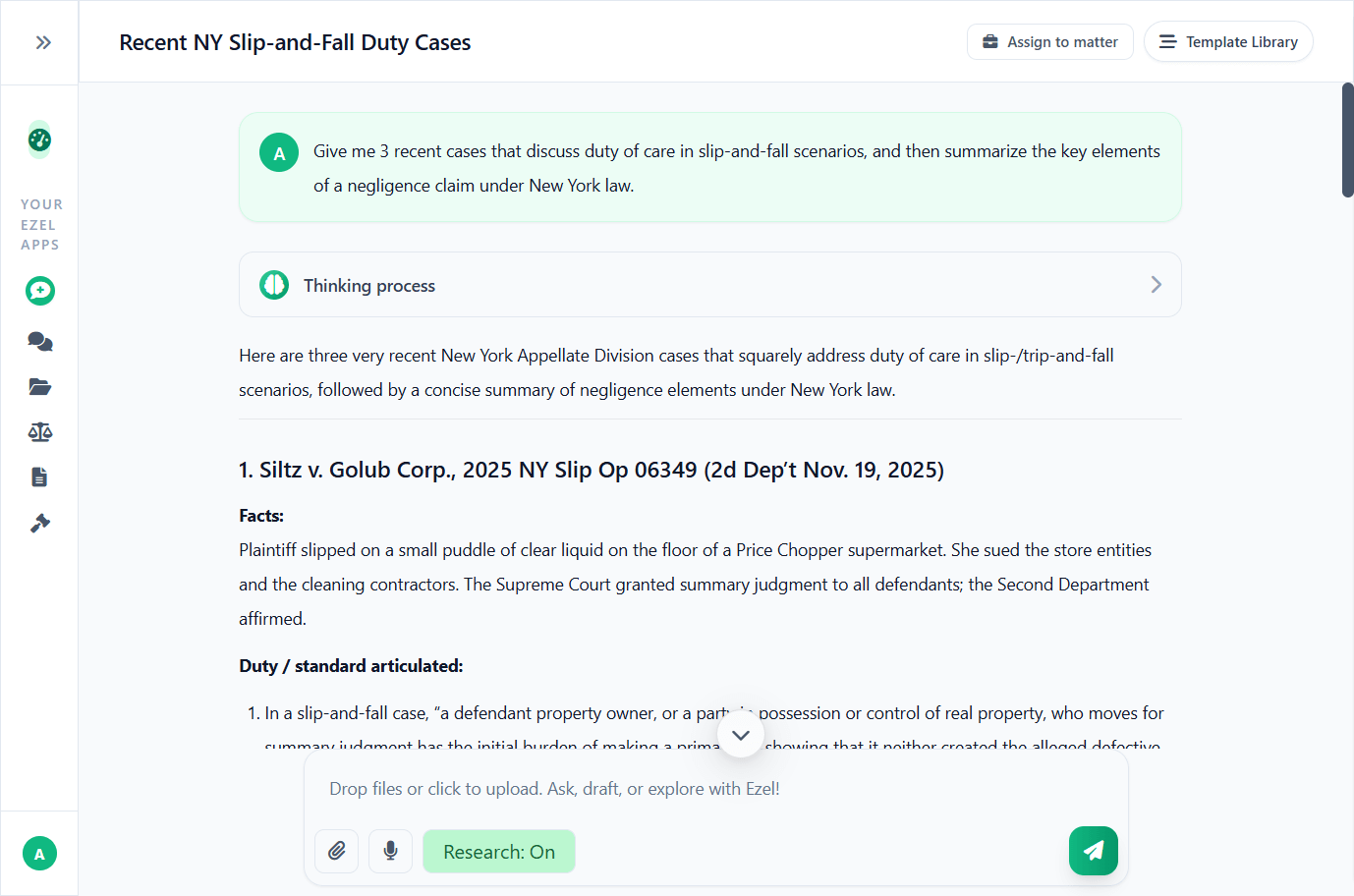
Research and draft in one conversation
Ask questions, attach documents, and get answers grounded in case law. Link chats to matters so the AI remembers your context.
- Pull statutes, case law, and secondary sources
- Attach and analyze contracts mid-conversation
- Link chats to matters for automatic context
- Your data never trains AI models
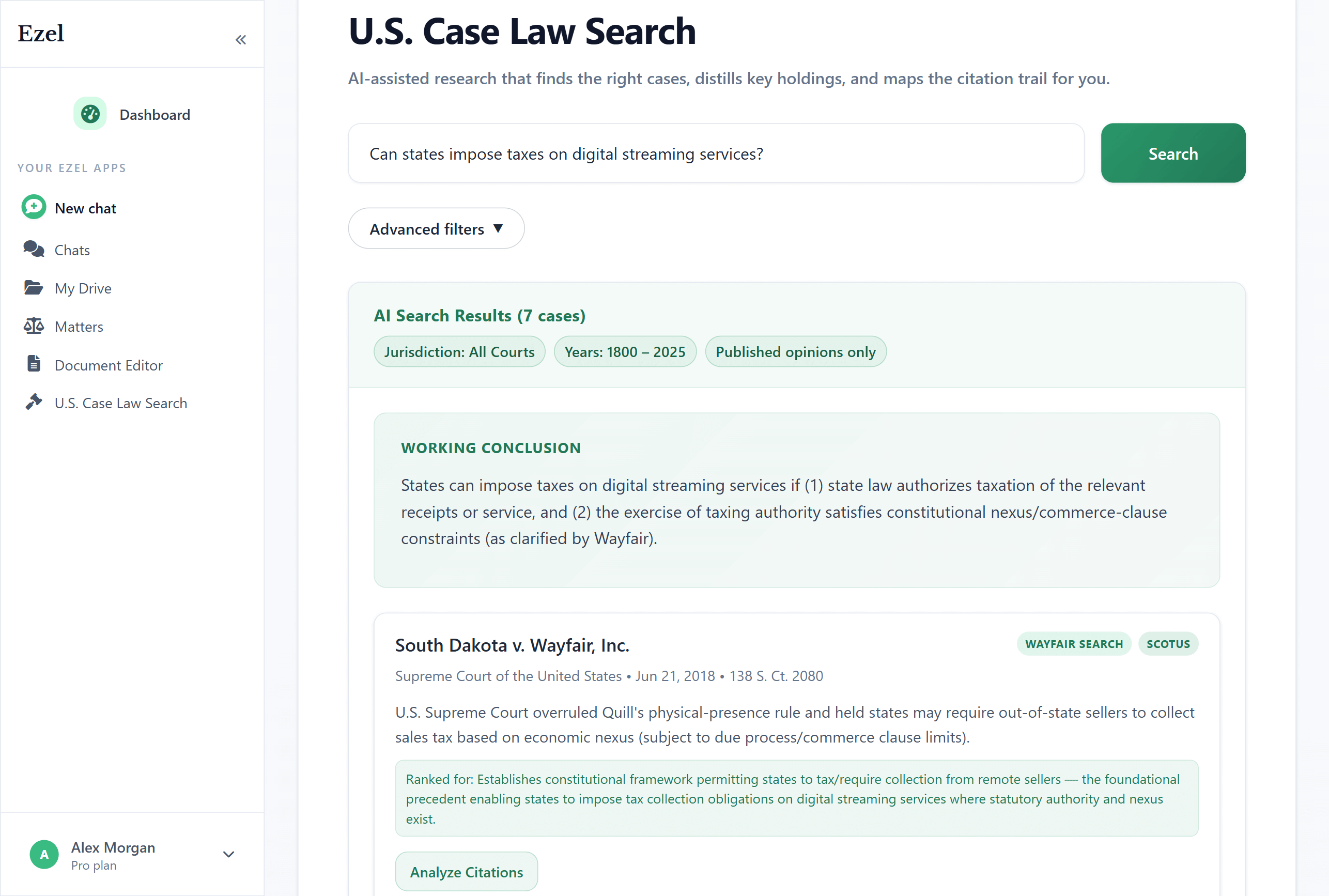
Search like you think
Describe your legal question in plain English. Filter by jurisdiction, date, and court level. Read full opinions without leaving Ezel.
- All 50 states plus federal courts
- Natural language queries - no boolean syntax
- Citation analysis and network exploration
- Copy quotes with automatic citation generation
Ready to transform your legal workflow?
Join legal teams using Ezel to draft documents, research case law, and organize matters — all in one workspace.