SOURCE CODE ESCROW AGREEMENT
District of Columbia
Governed by the Laws of the District of Columbia
Agreement Number: [________________________________]
Effective Date: [__/__/____]
TABLE OF CONTENTS
- Parties and Recitals
- Definitions
- Deposit Materials
- Deposit and Update Procedures
- Verification and Testing
- Release Conditions
- Release Procedures
- Post-Release License Rights
- Fees and Payment
- Confidentiality and Security
- Trade Secret Protections
- Intellectual Property
- Warranties and Disclaimers
- Indemnification
- Limitation of Liability
- Term and Termination
- Governing Law and Dispute Resolution
- District of Columbia-Specific Provisions
- Miscellaneous
- Signatures
- Schedules
1. PARTIES AND RECITALS
THIS SOURCE CODE ESCROW AGREEMENT (this "Agreement") is entered into as of [__/__/____] (the "Effective Date") by and among:
LICENSOR:
Name: [________________________________]
Address: [________________________________]
City, State/District, ZIP: [________________________________]
Jurisdiction of Organization: [________________________________]
Entity Type: ☐ Corporation ☐ LLC ☐ Partnership ☐ Sole Proprietor ☐ Other: [____]
Authorized Representative: [________________________________]
Title: [________________________________]
Email: [________________________________]
Phone: [________________________________]
BENEFICIARY:
Name: [________________________________]
Address: [________________________________]
City, State/District, ZIP: [________________________________]
Jurisdiction of Organization: [________________________________]
Entity Type: ☐ Corporation ☐ LLC ☐ Partnership ☐ Sole Proprietor ☐ Other: [____]
Authorized Representative: [________________________________]
Title: [________________________________]
Email: [________________________________]
Phone: [________________________________]
ESCROW AGENT:
Name: [________________________________]
Address: [________________________________]
City, State/District, ZIP: [________________________________]
Authorized Representative: [________________________________]
Title: [________________________________]
Email: [________________________________]
Phone: [________________________________]
Each individually a "Party" and collectively the "Parties."
RECITALS
WHEREAS, Licensor is the owner or authorized licensor of certain proprietary software known as [________________________________] (the "Software Product") and the associated source code, build environments, documentation, and related materials;
WHEREAS, Beneficiary has entered into or contemporaneously herewith enters into a software license agreement, software-as-a-service agreement, or other technology agreement dated [__/__/____] (the "Underlying Agreement") with Licensor;
WHEREAS, Beneficiary desires to ensure continuity of access to the Software Product in the event of certain triggering events;
WHEREAS, Licensor agrees to deposit source code and related materials with Escrow Agent for the benefit of Beneficiary;
WHEREAS, Escrow Agent agrees to accept, hold, and release the deposited materials in accordance with this Agreement;
WHEREAS, the Parties intend this Agreement to be governed by the laws of the District of Columbia, and the Parties acknowledge that the District of Columbia is a unique jurisdiction that is both a municipal government and a federal district, and that its courts and legal framework reflect this distinct status; and
WHEREAS, the Deposit Materials may constitute trade secrets under the District of Columbia Uniform Trade Secrets Act (D.C. Code §§ 36-401 to 36-410) and the federal Defend Trade Secrets Act (18 U.S.C. §§ 1836-1839).
NOW, THEREFORE, in consideration of the mutual covenants and for other good and valuable consideration, the Parties agree as follows:
2. DEFINITIONS
2.1 "Affiliate" means any entity that directly or indirectly controls, is controlled by, or is under common control with a Party, where "control" means ownership of more than fifty percent (50%) of voting securities.
2.2 "Bankruptcy Event" means the filing of a voluntary or involuntary petition under the Bankruptcy Code, appointment of a receiver or trustee, or a general assignment for creditors' benefit with respect to Licensor.
2.3 "Build Environment" means all hardware specifications, operating system requirements, compilers, interpreters, libraries, frameworks, and tools necessary to compile, build, and deploy the Software Product.
2.4 "Business Day" means any day other than Saturday, Sunday, or a day banking institutions in the District of Columbia are authorized to close, or a federal holiday observed in the District.
2.5 "Confidential Information" means all non-public information disclosed in connection with this Agreement, including Deposit Materials, financial data, business plans, and technical data.
2.6 "CPPA" means the District of Columbia Consumer Protection Procedures Act, D.C. Code §§ 28-3901 et seq.
2.7 "Deposit Materials" means the Source Code, Build Environment specifications, Documentation, Third-Party Components, and all other deposited materials.
2.8 "Documentation" means technical documentation, user manuals, system administration guides, API documentation, database schemas, architecture diagrams, and deployment guides.
2.9 "Force Majeure Event" means any event beyond reasonable control, including acts of God, fire, flood, earthquake, epidemic, pandemic, war, terrorism, government action (including federal government shutdowns affecting the District), labor strikes, or power failures.
2.10 "Intellectual Property Rights" means all worldwide intellectual property rights, including patents, copyrights, trademarks, trade secrets, know-how, and moral rights.
2.11 "Major Release" means a version with a new whole number or substantial new features.
2.12 "Minor Release" means a version with a new decimal number introducing incremental improvements.
2.13 "Personal Information" means personal information as defined in D.C. Code § 28-3851, including a person's first name or first initial and last name, or phone number, or address, and any one or more of the following: Social Security number, driver's license or ID card number, credit or debit card number, or other financial information used to authenticate identity or authorize a transaction.
2.14 "Release Conditions" means the conditions in Section 6 triggering entitlement to Deposit Materials.
2.15 "Source Code" means the human-readable programming code, including all modules, subroutines, scripts, comments, and related materials.
2.16 "Third-Party Components" means software libraries, frameworks, or components by others incorporated into or required for the Software Product.
2.17 "Underlying Agreement" means the software license, SaaS, or technology agreement identified in the Recitals.
3. DEPOSIT MATERIALS
3.1 Scope. Licensor shall deposit:
(a) Complete Source Code for the current production version and two (2) preceding versions;
(b) Build Environment specifications with version numbers;
(c) Complete Documentation;
(d) Third-Party Components with licenses, or identification list where deposit is restricted;
(e) Database schemas, data models, stored procedures, and migration scripts;
(f) Configuration files, environment variables, and deployment parameters;
(g) Complete file inventory with hash values (SHA-256); and
(h) Additional materials per Schedule B.
3.2 Format. Industry-standard, machine-readable formats in at least two (2) delivery methods with logical directory structure and top-level README.
3.3 Completeness. Licensor warrants materials are sufficient for reasonably skilled developers to compile, build, deploy, operate, maintain, and modify the Software Product.
4. DEPOSIT AND UPDATE PROCEDURES
4.1 Initial Deposit. Within [____] calendar days of the Effective Date.
4.2 Update Deposits. (a) Within [____] days of each Major Release; (b) within [____] days of each Minor Release; (c) no less than every [____] months; and (d) within [____] days of material environment or dependency changes.
4.3 Deposit Confirmation. Escrow Agent shall within five (5) Business Days: (a) acknowledge receipt; (b) verify integrity and readability; (c) maintain deposit log; (d) assign unique ID; and (e) store per Section 10.
4.4 Rejected Deposits. Notification within five (5) Business Days; replacement within ten (10) Business Days.
4.5 Supplemental Deposits. Beneficiary may request; Licensor shall comply within thirty (30) calendar days.
5. VERIFICATION AND TESTING
5.1 Verification Levels.
Tier 1 — Inventory Verification: File count, hash verification, readability, directory structure, README confirmation.
Tier 2 — Technical Review and Compilation: All Tier 1 plus compilation attempts, dependency verification, documentation review, and database schema testing.
Tier 3 — Full Build and Functional Verification: All Tier 1 and 2 plus complete clean-environment build, automated testing, functional verification, deployment testing, and detailed reporting.
5.2 Verification Requests. Up to [____] per level per year. Commencement within fifteen (15) Business Days.
5.3 Verification Reports. Written report to both Parties within ten (10) Business Days.
5.4 Deficiency Remediation. Cure within [____] calendar days. First follow-up at no cost to Beneficiary.
5.5 Costs. ☐ Beneficiary; ☐ Licensor; ☐ Shared; ☐ Per Schedule A. Licensor reimburses if material deficiencies found.
6. RELEASE CONDITIONS
6.1 Release Events. Beneficiary is entitled to Deposit Materials upon:
(a) Bankruptcy Event with failure to continue obligations for [____] consecutive Business Days, subject to 11 U.S.C. § 365(n);
(b) Cessation of Business without successor within [____] calendar days;
(c) Material Breach uncured for [____] calendar days after written notice;
(d) Extended Service Unavailability for [____] consecutive or [____] cumulative calendar days within [____] months, not from Force Majeure or Beneficiary;
(e) Failure to Deposit or Update continuing [____] calendar days after notice;
(f) Assignment Without Consent where assignee fails to assume;
(g) Dissolution or Liquidation of Licensor;
(h) Regulatory Action for [____] consecutive calendar days, including actions by federal agencies located in the District;
(i) Failure to Cure Verification Deficiencies; and
(j) Additional Triggers per Schedule D.
6.2 Exclusions. Mergers, acquisitions, or changes of control where successors assume obligations are not Release Conditions.
6.3 Bankruptcy Protections. Rights consistent with 11 U.S.C. § 365(n). Source Code constitutes "intellectual property" under 11 U.S.C. § 101(35A).
7. RELEASE PROCEDURES
7.1 Release Request. Written request to Escrow Agent with copy to Licensor, including: (a) Release Conditions; (b) factual description with evidence; (c) sworn statement or affirmation; and (d) Licensor notification confirmation.
7.2 Notice to Licensor. Escrow Agent transmits within two (2) Business Days.
7.3 Licensor Objection. Within [____] Business Days with grounds, evidence, and sworn statement.
7.4 Release Without Objection. Release within five (5) Business Days after the objection period expires.
7.5 Disputed Release. Escrow Agent holds pending resolution. Fifteen (15) Business Days negotiation, then arbitration or court proceedings per Section 17.
7.6 Emergency Interim Access. For catastrophic outages of [____] or more consecutive Business Days, read-only access within twenty-four (24) hours.
7.7 Partial Release. Upon agreement of Licensor and Beneficiary.
8. POST-RELEASE LICENSE RIGHTS
8.1 License Grant. Upon valid release, Beneficiary receives a non-exclusive, non-transferable (except per Section 8.3), irrevocable, perpetual, royalty-free license to use, copy, compile, modify, maintain, and create derivative works solely to: (a) operate the Software Product; (b) fix bugs and vulnerabilities; (c) make necessary modifications; (d) compile and build; and (e) create backup copies.
8.2 Restrictions. Beneficiary shall NOT: (a) exceed permitted purposes; (b) distribute, sublicense, or sell Source Code; (c) create competing products; (d) remove proprietary markings; or (e) reverse engineer other products.
8.3 Permitted Third-Party Access. Employees, Affiliates, and contractors under NDA no less restrictive than Section 10.
8.4 Third-Party Component Licenses. Beneficiary shall comply with and independently obtain required licenses.
8.5 Duration. Perpetual unless release determined improper or Beneficiary materially breaches without cure within thirty (30) calendar days.
9. FEES AND PAYMENT
9.1 Fee Schedule. Per Schedule A.
9.2 Fee Responsibility. ☐ Beneficiary; ☐ Licensor; ☐ Split equally; ☐ Per Schedule A.
9.3 Payment Terms. Due within [____] calendar days of invoice in United States dollars.
9.4 Late Payment. Unpaid amounts bear interest at the lesser of: (a) one percent (1%) per month (twelve percent (12%) per annum); or (b) the maximum rate permitted under District of Columbia law. Under D.C. Code § 28-3302, the legal rate of interest in the District is six percent (6%) per annum when no rate is agreed upon. For written agreements, the rate may exceed 6% subject to applicable D.C. usury limitations. D.C. Code § 28-3301 provides that a person may not directly or indirectly receive interest at a rate exceeding twenty-four percent (24%) per annum (with certain exceptions for federally regulated institutions). If the rate specified herein exceeds the applicable maximum, it shall be automatically reduced.
9.5 Fee Adjustments. Once per twelve (12) months with sixty (60) calendar days' notice. Increases not to exceed five percent (5%) or the CPI-U increase for the Washington-Arlington-Alexandria area.
9.6 Taxes. Fees exclude applicable taxes. The District imposes a six percent (6%) sales tax on certain goods and services. The paying Party is responsible for applicable taxes.
10. CONFIDENTIALITY AND SECURITY
10.1 Confidentiality Obligations. Each Receiving Party shall hold Confidential Information strictly confidential, limit disclosure, use only for Agreement purposes, and protect with reasonable care.
10.2 Escrow Agent Security. Escrow Agent shall implement:
(a) Physical Security. Secure, access-controlled facilities;
(b) Electronic Security. AES-256 encryption at rest and in transit, multi-factor authentication;
(c) Access Controls. Logged access by authorized personnel only;
(d) Backup and Redundancy. Geographically separate backup;
(e) Disaster Recovery. Plan for availability within [____] Business Days; and
(f) Security Audits. Annual audits with results available to Parties.
10.3 Data Breach Notification. In the event of a breach of the security of the system (as defined in D.C. Code § 28-3851) affecting personal information:
(a) Escrow Agent shall comply with the D.C. Consumer Security Breach Notification Act (D.C. Code §§ 28-3851 to 28-3853), as amended by the Security Breach Protection Amendment Act of 2020 (D.C. Law 23-98), including notification to affected District residents in the most expedient time possible and without unreasonable delay;
(b) The notification shall include: (i) the name and contact information of the Escrow Agent; (ii) the types of personal information compromised; (iii) the date or estimated date range of the breach; (iv) a description of the breach; (v) known steps taken to protect against further breaches; and (vi) a toll-free number for obtaining additional information;
(c) Where the breach affects more than fifty (50) District residents, Escrow Agent shall notify the District of Columbia Attorney General within the same time period as individual notifications are provided;
(d) Escrow Agent shall comply with any data security requirements established under D.C. law, including the obligation to implement and maintain reasonable security procedures and practices;
(e) Escrow Agent shall notify Licensor and Beneficiary promptly and provide a detailed written report; and
(f) All Parties shall cooperate in investigation and mitigation.
10.4 Exceptions. Standard exceptions: publicly available, prior possession, independent development, unrestricted third-party source, and legal compulsion with notice.
10.5 Return or Destruction. Upon termination or request, subject to legal retention.
11. TRADE SECRET PROTECTIONS
11.1 District of Columbia Uniform Trade Secrets Act. The Deposit Materials may constitute trade secrets under the District of Columbia Uniform Trade Secrets Act (D.C. Code §§ 36-401 to 36-410). Under D.C. Code § 36-401, a "trade secret" means information, including a formula, pattern, compilation, program, device, method, technique, or process, that: (a) derives independent economic value, actual or potential, from not being generally known to, and not being readily ascertainable by proper means by, other persons who can obtain economic value from its disclosure or use; and (b) is the subject of efforts that are reasonable under the circumstances to maintain its secrecy. The District of Columbia enacted its UTSA in 1989. All Parties agree to maintain the confidentiality of the Deposit Materials and take reasonable measures to preserve their trade secret status.
11.2 Injunctive Relief. Pursuant to D.C. Code § 36-403, actual or threatened misappropriation may be enjoined. An injunction shall be terminated when the trade secret ceases to exist but may continue for a reasonable period to eliminate commercial advantage. In exceptional circumstances, future use may be conditioned on a reasonable royalty. The Parties acknowledge that monetary damages may be inadequate and that equitable relief may be sought in D.C. Superior Court without posting a bond, to the extent permitted.
11.3 Damages. Pursuant to D.C. Code § 36-404, damages may include actual loss and unjust enrichment. A reasonable royalty may be imposed. If willful and malicious misappropriation exists, exemplary damages not exceeding twice the award may be granted.
11.4 Attorneys' Fees. Pursuant to D.C. Code § 36-405, a court may award reasonable attorneys' fees for bad faith claims, bad faith resistance to injunction termination, or willful and malicious misappropriation.
11.5 Federal Trade Secret Protections — DTSA. The Deposit Materials are also protected under the Defend Trade Secrets Act (18 U.S.C. §§ 1836-1839), providing federal remedies. Given the District's proximity to federal agencies and institutions, the DTSA may be particularly relevant for disputes involving parties with federal government connections.
11.6 Reasonable Measures. Each Party shall implement reasonable measures including access limitation, written acknowledgments, security, markings, and prompt notification of unauthorized disclosure.
11.7 Whistleblower Immunity. Pursuant to 18 U.S.C. § 1833(b), individuals are protected for disclosures to government officials or attorneys for reporting suspected violations.
11.8 Statute of Limitations. Under D.C. Code § 36-406, an action for misappropriation must be brought within three (3) years after discovery or when it should have been discovered by reasonable diligence.
11.9 Preemption. The DC UTSA displaces conflicting tort, restitutionary, and other law providing civil remedies for misappropriation, pursuant to D.C. Code § 36-407. Contractual and criminal remedies are not affected.
11.10 Preservation of Secrecy. Escrow Agent shall implement commercially reasonable measures to preserve trade secret status.
12. INTELLECTUAL PROPERTY
12.1 Ownership. Licensor retains all right, title, and interest in the Deposit Materials and all Intellectual Property Rights.
12.2 Escrow Agent's Role. Custodian only, with no proprietary interest.
12.3 No Implied Licenses. No rights beyond those expressly granted.
13. WARRANTIES AND DISCLAIMERS
13.1 Licensor Warranties. (a) Full authority; (b) no third-party IP infringement to knowledge; (c) no intentional malware; (d) correspondence to current version; (e) no conflicting agreements; and (f) accuracy of information.
13.2 Beneficiary Warranties. Authority and commitment to authorized use.
13.3 Escrow Agent Warranties. Authority, professional performance, and legal compliance.
13.4 Disclaimers. DEPOSIT MATERIALS PROVIDED "AS IS" UPON RELEASE. NO WARRANTIES OF MERCHANTABILITY, FITNESS, OR NON-INFRINGEMENT BEYOND THOSE EXPRESSLY STATED.
14. INDEMNIFICATION
14.1 Licensor. Indemnifies from: (a) warranty/obligation breaches; (b) IP claims; (c) malware; and (d) confidentiality breaches.
14.2 Beneficiary. Indemnifies from: (a) obligation breaches; (b) use beyond scope; (c) modifications; and (d) confidentiality breaches.
14.3 Escrow Agent. Indemnifies for gross negligence or willful misconduct only.
14.4 Procedures. Prompt notice, defense control, cooperation, and settlement consent requirements.
15. LIMITATION OF LIABILITY
15.1 Consequential Damages. TO THE MAXIMUM EXTENT PERMITTED BY D.C. LAW, NO INDIRECT, INCIDENTAL, SPECIAL, CONSEQUENTIAL, PUNITIVE, OR EXEMPLARY DAMAGES.
15.2 Aggregate Cap. (a) Escrow Agent: fees paid in preceding twelve (12) months; (b) Licensor/Beneficiary: greater of Underlying Agreement fees for preceding twelve (12) months or $[________________________________].
15.3 Carve-Outs. Not applicable to: (a) indemnification; (b) gross negligence/willful misconduct; (c) confidentiality/trade secret breach; (d) use beyond scope; (e) IP warranty breach; and (f) personal injury.
16. TERM AND TERMINATION
16.1 Term. From the Effective Date until: (a) Underlying Agreement termination; (b) mutual agreement; or (c) termination under this Section.
16.2 Termination for Cause. Thirty (30) calendar days' written notice for uncured material breach.
16.3 Termination by Escrow Agent. Ninety (90) calendar days' notice for unpaid fees exceeding sixty (60) days.
16.4 Effect. Return, destruction, or transfer of unreleased materials; unpaid fees due; Sections 10, 11, 12, 14, 15 survive; accrued rights survive.
16.5 Transition. Sixty (60) calendar days of reasonable assistance.
17. GOVERNING LAW AND DISPUTE RESOLUTION
17.1 Governing Law. This Agreement shall be governed by and construed in accordance with the laws of the District of Columbia, without regard to its conflicts of laws principles.
17.2 Exclusive Jurisdiction and Venue. The Parties consent to exclusive jurisdiction and venue in the Superior Court of the District of Columbia and the United States District Court for the District of Columbia. The Parties acknowledge that the District of Columbia does not have separate "state" courts in the traditional sense; the Superior Court of the District of Columbia serves as the general jurisdiction trial court, and the United States District Court for the District of Columbia has federal subject matter jurisdiction.
17.3 WAIVER OF JURY TRIAL. TO THE FULLEST EXTENT PERMITTED BY D.C. LAW, EACH PARTY KNOWINGLY, VOLUNTARILY, AND INTENTIONALLY WAIVES ANY RIGHT TO TRIAL BY JURY IN ANY LITIGATION ARISING OUT OF OR RELATING TO THIS AGREEMENT. D.C. courts generally enforce knowing and voluntary jury waivers in commercial contracts between sophisticated parties.
17.4 Injunctive Relief. Any Party may seek equitable relief in D.C. Superior Court or the U.S. District Court for D.C. without posting a bond or proving actual damages, to the extent permitted.
17.5 Arbitration (Optional).
☐ Arbitration Elected. Binding arbitration in the District of Columbia under [________________________________] Commercial Arbitration Rules. [One (1) / Three (3)] arbitrator(s). D.C. law applies. Given the District's concentration of law firms with technology and intellectual property expertise, the Parties anticipate the availability of qualified arbitrators.
☐ Arbitration Not Elected. Litigation per Section 17.2.
17.6 Attorneys' Fees. Each Party bears its own fees unless awarded under the DC UTSA, CPPA, or other applicable D.C. law.
18. DISTRICT OF COLUMBIA-SPECIFIC PROVISIONS
18.1 Electronic Signatures — UETA. This Agreement may be executed electronically pursuant to the District of Columbia Uniform Electronic Transactions Act (D.C. Code §§ 28-4901 to 28-4918). Electronic signatures have the same legal effect as original signatures. Records and signatures shall not be denied legal effect solely because they are electronic.
18.2 Consumer Protection Procedures Act (CPPA). The D.C. Consumer Protection Procedures Act (D.C. Code §§ 28-3901 et seq.) is a broad consumer protection statute that prohibits unlawful trade practices in the District. Key provisions relevant to this Agreement include:
(a) D.C. Code § 28-3904 enumerates specific unlawful trade practices, including misrepresentation, deception, and failure to state material facts;
(b) The CPPA provides a private right of action for consumers, with remedies including treble damages (up to $1,500 per violation), punitive damages, injunctive relief, and reasonable attorneys' fees per D.C. Code § 28-3905;
(c) The CPPA applies only to consumer transactions — a lawsuit can only be brought by or on behalf of a "consumer" and does not cover merchant-to-merchant transactions;
(d) The District of Columbia Attorney General may also enforce the CPPA; and
(e) To the extent any aspect of this Agreement involves a consumer transaction, nothing herein limits rights under the CPPA.
18.3 Security Breach Protection. The Parties shall comply with the D.C. Consumer Security Breach Notification Act (D.C. Code §§ 28-3851 to 28-3853), as amended by the Security Breach Protection Amendment Act of 2020 (D.C. Law 23-98). Key requirements include:
(a) Notification to affected District residents in the most expedient time possible without unreasonable delay upon discovery of a breach;
(b) Notification to the D.C. Attorney General when the breach affects fifty (50) or more District residents;
(c) Implementation of reasonable security procedures to protect personal information;
(d) Content requirements for breach notifications, including description of the breach, types of information compromised, contact information, and remediation steps; and
(e) Maintenance of records regarding breaches and notifications.
18.4 Interest Rates. Under D.C. Code § 28-3302, the legal rate of interest is six percent (6%) per annum when no rate is contractually specified. Under D.C. Code § 28-3301, no person may directly or indirectly receive interest exceeding twenty-four percent (24%) per annum (with exceptions for federally regulated institutions under federal preemption doctrines). All interest provisions herein comply with D.C. law.
18.5 Statute of Limitations. Under D.C. law: (a) the statute of limitations for breach of contract is three (3) years from accrual pursuant to D.C. Code § 12-301(7); (b) trade secret misappropriation actions are subject to three (3) years per D.C. Code § 36-406; and (c) UCC sale of goods actions are subject to four (4) years per D.C. Code § 28:2-725.
18.6 District-Specific Considerations. The Parties acknowledge the following unique aspects of the District of Columbia as a jurisdiction:
(a) Federal District Status. The District of Columbia is not a state but a federal district. Its laws are enacted by the Council of the District of Columbia (subject to congressional review under the District of Columbia Home Rule Act) rather than a state legislature;
(b) Court Structure. The D.C. Superior Court serves as the trial court of general jurisdiction, and the D.C. Court of Appeals is the court of last resort. The U.S. District Court for the District of Columbia exercises federal jurisdiction;
(c) Federal Government Proximity. Many entities contracting in the District have federal government connections. If any Party is a federal government contractor or subcontractor, additional requirements under the Federal Acquisition Regulation (FAR) or applicable agency supplements may apply to escrow arrangements;
(d) Multi-Jurisdictional Workforce. The District's workforce commonly resides in Maryland and Virginia. Data breach notification obligations may extend to residents of multiple jurisdictions if personal information of Maryland and Virginia residents is also compromised; and
(e) D.C. Business Licensing. Entities conducting business in the District may need to maintain a D.C. basic business license.
18.7 Bankruptcy Code Section 365(n). In Licensor's bankruptcy, Beneficiary may retain rights under 11 U.S.C. § 365(n)(1)(B). Source Code constitutes "intellectual property" under 11 U.S.C. § 101(35A).
18.8 Forum Selection Enforceability. D.C. courts generally enforce forum selection clauses in commercial agreements. The Parties acknowledge the forum selection in Section 17.2 was freely negotiated.
18.9 Commercial Reasonableness. This Agreement was negotiated at arm's length between sophisticated parties with opportunity for independent counsel.
19. MISCELLANEOUS
19.1 Notices. Written, deemed given: (a) personally; (b) one (1) Business Day after overnight courier; (c) five (5) Business Days after certified mail; or (d) upon email with courier confirmation within one (1) Business Day.
19.2 Entire Agreement. This Agreement, Schedules, and the Underlying Agreement constitute the entire agreement.
19.3 Amendments. Written instrument signed by all three Parties.
19.4 Waiver. Written and signed; no failure operates as waiver.
19.5 Assignment. Consent required except: (a) Beneficiary to Affiliate or successor; and (b) Licensor to successor. Assignees must assume obligations.
19.6 Severability. Invalid provisions modified; remaining provisions continue.
19.7 Force Majeure. Excused with notice, mitigation, and resumption. Federal government shutdowns that directly impair a Party's ability to perform (e.g., where a Party is a federal contractor or requires federal agency action) may constitute Force Majeure Events. Termination after ninety (90) days.
19.8 Counterparts. Executed in counterparts. Electronic execution valid under UETA.
19.9 Headings. For convenience only.
19.10 Relationship. Independent contractors. No partnership or agency.
19.11 Third-Party Beneficiaries. None except indemnitees under Section 14.
19.12 Order of Precedence. This Agreement controls escrow matters; Underlying Agreement controls otherwise.
19.13 Construction. No presumption against drafter. "Including" means "without limitation."
19.14 Cumulative Remedies. Rights and remedies are cumulative.
20. SIGNATURES
IN WITNESS WHEREOF, the Parties have executed this Agreement as of the Effective Date.
LICENSOR
Signature: [________________________________]
Printed Name: [________________________________]
Title: [________________________________]
Date: [__/__/____]
BENEFICIARY
Signature: [________________________________]
Printed Name: [________________________________]
Title: [________________________________]
Date: [__/__/____]
ESCROW AGENT
Signature: [________________________________]
Printed Name: [________________________________]
Title: [________________________________]
Date: [__/__/____]
21. SCHEDULES
SCHEDULE A — FEE SCHEDULE
| Service | Fee | Payable By |
|---|---|---|
| Initial Setup | $[________________________________] | ☐ Licensor ☐ Beneficiary ☐ Split |
| Annual Maintenance | $[________________________________] | ☐ Licensor ☐ Beneficiary ☐ Split |
| Deposit Processing (Initial) | $[________________________________] | ☐ Licensor ☐ Beneficiary ☐ Split |
| Deposit Processing (Updates) | $[________________________________] | ☐ Licensor ☐ Beneficiary ☐ Split |
| Tier 1 Verification | $[________________________________] | ☐ Licensor ☐ Beneficiary ☐ Split |
| Tier 2 Verification | $[________________________________] | ☐ Licensor ☐ Beneficiary ☐ Split |
| Tier 3 Verification | $[________________________________] | ☐ Licensor ☐ Beneficiary ☐ Split |
| Release Processing | $[________________________________] | ☐ Licensor ☐ Beneficiary ☐ Split |
| Emergency Access | $[________________________________] | ☐ Licensor ☐ Beneficiary ☐ Split |
Payment Terms: Net [____] days.
Late Payment Interest Rate: [____]% per annum (not to exceed 24% per D.C. Code § 28-3301).
SCHEDULE B — DEPOSIT MATERIALS INVENTORY
| Item No. | Description | File Name/Path | Version | Format | Hash (SHA-256) |
|---|---|---|---|---|---|
| 1 | [________________________________] | [________________] | [____] | [____] | [________________________________] |
| 2 | [________________________________] | [________________] | [____] | [____] | [________________________________] |
| 3 | [________________________________] | [________________] | [____] | [____] | [________________________________] |
| 4 | [________________________________] | [________________] | [____] | [____] | [________________________________] |
| 5 | [________________________________] | [________________] | [____] | [____] | [________________________________] |
(Attach additional pages as necessary.)
Software Product Version: [________________________________]
Date of Deposit: [__/__/____]
Total Files: [____] | Total Size: [____] GB/MB
Licensor Certification: I certify the above is complete and accurate.
Signature: [________________________________] Date: [__/__/____]
SCHEDULE C — VERIFICATION LEVELS AND PROCEDURES
Tier 1 — Inventory: File count, hash verification, readability, directory structure, README. Estimated: [____] Business Days.
Tier 2 — Technical Review: Tier 1 plus compilation, dependencies, documentation, database schemas. Estimated: [____] Business Days.
Tier 3 — Full Build: Tiers 1-2 plus complete build, testing, functional verification, deployment, report. Estimated: [____] Business Days.
Deficiency Classification: Critical | Major | Minor.
Remediation Deadlines: Critical: [____] days | Major: [____] days | Minor: [____] days.
SCHEDULE D — RELEASE REQUEST AND OBJECTION FORMS
RELEASE REQUEST FORM
To: Escrow Agent — [________________________________]
From: Beneficiary — [________________________________]
Date: [__/__/____]
Agreement Number: [________________________________]
Release Condition(s):
☐ Section 6.1(a) — Bankruptcy Event
☐ Section 6.1(b) — Cessation of Business
☐ Section 6.1(c) — Material Breach
☐ Section 6.1(d) — Service Unavailability
☐ Section 6.1(e) — Failure to Deposit/Update
☐ Section 6.1(f) — Assignment Without Consent
☐ Section 6.1(g) — Dissolution/Liquidation
☐ Section 6.1(h) — Regulatory Action
☐ Section 6.1(i) — Verification Deficiency
☐ Section 6.1(j) — Additional Trigger: [________________________________]
Factual Description: [________________________________]
Evidence: ☐ Attached ([____] exhibits) ☐ To follow within [____] Business Days
Sworn Statement: I declare under penalty of perjury under the laws of the District of Columbia that the foregoing is true and correct.
Signature: [________________________________]
Printed Name: [________________________________]
Title: [________________________________]
Date: [__/__/____]
OBJECTION NOTICE FORM
To: Escrow Agent | Cc: Beneficiary | From: Licensor
Date: [__/__/____]
Grounds: [________________________________]
Evidence: ☐ Attached ([____] exhibits)
Sworn Statement: I declare under penalty of perjury under the laws of the District of Columbia that the foregoing is true and correct.
Signature: [________________________________]
Title: [________________________________]
Date: [__/__/____]
This template is for informational purposes only. Consult a qualified D.C.-licensed attorney before use. Verify all statutory citations.
Prepared for use on the ezel.ai platform.
Sources and References
- D.C. Code §§ 36-401 to 36-410 (DC Uniform Trade Secrets Act)
- D.C. Code §§ 28-4901 to 28-4918 (DC UETA)
- D.C. Code §§ 28-3851 to 28-3853 (Consumer Security Breach Notification)
- D.C. Law 23-98 (Security Breach Protection Amendment Act of 2020)
- D.C. Code §§ 28-3901 et seq. (Consumer Protection Procedures Act)
- D.C. Code §§ 28-3301 to 28-3302 (Interest Rates)
- D.C. Code § 12-301 (Statute of Limitations)
- 18 U.S.C. §§ 1833, 1836-1839 (Defend Trade Secrets Act)
- 11 U.S.C. §§ 101(35A), 365(n) (Bankruptcy Code)
Do more with Ezel
This free template is just the beginning. See how Ezel helps legal teams draft, research, and collaborate faster.
AI that drafts while you watch
Tell the AI what you need and watch your document transform in real-time. No more copy-pasting between tools or manually formatting changes.
- Natural language commands: "Add a force majeure clause"
- Context-aware suggestions based on document type
- Real-time streaming shows edits as they happen
- Milestone tracking and version comparison
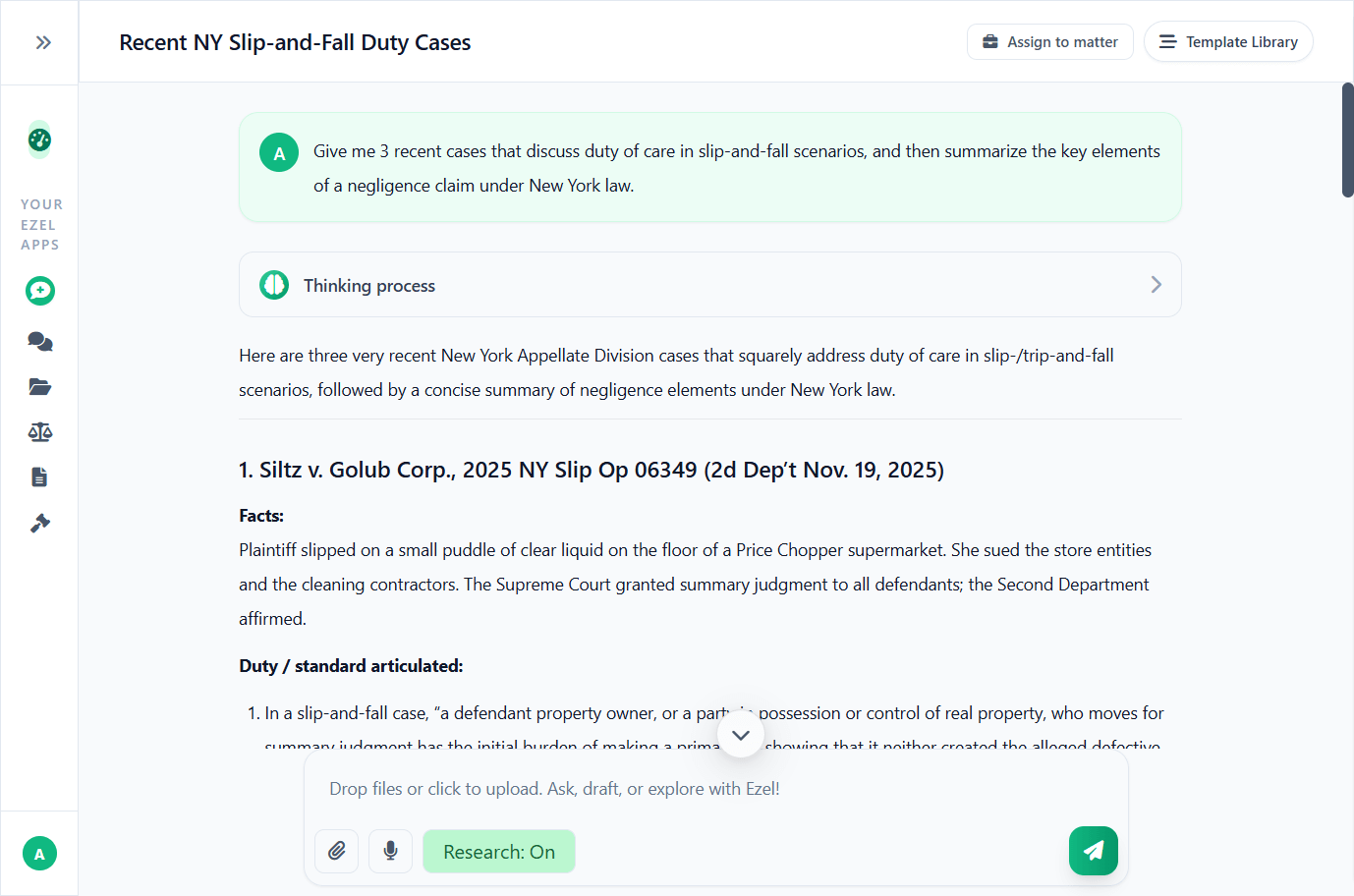
Research and draft in one conversation
Ask questions, attach documents, and get answers grounded in case law. Link chats to matters so the AI remembers your context.
- Pull statutes, case law, and secondary sources
- Attach and analyze contracts mid-conversation
- Link chats to matters for automatic context
- Your data never trains AI models
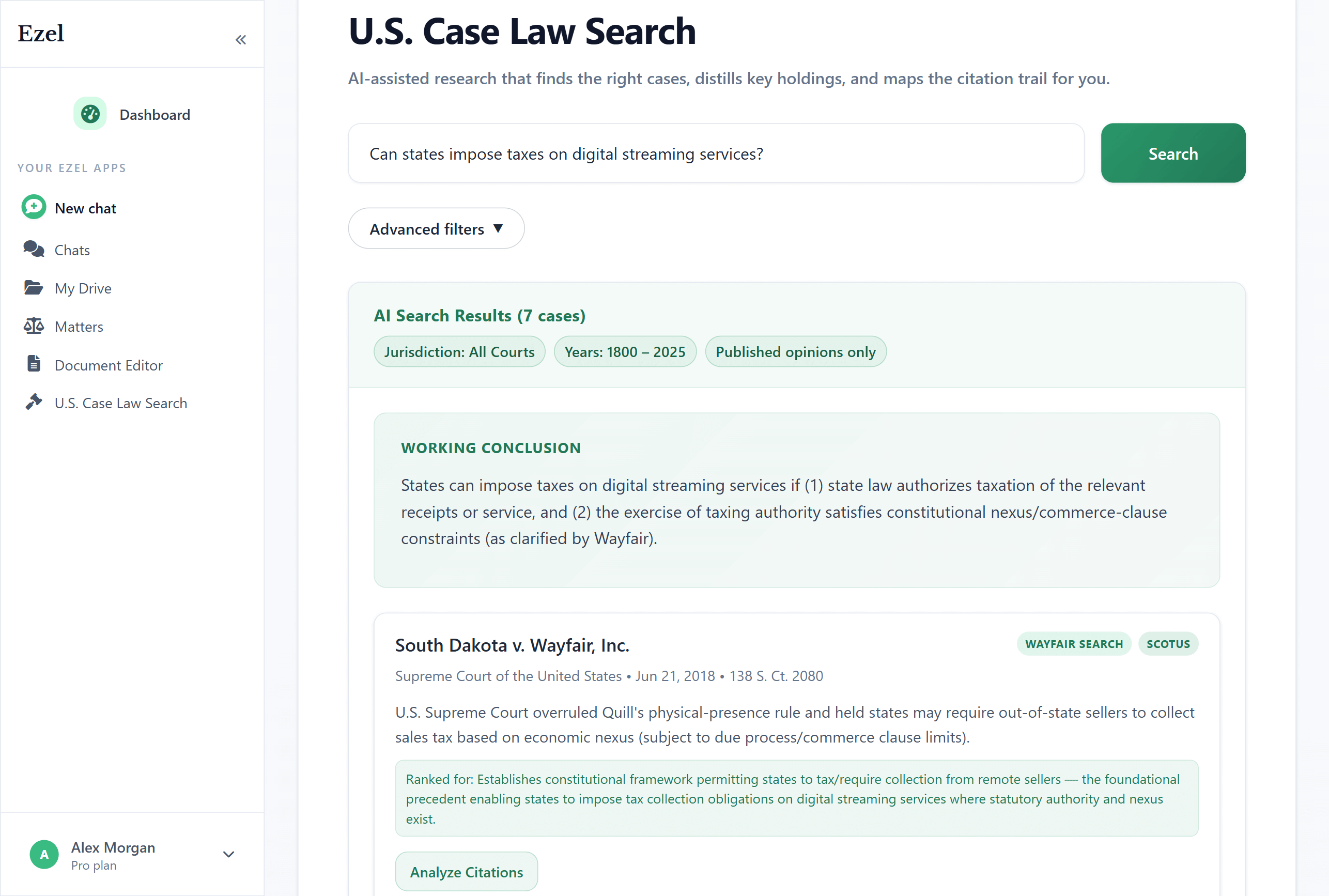
Search like you think
Describe your legal question in plain English. Filter by jurisdiction, date, and court level. Read full opinions without leaving Ezel.
- All 50 states plus federal courts
- Natural language queries - no boolean syntax
- Citation analysis and network exploration
- Copy quotes with automatic citation generation
Ready to transform your legal workflow?
Join legal teams using Ezel to draft documents, research case law, and organize matters — all in one workspace.