RETALIATION DEMAND LETTER
Minnesota Whistleblower Act and Anti-Retaliation Claims
[ATTORNEY/FIRM LETTERHEAD]
[Firm Name]
[Address Line 1]
[City, Minnesota ZIP]
Tel: [Phone Number]
Fax: [Fax Number]
[Attorney Email]
[Minnesota Attorney Registration Number]
VIA CERTIFIED MAIL, RETURN RECEIPT REQUESTED
AND VIA EMAIL TO: [recipient_email]
[Date]
[Employer Contact Name]
[Title]
[Company Legal Name]
[Company Address]
[City, State ZIP]
Copy to:
[General Counsel]
[EPLI Carrier, if known]
Re: Unlawful Retaliation Against [Client Full Name]
MDHR Charge No.: [XXXXX] (if applicable)
EEOC Charge No.: [XXX-XXXX-XXXXX] (if applicable)
CONFIDENTIAL SETTLEMENT COMMUNICATION PURSUANT TO MINN. R. EVID. 408
Dear [Mr./Ms./Mx. Last Name]:
This firm represents [Client Full Name] ("our client") in connection with claims of unlawful retaliation against [Company Legal Name] ("[Company Short Name]" or "the Company"). Please direct all future communications regarding this matter to our office.
Our client engaged in legally protected activity by [briefly describe protected activity], and [Company Short Name] retaliated by [briefly describe adverse action]. This retaliation violates Minnesota law and exposes the Company to substantial liability for compensatory damages, civil penalties, and attorney's fees.
We write to demand immediate resolution of this matter and to advise that we are prepared to file suit if a satisfactory response is not received.
I. MINNESOTA-SPECIFIC LEGAL FRAMEWORK
A. Minnesota Whistleblower Act
The Minnesota Whistleblower Act, Minn. Stat. Section 181.932, provides broad protection for employees who report violations of law or refuse to participate in illegal activities.
Key Provisions:
Under Minn. Stat. Section 181.932, subd. 1, an employer shall not discharge, discipline, threaten, otherwise discriminate against, or penalize an employee regarding the employee's compensation, terms, conditions, location, or privileges of employment because:
(a) The employee, or a person acting on behalf of an employee, in good faith, reports a violation, suspected violation, or planned violation of any federal, state, or common law, or rule adopted pursuant to law, to an employer or to any governmental body or law enforcement official;
(b) The employee is requested by a public body or office to participate in an investigation, hearing, or inquiry;
(c) The employee refuses an employer's order to perform an action that the employee has an objective basis in fact to believe violates any state or federal law or rule or regulation;
(d) The employee, in good faith, reports a situation in which the quality of health care services provided by a health care facility, organization, or health care provider violates a standard established by federal or state law or rule.
Good Faith Requirement: The employee must act in "good faith," meaning a genuine belief that a violation has occurred or is about to occur.
Statute of Limitations: Two (2) years from the date of the violation. Minn. Stat. Section 181.932, subd. 3.
Remedies under Section 181.932:
- Reinstatement with back pay
- Restoration of lost service credit
- Compensatory damages
- Civil penalty up to $25,000 payable to the employee
- Reasonable attorney's fees and costs
- Injunctive relief
B. Minnesota Human Rights Act (MHRA)
The Minnesota Human Rights Act, Minn. Stat. Section 363A.01 et seq., prohibits discrimination and retaliation in employment.
Anti-Retaliation Provision: Minn. Stat. Section 363A.15 provides that it is an unfair discriminatory practice for any person to intentionally engage in any reprisal against any person because that person:
- Opposed a practice forbidden under the MHRA;
- Filed a charge with the MDHR;
- Testified, assisted, or participated in an investigation, proceeding, or hearing under the MHRA;
- Associated with a person or group of persons who are disabled or who are of a different race, color, creed, religion, sexual orientation, or national origin.
Administrative Exhaustion: A charge must be filed with the Minnesota Department of Human Rights (MDHR) within one (1) year of the alleged unfair discriminatory practice. Minn. Stat. Section 363A.28, subd. 3.
Remedies under MHRA:
- Reinstatement
- Back pay with interest
- Compensatory damages for mental anguish and suffering
- Punitive damages (in cases of willful conduct)
- Civil penalties
- Attorney's fees and costs
C. Minnesota Common Law Wrongful Discharge
Minnesota recognizes a common law cause of action for wrongful discharge in violation of public policy, though it is narrowly construed.
Key Case Law:
- Phipps v. Clark Oil & Ref. Corp., 408 N.W.2d 569 (Minn. 1987) (recognizing public policy exception for refusing to violate law)
- Abraham v. County of Hennepin, 639 N.W.2d 342 (Minn. 2002) (discussing scope of whistleblower protections)
- Benson v. Nw. Airlines, Inc., 561 N.W.2d 530 (Minn. Ct. App. 1997) (public policy exception)
Statute of Limitations: Six (6) years for breach of contract. Minn. Stat. Section 541.05.
D. Specific Whistleblower Protections
Minnesota provides additional protections in specific contexts:
1. Healthcare Workers: Minn. Stat. Section 181.932, subd. 1(d) specifically protects healthcare workers who report quality of care violations.
2. Public Employees: Minn. Stat. Section 181.931 et seq. provides specific protections for state employees.
3. Occupational Safety: Minn. Stat. Section 182.654, subd. 9 protects employees who report workplace safety violations.
4. Financial Fraud: Minn. Stat. Section 302A.781 protects employees who report securities violations.
II. NATURE OF THE PROTECTED ACTIVITY
Our client engaged in one or more forms of protected activity that triggered [Company Short Name]'s unlawful retaliation:
A. Type of Protected Activity
[Check all that apply]
Reporting Violations (Whistleblower Act)
- [ ] Reported violations of federal law in good faith
- [ ] Reported violations of state law in good faith
- [ ] Reported violations of common law in good faith
- [ ] Reported suspected or planned violations
- [ ] Reported violations to employer
- [ ] Reported violations to governmental body or law enforcement
Participation in Investigation (Whistleblower Act)
- [ ] Requested by a public body to participate in an investigation
- [ ] Testified in a hearing or inquiry
- [ ] Provided information to investigators
Refusal to Participate in Illegal Activity (Whistleblower Act)
- [ ] Refused employer's order to perform an action that violates state law
- [ ] Refused employer's order to perform an action that violates federal law
- [ ] Had objective basis in fact for belief that action was illegal
Healthcare Quality Reporting (Whistleblower Act)
- [ ] Reported quality of care violations to a health care facility
- [ ] Reported violations of healthcare standards
- [ ] Reported patient safety concerns
Opposition to Discrimination/Harassment (MHRA)
- [ ] Complained internally about discrimination based on [race / color / creed / religion / national origin / sex / marital status / familial status / disability / public assistance status / age / sexual orientation / gender identity]
- [ ] Complained internally about harassment or hostile work environment
- [ ] Reported discrimination or harassment to human resources
Participation in Discrimination Proceedings (MHRA)
- [ ] Filed a Charge of Discrimination with MDHR or EEOC
- [ ] Participated in an MDHR investigation
- [ ] Testified or provided information in a discrimination proceeding
Other Protected Activity
- [ ] Filed a workers' compensation claim
- [ ] Reported workplace safety violations
- [ ] Engaged in concerted activity protected by the NLRA
- [ ] [Other: describe]
B. Timeline of Protected Activity
| Date | Protected Activity | Reported To / Filed With | Documentation |
|---|---|---|---|
| [Date] | [Description] | [Recipient/Agency] | [Emails, written complaint, etc.] |
| [Date] | [Description] | [Recipient/Agency] | [Documentation] |
| [Date] | [Description] | [Recipient/Agency] | [Documentation] |
C. Detailed Narrative
On [Date], our client [describe the protected activity in detail]:
[Provide comprehensive narrative including:
- What our client observed, learned, or experienced that prompted the protected activity
- The specific concerns raised or actions taken
- To whom the concerns were raised (names, titles)
- The manner of reporting (verbal, written, formal complaint)
- Any response received from management or HR
- Any instructions given to our client regarding the matter
- Any witnesses to the protected activity]
Our client's [complaint / report / testimony / action] was made in good faith and based on a reasonable belief that [the conduct complained of was unlawful / the information reported was accurate / the activity opposed was illegal].
III. THE RETALIATORY CONDUCT
A. Adverse Employment Actions
Following our client's protected activity, [Company Short Name] subjected [him/her/them] to the following retaliatory adverse employment actions:
[Check all applicable actions and provide details]
Termination/Constructive Discharge
- [ ] Our client was terminated on [Date]
- [ ] Our client was forced to resign due to intolerable conditions on [Date]
Demotion/Reassignment
- [ ] Demoted from [Former Position] to [New Position] on [Date]
- [ ] Reassigned to less desirable duties/location/shift on [Date]
- [ ] Stripped of [responsibilities / authority / direct reports] on [Date]
Compensation Reductions
- [ ] Salary reduced from $[Amount] to $[Amount] on [Date]
- [ ] Bonus denied or reduced on [Date]
- [ ] Hours reduced from [X] to [X] per week on [Date]
Performance/Discipline
- [ ] Received negative performance review on [Date] (previously had positive reviews)
- [ ] Placed on performance improvement plan (PIP) on [Date]
- [ ] Received written warning on [Date] for [pretextual reason]
- [ ] Suspended [with/without] pay from [Date] to [Date]
Hostile Treatment/Exclusion
- [ ] Excluded from meetings, communications, or decisions
- [ ] Subjected to increased scrutiny and micromanagement
- [ ] Isolated from coworkers or ostracized
- [ ] Given impossible tasks or set up to fail
Other Adverse Actions
- [ ] Denied promotion to [Position] on [Date]
- [ ] Negative reference provided to prospective employer
- [ ] [Other: describe]
B. Timeline of Retaliation
| Date | Days After Protected Activity | Adverse Action | Decision-Maker |
|---|---|---|---|
| [Protected Activity Date] | 0 | [Protected Activity] | N/A |
| [Date] | [X days] | [Adverse Action 1] | [Name/Title] |
| [Date] | [X days] | [Adverse Action 2] | [Name/Title] |
| [Date] | [X days] | [Termination/Final Action] | [Name/Title] |
C. Evidence of Causal Connection
The causal connection between our client's protected activity and the adverse actions is demonstrated by:
1. Temporal Proximity
The adverse actions began just [X days/weeks] after our client's protected activity. Minnesota courts recognize that close temporal proximity between protected activity and adverse action supports an inference of causation. See Hubbard v. United Press Int'l, Inc., 330 N.W.2d 428, 445 (Minn. 1983).
2. Knowledge
The decision-makers who took adverse action against our client had knowledge of [his/her/their] protected activity.
3. Pattern of Antagonism
Following the protected activity, our client experienced a sudden shift in treatment from positive to hostile.
4. Pretext
The reasons offered by [Company Short Name] for the adverse actions are pretextual.
IV. LEGAL CLAIMS
A. Minnesota Whistleblower Act
Minn. Stat. Section 181.932
Our client is entitled to protection under the Minnesota Whistleblower Act because [he/she/they]:
[Select applicable theory]
-
[ ] Reporting Theory: In good faith, reported a violation, suspected violation, or planned violation of federal, state, or common law to the employer or a governmental body.
-
[ ] Participation Theory: Was requested by a public body or office to participate in an investigation, hearing, or inquiry.
-
[ ] Refusal Theory: Refused an employer's order to perform an action that [he/she/they] had an objective basis in fact to believe violated state or federal law.
-
[ ] Healthcare Quality Theory: In good faith, reported a situation in which the quality of health care services violated established standards.
The law or regulation at issue is [cite specific Minnesota statute, federal law, or regulation].
B. Minnesota Human Rights Act - Retaliation
Minn. Stat. Section 363A.15
Our client [opposed discrimination / filed a charge / testified / participated in an investigation] and suffered retaliation as a result.
The protected conduct related to discrimination based on [identify protected class under MHRA].
C. Common Law Wrongful Discharge
Our client's termination violated the well-established public policy of Minnesota as expressed in [cite specific statute or constitutional provision].
See Phipps v. Clark Oil & Ref. Corp., 408 N.W.2d 569 (Minn. 1987).
D. Federal Claims (If Applicable)
[Include if federal claims are being asserted alongside Minnesota claims]
- [ ] Title VII Anti-Retaliation, 42 U.S.C. Section 2000e-3(a)
- [ ] 42 U.S.C. Section 1981 (Race-Based Retaliation)
- [ ] ADA Anti-Retaliation, 42 U.S.C. Section 12203
- [ ] ADEA Anti-Retaliation, 29 U.S.C. Section 623(d)
- [ ] FLSA Anti-Retaliation, 29 U.S.C. Section 215(a)(3)
V. DAMAGES
A. Economic Damages
1. Lost Wages (Back Pay)
| Category | Calculation | Amount |
|---|---|---|
| Base salary | $[Annual] / 12 x [X months] | $[Amount] |
| Lost bonuses | [Calculation] | $[Amount] |
| Lost overtime | [Calculation] | $[Amount] |
| Subtotal Back Pay | $[Amount] |
2. Lost Benefits
| Benefit | Monthly Value | Months | Amount |
|---|---|---|---|
| Health insurance | $[Amount] | [X] | $[Amount] |
| 401(k) match | $[Amount] | [X] | $[Amount] |
| Other benefits | $[Amount] | [X] | $[Amount] |
| Subtotal Benefits | $[Amount] |
3. Front Pay
| Category | Calculation | Amount |
|---|---|---|
| Future salary loss | [Calculation] | $[Amount] |
| Future benefits loss | [Calculation] | $[Amount] |
| Subtotal Front Pay | $[Amount] |
B. Compensatory Damages
For emotional distress and other non-economic harm:
- [Describe emotional impact]
- [Describe physical manifestations]
- [Describe impact on daily life]
Compensatory damages: $[Amount]
C. Civil Penalty (Whistleblower Act)
Under Minn. Stat. Section 181.932, subd. 2, a civil penalty of up to $25,000 payable to the employee.
Civil penalty: $[Amount]
D. Punitive Damages (MHRA)
For willful violations of the Minnesota Human Rights Act:
Punitive damages: $[Amount]
E. Interest
Pre-judgment interest as provided by Minnesota law.
F. Attorney's Fees and Costs
Minnesota law provides for recovery of reasonable attorney's fees in whistleblower and discrimination cases.
Estimated fees through trial: $[Amount]
Estimated costs: $[Amount]
G. Summary of Damages
| Category | Amount |
|---|---|
| Back Pay | $[Amount] |
| Lost Benefits | $[Amount] |
| Front Pay | $[Amount] |
| Emotional Distress | $[Amount] |
| Civil Penalty | $[Amount] |
| Punitive Damages | $[Amount] |
| Interest | $[Amount] |
| Attorney's Fees | $[Amount] |
| TOTAL | $[Amount] |
VI. SETTLEMENT DEMAND
Based on the foregoing, we demand that [Company Short Name] pay $[Settlement Demand Amount] in full and final settlement of all claims arising from the unlawful retaliation against our client.
Settlement Terms
In addition to the monetary payment, settlement must include:
- [ ] Neutral Reference: [Company Short Name] will provide only dates of employment and final position
- [ ] Personnel File: Expungement of all documents related to the pretextual discipline and termination
- [ ] Non-Disparagement: Mutual non-disparagement provisions
- [ ] Confidentiality: Subject to negotiation
- [ ] Unemployment: [Company Short Name] will not contest unemployment benefits
VII. RESPONSE DEADLINE
Please respond to this demand in writing within fourteen (14) calendar days of receipt, no later than [Response Deadline Date].
Critical Deadlines:
- Whistleblower Act statute of limitations (2 years): [Date]
- MDHR 1-year filing deadline: [Date]
- EEOC filing deadline (if applicable): [Date]
If we do not receive a satisfactory response, we will file suit in [Minnesota District Court, [County] County] or [United States District Court, District of Minnesota] asserting:
- Violation of the Minnesota Whistleblower Act, Minn. Stat. Section 181.932
- Retaliation in violation of the Minnesota Human Rights Act, Minn. Stat. Section 363A.15 [if applicable]
- Common law wrongful discharge in violation of public policy
- [Additional claims as applicable]
VIII. DOCUMENT PRESERVATION
This letter constitutes formal notice of litigation. [Company Short Name] must immediately implement a litigation hold to preserve all documents and ESI relevant to our client's employment, the protected activity, and all adverse actions.
Spoliation of evidence may result in sanctions and adverse inferences under Minnesota law.
IX. CONFIDENTIALITY
This letter is a confidential settlement communication protected by Minnesota Rule of Evidence 408 and applicable state law.
We are prepared to discuss resolution of this matter at your earliest convenience. Please contact me to arrange a settlement conference.
Sincerely,
[Attorney Name]
[Title]
[Firm Name]
[Attorney Signature Block]
Enclosures:
- [ ] MDHR Charge (if applicable)
- [ ] EEOC Right to Sue Notice (if applicable)
- [ ] Authorization to Represent
cc: [Client Name] (via email)
[File]
MINNESOTA-SPECIFIC PRACTICE NOTES
Broad Scope of Protected Reports: The Minnesota Whistleblower Act protects reports of violations of "any federal, state, or common law, or rule adopted pursuant to law." This is broader than many states' whistleblower statutes and includes common law violations.
Good Faith Requirement: The employee must act in "good faith," which means a genuine belief that a violation occurred. The belief need not be correct, but it must be sincere and based on reasonable information.
Civil Penalty: The Whistleblower Act provides for a civil penalty of up to $25,000 payable directly to the employee, in addition to compensatory damages. This is a significant enhancement beyond typical remedies.
Internal Reporting Protected: Unlike some states, Minnesota protects reports made to the employer as well as to governmental bodies. This is a key advantage for employees who first report internally.
MHRA Administrative Exhaustion: For MHRA claims, a charge must be filed with the Minnesota Department of Human Rights within one year. After receiving a Right to Sue letter, the plaintiff has only 45 days to file in court.
Broad Protected Classes: The MHRA protects more classes than federal law, including sexual orientation, gender identity, and public assistance status.
Healthcare-Specific Protections: Minnesota has specific statutory protection for healthcare workers who report quality of care concerns, recognizing the critical importance of patient safety whistleblowing.
Do more with Ezel
This free template is just the beginning. See how Ezel helps legal teams draft, research, and collaborate faster.
AI that drafts while you watch
Tell the AI what you need and watch your document transform in real-time. No more copy-pasting between tools or manually formatting changes.
- Natural language commands: "Add a force majeure clause"
- Context-aware suggestions based on document type
- Real-time streaming shows edits as they happen
- Milestone tracking and version comparison
Research and draft in one conversation
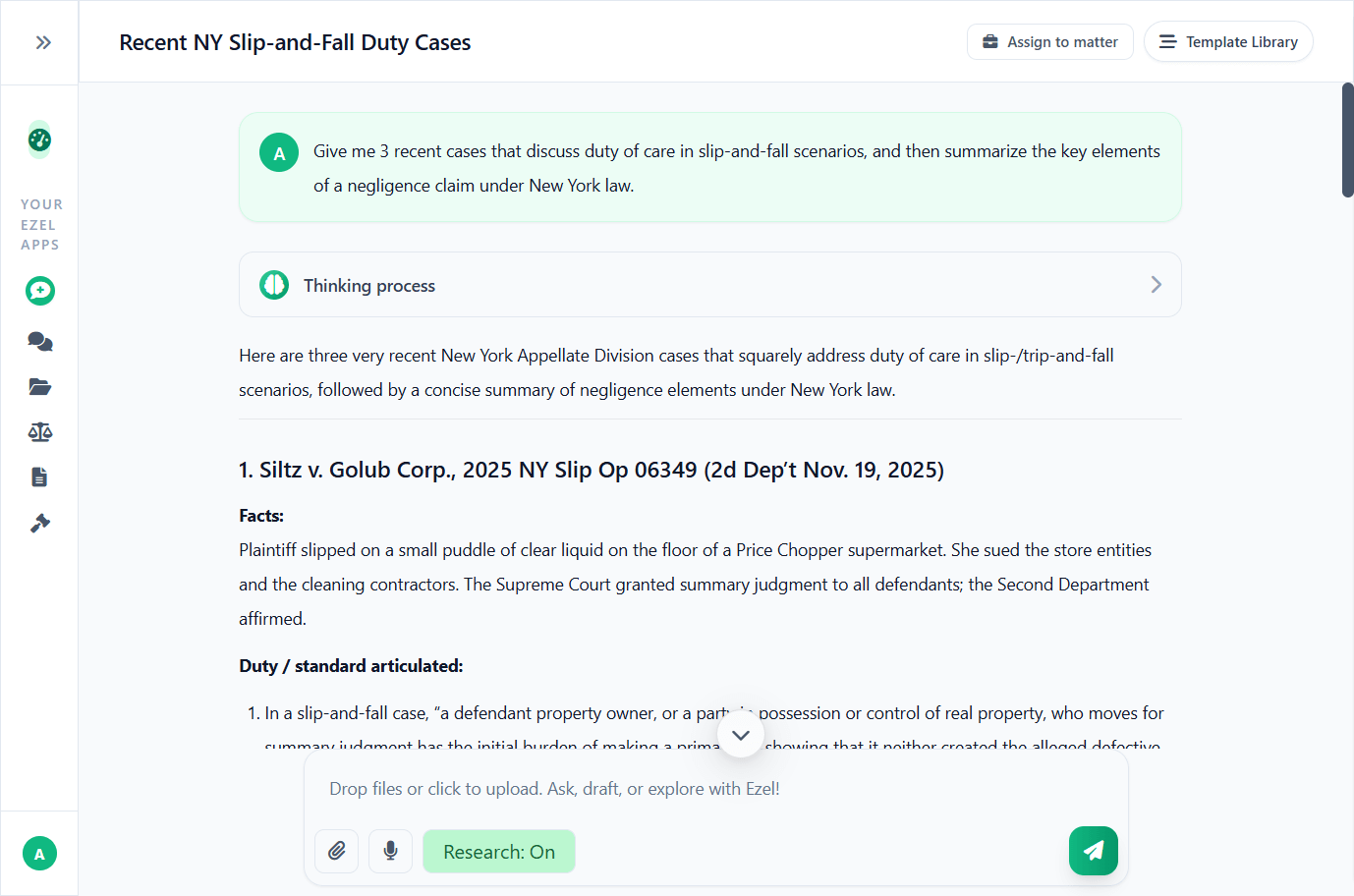
Ask questions, attach documents, and get answers grounded in case law. Link chats to matters so the AI remembers your context.
- Pull statutes, case law, and secondary sources
- Attach and analyze contracts mid-conversation
- Link chats to matters for automatic context
- Your data never trains AI models
Search like you think
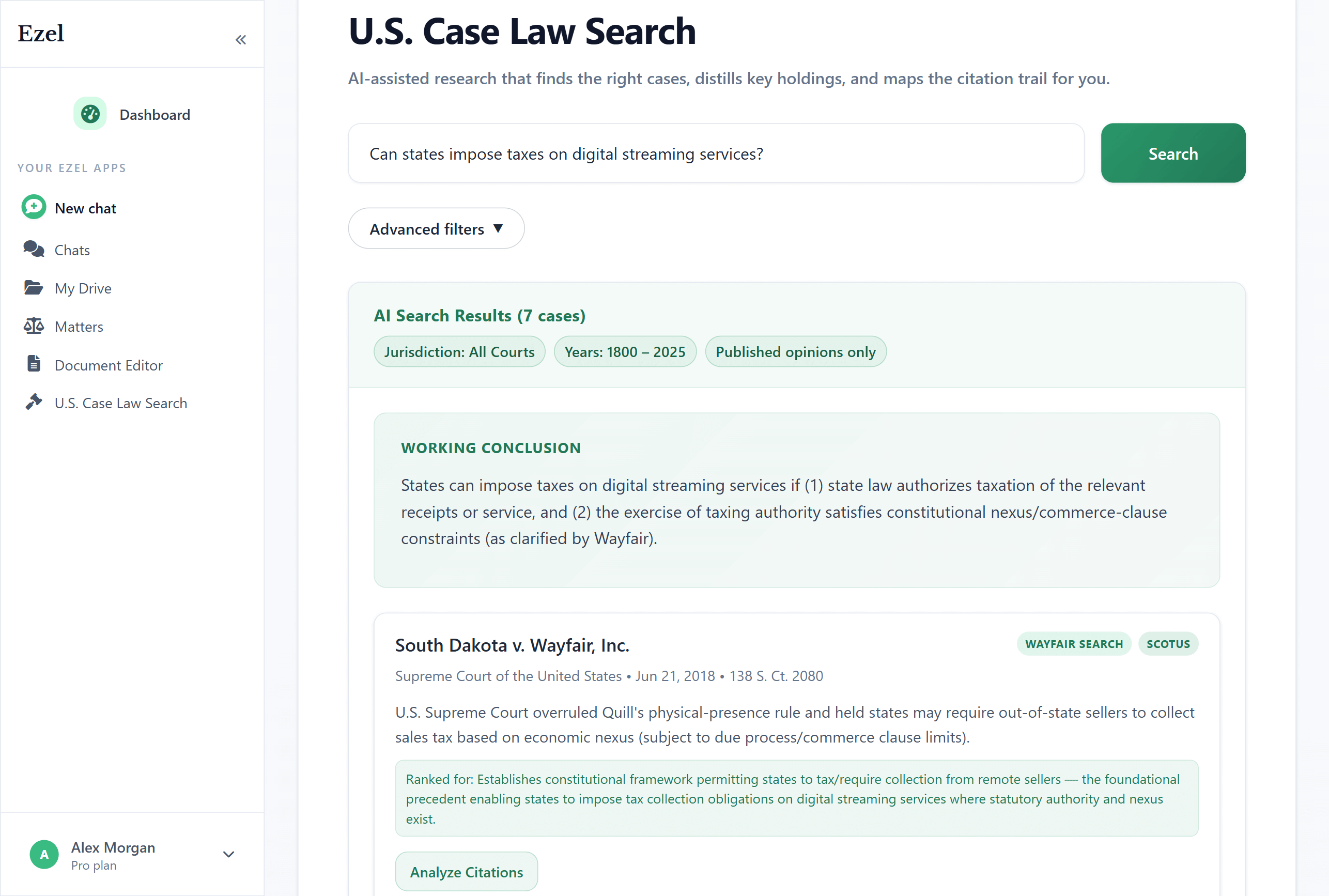
Describe your legal question in plain English. Filter by jurisdiction, date, and court level. Read full opinions without leaving Ezel.
- All 50 states plus federal courts
- Natural language queries - no boolean syntax
- Citation analysis and network exploration
- Copy quotes with automatic citation generation
Ready to transform your legal workflow?
Join legal teams using Ezel to draft documents, research case law, and organize matters — all in one workspace.