REMOTE WORK POLICY
Company: [________________________________]
Policy Number: [________________________________]
Effective Date: [__/__/____]
Last Revised: [__/__/____]
Approved By: [________________________________], [Title]
Applies To: All employees approved for remote or hybrid work arrangements
TABLE OF CONTENTS
- Purpose and Policy Statement
- Scope and Definitions
- Eligibility Criteria
- Application and Approval Process
- Remote Work Agreement
- Work Schedule, Availability, and Communication
- Timekeeping and Overtime — FLSA Compliance
- Workspace Requirements
- Equipment and Technology
- Data Security and Confidentiality
- Expense Reimbursement
- Workers' Compensation
- Health and Safety
- Tax Implications
- Remote Work as ADA Reasonable Accommodation
- Performance Management
- Communication and Collaboration
- Modification, Suspension, and Termination of Remote Work
- Return of Company Property
- State-Specific Considerations
- Policy Administration
- Acknowledgment and Remote Work Agreement
1. PURPOSE AND POLICY STATEMENT
[________________________________] ("Company") recognizes that remote work arrangements can benefit both the organization and its employees by increasing flexibility, expanding access to talent, improving work-life balance, and supporting business continuity. This policy establishes a framework for remote and hybrid work arrangements that balances these benefits with the Company's operational needs, legal compliance obligations, and security requirements.
Remote work is a privilege, not an entitlement, and is subject to Company approval unless provided as a reasonable accommodation under the Americans with Disabilities Act (ADA) or other applicable law. The Company retains the right to modify, suspend, or revoke remote work arrangements based on business needs, performance, or other factors described in this policy.
This policy is intended to comply with all applicable federal, state, and local employment laws, including the Fair Labor Standards Act (FLSA), state wage and hour laws, workers' compensation laws, expense reimbursement statutes, tax withholding requirements, and the ADA.
2. SCOPE AND DEFINITIONS
2.1 Definitions
| Term | Definition |
|---|---|
| Remote work | A work arrangement in which an employee performs their job duties from a location other than the Company's designated office or worksite on a regular, recurring basis |
| Fully remote | An arrangement in which the employee works exclusively from a remote location and is not assigned to a Company office |
| Hybrid | An arrangement in which the employee works from a remote location on some days and from a Company office on other days, according to an agreed-upon schedule |
| Temporary remote work | A short-term remote arrangement granted for a specific reason and duration (e.g., inclement weather, personal circumstances, facility closure) |
| Primary remote work location | The employee's designated remote work address, typically their home residence, from which they regularly perform work |
| Telecommuting | Used interchangeably with "remote work" in this policy |
2.2 Types of Remote Work Arrangements
The Company offers the following categories of remote work:
- Category A — Fully Remote: Employee works 100% remotely; no regular in-office requirement. May be required to travel to a Company location periodically for meetings, training, or other business needs.
- Category B — Hybrid: Employee works remotely [____] days per week and in-office [____] days per week, according to a regular schedule approved by their manager.
- Category C — Occasional/Flexible Remote: Employee primarily works on-site but may work remotely on an occasional, as-needed basis with supervisor approval.
- Category D — Temporary Remote: Employee works remotely for a defined period due to specific circumstances (e.g., medical recovery, relocation transition, facility maintenance).
3. ELIGIBILITY CRITERIA
3.1 Position Eligibility
Not all positions are suitable for remote work. Eligibility is determined based on the nature of the position, including:
- Whether the essential functions of the position can be performed effectively from a remote location
- Whether the position requires regular in-person interaction with customers, clients, patients, or other individuals
- Whether the position requires access to equipment, materials, or facilities that are only available on-site
- Whether the position requires in-person supervision or collaboration that cannot be effectively conducted remotely
- Security or regulatory requirements that necessitate on-site presence
The Company will maintain a list of positions eligible for remote work by category (fully remote, hybrid, or occasional). The determination of position eligibility is made by the department head in consultation with HR.
3.2 Employee Eligibility
Employees seeking remote work arrangements must generally meet the following criteria:
☐ Minimum of [____] months of employment with the Company (waived for positions designated as fully remote at time of hire)
☐ Satisfactory performance rating on most recent performance evaluation
☐ No active performance improvement plan or final disciplinary warning
☐ Demonstrated ability to work independently and manage time effectively
☐ Adequate home workspace that meets the requirements of Section 8
☐ Reliable internet connectivity meeting minimum bandwidth requirements
☐ Ability to maintain data security in accordance with Section 10
☐ Compliance with all other requirements specified in this policy
3.3 Exceptions
The eligibility criteria in Section 3.2 may be waived or modified in the following circumstances:
- The position was designated as remote at the time of hire
- Remote work is provided as a reasonable accommodation under the ADA, PWFA, or applicable state disability law (see Section 15)
- Remote work is necessitated by a business continuity event, public health emergency, or other extraordinary circumstance
- Remote work is required to comply with a medical restriction or return-to-work condition
4. APPLICATION AND APPROVAL PROCESS
4.1 Requesting Remote Work
Employees who wish to establish a regular remote work arrangement must submit a written request using the Company's Remote Work Request Form. The request should include:
☐ Type of arrangement requested (fully remote, hybrid, or occasional)
☐ Proposed schedule (for hybrid: which days remote, which days on-site)
☐ Primary remote work location (full address)
☐ Description of proposed workspace
☐ Confirmation of adequate internet connectivity
☐ Business justification for the arrangement (if applicable)
☐ Any accommodations or modifications needed
4.2 Approval Process
| Step | Action | Timeline |
|---|---|---|
| 1 | Employee submits Remote Work Request Form to supervisor | — |
| 2 | Supervisor reviews request and discusses with employee | Within [____] business days |
| 3 | Supervisor forwards recommendation (approve/deny) to HR and department head | Within [____] business days |
| 4 | HR reviews for compliance (tax, workers' comp, expense reimbursement, ADA) | Within [____] business days |
| 5 | Final decision communicated to employee in writing | Within [____] business days of submission |
| 6 | If approved, employee signs Remote Work Agreement (Section 22) | Before remote work begins |
4.3 Denial and Appeal
If a remote work request is denied, the employee will receive a written explanation of the reasons. Employees may appeal the denial by submitting a written appeal to [________________________________] within [____] business days. Denials of requests made as ADA reasonable accommodations will be handled through the Company's ADA interactive process.
5. REMOTE WORK AGREEMENT
Before beginning a remote work arrangement, the employee and the Company must execute a written Remote Work Agreement (see Section 22). The agreement will specify:
- Type and category of remote work arrangement
- Approved work schedule and core hours
- Primary remote work location
- Equipment and technology provided
- Expense reimbursement terms
- Data security obligations
- Duration of the arrangement (if temporary) or ongoing nature (subject to modification or revocation)
- Performance expectations and communication requirements
- Acknowledgment that the arrangement may be modified or revoked
- Employee's agreement to comply with this policy
The Remote Work Agreement is incorporated into and governed by this policy. In the event of a conflict between the agreement and this policy, this policy controls.
6. WORK SCHEDULE, AVAILABILITY, AND COMMUNICATION
6.1 Work Schedule
Remote employees are expected to work their regularly scheduled hours unless an alternative schedule has been approved by their supervisor. The approved schedule will be documented in the Remote Work Agreement.
- Core hours: Remote employees must be available during core business hours: [________________________________] (e.g., 9:00 AM to 3:00 PM in the employee's local time zone, or the Company's headquarters time zone, as specified)
- Flexible hours: With supervisor approval, employees may have flexibility outside of core hours to complete their remaining scheduled hours
- Schedule changes: Any changes to the approved schedule must be approved by the supervisor in advance
6.2 Availability and Responsiveness
During scheduled work hours, remote employees must:
- Be accessible by phone, email, and instant messaging (e.g., [________________________________])
- Respond to communications within a reasonable timeframe (generally [____] minutes during core hours, unless in a meeting)
- Participate in scheduled meetings and conference calls as required
- Notify their supervisor promptly if they become unavailable due to technical issues, illness, or personal emergencies
6.3 Dependent Care
Remote work is not a substitute for dependent care. Employees with caregiving responsibilities for children, elderly family members, or others must arrange for adequate dependent care during scheduled work hours. Occasional, short-term exceptions may be made at the supervisor's discretion for emergency situations.
7. TIMEKEEPING AND OVERTIME — FLSA COMPLIANCE
7.1 Non-Exempt Employees
Non-exempt (hourly) remote employees are subject to the timekeeping and overtime provisions of the FLSA (29 U.S.C. § 201 et seq.) and applicable state wage and hour laws. Non-exempt remote employees must:
☐ Accurately record all hours worked, including start and stop times, using the Company's designated timekeeping system: [________________________________]
☐ Record all meal periods and rest breaks in accordance with applicable state law
☐ Report any time worked outside of scheduled hours to their supervisor promptly
☐ Obtain prior written approval from their supervisor before working overtime
☐ Not perform any work "off the clock" — all compensable time must be recorded, including time spent checking emails, responding to messages, or performing other work duties before or after scheduled hours
7.2 Overtime
All overtime for non-exempt employees must be approved in advance by the employee's supervisor unless an emergency or urgent business need arises. The Company will compensate all hours actually worked, whether or not pre-approved, in accordance with the FLSA and applicable state law.
Overtime rates:
- Federal: 1.5 times the regular rate for hours exceeding 40 in a workweek (29 U.S.C. § 207)
- California: 1.5 times for hours exceeding 8 in a workday or 40 in a workweek; 2 times for hours exceeding 12 in a workday (Cal. Lab. Code § 510)
- Other states: As required by applicable state overtime law
NOTE: Failure to pre-approve overtime does not relieve the Company of its obligation to pay for all hours worked. However, repeated unauthorized overtime may result in disciplinary action.
7.3 Exempt Employees
Exempt employees are not subject to hourly timekeeping requirements. However, exempt remote employees are expected to work the hours necessary to fulfill their responsibilities and maintain their salary basis in accordance with 29 C.F.R. § 541.602. Exempt employees are not eligible for overtime pay.
7.4 Meal and Rest Breaks
Remote employees are entitled to the same meal and rest break rights as on-site employees under applicable state law. Non-exempt employees must take all required breaks and record them accurately. Key state requirements include:
| State | Meal Break | Rest Break |
|---|---|---|
| California | 30 minutes for shifts over 5 hours; second meal break for shifts over 10 hours | 10 minutes per 4 hours worked |
| New York | 30 minutes for shifts over 6 hours (factory); 45 minutes for shifts over 6 hours (factory, noon meal) | No state requirement |
| Washington | 30 minutes for shifts over 5 hours | 10 minutes per 4 hours worked |
| Colorado | 30 minutes for shifts over 5 hours | 10 minutes per 4 hours worked |
| Oregon | 30 minutes for shifts over 6 hours | 10 minutes per 4 hours worked |
NOTE TO EMPLOYER: Verify break requirements for all states with remote workers. Penalties for meal and rest break violations can be substantial, particularly in California.
8. WORKSPACE REQUIREMENTS
8.1 Designated Workspace
Remote employees must maintain a designated workspace at their primary remote work location that is:
☐ Reasonably quiet and free from distractions during work hours
☐ Adequate for performing job duties effectively (sufficient desk space, seating, lighting)
☐ Safe and free from hazards (see Section 13)
☐ Secure from unauthorized access to Company information, equipment, and documents
☐ Equipped with a reliable, high-speed internet connection meeting minimum requirements: [____] Mbps download / [____] Mbps upload
☐ In compliance with applicable building codes and zoning regulations (employee's responsibility to verify)
8.2 Home Office Inspection
The Company reserves the right to inspect the employee's remote workspace to verify compliance with safety and security requirements, with reasonable advance notice and at a mutually agreed-upon time. Inspections may be conducted in person or via video walkthrough.
8.3 Change of Work Location
Employees must notify HR and their supervisor in writing before changing their primary remote work location. A change in work location may trigger:
- State tax withholding and nexus obligations
- Workers' compensation jurisdiction changes
- Changes to applicable employment laws
- Expense reimbursement adjustments
The Company must approve any change of primary work location before it takes effect.
9. EQUIPMENT AND TECHNOLOGY
9.1 Company-Provided Equipment
The Company will provide the following equipment for use in the employee's remote workspace (as applicable to the role):
☐ Laptop computer or desktop computer
☐ Monitor(s): [____]
☐ Keyboard and mouse
☐ Headset or speakerphone
☐ Docking station
☐ Webcam (if not built into laptop)
☐ VPN access and necessary software licenses
☐ Other: [________________________________]
9.2 Terms of Equipment Use
- Company-provided equipment remains the property of the Company and must be used primarily for business purposes
- Employees must take reasonable care to protect Company equipment from damage, theft, and unauthorized access
- Employees must not install unauthorized software, modify hardware configurations, or allow non-employees to use Company equipment
- Lost, stolen, or damaged equipment must be reported to IT immediately
- All equipment must be returned upon termination of the remote work arrangement or separation from employment (see Section 19)
9.3 Personal Equipment
Where the Company does not provide certain equipment and the employee uses personal equipment (e.g., personal computer, personal phone, printer) for work purposes:
- The Company may require that personal equipment meet minimum security and technical specifications
- The Company reserves the right to install security software or mobile device management (MDM) tools on personal devices used for work, where necessary to protect Company data
- Expense reimbursement for personal equipment may apply (see Section 11)
9.4 Technical Support
The Company's IT department will provide remote technical support for Company-provided equipment and Company-supported software. IT support is available during: [________________________________] (e.g., Monday through Friday, 8:00 AM to 6:00 PM ET).
Employees are responsible for maintaining their own internet service and resolving issues with their internet service provider. If internet connectivity is unavailable, employees should notify their supervisor promptly and, if the outage is expected to last beyond [____] hours, should report to a Company office or make alternative arrangements approved by their supervisor.
10. DATA SECURITY AND CONFIDENTIALITY
10.1 General Obligations
Remote employees must comply with all Company information security, data privacy, and confidentiality policies, including the Company's [Information Security Policy / Acceptable Use Policy / Data Privacy Policy]. Remote work does not diminish these obligations.
10.2 Security Requirements
All remote employees must:
☐ Use the Company's VPN when accessing Company systems, networks, or data remotely
☐ Use strong, unique passwords and enable multi-factor authentication (MFA) on all work accounts
☐ Keep all software, operating systems, and security tools up to date with the latest patches
☐ Lock their computer or device when stepping away from their workspace
☐ Ensure that work is not visible to unauthorized persons (e.g., family members, roommates, visitors)
☐ Store Company documents and data only on Company-approved platforms and devices — not on personal cloud storage, USB drives, or other unapproved media
☐ Shred or securely dispose of any printed Company documents containing confidential or sensitive information
☐ Not use public Wi-Fi networks for work purposes without VPN protection
☐ Report any suspected security incident, data breach, or loss of equipment or data to IT and their supervisor immediately
☐ Comply with all applicable data protection and privacy laws (e.g., HIPAA, CCPA/CPRA, GDPR, GLBA, as applicable to the employee's role)
10.3 Confidential Information
Remote employees must ensure that confidential, proprietary, and personally identifiable information (PII) is:
- Accessed only as necessary to perform job duties
- Not disclosed to unauthorized persons, including household members
- Stored securely and not left in unattended or unsecured areas
- Discussed in private settings where conversations cannot be overheard
- Transmitted using encrypted communication channels
10.4 Video Conferencing and Virtual Meetings
When participating in video conferences from a remote location, employees should:
- Use headphones or a private room to prevent confidential information from being overheard
- Be mindful of what is visible in their camera background
- Use virtual backgrounds or blur features when in shared or public spaces
- Not record meetings without the consent of all participants (and in compliance with applicable state wiretapping laws)
11. EXPENSE REIMBURSEMENT
11.1 Federal Law
Federal law (FLSA) does not generally require employers to reimburse employees for remote work expenses, except where unreimbursed expenses would cause a non-exempt employee's effective hourly rate to fall below the federal minimum wage or the applicable state minimum wage.
11.2 State Expense Reimbursement Requirements
Several states require employers to reimburse employees for necessary business expenses, including expenses incurred while working remotely. The Company will comply with all applicable state expense reimbursement laws.
| State | Requirement | Key Citation |
|---|---|---|
| California | Employers must reimburse employees for all necessary expenditures incurred in direct discharge of duties. Includes reasonable percentage of internet, phone, and other expenses used for work. Applies regardless of whether the employee voluntarily works remotely. | Cal. Lab. Code § 2802 |
| Illinois | Employers must reimburse employees for all necessary expenditures incurred within the scope of employment, provided the expenses are authorized or required by the employer. Employees must submit reimbursement requests within 30 calendar days. | 820 ILCS 115/9.5 (IWPCA amendment) |
| Washington, D.C. | Employers must reimburse employees for all reasonable expenses required in connection with employment. | D.C. Code § 32-1331 |
| Iowa | Employers must reimburse expenses incurred by employees in the discharge of duties. | Iowa Code § 91A.3 |
| Montana | Employers must reimburse employees for necessary business expenses. | Mont. Code Ann. § 39-2-701 |
| New Hampshire | Employers must reimburse employees for expenses incurred in furtherance of the employer's business. | N.H. Rev. Stat. Ann. § 275:57 |
| South Dakota | Employer reimbursement required for necessary expenses. | S.D. Codified Laws § 60-2-1 |
| Massachusetts | Employer may not require employees to pay for supplies, tools, or equipment necessary for work unless allowed by regulation. | M.G.L. c. 149, § 148 |
| Minnesota | Employers must reimburse necessary expenditures made by employees. | Minn. Stat. § 177.24 |
NOTE TO EMPLOYER: Even in states without explicit reimbursement statutes, providing expense reimbursement for remote workers is a recommended best practice and may be required under common-law agency principles or employment agreements.
11.3 Reimbursable Expenses
Subject to applicable state law and Company approval, the following expenses may be eligible for reimbursement for remote employees:
| Expense Category | Reimbursement Approach |
|---|---|
| Internet service | [☐ Fixed monthly stipend of $[____] / ☐ Reasonable percentage of actual cost / ☐ Company-provided] |
| Cell phone / telephone | [☐ Fixed monthly stipend of $[____] / ☐ Reasonable percentage of actual cost / ☐ Company-provided] |
| Office supplies (paper, pens, ink, etc.) | Actual cost with receipt, up to $[____] per [month/quarter] |
| Office furniture (desk, chair, etc.) | [☐ One-time stipend of $[____] / ☐ Actual cost with prior approval / ☐ Not reimbursed] |
| Computer peripherals (monitor, keyboard, etc.) | [☐ Company-provided / ☐ Reimbursed with prior approval] |
| Printing and copying | Actual cost with receipt |
| Electricity / utilities | [☐ Included in stipend / ☐ Not separately reimbursed] |
| Software / applications | Company-provided or reimbursed with IT approval |
11.4 Reimbursement Procedure
☐ Employee submits expense reimbursement request through [________________________________] (e.g., expense management system, email to AP)
☐ Include itemized receipts for all expenses over $[____]
☐ Submit reimbursement requests within [____] days of incurring the expense (within 30 days for Illinois employees per IWPCA)
☐ Supervisor approves and forwards to Accounts Payable
☐ Reimbursement processed within [____] business days of approval
☐ For fixed stipends: Paid [☐ monthly / ☐ bi-weekly] with regular payroll
12. WORKERS' COMPENSATION
12.1 Coverage
Remote employees are covered by the Company's workers' compensation insurance for work-related injuries and illnesses that arise out of and in the course of employment, regardless of where the work is performed. The employee's home or other approved remote work location is considered an extension of the workplace during work hours.
12.2 Work-Related Injuries
A work-related injury at a remote location is generally compensable under workers' compensation if:
- The injury occurred during scheduled work hours (or while the employee was performing work duties)
- The injury arose out of the employee's work activities — not personal activities
- The employee was engaged in activity that was within the scope of their employment at the time of injury
Examples:
- An ergonomic injury (e.g., carpal tunnel, back strain) resulting from performing work duties at a remote workstation: likely compensable
- A fall while walking to the home office from the kitchen to get water during a work break: may be compensable (varies by state)
- An injury sustained while running a personal errand during a lunch break: generally not compensable
12.3 Reporting Injuries
Remote employees must report any work-related injury or illness immediately to their supervisor and HR, regardless of the severity. The same reporting procedures and timelines that apply to on-site injuries apply to injuries that occur at a remote work location.
☐ Report the injury to supervisor and HR on the same day (or as soon as practicable)
☐ Complete the Company's incident report form: [________________________________]
☐ Seek medical attention as appropriate
☐ Cooperate with the workers' compensation claims process
12.4 Jurisdiction
Workers' compensation coverage and claims are generally governed by the law of the state in which the employee is working at the time of the injury. For remote employees, this is typically the state where their primary remote work location is situated. The Company must maintain workers' compensation coverage in each state where remote employees are located.
NOTE TO EMPLOYER: Ensure you have workers' compensation coverage in every state where you have remote employees. Adding remote workers in a new state may require purchasing coverage in that state or updating your existing policy.
13. HEALTH AND SAFETY
13.1 Ergonomics
The Company is committed to promoting ergonomic health for remote employees. Remote employees should set up their workspace to minimize the risk of musculoskeletal injuries:
☐ Use a chair with proper lumbar support at an appropriate height
☐ Position monitor(s) at eye level, approximately arm's length away
☐ Keep keyboard and mouse at a height that allows wrists to remain straight
☐ Maintain adequate lighting to reduce eye strain
☐ Take regular breaks to stretch and move (at least every 60 minutes)
The Company may provide ergonomic assessments (in-person or virtual) upon request.
13.2 OSHA Considerations
The Occupational Safety and Health Administration (OSHA) has stated that it does not conduct inspections of employees' home offices and does not hold employers liable for employees' home office conditions. However, OSHA still requires employers to report work-related injuries and illnesses that occur in home offices, and the general duty clause (29 U.S.C. § 654(a)(1)) continues to apply.
The Company encourages remote employees to maintain a safe home workspace and will provide safety guidance and resources upon request.
13.3 Workplace Safety Self-Certification
As part of the Remote Work Agreement, employees will be asked to certify that their remote workspace:
☐ Is free from known safety hazards (e.g., trip hazards, fire hazards, electrical hazards)
☐ Has functioning smoke detectors and a fire extinguisher within reasonable proximity
☐ Has adequate ventilation and temperature control
☐ Meets applicable building and zoning codes
14. TAX IMPLICATIONS
14.1 State Income Tax and Withholding
Working remotely may create tax obligations in the state where the employee physically performs work, which may differ from the state where the Company is headquartered or where the employee previously worked. Key considerations include:
- State income tax withholding: The Company is generally required to withhold state income tax in the state where the employee performs work. Remote employees working from a different state than the Company's primary location may trigger withholding obligations in the employee's state.
- Convenience of the employer rule: Certain states (notably New York, and reciprocally New Jersey and Connecticut) impose income tax on nonresident employees who work remotely from another state if the remote work is for the employee's convenience rather than the employer's necessity. This can result in double taxation.
- New York: Taxes the full income of nonresident employees working for New York-based employers unless the remote work is required by the employer and the employee has a bona fide employer office in their home state (N.Y. Tax Law § 601; 20 NYCRR § 132.18)
- New Jersey: Enacted a convenience of the employer rule effective retroactively to January 1, 2023, applying reciprocally to residents of states with similar rules (N.J.S.A. 54A:4-1)
-
Connecticut: Applies a reciprocal convenience rule (Conn. Gen. Stat. § 12-711(b))
-
Tax credits: Most states provide credits for taxes paid to other states on the same income, which may mitigate double taxation. However, the credits may not fully offset the liability.
14.2 Corporate Tax Nexus
Allowing employees to work remotely in a state where the Company does not otherwise have a presence may create corporate income tax, franchise tax, or sales tax nexus in that state. The Company's tax or finance department must be consulted before approving remote work arrangements in new states.
14.3 Local Taxes
Some municipalities impose local income taxes, payroll taxes, or business privilege taxes that may be triggered by remote work. Examples include New York City, Philadelphia, San Francisco, and others.
14.4 Employee Responsibilities
Employees are responsible for:
- Accurately reporting their work location to the Company
- Complying with the tax filing requirements of their state and local jurisdictions
- Consulting a personal tax advisor regarding the individual tax consequences of their remote work arrangement
- Notifying the Company promptly of any change in their work state or location
NOTE TO EMPLOYER: This section provides general information only. State tax nexus and withholding rules are complex and evolving, particularly in the post-COVID remote work environment. Consult a tax advisor or employment counsel before approving remote work in new states.
15. REMOTE WORK AS ADA REASONABLE ACCOMMODATION
15.1 General Principles
Under the ADA, remote work may be a form of reasonable accommodation for a qualified employee with a disability, provided the employee can perform the essential functions of their position from a remote location with or without the accommodation.
The fact that an employer permitted remote work during the COVID-19 pandemic does not automatically mean that remote work is a reasonable accommodation for all positions going forward. Whether remote work is a reasonable accommodation is determined on a case-by-case basis through the interactive process, considering factors such as:
- Whether physical presence at the worksite is an essential function of the position
- Whether the employee performed satisfactorily when working remotely during the pandemic or other periods
- Whether the employee's specific disability necessitates remote work as opposed to other accommodations
- Whether the employer's job descriptions and policies identify on-site presence as essential
- Whether the position requires in-person interaction, supervision, or use of on-site equipment
15.2 Interactive Process
When an employee requests remote work as a disability accommodation:
☐ HR will initiate the interactive process promptly upon receiving the request
☐ The Company may request medical documentation establishing the disability and explaining how remote work would address the functional limitations
☐ The Company will evaluate whether the employee can perform the essential functions of their position remotely
☐ If remote work is not feasible for the specific position, the Company will explore alternative accommodations (e.g., modified schedule, ergonomic adjustments, reassignment to a remote-eligible position)
☐ The Company will document the interactive process and the outcome
15.3 Key Case Law
- Rogers v. Unified Government of Wyandotte County (D. Kan. 2024): Indefinite remote work is not a reasonable accommodation where the employer establishes that in-office presence is an essential job function.
- EEOC v. ISS Facility Services (5th Cir. 2024): The Fifth Circuit held that whether remote work is a reasonable accommodation depends on whether the essential functions require physical presence; evidence that the employee successfully performed remotely during COVID may be relevant.
- Groff v. DeJoy, 600 U.S. 447 (2023): Although a religious accommodation case, the Court's clarification of "undue hardship" as requiring "substantial increased costs" in relation to the employer's business may influence ADA analysis in some circuits.
NOTE: An employer's refusal to consider remote work as an accommodation — particularly where the employee successfully worked remotely in the past — may create significant legal risk. Always engage in the interactive process in good faith.
16. PERFORMANCE MANAGEMENT
16.1 Performance Standards
Remote employees are held to the same performance standards as on-site employees in the same or similar positions. Remote work does not alter job expectations, quality standards, productivity requirements, or deadlines.
16.2 Performance Evaluation
Remote employees will be evaluated using the same performance evaluation process and criteria as on-site employees. Supervisors should:
- Set clear, measurable goals and deliverables
- Conduct regular check-ins (at least [☐ weekly / ☐ bi-weekly / ☐ monthly])
- Provide timely feedback on performance
- Document performance observations and discussions
- Evaluate performance based on results and output, not physical presence or hours observed
16.3 Performance Concerns
If a remote employee's performance declines, the supervisor should:
- Discuss the performance concerns with the employee promptly
- Identify whether remote work is contributing to the performance issue
- Consider adjustments to the remote work arrangement (e.g., increased check-ins, temporary return to on-site work, modified schedule)
- Implement a performance improvement plan if warranted
- Consult with HR before modifying or revoking the remote work arrangement, particularly if the arrangement is an ADA accommodation
17. COMMUNICATION AND COLLABORATION
17.1 Communication Tools
The Company uses the following tools for communication and collaboration:
| Purpose | Tool |
|---|---|
| [________________________________] | |
| Instant messaging / chat | [________________________________] |
| Video conferencing | [________________________________] |
| Project management | [________________________________] |
| File sharing / collaboration | [________________________________] |
| Phone / VoIP | [________________________________] |
17.2 In-Person Requirements
Remote and hybrid employees may be required to attend in-person meetings, training sessions, team-building events, or other on-site activities. The Company will provide reasonable advance notice (typically [____] business days) for required in-person attendance. Travel expenses for required in-person attendance will be handled in accordance with the Company's travel and expense policy.
17.3 Inclusion
Supervisors should take steps to ensure that remote employees are fully included in team activities, communications, and decisions. Remote employees should not be disadvantaged in terms of access to information, training, mentoring, or advancement opportunities because of their work location.
18. MODIFICATION, SUSPENSION, AND TERMINATION OF REMOTE WORK
18.1 Company-Initiated Changes
The Company reserves the right to modify, suspend, or revoke a remote work arrangement at any time based on:
- Changes in business needs, operational requirements, or organizational structure
- Performance concerns
- Failure to comply with this policy or the Remote Work Agreement
- Security incidents or data breaches
- Changes in the employee's position or job duties
- Other legitimate business reasons
The Company will provide [____] business days' written notice before revoking or significantly modifying a remote work arrangement, except in urgent situations (e.g., security breach, serious policy violation) where immediate action is required.
18.2 Employee-Initiated Changes
An employee who wishes to modify or terminate their remote work arrangement should submit a written request to their supervisor at least [____] business days in advance.
18.3 ADA Accommodation Exception
If the remote work arrangement is an ADA reasonable accommodation, it cannot be revoked or modified without going through the interactive process and identifying an alternative effective accommodation, unless the accommodation creates an undue hardship or the employee is no longer qualified for the position.
18.4 Effect of Termination of Remote Work
Upon termination of a remote work arrangement:
- The employee will be expected to resume in-office work on the date specified in the notice
- The employee must return all Company equipment in accordance with Section 19
- Any ongoing expense reimbursement (e.g., stipends) will cease
- The Remote Work Agreement will be terminated
19. RETURN OF COMPANY PROPERTY
Upon termination of a remote work arrangement or separation from employment, the employee must return all Company property within [____] business days, including:
☐ Laptop, desktop, and all peripheral equipment
☐ Company-issued mobile devices
☐ Access badges, keys, and security tokens
☐ Company files, documents, and records (physical and electronic)
☐ Software and data — all Company data must be removed from personal devices
☐ Office supplies and furniture provided by the Company
Return procedure:
- The employee should coordinate with IT and their supervisor to arrange return shipping or drop-off
- The Company will provide prepaid shipping materials or arrange for pickup of large items
- Failure to return Company property may result in deductions from the employee's final pay to the extent permitted by applicable state law, withholding of the final paycheck (where legally permitted), or other legal action
20. STATE-SPECIFIC CONSIDERATIONS
20.1 California
- Expense reimbursement: Required for all necessary business expenses (Cal. Lab. Code § 2802), including reasonable portion of internet, phone, and utilities used for work. This applies even if the employee voluntarily chose to work remotely.
- Meal and rest breaks: Must comply with California's meal period and rest break requirements (Cal. Lab. Code §§ 226.7, 512). Employers should provide a mechanism for remote employees to attest to breaks taken.
- Overtime: Daily overtime applies (over 8 hours/day at 1.5x; over 12 hours/day at 2x) in addition to weekly overtime (Cal. Lab. Code § 510).
- Itemized wage statements: Must include all information required by Cal. Lab. Code § 226.
20.2 New York
- Convenience of the employer rule: Nonresidents working remotely for New York employers may be subject to New York income tax unless remote work is required by the employer and the employee has a bona fide office in their state.
- Wage theft prevention act: Written wage notice required at hire (N.Y. Lab. Law § 195).
- Spread of hours: Non-exempt employees working a spread of more than 10 hours may be entitled to an additional hour of pay at minimum wage (12 NYCRR § 142-2.4).
20.3 Texas
- No state income tax: No state income tax withholding implications for employees working remotely in Texas.
- At-will employment: Remote work arrangements are subject to Texas's at-will employment doctrine.
- No state expense reimbursement statute: Federal FLSA minimum wage floor applies.
20.4 Florida
- No state income tax: Similar to Texas, no state income tax.
- Workers' compensation: Florida law applies to injuries occurring at the remote work location within the state.
- No state expense reimbursement statute: Federal FLSA minimum wage floor applies.
20.5 Illinois
- Expense reimbursement: Required under the Illinois Wage Payment and Collection Act (820 ILCS 115/9.5) for all necessary expenditures incurred within the scope of employment. Employees must submit reimbursement requests within 30 calendar days.
- Overtime: Federal overtime rules apply (no daily overtime).
- Paid leave: Illinois Paid Leave for All Workers Act (820 ILCS 192/) requires paid leave accrual for all employees.
20.6 Colorado
- Overtime: Colorado overtime rules require overtime for hours exceeding 40/week and for hours exceeding 12/day (with some exceptions).
- Paid sick leave: Colorado Healthy Families and Workplaces Act (C.R.S. § 8-13.3-401 et seq.).
- Wage transparency: Colorado requires disclosure of compensation ranges in job postings, including for remote positions that could be performed from Colorado.
NOTE TO EMPLOYER: If you have remote employees in states not listed above, consult counsel to identify all applicable requirements. Key areas to verify include: expense reimbursement, overtime rules, meal and break requirements, paid sick leave, tax withholding, and workers' compensation coverage.
21. POLICY ADMINISTRATION
21.1 Dissemination
This policy shall be:
- Distributed to all employees approved for remote or hybrid work arrangements
- Made available to all employees on the Company intranet or employee handbook
- Provided to new hires during the onboarding process
- Reviewed with employees upon entering into a Remote Work Agreement
21.2 Annual Review
This policy shall be reviewed at least annually by HR, IT, Legal, and Finance to ensure compliance with current law and alignment with Company practices, technology, and security requirements.
21.3 Policy Owner
The following individual has overall responsibility for the administration of this policy:
Name: [________________________________]
Title: [________________________________]
Phone: [________________________________]
Email: [________________________________]
22. ACKNOWLEDGMENT AND REMOTE WORK AGREEMENT
Part A — Policy Acknowledgment
By signing below, I acknowledge that I have received, read, and understood the Company's Remote Work Policy. I agree to comply with all terms and conditions of this policy. I understand that violation of this policy may result in modification or revocation of my remote work arrangement and/or disciplinary action, up to and including termination.
I understand that this policy does not create a contract of employment or alter the at-will nature of my employment (where applicable under state law).
Employee Name (Print): [________________________________]
Employee Signature: [________________________________]
Date: [__/__/____]
Part B — Remote Work Agreement
Employee Name: [________________________________]
Department: [________________________________]
Position/Title: [________________________________]
Manager/Supervisor: [________________________________]
Type of Arrangement: [☐ Fully Remote / ☐ Hybrid / ☐ Occasional / ☐ Temporary]
Schedule:
- Remote days: [________________________________]
- In-office days (hybrid only): [________________________________]
- Core hours: [________________________________]
Primary Remote Work Location:
- Address: [________________________________]
- City, State, ZIP: [________________________________]
Effective Date: [__/__/____]
End Date (if temporary): [__/__/____] or [☐ Ongoing until modified or revoked]
Equipment Provided by Company:
[________________________________]
Expense Reimbursement Terms:
[________________________________]
By signing below, I agree to the following:
☐ I will comply with the Company's Remote Work Policy in all respects.
☐ I will maintain a safe, secure, and productive workspace at my primary remote work location.
☐ I will accurately record all hours worked (non-exempt employees).
☐ I will protect Company confidential information and comply with all data security requirements.
☐ I will return all Company property upon termination of this arrangement or separation from employment.
☐ I understand that the Company may modify, suspend, or revoke this arrangement at any time.
☐ I will notify the Company immediately if my remote work location changes.
☐ I certify that my remote workspace is free from known safety hazards.
Employee Signature: [________________________________]
Date: [__/__/____]
Supervisor Signature: [________________________________]
Date: [__/__/____]
HR Representative Signature: [________________________________]
Date: [__/__/____]
SOURCES AND REFERENCES
- Fair Labor Standards Act, 29 U.S.C. § 201 et seq.; 29 C.F.R. Parts 516, 541, 778, 785
- Occupational Safety and Health Act, 29 U.S.C. § 651 et seq.
- Americans with Disabilities Act, 42 U.S.C. § 12101 et seq.; 29 C.F.R. Part 1630
- California Labor Code § 2802 (expense reimbursement)
- California Labor Code §§ 226.7, 510, 512 (overtime, meal and rest breaks)
- Illinois Wage Payment and Collection Act, 820 ILCS 115/9.5
- Illinois Paid Leave for All Workers Act, 820 ILCS 192/
- D.C. Code § 32-1331 (expense reimbursement)
- New York Tax Law § 601; 20 NYCRR § 132.18 (convenience of the employer rule)
- New Jersey convenience of the employer rule: N.J.S.A. 54A:4-1
- Connecticut General Statutes § 12-711(b) (reciprocal convenience rule)
- Colorado Healthy Families and Workplaces Act, C.R.S. § 8-13.3-401 et seq.
- OSHA Home Office Guidance (February 2000)
- Rogers v. Unified Government of Wyandotte County (D. Kan. 2024)
- Groff v. DeJoy, 600 U.S. 447 (2023)
- EEOC Enforcement Guidance on Reasonable Accommodation and Undue Hardship (2002, as revised)
This template is provided for informational purposes only and does not constitute legal advice. It must be reviewed and customized by a qualified attorney licensed in your jurisdiction before use. Remote work laws, tax rules, and compliance requirements vary by jurisdiction and change frequently. Do not implement this policy without professional legal review tailored to your specific circumstances.
Generated by ezel.ai — Last updated 2026-02-26
Do more with Ezel
This free template is just the beginning. See how Ezel helps legal teams draft, research, and collaborate faster.
AI that drafts while you watch
Tell the AI what you need and watch your document transform in real-time. No more copy-pasting between tools or manually formatting changes.
- Natural language commands: "Add a force majeure clause"
- Context-aware suggestions based on document type
- Real-time streaming shows edits as they happen
- Milestone tracking and version comparison
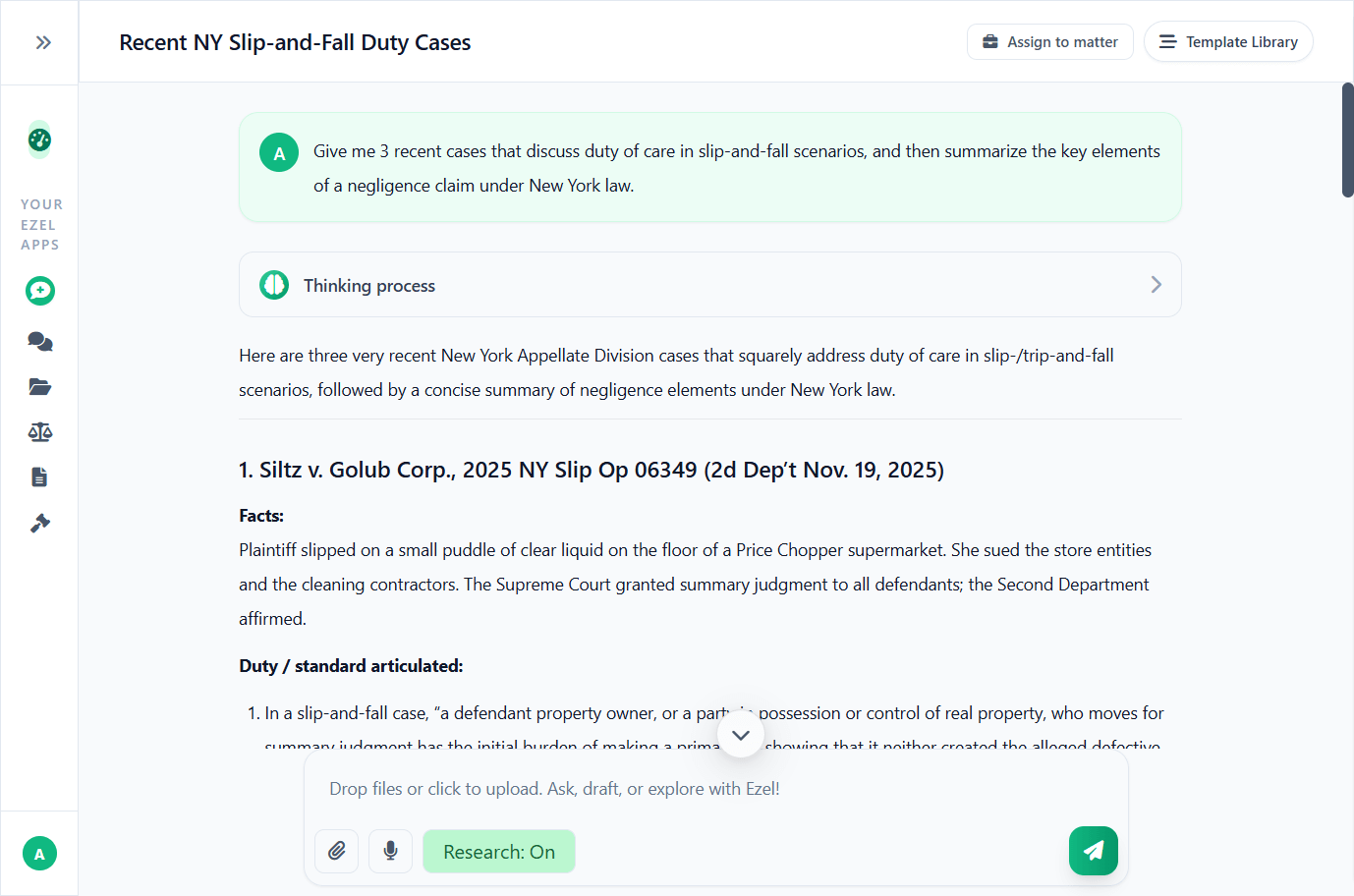
Research and draft in one conversation
Ask questions, attach documents, and get answers grounded in case law. Link chats to matters so the AI remembers your context.
- Pull statutes, case law, and secondary sources
- Attach and analyze contracts mid-conversation
- Link chats to matters for automatic context
- Your data never trains AI models
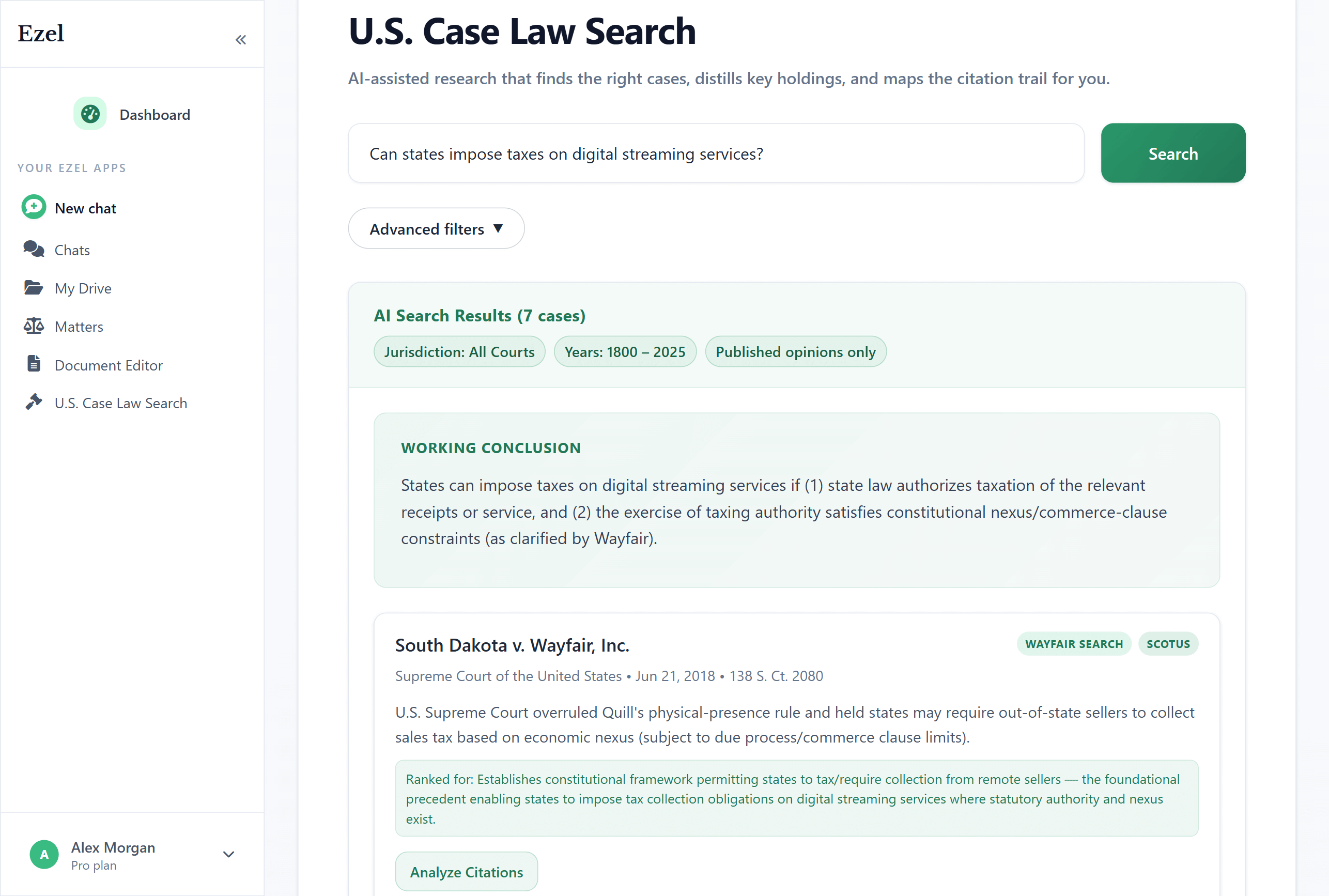
Search like you think
Describe your legal question in plain English. Filter by jurisdiction, date, and court level. Read full opinions without leaving Ezel.
- All 50 states plus federal courts
- Natural language queries - no boolean syntax
- Citation analysis and network exploration
- Copy quotes with automatic citation generation
Ready to transform your legal workflow?
Join legal teams using Ezel to draft documents, research case law, and organize matters — all in one workspace.