COMPLAINT FOR REGULATORY TAKING
IN THE [________________________________] COURT
[________________________________] COUNTY, STATE OF [________________________________]
[________________________________],
Plaintiff(s),
v.
[________________________________],
Defendant(s),
Case No.: [________________________________]
COMPLAINT FOR REGULATORY TAKING AND JUST COMPENSATION
Plaintiff(s), [________________________________] ("Plaintiff"), by and through undersigned counsel, bring this action against Defendant(s), [________________________________] ("Defendant" or "Government"), for regulatory taking and just compensation under the Fifth and Fourteenth Amendments to the United States Constitution and [State] Constitution, Article [____], Section [____], and allege as follows:
I. NATURE OF THE ACTION
-
This is an action for just compensation arising from Defendant's regulatory actions that have effected a taking of Plaintiff's private property without compensation in violation of the Fifth Amendment to the United States Constitution, made applicable to the states through the Fourteenth Amendment.
-
In Pennsylvania Coal Co. v. Mahon, 260 U.S. 393, 415 (1922), the Supreme Court held that "while property may be regulated to a certain extent, if regulation goes too far it will be recognized as a taking."
-
Defendant's regulatory actions have deprived Plaintiff of all economically beneficial use of the Subject Property, or alternatively, have gone "too far" under the Penn Central analysis, thereby effecting a taking requiring just compensation.
II. PARTIES
A. Plaintiff(s)
-
Plaintiff, [________________________________], is [an individual/a corporation/an LLC/a partnership/other: ____________] who owns real property located at [________________________________], [________________________________] County, State of [________________________________] ("Subject Property").
-
Plaintiff has owned the Subject Property since [__/__/____].
-
Plaintiff acquired the Subject Property for $[____________] and has invested an additional $[____________] in improvements and carrying costs.
B. Defendant(s)
-
Defendant, [________________________________], is a [governmental entity type: city/county/state/federal agency/other: ____________] organized and existing under the laws of [________________________________].
-
Defendant is responsible for [enacting/administering/enforcing] the regulations at issue in this case.
-
At all times relevant hereto, Defendant acted under color of law and in its governmental/regulatory capacity.
III. JURISDICTION AND VENUE
-
This Court has jurisdiction over this action pursuant to [________________________________].
-
Venue is proper in this Court because the Subject Property is located within this judicial district.
-
Pursuant to Knick v. Township of Scott, 139 S. Ct. 2162 (2019), property owners may bring Fifth Amendment takings claims in federal court without first seeking compensation through state court procedures.
IV. THE SUBJECT PROPERTY
-
The Subject Property is located at [________________________________] and consists of approximately [____] acres/square feet of land.
-
A legal description of the Subject Property is attached hereto as Exhibit A.
-
At the time of Plaintiff's acquisition, the Subject Property was zoned [________________________________] and permitted the following uses: [________________________________].
-
The Subject Property's characteristics include:
| Characteristic | Description |
|---|---|
| Topography | [________________________________] |
| Access | [________________________________] |
| Utilities | [________________________________] |
| Improvements | [________________________________] |
| Environmental Features | [________________________________] |
-
Prior to the regulatory action at issue, the fair market value of the Subject Property was approximately $[____________].
-
The highest and best use of the Subject Property [was/is] [________________________________].
V. THE REGULATORY ACTION
A. Description of the Regulation
- On or about [__/__/____], Defendant [enacted/applied/enforced] the following regulation(s) affecting the Subject Property:
☐ Zoning Regulation
Name/Number: [________________________________]
Description: [________________________________]
☐ Environmental Regulation
Name/Number: [________________________________]
Description: [________________________________]
☐ Land Use Restriction
Name/Number: [________________________________]
Description: [________________________________]
☐ Building/Development Moratorium
Name/Number: [________________________________]
Description: [________________________________]
☐ Historic Preservation Designation
Name/Number: [________________________________]
Description: [________________________________]
☐ Wetlands/Critical Area Designation
Name/Number: [________________________________]
Description: [________________________________]
☐ Other Regulatory Action
Name/Number: [________________________________]
Description: [________________________________]
-
As a result of this regulatory action, Plaintiff is prohibited from [________________________________].
-
The regulation restricts Plaintiff's property rights by:
a. [________________________________]
b. [________________________________]
c. [________________________________]
B. Impact on Property Value and Use
- As a direct result of Defendant's regulatory action:
☐ The Subject Property has been deprived of ALL economically beneficial use.
☐ The Subject Property has lost [____]% of its value.
☐ Plaintiff can no longer use the property for [________________________________].
☐ The only remaining uses permitted are [________________________________].
-
The fair market value of the Subject Property after the regulatory action is $[____________].
-
The diminution in value caused by the regulation is $[____________], representing a [____]% loss.
C. Plaintiff's Efforts to Obtain Relief
-
On or about [__/__/____], Plaintiff applied for [variance/permit/exemption/other: ____________].
-
On [__/__/____], Defendant [denied the application/imposed conditions/failed to respond].
-
Plaintiff appealed the decision to [________________________________] on [__/__/____].
-
The appeal was [denied/is pending/other: ____________] on [__/__/____].
-
Plaintiff has exhausted available administrative remedies, or alternatively, such exhaustion would be futile because [________________________________].
VI. CLAIMS FOR RELIEF
FIRST CAUSE OF ACTION
Regulatory Taking - Total/Categorical Taking (Lucas)
(Fifth and Fourteenth Amendments, U.S. Constitution)
-
Plaintiff incorporates by reference all preceding paragraphs.
-
In Lucas v. South Carolina Coastal Council, 505 U.S. 1003 (1992), the Supreme Court held that a regulation that deprives a property owner of "all economically beneficial use" of property constitutes a categorical taking requiring just compensation, unless the restriction inheres in the property owner's title through background principles of state property or nuisance law.
-
Defendant's regulatory action has deprived Plaintiff of all economically beneficial use of the Subject Property.
-
The restriction does not inhere in Plaintiff's title through background principles of state property or nuisance law because:
a. [________________________________]
b. [________________________________]
- Plaintiff is entitled to just compensation equal to the fair market value of the property.
SECOND CAUSE OF ACTION
Regulatory Taking - Penn Central Analysis
(Fifth and Fourteenth Amendments, U.S. Constitution)
-
Plaintiff incorporates by reference all preceding paragraphs.
-
Even if Defendant's regulation does not effect a total taking, it constitutes a regulatory taking under the three-factor test established in Penn Central Transportation Co. v. City of New York, 438 U.S. 104 (1978).
-
Economic Impact: The regulation has had a severe economic impact on Plaintiff, diminishing the value of the Subject Property by [____]% ($[____________]).
-
Investment-Backed Expectations: The regulation has substantially interfered with Plaintiff's distinct, reasonable investment-backed expectations because:
a. Plaintiff acquired the property on [__/__/____], [before/after] the regulation was enacted;
b. At the time of acquisition, Plaintiff reasonably expected to use the property for [________________________________];
c. Plaintiff invested $[____________] in the property based on these expectations;
d. [________________________________]
- Character of the Government Action: The character of the government action weighs in favor of finding a taking because:
a. ☐ The regulation effectively transfers a benefit to the public at Plaintiff's expense;
b. ☐ The regulation is not designed to prevent a harm that Plaintiff's use would cause;
c. ☐ The regulation singles out Plaintiff rather than spreading the burden across property owners;
d. ☐ The regulation amounts to a physical invasion or appropriation;
e. ☐ Other: [________________________________]
- Weighing these factors, the regulation has gone "too far" and constitutes a taking requiring just compensation.
THIRD CAUSE OF ACTION
Exaction/Conditions Taking (Nollan/Dolan)
(Fifth and Fourteenth Amendments, U.S. Constitution)
(If applicable)
-
Plaintiff incorporates by reference all preceding paragraphs.
-
[If applicable:] Defendant conditioned approval of Plaintiff's [development permit/subdivision application/other: ____________] on Plaintiff's agreement to [________________________________].
-
Under Nollan v. California Coastal Commission, 483 U.S. 825 (1987), and Dolan v. City of Tigard, 512 U.S. 374 (1994), such conditions must have an "essential nexus" with a legitimate governmental interest and must be "roughly proportional" to the impact of the proposed development.
-
The condition fails the essential nexus test because: [________________________________]
-
The condition fails the rough proportionality test because: [________________________________]
-
The unconstitutional condition constitutes a taking requiring just compensation.
FOURTH CAUSE OF ACTION
Regulatory Taking
([State] Constitution, Article [____], Section [____])
-
Plaintiff incorporates by reference all preceding paragraphs.
-
[State] Constitution, Article [____], Section [____], provides: "[________________________________]"
-
Under state constitutional law, Defendant's regulatory action constitutes a taking requiring just compensation.
-
[If applicable:] [State] provides broader takings protections than the federal constitution because [________________________________].
VII. DAMAGES
- As a result of Defendant's regulatory taking, Plaintiff has suffered damages including:
| Category | Amount |
|---|---|
| Diminution in property value | $[____________] |
| Lost development opportunities | $[____________] |
| Carrying costs during regulatory process | $[____________] |
| Professional fees (engineers, consultants) | $[____________] |
| Lost income/rents | $[____________] |
| Other damages | $[____________] |
| TOTAL DAMAGES | $[____________] |
- Plaintiff is entitled to just compensation in an amount equal to the fair market value of the property rights taken, plus interest from the date of taking.
VIII. PRAYER FOR RELIEF
WHEREFORE, Plaintiff respectfully prays that this Court:
-
☐ Enter judgment in favor of Plaintiff and against Defendant;
-
☐ Declare that Defendant's regulatory action constitutes a taking of Plaintiff's property requiring just compensation;
-
☐ Award Plaintiff just compensation in an amount to be determined at trial, but not less than $[____________];
-
☐ Award Plaintiff pre-judgment interest from the date of taking at the applicable legal rate;
-
☐ Award Plaintiff post-judgment interest at the applicable legal rate;
-
☐ In the alternative, invalidate the regulation as applied to Plaintiff's property;
-
☐ Award Plaintiff reasonable attorney's fees and costs pursuant to [42 U.S.C. § 1988/state statute/other: ____________];
-
☐ Award Plaintiff expert witness fees;
-
☐ Grant such other relief as the Court deems just and equitable.
IX. JURY DEMAND
☐ Plaintiff demands a trial by jury on all issues so triable.
Respectfully submitted,
Attorney Signature: [________________________________]
Printed Name: [________________________________]
State Bar No.: [________________________________]
Firm Name: [________________________________]
Address: [________________________________]
Telephone: [________________________________]
Email: [________________________________]
Date: [__/__/____]
Attorney for Plaintiff
VERIFICATION
STATE OF [________________________________]
COUNTY OF [________________________________]
I, [________________________________], declare under penalty of perjury that I am the Plaintiff in this action, that I have read the foregoing Complaint, and that the facts alleged therein are true and correct to the best of my knowledge, information, and belief.
Executed on [__/__/____] at [________________________________].
Signature: [________________________________]
Printed Name: [________________________________]
EXHIBIT A - LEGAL DESCRIPTION
[________________________________]
EXHIBIT B - COPY OF REGULATION(S)
(Attach copies of relevant regulations, ordinances, or decisions)
EXHIBIT C - PERMIT DENIAL/REGULATORY DECISION
(Attach copies of permit denials or regulatory decisions)
REGULATORY TAKINGS FRAMEWORK
Per Se (Categorical) Takings
1. Physical Appropriation (Loretto v. Teleprompter Manhattan CATV Corp., 458 U.S. 419 (1982))
- Any permanent physical occupation of property is a per se taking
2. Total Deprivation of Economic Value (Lucas v. South Carolina Coastal Council, 505 U.S. 1003 (1992))
- Regulation that eliminates ALL economically beneficial use
- Exception: Background principles of property/nuisance law
3. Required Physical Access (Cedar Point Nursery v. Hassid, 141 S. Ct. 2063 (2021))
- Government-authorized physical access to property is a per se taking
Penn Central Balancing Test
When regulation does not fall into per se category, courts apply Penn Central factors:
Factor 1: Economic Impact
- Percentage diminution in value
- Remaining economically viable use
- Compare before/after values
Factor 2: Investment-Backed Expectations
- Nature and timing of investment
- Reasonable expectations at acquisition
- Notice of regulatory scheme
Factor 3: Character of Government Action
- Physical invasion vs. regulation
- Average reciprocity of advantage
- Singling out vs. general regulation
- Prevention of harm vs. conferral of benefit
Exactions (Nollan/Dolan/Koontz)
Essential Nexus (Nollan): Condition must have connection to legitimate government interest
Rough Proportionality (Dolan): Condition must be proportional to development's impact
Monetary Exactions (Koontz v. St. Johns River Water Management District, 570 U.S. 595 (2013)): Same tests apply to monetary conditions
STATE-SPECIFIC CONSIDERATIONS
California
Cal. Const. art. I, § 19. Significant regulatory takings jurisprudence. Agins v. City of Tiburon (before overruling). Government Code § 65009 (90-day statute of limitations for land use decisions).
Texas
Tex. Const. art. I, § 17. Texas Private Real Property Rights Preservation Act, Tex. Gov't Code § 2007.001 et seq. requires takings impact assessments.
Florida
Fla. Const. art. X, § 6. Bert J. Harris, Jr., Private Property Rights Protection Act, Fla. Stat. § 70.001, provides additional remedies for property owners when government action "inordinately burdens" property.
New York
N.Y. Const. art. I, § 7. Court of Claims jurisdiction for state regulatory takings claims.
CHECKLIST FOR FILING
☐ Documented the regulatory action
☐ Calculated diminution in value (before/after appraisals)
☐ Documented investment-backed expectations
☐ Applied for permits/variances
☐ Exhausted administrative remedies
☐ Researched applicable statute of limitations
☐ Determined proper court (state vs. federal)
☐ Identified all governmental defendants
☐ Gathered supporting documentation
☐ Verified service requirements
This template is provided for educational and informational purposes only. Regulatory takings claims involve complex constitutional analysis that varies by jurisdiction. Consult with a qualified attorney experienced in takings law before filing any legal action.
Do more with Ezel
This free template is just the beginning. See how Ezel helps legal teams draft, research, and collaborate faster.
AI that drafts while you watch
Tell the AI what you need and watch your document transform in real-time. No more copy-pasting between tools or manually formatting changes.
- Natural language commands: "Add a force majeure clause"
- Context-aware suggestions based on document type
- Real-time streaming shows edits as they happen
- Milestone tracking and version comparison
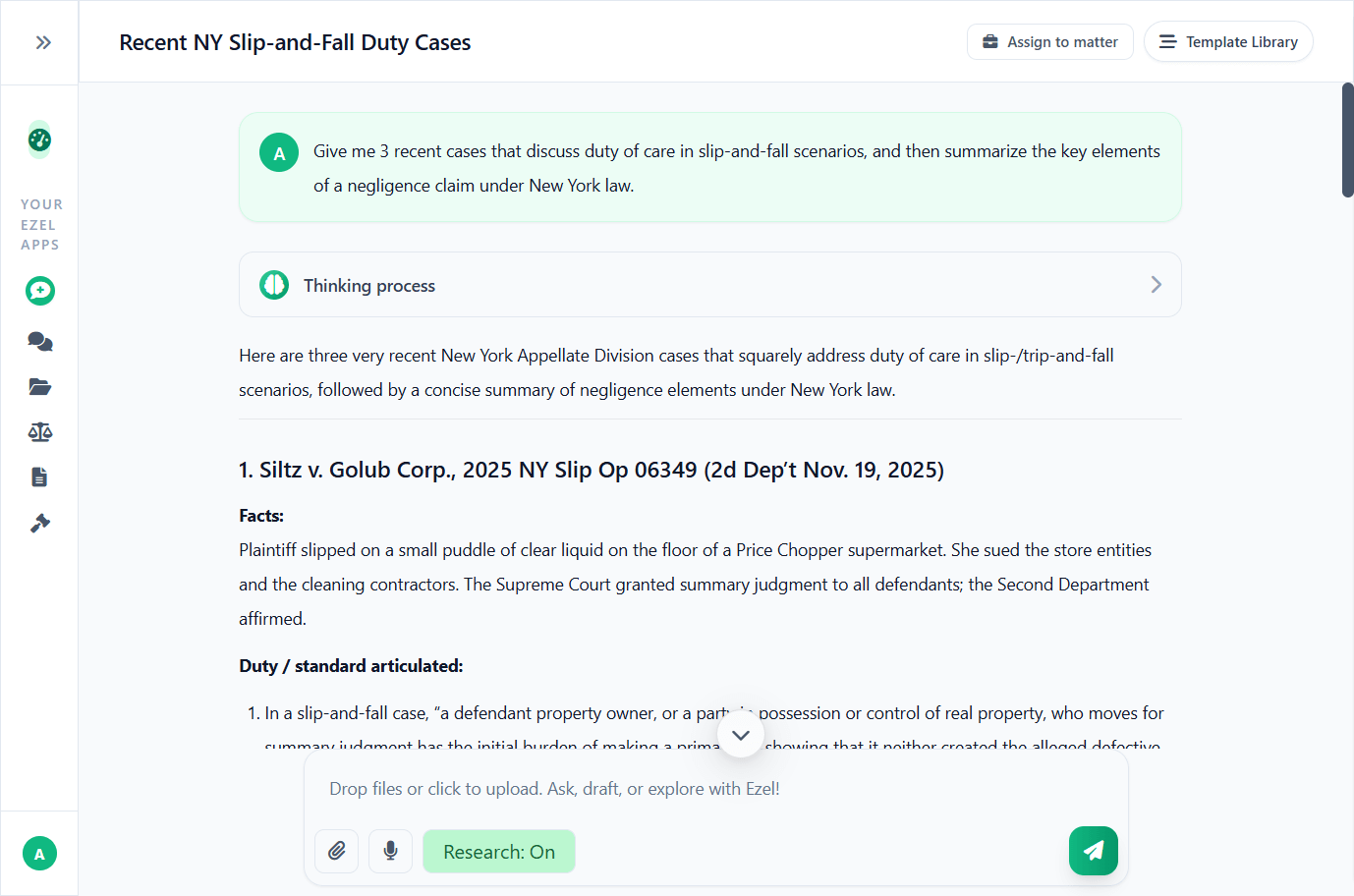
Research and draft in one conversation
Ask questions, attach documents, and get answers grounded in case law. Link chats to matters so the AI remembers your context.
- Pull statutes, case law, and secondary sources
- Attach and analyze contracts mid-conversation
- Link chats to matters for automatic context
- Your data never trains AI models
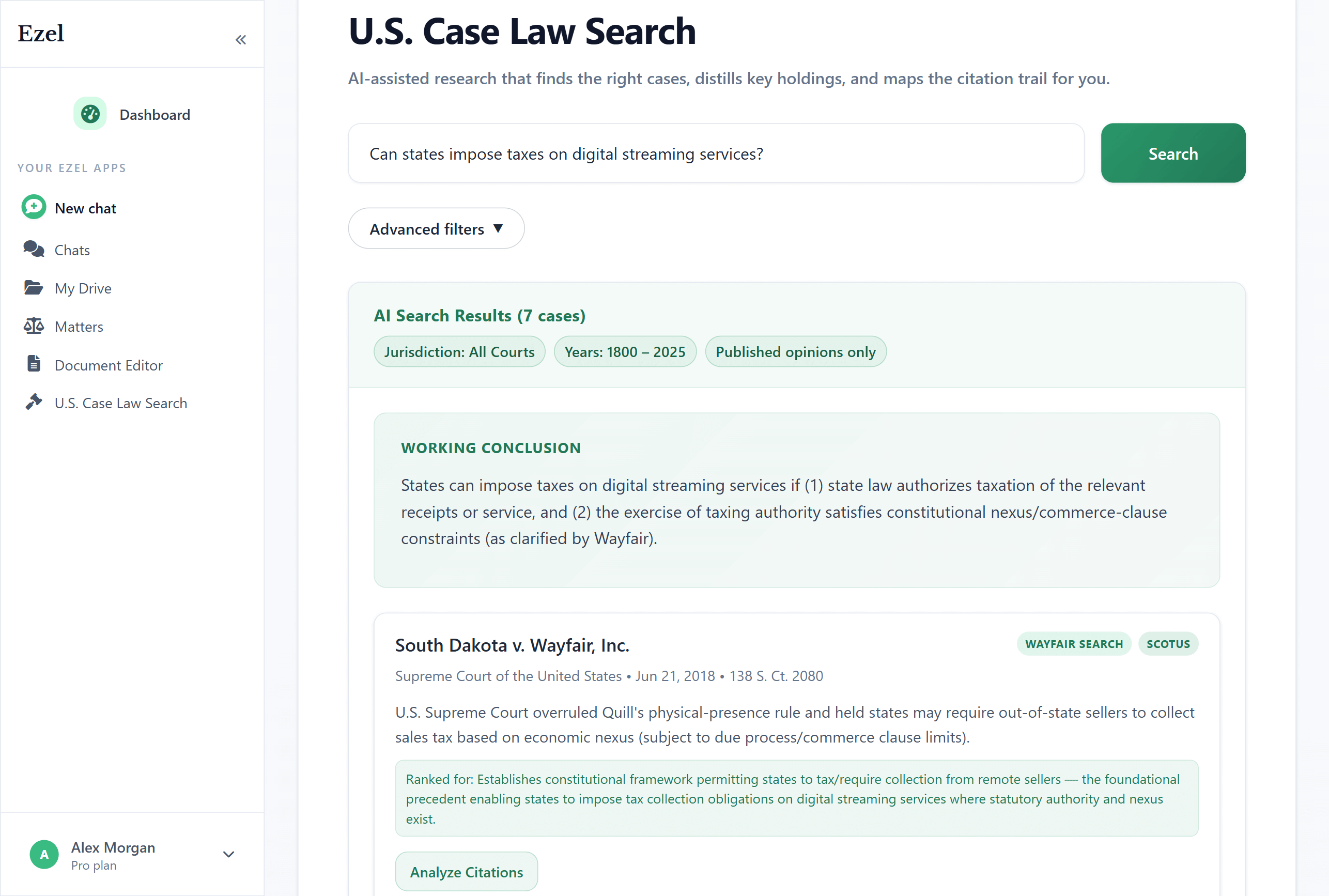
Search like you think
Describe your legal question in plain English. Filter by jurisdiction, date, and court level. Read full opinions without leaving Ezel.
- All 50 states plus federal courts
- Natural language queries - no boolean syntax
- Citation analysis and network exploration
- Copy quotes with automatic citation generation
Ready to transform your legal workflow?
Join legal teams using Ezel to draft documents, research case law, and organize matters — all in one workspace.