DEMAND FOR SETTLEMENT - PRODUCTS LIABILITY
STATE OF CONNECTICUT
[FIRM NAME]
Attorneys at Law
[Street Address]
[City, Connecticut ZIP]
Telephone: [Phone]
Facsimile: [Fax]
Email: [Email]
Licensed in the State of Connecticut
DATE: [Date]
VIA CERTIFIED MAIL, RETURN RECEIPT REQUESTED
AND FIRST-CLASS MAIL
[General Counsel / Risk Management / Claims Representative]
[Manufacturer / Distributor / Retailer Name]
[Street Address]
[City, State ZIP]
RE: PRODUCTS LIABILITY CLAIM - SETTLEMENT DEMAND
Claimant: [Client Full Name]
Date of Incident: [Date]
Product: [Product Name, Model Number, Serial Number]
Manufacturer: [Manufacturer Name]
Purchase Date/Location: [Date / Retailer Name]
Claim Number: [If assigned]
Dear [Recipient Name]:
This firm represents [Client Name] in connection with serious personal injuries caused by a defective [Product Name] designed, manufactured, distributed, and/or sold by your company. This letter constitutes our formal demand for settlement pursuant to Connecticut law.
I. CONNECTICUT-SPECIFIC LEGAL FRAMEWORK
A. Governing Law - Connecticut Products Liability Act
Connecticut products liability claims are governed exclusively by the Connecticut Products Liability Act (CPLA), codified at Conn. Gen. Stat. Sections 52-572m through 52-572q. The CPLA provides the sole remedy for claims arising from harm caused by defective products. Winslow v. Lewis-Shepard, Inc., 212 Conn. 462 (1989).
Key Elements Under CPLA:
1. The defendant was engaged in the business of selling the product;
2. The product was in a defective condition unreasonably dangerous to the consumer or user;
3. The defect existed when the product left the defendant's control;
4. The defect was a proximate cause of the plaintiff's injuries; and
5. The plaintiff suffered damages.
See Potter v. Chicago Pneumatic Tool Co., 241 Conn. 199 (1997).
B. Definition of Product Liability Claim
Under Conn. Gen. Stat. Section 52-572m(b), a "product liability claim" includes all claims against product sellers, including those for:
- Strict liability
- Negligence
- Breach of warranty (express or implied)
- Any other theory
This consolidation means warranty claims are subject to the CPLA's provisions and limitations.
C. Theories of Liability Recognized
Connecticut recognizes the following theories under the CPLA:
1. Strict Liability:
Liability without fault for products that are defective and unreasonably dangerous. Connecticut applies the modified consumer expectations test and risk-utility test. Potter v. Chicago Pneumatic Tool Co., 241 Conn. 199 (1997).
2. Negligence:
Claims for negligent design, manufacture, inspection, or failure to warn.
3. Breach of Warranty:
Subsumed under the CPLA; treated as product liability claims subject to the Act's provisions.
D. Defect Standards - The Potter Test
Under Potter v. Chicago Pneumatic Tool Co., 241 Conn. 199 (1997), Connecticut uses a dual test for design defects:
Modified Consumer Expectations Test: Whether the product failed to perform as safely as an ordinary consumer would expect when used in an intended or reasonably foreseeable manner.
Risk-Utility Test: Applied when consumer expectations do not provide an adequate standard (complex products). Factors include:
1. Usefulness and desirability of the product
2. Availability of safer alternative products
3. Likelihood and severity of injury
4. Ability to reduce danger without impairing usefulness
5. User's ability to avoid danger
6. State of the art at time of manufacture
7. Manufacturer's ability to spread the cost
E. Statute of Limitations
Under Conn. Gen. Stat. Section 52-577a, the statute of limitations for products liability claims is three (3) years from the date of injury. This claim arises from an injury that occurred on [Date], and therefore the limitations period expires on [Expiration Date].
F. Statute of Repose
Connecticut has a ten (10) year statute of repose under Conn. Gen. Stat. Section 52-577a(a). No product liability claim may be brought more than ten years from the date the defendant last parted with possession or control of the product.
The product at issue was [manufactured/sold] on [Date], which is within the repose period.
G. Comparative Negligence
CONNECTICUT FOLLOWS MODIFIED COMPARATIVE NEGLIGENCE.
Under Conn. Gen. Stat. Section 52-572h, a plaintiff's recovery is reduced by their percentage of fault. Recovery is completely barred if the plaintiff is more than 50% at fault (51% rule).
- Comparative negligence includes product misuse and failure to observe obvious dangers
- Failure to discover a defect is not comparative negligence unless the defect was obvious
Our client was not comparatively negligent: [Describe why client bears no or minimal fault]
H. Joint and Several Liability
Connecticut has modified joint and several liability under Conn. Gen. Stat. Section 52-572h(g):
- Economic damages: Joint and several liability applies
- Non-economic damages: Several liability only (each defendant pays proportionate share)
I. Punitive Damages
Punitive damages are generally NOT available in Connecticut product liability actions. However, under Conn. Gen. Stat. Section 52-240b, if the plaintiff proves the defendant acted with reckless disregard for safety, the court may award reasonable attorney's fees.
II. PRESERVATION OF EVIDENCE - SPOLIATION WARNING
YOU ARE HEREBY DIRECTED TO IMMEDIATELY PRESERVE ALL EVIDENCE relating to this product and claim, including but not limited to:
Product-Related:
- [ ] The subject product and all component parts
- [ ] All exemplar products of the same make and model
- [ ] Design documents, specifications, and engineering drawings
- [ ] Manufacturing records for the subject product
- [ ] Quality control records and inspection reports
- [ ] Testing data and results (pre-market and post-market)
- [ ] Safety assessments and risk analyses
- [ ] FMEA (Failure Mode and Effects Analysis) documents
- [ ] All versions of owner's manuals, instructions, warnings, and labels
Regulatory and Complaints:
- [ ] Communications with FDA, CPSC, NHTSA, or other regulatory agencies
- [ ] Consumer complaints involving this product
- [ ] Prior claims and lawsuits involving this product
- [ ] Recall notices and service bulletins
Connecticut courts impose sanctions for spoliation of evidence. Beers v. Bayliner Marine Corp., 236 Conn. 769 (1996). Destruction of evidence may result in adverse inferences and other sanctions at trial.
III. THE DEFECTIVE PRODUCT
A. Product Identification
| Product Information | Details |
|---|---|
| Product Name | [Full Product Name] |
| Manufacturer | [Manufacturer Name and Address] |
| Model Number | [Model Number] |
| Serial Number | [Serial Number] |
| Date of Manufacture | [Date, if known] |
| Lot/Batch Number | [If known] |
| Date of Purchase | [Purchase Date] |
| Retailer/Seller | [Retailer Name and Location] |
| Purchase Price | $[Amount] |
B. Chain of Distribution
| Entity | Role | Contact |
|---|---|---|
| [Manufacturer Name] | Manufacturer | [Address] |
| [Component Supplier] | Component Manufacturer | [Address] |
| [Distributor Name] | Distributor | [Address] |
| [Retailer Name] | Retailer/Seller | [Address] |
IV. THE DEFECT
A. Nature of Defect - Design Defect
Under the Potter framework, this product contains a design defect.
Under the Consumer Expectations Test:
The [Product Name] failed to perform as safely as an ordinary consumer would expect. An ordinary consumer would expect that:
[Describe consumer expectations]
Under the Risk-Utility Test:
Applying the risk-utility factors:
[Apply factors to the specific case]
The [Product Name] contains a design defect in that:
[Detailed description of design defect]
Alternative Safer Design:
A feasible alternative design existed that would have prevented this injury:
[Describe alternative design]
B. Nature of Defect - Manufacturing Defect
A manufacturing defect exists when the specific product departed from its intended design, making it more dangerous than intended. Izzarelli v. R.J. Reynolds Tobacco Co., 321 Conn. 172 (2016).
The product at issue:
[Describe manufacturing defect if applicable]
C. Nature of Defect - Failure to Warn
Under Connecticut law, a manufacturer has a duty to warn of known dangers and dangers that should have been known through reasonable testing. Vitanza v. Upjohn Co., 257 Conn. 365 (2001).
Adequacy of Warnings:
A warning must be:
- Clear and understandable
- Prominently displayed
- Adequate to convey the nature and extent of the danger
Learned Intermediary Doctrine: Connecticut recognizes this doctrine for prescription drugs and medical devices. Vitanza, 257 Conn. at 380.
The warnings provided were inadequate because:
[Describe warning deficiencies]
V. THE INCIDENT
A. How the Injury Occurred
On [Date], at approximately [Time], our client was [describe what client was doing with the product]:
[Detailed narrative of the incident]
B. Foreseeable Use
Our client was using the product in a manner that was:
- [ ] Intended by the manufacturer
- [ ] Foreseeable by the manufacturer
- [ ] In accordance with provided instructions
C. No Comparative Negligence
Our client exercised reasonable care at all times. Even if comparative fault is alleged, our client's conduct was not more than 50% at fault, and therefore recovery is not barred under Conn. Gen. Stat. Section 52-572h.
VI. LIABILITY ANALYSIS
A. Strict Liability Under CPLA
All elements of Connecticut product liability are satisfied:
-
Defective Condition: The product contained a [design / manufacturing / warning] defect as described above.
-
Unreasonably Dangerous: Applying Potter, the product was unreasonably dangerous under both consumer expectations and risk-utility analysis.
-
Defect Existed When Product Left Defendant's Control: The defect was present at the time of sale.
-
Causation: The defect was a proximate cause of our client's injuries.
-
Damages: Our client has suffered substantial damages as detailed herein.
B. Negligence
Your company breached its duty of care by:
-
Negligent Design: Designing a product with an unreasonably dangerous characteristic when safer alternatives existed.
-
Negligent Manufacture: Failing to implement adequate quality control procedures.
-
Negligent Failure to Warn: Failing to provide adequate warnings of known dangers.
C. Breach of Warranty
Under the CPLA, warranty claims are treated as product liability claims:
Express Warranty:
Your company expressly warranted that [describe warranty]. This warranty was breached.
Implied Warranty of Merchantability:
The product was not fit for its ordinary purpose due to the defect.
VII. PRIOR KNOWLEDGE OF DEFECT
Evidence of your company's prior knowledge of this defect includes:
- [ ] [Number] prior complaints regarding this defect
- [ ] [Number] prior injuries from this defect
- [ ] Recall or service bulletins issued
- [ ] Internal documents acknowledging the defect
Such prior knowledge supports an award of attorney's fees for reckless disregard under Conn. Gen. Stat. Section 52-240b.
VIII. INJURIES AND DAMAGES
A. Injuries Sustained
As a direct and proximate result of the defective product, our client sustained:
Physical Injuries:
- [ ] [Injury 1]
- [ ] [Injury 2]
- [ ] [Injury 3]
Surgeries and Procedures:
- [ ] [Surgery 1]
- [ ] [Surgery 2]
Permanent Conditions:
- [ ] [Permanent condition 1]
- [ ] [Permanent condition 2]
B. Medical Expenses
| Provider | Service | Amount |
|---|---|---|
| [Provider 1] | [Service] | $[Amount] |
| [Provider 2] | [Service] | $[Amount] |
| TOTAL PAST MEDICAL | $[Total] |
Future Medical Expenses: $[Amount]
C. Lost Wages and Earning Capacity
| Category | Amount |
|---|---|
| Past Lost Wages | $[Amount] |
| Future Lost Earning Capacity | $[Amount] |
| TOTAL LOST WAGES | $[Total] |
D. Non-Economic Damages
- Physical pain and suffering
- Emotional distress
- Disfigurement
- Loss of enjoyment of life
- Inconvenience
E. Summary of Damages
| Category | Amount |
|---|---|
| Past Medical Expenses | $[Amount] |
| Future Medical Expenses | $[Amount] |
| Past Lost Wages | $[Amount] |
| Future Lost Earning Capacity | $[Amount] |
| TOTAL ECONOMIC DAMAGES | $[Subtotal] |
| Pain and Suffering | $[Amount] |
| Disfigurement | $[Amount] |
| Emotional Distress | $[Amount] |
| Loss of Enjoyment of Life | $[Amount] |
| TOTAL NON-ECONOMIC DAMAGES | $[Subtotal] |
| TOTAL COMPENSATORY DAMAGES | $[Total] |
F. Attorney's Fees for Reckless Conduct
Your company's conduct warrants an award of attorney's fees under Conn. Gen. Stat. Section 52-240b for reckless disregard of the safety of product users.
IX. SETTLEMENT DEMAND
Based upon the clear liability of your company under Connecticut law and the severe injuries suffered by our client, we hereby demand:
$[DEMAND AMOUNT]
This demand will remain open for forty-five (45) days from the date of this letter, expiring at 5:00 p.m. Eastern Time on [Expiration Date].
X. CONCLUSION
This case involves a defective product that caused serious injuries to our client. Your company is liable under the Connecticut Products Liability Act. Our client was not comparatively negligent, or was 50% or less at fault, thus preserving the right to recovery.
If this matter cannot be resolved, we are prepared to file suit in the Superior Court of Connecticut, Judicial District of [County], and to pursue this matter through trial.
Please contact me at your earliest convenience.
Respectfully submitted,
[FIRM NAME]
By: _________________________________
[Attorney Name]
Connecticut Bar Registration No. [Number]
Attorney for [Client Name]
ENCLOSURES: [List]
cc: [Client Name]
[File]
CONNECTICUT PRODUCTS LIABILITY PRACTICE NOTES
-
[ ] Exclusive Remedy: The CPLA is the exclusive remedy for product liability claims in Connecticut. All theories (strict liability, negligence, warranty) are brought under the Act.
-
[ ] Comparative Negligence: Connecticut uses modified comparative negligence - plaintiff barred if more than 50% at fault. Product misuse and failure to discover obvious defects can constitute comparative negligence.
-
[ ] Statute of Repose: Critical 10-year limitation from date defendant parted with possession. Verify product date.
-
[ ] No Punitive Damages: Connecticut does not allow punitive damages in product liability cases. Only attorney's fees for reckless conduct are available.
-
[ ] Expert Testimony: Required to establish defect and causation in most cases. Connecticut follows Daubert standard.
-
[ ] Innocent Seller Defense: Under Conn. Gen. Stat. Section 52-572m(a), product sellers in the chain of distribution are potentially liable. However, sealed container defense may apply.
-
[ ] Economic Loss Rule: Connecticut recognizes the economic loss doctrine - purely economic losses generally require a contract remedy. Ulbrich v. Groth, 310 Conn. 375 (2013).
-
[ ] Offer of Judgment: Under Conn. Gen. Stat. Section 52-192a, failure to accept offer of judgment may result in interest and costs being awarded from date of offer.
-
[ ] Venue: Superior Court in judicial district where defendant resides or where injury occurred. Conn. Gen. Stat. Section 51-345.
Connecticut products liability law is complex. This template must be reviewed and customized by a licensed Connecticut attorney before use.
Do more with Ezel
This free template is just the beginning. See how Ezel helps legal teams draft, research, and collaborate faster.
AI that drafts while you watch
Tell the AI what you need and watch your document transform in real-time. No more copy-pasting between tools or manually formatting changes.
- Natural language commands: "Add a force majeure clause"
- Context-aware suggestions based on document type
- Real-time streaming shows edits as they happen
- Milestone tracking and version comparison
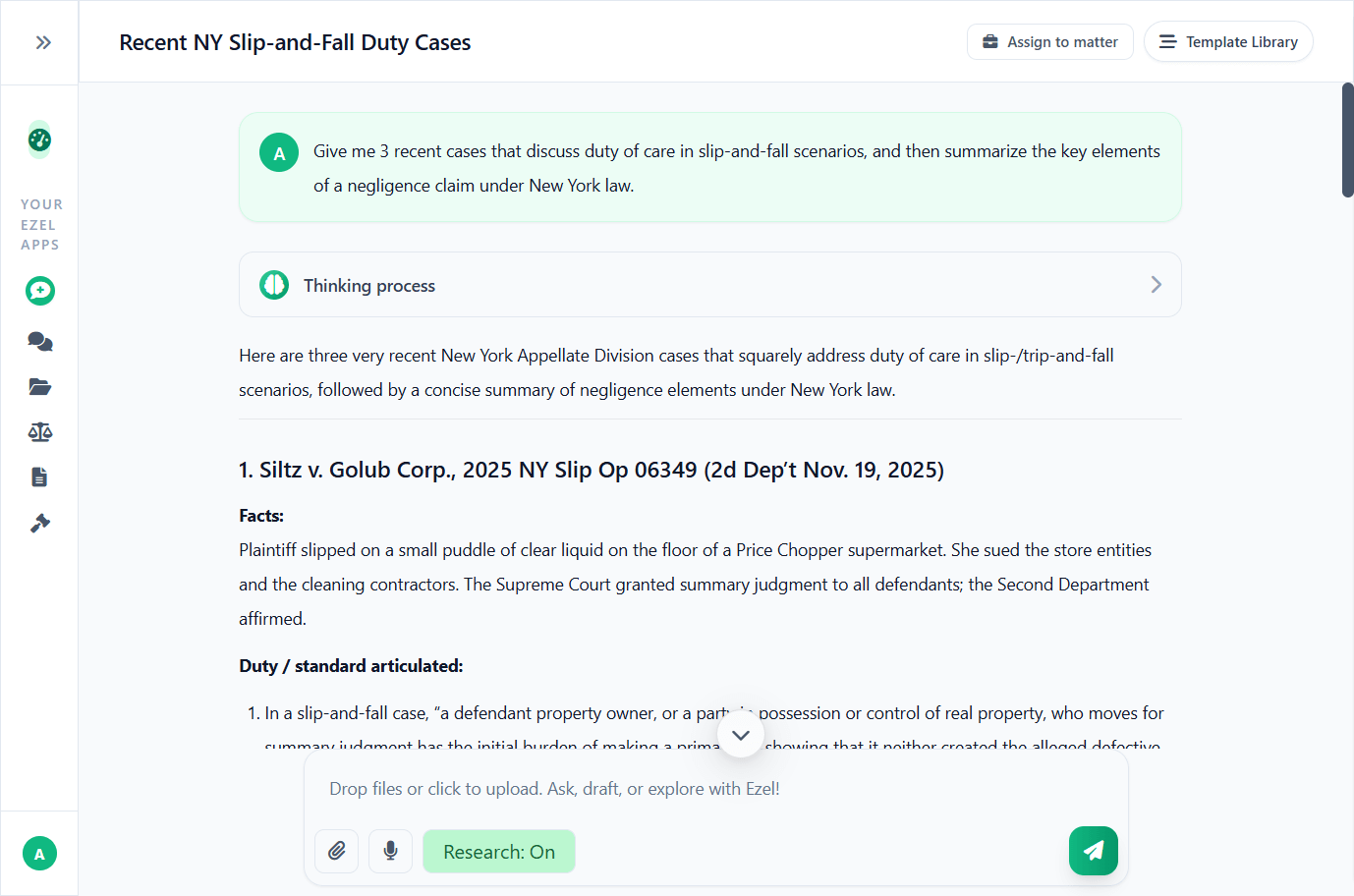
Research and draft in one conversation
Ask questions, attach documents, and get answers grounded in case law. Link chats to matters so the AI remembers your context.
- Pull statutes, case law, and secondary sources
- Attach and analyze contracts mid-conversation
- Link chats to matters for automatic context
- Your data never trains AI models
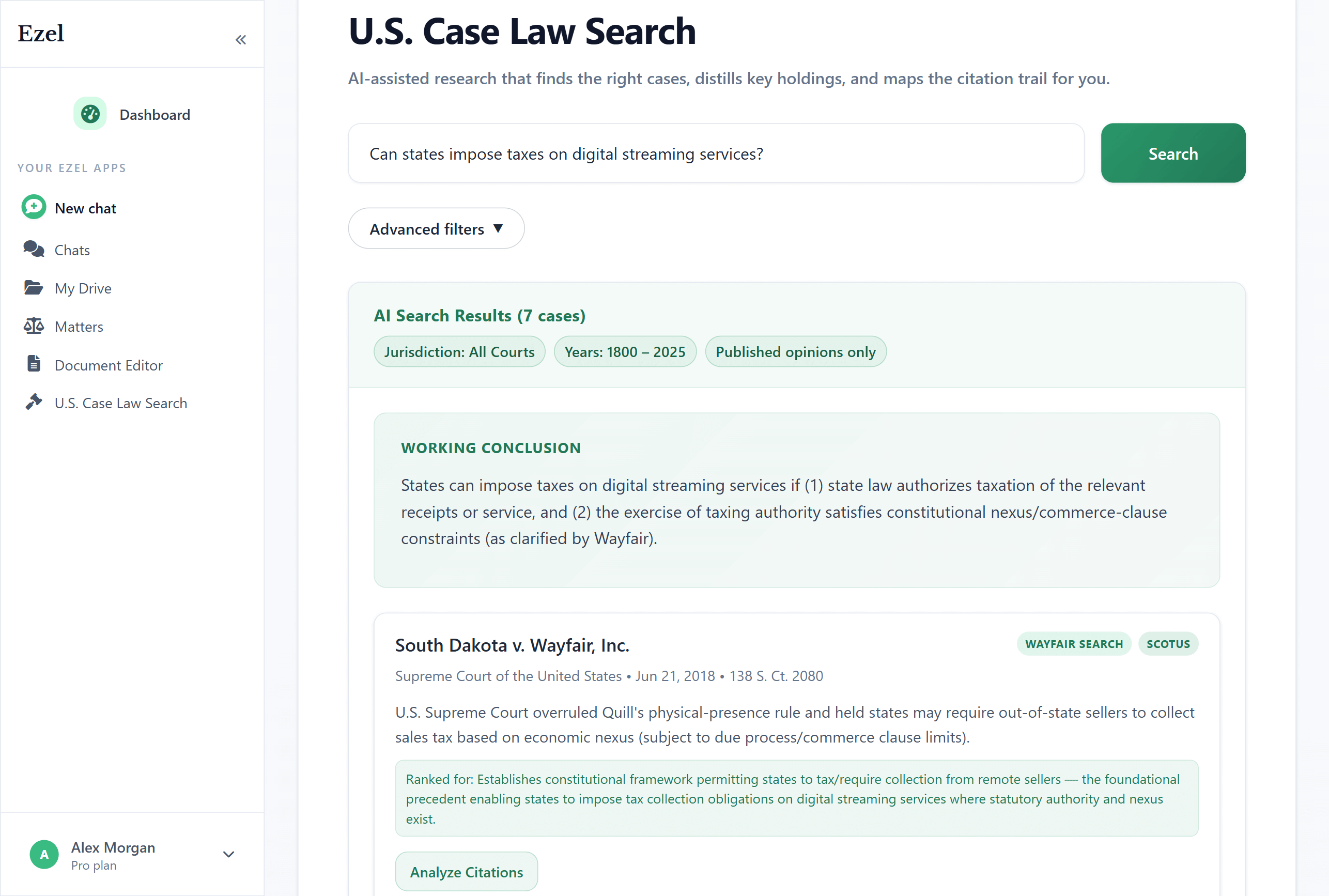
Search like you think
Describe your legal question in plain English. Filter by jurisdiction, date, and court level. Read full opinions without leaving Ezel.
- All 50 states plus federal courts
- Natural language queries - no boolean syntax
- Citation analysis and network exploration
- Copy quotes with automatic citation generation
Ready to transform your legal workflow?
Join legal teams using Ezel to draft documents, research case law, and organize matters — all in one workspace.