PERSONAL GUARANTY AGREEMENT
(Continuing Guaranty of Payment)
Effective Date: [__/__/____]
Guaranty Number: [________________________________]
RECITALS
WHEREAS, the Borrower (as identified below) has requested or obtained credit, loans, or other financial accommodations from the Lender (as identified below) pursuant to the Loan Documents (as defined herein);
WHEREAS, the Lender is unwilling to extend or continue to extend such credit without the personal guaranty of the Guarantor (as identified below);
WHEREAS, the Guarantor has a direct or indirect financial interest in the Borrower and will derive substantial benefit from the Lender's extension of credit to the Borrower;
WHEREAS, the Guarantor desires to induce the Lender to extend or continue to extend credit to the Borrower by executing and delivering this Guaranty;
NOW, THEREFORE, in consideration of the Lender's extension of credit to the Borrower and for other good and valuable consideration, the receipt and sufficiency of which are hereby acknowledged, the Guarantor agrees as follows:
ARTICLE I — PARTIES AND IDENTIFICATION
Section 1.1 — Lender
| Field | Information |
|---|---|
| Legal Name | [________________________________] |
| Entity Type | ☐ Bank/Financial Institution ☐ Corporation ☐ LLC ☐ Fund ☐ Individual ☐ Other: [________] |
| State of Organization | [________________________________] |
| Principal Address | [________________________________] |
| City, State, ZIP | [________________________________] |
| Contact Person | [________________________________] |
| Telephone | [________________________________] |
| [________________________________] |
Section 1.2 — Borrower
| Field | Information |
|---|---|
| Legal Name | [________________________________] |
| Entity Type | ☐ Corporation ☐ LLC ☐ Partnership ☐ Individual ☐ Other: [________] |
| State of Organization | [________________________________] |
| Tax ID / EIN | [________________________________] |
| Principal Address | [________________________________] |
| City, State, ZIP | [________________________________] |
| Relationship to Guarantor | [________________________________] |
Section 1.3 — Guarantor
| Field | Information |
|---|---|
| Full Legal Name | [________________________________] |
| Date of Birth | [__/__/____] |
| Social Security Number (last 4) | [____] |
| Home Address | [________________________________] |
| City, State, ZIP | [________________________________] |
| Telephone | [________________________________] |
| [________________________________] | |
| Employer / Position | [________________________________] |
| Marital Status | ☐ Single ☐ Married ☐ Domestic Partnership ☐ Divorced ☐ Widowed |
| Spouse/Partner Name (if applicable) | [________________________________] |
| State of Residence | [________________________________] |
Section 1.4 — Loan Documents
| Document | Date | Amount |
|---|---|---|
| Loan Agreement / Credit Agreement | [__/__/____] | $[________________________________] |
| Promissory Note | [__/__/____] | $[________________________________] |
| Security Agreement | [__/__/____] | N/A |
| Deed of Trust / Mortgage (if any) | [__/__/____] | N/A |
| Other: [________________________________] | [__/__/____] | $[________________________________] |
ARTICLE II — GUARANTY OF PAYMENT
Section 2.1 — Guaranty
The Guarantor hereby irrevocably and unconditionally guarantees to the Lender the full and punctual payment and performance when due (whether at stated maturity, by acceleration, by demand, or otherwise) of all Guaranteed Obligations (as defined below). This is a guaranty of payment and not of collection. The Lender shall not be required to proceed against the Borrower, exhaust any collateral, or pursue any other remedy before enforcing this Guaranty against the Guarantor.
Section 2.2 — Guaranteed Obligations
The "Guaranteed Obligations" means all present and future indebtedness, liabilities, and obligations of the Borrower to the Lender arising under or in connection with the Loan Documents, including without limitation:
(a) All principal, interest (including post-petition interest in bankruptcy to the extent allowed), and fees;
(b) All charges, premiums, and penalties;
(c) All costs of collection, enforcement, and workout (including reasonable attorneys' fees and expenses);
(d) All indemnification and reimbursement obligations;
(e) All obligations arising from overdrafts, letters of credit, banker's acceptances, and other banking products;
(f) All obligations that survive termination, invalidity, or unenforceability of the Loan Documents; and
(g) All renewals, extensions, modifications, refinancings, restructurings, and rearrangements of any of the foregoing.
Section 2.3 — Scope of Guaranty (Select One)
☐ Unlimited Guaranty. The Guarantor's liability under this Guaranty is unlimited and includes all Guaranteed Obligations without cap or limitation.
☐ Limited Guaranty. The Guarantor's liability under this Guaranty shall not exceed $[________________________________] in aggregate principal amount (the "Guaranty Cap"), plus all interest, fees, costs, and expenses accruing on or relating to such amount. The Guaranty Cap shall not limit the Guarantor's liability for:
- Accrued and unpaid interest on the Guaranteed Obligations up to the Guaranty Cap;
- Costs and expenses of enforcement (including attorneys' fees);
- Indemnification obligations under this Guaranty; and
- Obligations arising from fraud, willful misconduct, or environmental liabilities.
☐ Proportional Guaranty. The Guarantor's liability shall be limited to [____]% of the outstanding Guaranteed Obligations at any time.
Section 2.4 — Continuing Guaranty
This Guaranty is a continuing guaranty and shall remain in full force and effect until the indefeasible payment in full of all Guaranteed Obligations and the termination of all commitments of the Lender to extend credit to the Borrower. This Guaranty applies to all Guaranteed Obligations now existing or hereafter arising, whether incurred before, on, or after the date hereof, and whether or not contemplated by the parties at the time this Guaranty is executed.
Section 2.5 — Primary Obligation
The Guarantor acknowledges that this Guaranty constitutes a primary obligation and not merely a surety obligation. The Lender may treat the Guarantor as a primary obligor and may proceed directly against the Guarantor without first pursuing the Borrower, regardless of whether the Borrower is joined in any action.
ARTICLE III — WAIVERS BY GUARANTOR
Section 3.1 — General Suretyship Waivers
THE GUARANTOR HEREBY IRREVOCABLY AND UNCONDITIONALLY WAIVES, to the fullest extent permitted by applicable law:
☐ (a) Presentment and Demand. Any requirement of presentment for payment, demand, protest, or notice of protest regarding any of the Guaranteed Obligations.
☐ (b) Notice of Acceptance. Notice of acceptance of this Guaranty.
☐ (c) Notice of Default. Notice of any default or nonpayment by the Borrower.
☐ (d) Notice of Dishonor. Notice of dishonor of any instrument evidencing the Guaranteed Obligations.
☐ (e) Notice of Modification. Notice of any amendment, modification, supplement, extension, renewal, or restatement of the Loan Documents.
☐ (f) Notice of Collateral Release. Notice of any release, substitution, exchange, or non-perfection of any collateral securing the Guaranteed Obligations.
☐ (g) Notice of Guarantor Release. Notice of any release of any other guarantor or obligor.
☐ (h) Marshaling. Any right to require the Lender to marshal assets, proceed in any particular order, or pursue any particular remedy.
☐ (i) Exhaustion of Remedies. Any right to require the Lender to first proceed against the Borrower, any other guarantor, or any collateral before proceeding against the Guarantor (waiver of benefit of excussion).
☐ (j) One-Action Rule. To the extent permitted by applicable law, any benefit of the one-action rule or any similar statutory requirement that the Lender bring only a single action.
☐ (k) Statute of Limitations. Any defense based on the statute of limitations in any action under this Guaranty, to the extent waiver is permitted by applicable law.
☐ (l) Diligence. Any duty of the Lender to act with diligence in collecting, protecting, or realizing upon the Guaranteed Obligations or any collateral.
☐ (m) Valuation of Collateral. Any defense based on the adequacy or value of any collateral.
☐ (n) Election of Remedies. Any defense based on any election of remedies by the Lender, including any election to proceed by non-judicial foreclosure that may destroy the Guarantor's subrogation or reimbursement rights.
Section 3.2 — Waiver of Defenses Based on Lender Conduct
The Guarantor further waives any defense arising by reason of:
(a) Any lack of authority or capacity of the Borrower;
(b) The invalidity, irregularity, or unenforceability of the Guaranteed Obligations or the Loan Documents;
(c) Any disability, insolvency, bankruptcy, dissolution, liquidation, or change in the legal status of the Borrower;
(d) Any modification, supplement, extension, renewal, or restatement of the Loan Documents;
(e) Any increase in the amount of the Guaranteed Obligations;
(f) Any release, exchange, substitution, impairment, deterioration, or non-perfection of any collateral;
(g) Any release of any other guarantor or obligor;
(h) The Lender's failure to pursue any remedy against the Borrower or any collateral;
(i) The Lender's failure to give the Guarantor notice of any of the foregoing; and
(j) Any other circumstance that might otherwise constitute a defense available to, or a discharge of, the Borrower or any guarantor.
Section 3.3 — California Suretyship Waivers (If Applicable)
If the Governing Law is California, or if any collateral is located in California, the following additional waivers apply:
The Guarantor acknowledges having read and understood the provisions of California Civil Code Sections 2787 through 2855 (suretyship) and hereby specifically waives, to the fullest extent permitted by California Civil Code Section 2856:
(a) All rights and defenses arising out of an election of remedies by the Lender, even though that election of remedies, such as a nonjudicial foreclosure with respect to security for a guaranteed obligation, has destroyed the Guarantor's rights of subrogation and reimbursement against the Borrower by the operation of Section 580d of the Code of Civil Procedure or otherwise;
(b) All rights and defenses that the Guarantor may have because the Borrower's debt is secured by real property, including any rights or defenses based upon or arising out of:
- California Code of Civil Procedure Section 580a (fair-value limitation on deficiency after foreclosure sale);
- California Code of Civil Procedure Section 580b (purchase-money mortgage anti-deficiency protection);
- California Code of Civil Procedure Section 580d (anti-deficiency protection after trustee's sale under power of sale);
- California Code of Civil Procedure Section 726 (one-action rule); and
- Any other anti-deficiency or one-action protections under California law;
(c) All rights and defenses based upon impairment of collateral, including any rights under California Civil Code Section 2809 or any successor provision; and
(d) All other suretyship defenses that the Guarantor might otherwise assert under California law.
IMPORTANT LIMITATION (CALIFORNIA): Pursuant to California Civil Code Section 2856(c), the waivers in this Section 3.3 do NOT apply if the Guaranteed Obligations are secured by a deed of trust or mortgage on a dwelling for not more than four families occupied entirely or in part by the Borrower, and the loan was used to pay all or part of the purchase price of such dwelling. In such case, the Guarantor retains suretyship defenses notwithstanding the waivers above.
Section 3.4 — General Waiver Acknowledgment
THE GUARANTOR ACKNOWLEDGES THAT THE WAIVERS SET FORTH IN THIS ARTICLE III MAY RESULT IN THE LOSS OF SUBSTANTIAL RIGHTS AND DEFENSES AND THAT THE GUARANTOR HAS AGREED TO THESE WAIVERS VOLUNTARILY, WITH FULL KNOWLEDGE OF THEIR SIGNIFICANCE AND CONSEQUENCES, AND AFTER HAVING HAD THE OPPORTUNITY TO CONSULT WITH INDEPENDENT LEGAL COUNSEL.
ARTICLE IV — REINSTATEMENT AND BANKRUPTCY
Section 4.1 — Reinstatement of Guaranty
If at any time any payment made by the Borrower or any other person to the Lender on account of the Guaranteed Obligations is rescinded, avoided, set aside, invalidated, declared fraudulent, or must be restored or returned by the Lender (whether in connection with any bankruptcy, insolvency, reorganization, or similar proceeding involving the Borrower or otherwise), the Guarantor's obligations under this Guaranty shall be reinstated and revived, and this Guaranty shall continue in full force and effect, as if such payment had not been made. The Guarantor agrees that the Guarantor's obligations under this reinstatement provision shall survive the termination of this Guaranty and shall remain enforceable even if the Lender has previously released the Guarantor.
Section 4.2 — Bankruptcy of Borrower
The Guarantor acknowledges and agrees:
(a) No Discharge. The Borrower's discharge in bankruptcy (under 11 U.S.C. § 524 or any similar provision) does not discharge or release the Guarantor's obligations under this Guaranty. Pursuant to 11 U.S.C. § 524(e), the discharge of a debtor does not affect the liability of any other entity (including a guarantor) on or with respect to the discharged debt.
(b) Automatic Stay. The automatic stay imposed by 11 U.S.C. § 362 applies only to actions against the Borrower and does not stay the Lender from enforcing this Guaranty directly against the Guarantor, except to the extent a bankruptcy court specifically extends the stay to the Guarantor.
(c) Preference Risk. Payments made by the Guarantor to the Lender may be subject to avoidance as preferential transfers under 11 U.S.C. § 547 if made within ninety (90) days of a bankruptcy filing by the Guarantor (or one year if the Guarantor is an insider of the Borrower). The reinstatement provisions of Section 4.1 address this risk.
(d) Fraudulent Transfer. The Guarantor represents that this Guaranty is not a fraudulent transfer under 11 U.S.C. § 548 or applicable state fraudulent transfer/voidable transaction law because (i) the Guarantor receives reasonably equivalent value (direct or indirect benefit) from the Lender's extension of credit to the Borrower, and (ii) the Guarantor is not rendered insolvent by this Guaranty.
Section 4.3 — Claims Against Borrower in Bankruptcy
If the Borrower becomes subject to a bankruptcy proceeding:
(a) The Guarantor shall not file any claim or proof of claim in the Borrower's bankruptcy case in competition with the Lender, and any claim the Guarantor may have is subordinated to the Lender's claims;
(b) The Guarantor shall not seek to participate in any distribution from the Borrower's bankruptcy estate until the Guaranteed Obligations are paid in full; and
(c) The Guarantor shall not vote on any plan of reorganization proposed in the Borrower's bankruptcy case without the Lender's consent.
ARTICLE V — SUBROGATION, CONTRIBUTION, AND REIMBURSEMENT
Section 5.1 — Subordination of Subrogation Rights
Until the indefeasible payment in full of all Guaranteed Obligations and the termination of all commitments of the Lender to extend credit to the Borrower, the Guarantor hereby:
(a) Waives and subordinates all rights of subrogation, reimbursement, contribution, exoneration, and indemnity that the Guarantor may have against the Borrower or against any collateral or security for the Guaranteed Obligations;
(b) Waives any right to enforce any remedy that the Lender now has or may hereafter have against the Borrower or any other guarantor; and
(c) Waives any benefit of, and any right to participate in, any collateral or security now or hereafter held by the Lender.
Section 5.2 — Subordination of Claims
Any indebtedness or obligations of the Borrower to the Guarantor (whether now existing or hereafter arising) are hereby subordinated to the Guaranteed Obligations. If the Guarantor receives any payment from the Borrower on account of subordinated indebtedness while any Guaranteed Obligations remain outstanding, the Guarantor shall hold such payment in trust for the Lender and immediately deliver it to the Lender for application to the Guaranteed Obligations.
Section 5.3 — Contribution Among Co-Guarantors
If there are multiple guarantors of the Guaranteed Obligations:
☐ Contribution Waived. Each Guarantor hereby waives any right of contribution from any other guarantor until all Guaranteed Obligations are indefeasibly paid in full.
☐ Contribution Preserved. Each Guarantor retains its rights of contribution against other guarantors, but such rights are subordinated to the Lender's rights and may not be exercised until all Guaranteed Obligations are paid in full.
ARTICLE VI — REPRESENTATIONS AND WARRANTIES OF GUARANTOR
Section 6.1 — Representations
The Guarantor represents and warrants as of the date hereof:
(a) Capacity. The Guarantor has full legal capacity to execute, deliver, and perform this Guaranty.
(b) Enforceability. This Guaranty constitutes a legal, valid, and binding obligation of the Guarantor, enforceable in accordance with its terms, subject to applicable bankruptcy, insolvency, and similar laws affecting creditors' rights generally and to general principles of equity.
(c) No Conflicts. The execution and performance of this Guaranty do not violate any law, regulation, order, or agreement applicable to the Guarantor.
(d) Financial Condition. The personal financial statement of the Guarantor delivered to the Lender (dated [__/__/____]) is true, correct, and complete in all material respects and accurately represents the Guarantor's financial condition as of such date.
(e) Benefit. The Guarantor has a direct or indirect financial interest in the Borrower and will derive substantial economic benefit from the Lender's extension of credit to the Borrower.
(f) Due Diligence. The Guarantor has independently investigated the Borrower's financial condition and the terms of the Loan Documents and has not relied on any representation made by the Lender regarding the Borrower's creditworthiness or prospects.
(g) No Litigation. There is no pending or threatened litigation, arbitration, or proceeding against the Guarantor that could materially adversely affect the Guarantor's ability to perform under this Guaranty.
(h) Solvency. After giving effect to this Guaranty, the Guarantor (i) is not insolvent and will not be rendered insolvent, (ii) does not have unreasonably small capital and will not be left with unreasonably small capital, and (iii) does not intend to, and does not believe it will, incur debts beyond its ability to pay as they mature.
(i) Community Property / Spousal Consent. If the Guarantor is married and resides in a community property state (Arizona, California, Idaho, Louisiana, Nevada, New Mexico, Texas, Washington, or Wisconsin), the Guarantor has obtained or will obtain spousal consent as provided in Article VIII.
(j) Tax Obligations. The Guarantor has filed all required tax returns and paid all taxes due, except those being contested in good faith.
ARTICLE VII — FINANCIAL REPORTING AND COVENANTS
Section 7.1 — Financial Reporting
The Guarantor shall provide the Lender with the following financial information:
☐ (a) Personal Financial Statement. An updated personal financial statement (in the form required by the Lender) within [____] days of the Lender's request and no less frequently than annually, within [____] days after the end of each calendar year.
☐ (b) Tax Returns. Copies of the Guarantor's complete federal and state income tax returns (with all schedules and attachments) within [____] days of filing.
☐ (c) Material Changes. Prompt written notice (within [____] days) of any material adverse change in the Guarantor's financial condition, including:
- Loss of employment or material reduction in income;
- Divorce or separation proceedings;
- Filing of any lawsuit or claim against the Guarantor in excess of $[________________________________];
- Any tax lien, judgment lien, or other lien filed against the Guarantor's assets;
- Any bankruptcy filing or contemplated bankruptcy filing; and
- Any transfer of material assets outside the ordinary course.
☐ (d) Schedule of Assets and Liabilities. A detailed schedule of assets (including real property, investment accounts, bank accounts, and business interests) and liabilities, updated annually.
Section 7.2 — Financial Covenants
The Guarantor covenants and agrees that, so long as any Guaranteed Obligations remain outstanding:
☐ (a) Minimum Net Worth. The Guarantor shall maintain a net worth (total assets minus total liabilities) of not less than $[________________________________].
☐ (b) Minimum Liquidity. The Guarantor shall maintain liquid assets (cash, cash equivalents, and marketable securities) of not less than $[________________________________].
☐ (c) No Transfers. The Guarantor shall not transfer, convey, or encumber any material assets for less than reasonably equivalent value, or transfer assets with the intent to hinder, delay, or defraud the Lender.
☐ (d) No Additional Guaranties. The Guarantor shall not guarantee the obligations of any other person or entity in an amount exceeding $[________________________________] without the Lender's prior written consent.
☐ (e) Maintenance of Insurance. The Guarantor shall maintain life insurance with a death benefit of not less than $[________________________________], with the Lender named as collateral assignee or loss payee as applicable.
ARTICLE VIII — SPOUSAL CONSENT AND COMMUNITY PROPERTY
Section 8.1 — Community Property State Acknowledgment
If the Guarantor resides in a community property state (Arizona, California, Idaho, Louisiana, Nevada, New Mexico, Texas, Washington, or Wisconsin), the Guarantor's spouse may have community property rights in the assets that may be used to satisfy the Guaranteed Obligations.
Section 8.2 — Spousal Consent
☐ Spousal Consent Required. The Guarantor's spouse shall execute the Spousal Consent attached as Exhibit A, acknowledging and consenting to this Guaranty and agreeing that the community property of the Guarantor and spouse may be reached to satisfy the Guaranteed Obligations.
☐ Spousal Consent Not Required. The Guarantor represents that (a) the Guarantor is not married, (b) the Guarantor's state of residence is not a community property state, or (c) the assets subject to this Guaranty are the Guarantor's separate property.
Section 8.3 — Separate Property Representation
If Spousal Consent is not obtained, the Guarantor represents and warrants that all assets pledged or made available to satisfy the Guaranteed Obligations are the Guarantor's separate property and are not community property.
ARTICLE IX — EVENTS OF DEFAULT AND REMEDIES
Section 9.1 — Events of Default
Each of the following shall constitute an Event of Default under this Guaranty:
(a) Borrower Default. Any Event of Default under the Loan Documents;
(b) Guarantor Payment Default. The Guarantor's failure to pay any amount due under this Guaranty when due (subject to [____] days' written notice and cure);
(c) Guarantor Breach. The Guarantor's breach of any representation, warranty, covenant, or agreement under this Guaranty and such breach (if curable) is not cured within [____] days after written notice;
(d) Guarantor Bankruptcy. The Guarantor:
- Files a voluntary petition under any bankruptcy or insolvency law;
- Is the subject of an involuntary petition that is not dismissed within sixty (60) days;
- Makes a general assignment for the benefit of creditors;
- Is the subject of an appointment of a receiver, trustee, or custodian for any substantial part of the Guarantor's property;
(e) Material Adverse Change. A material adverse change in the Guarantor's financial condition that, in the Lender's reasonable judgment, materially impairs the Guarantor's ability to perform under this Guaranty;
(f) Death or Incapacity. The death, legal incapacity, or adjudication of incompetency of the Guarantor;
(g) Judgment. A final, non-appealable judgment for the payment of money in excess of $[________________________________] is entered against the Guarantor and is not satisfied, vacated, or stayed within thirty (30) days;
(h) Financial Reporting Failure. The Guarantor's failure to provide financial reports or information required by Article VII within the time periods specified;
(i) Fraudulent Transfer. Any transfer of the Guarantor's assets is made with the intent to hinder, delay, or defraud the Lender or any other creditor; or
(j) Cross-Default. A default occurs under any other guaranty, loan, or financial obligation of the Guarantor in an amount exceeding $[________________________________].
Section 9.2 — Remedies
Upon the occurrence of an Event of Default, the Lender may, without notice or demand (except as required by applicable law):
(a) Declare all Guaranteed Obligations immediately due and payable by the Guarantor;
(b) Exercise all rights and remedies available under this Guaranty, the Loan Documents, and applicable law;
(c) Commence legal proceedings against the Guarantor, including suit for money judgment;
(d) Set off any amounts owed to the Guarantor by the Lender against amounts owed under this Guaranty;
(e) Pursue recovery from any and all assets of the Guarantor (subject to applicable exemptions);
(f) Seek injunctive relief or appointment of a receiver; and
(g) Exercise any other remedy available at law or in equity.
Section 9.3 — Cumulative Remedies
All remedies are cumulative and may be exercised concurrently or sequentially. No delay or failure to exercise any remedy shall constitute a waiver.
ARTICLE X — STATE-SPECIFIC ENFORCEABILITY PROVISIONS
Section 10.1 — California
If this Guaranty is governed by California law, or if the Borrower's obligations are secured by real property in California:
(a) Anti-Deficiency Protections.
- Cal. Code Civ. Proc. § 580a limits the deficiency judgment after a judicial foreclosure sale to the difference between the outstanding debt and the greater of the fair market value or the sale price.
- Cal. Code Civ. Proc. § 580b prohibits deficiency judgments on purchase-money mortgages and deeds of trust.
- Cal. Code Civ. Proc. § 580d prohibits deficiency judgments after a non-judicial trustee's sale (power-of-sale foreclosure). However, as amended, § 580d(b) provides that the prohibition does not affect the liability that a guarantor, pledgor, or other surety might otherwise have.
- Cal. Code Civ. Proc. § 726 establishes the "one-action rule" requiring a creditor to foreclose on real property security before seeking a personal judgment.
(b) Guarantor Waivers (Cal. Civ. Code § 2856).
California law expressly permits guarantors to waive all suretyship defenses, including anti-deficiency protections, by a signed waiver. The waiver need not include particular language to be effective, but must express an intent to waive the rights and defenses.
(c) Limitation on Waivers.
Under Cal. Civ. Code § 2856(c), the waivers set forth in Article III, Section 3.3 do not apply if the guaranteed debt is secured by a deed of trust on a dwelling of not more than four families that is occupied (entirely or in part) by the borrower as a residence, and the loan was used to pay all or part of the purchase price of such dwelling. In such cases, the guarantor retains suretyship defenses.
(d) Fair Value Limitation.
Even where a guarantor waives anti-deficiency protections, the guarantor may still be entitled to a "fair value" credit under certain circumstances. California courts have addressed this issue in cases including Union Bank v. Gradsky and Cadle Co. II v. Harvey.
Section 10.2 — Texas
If this Guaranty is governed by Texas law:
(a) Homestead Protection.
The Texas Constitution (Art. XVI, §§ 50, 51) provides expansive homestead protections. The homestead is exempt from forced sale for payment of all debts except those specifically enumerated in the Constitution (purchase-money liens, tax liens, and certain other specific categories). Homestead protections cannot be waived by guaranty or otherwise. There is no dollar limitation on the homestead's exempt value. In urban areas, the exemption covers up to 10 acres; in rural areas, up to 100 acres for a single adult and 200 acres for a family.
(b) Guaranty Enforceability.
Texas courts generally enforce personal guaranties. Under Tex. Bus. & Com. Code § 34.001 et seq., a suretyship obligation is enforceable according to its terms. However, courts may apply equitable defenses where the guarantee was procured through fraud, duress, or undue influence.
(c) Texas Property Code Exemptions.
In addition to homestead, Texas exempts certain personal property from seizure by creditors, including current wages, professionally prescribed health aids, and certain personal property (Tex. Prop. Code § 42.001 et seq.).
(d) Usury Limitations.
Texas usury laws (Tex. Fin. Code Chapter 302 et seq.) apply. The maximum rate is the greater of 18% per annum or the weekly ceiling rate. Interest charged in excess may render the obligation voidable.
Section 10.3 — Florida
If this Guaranty is governed by Florida law:
(a) Homestead Exemption.
The Florida Constitution (Art. X, § 4) provides an unlimited homestead exemption in terms of value. The exemption applies to one-half acre in a municipality and 160 acres in an unincorporated area. The homestead exemption cannot be waived, and personal guaranty claims cannot reach homestead property. The exemption inures to the surviving spouse and heirs of the owner.
(b) Guaranty Enforceability.
Florida courts enforce personal guaranties according to their terms. Florida does not have a statutory equivalent to California's anti-deficiency protections for guarantors, making Florida guaranties generally more enforceable against the guarantor's non-exempt assets.
(c) Tenancy by the Entireties.
Florida recognizes tenancy by the entireties for married couples. Property held as tenants by the entireties is generally protected from the creditors of only one spouse. A guaranty signed by only one spouse may not be enforceable against entireties property.
(d) Fraudulent Transfer.
Florida's Uniform Fraudulent Transfer Act (Fla. Stat. §§ 726.101-726.112) applies to transfers made with the intent to hinder, delay, or defraud creditors, or for less than reasonably equivalent value when the debtor is insolvent.
Section 10.4 — New York
If this Guaranty is governed by New York law:
(a) Guaranty Enforceability.
New York law is generally favorable to the enforcement of commercial guaranties. New York courts uphold guarantor waivers of suretyship defenses and enforce guaranties according to their terms. Under N.Y. Gen. Oblig. Law, a guaranty supported by consideration and executed by a competent party is fully enforceable.
(b) Confession of Judgment.
CPLR § 3218 permits confession of judgment in New York, subject to specific requirements: (i) the confession must be made by a New York resident (for confessions executed after August 30, 2019); (ii) the confession must be filed in the county of the defendant's residence; and (iii) the confession must state the facts upon which liability is based and the specific amount due or to become due.
☐ Confession of Judgment Included. A Confession of Judgment is attached hereto as Exhibit B. (Available only if the Guarantor is a New York resident.)
☐ Confession of Judgment Not Included.
(c) Statute of Limitations.
New York's statute of limitations for breach of a written guaranty is six (6) years from the date of breach (CPLR § 213).
(d) New York CPLR § 3213.
A guaranty may be enforced by motion for summary judgment in lieu of complaint under CPLR § 3213 if the guaranty constitutes an "instrument for the payment of money only."
(e) New York Homestead.
New York provides a limited homestead exemption of $179,950 to $399,900 (depending on county) under CPLR § 5206, which is significantly more limited than Texas or Florida.
ARTICLE XI — CONFESSION OF JUDGMENT (WHERE PERMITTED)
Section 11.1 — Applicability
☐ Not Applicable. This Article is not included.
☐ Applicable (New York Residents Only). The following confession of judgment provisions apply only if the Guarantor is a resident of New York State at the time of execution of this Guaranty. If the Guarantor does not reside in New York, this section is void and unenforceable pursuant to CPLR § 3218.
Section 11.2 — Confession
If applicable, the Guarantor hereby confesses judgment in favor of the Lender in the amount of the Guaranteed Obligations (or the Guaranty Cap, if a Limited Guaranty) plus interest, costs, and attorneys' fees, in accordance with CPLR § 3218. The Guarantor authorizes the entry of judgment without further notice.
Section 11.3 — Affidavit
The Guarantor's Affidavit of Confession of Judgment, setting forth the facts upon which liability is based and the amount due, is attached as Exhibit B.
Section 11.4 — Filing
The confession of judgment shall be filed in the county of the Guarantor's residence at the time of filing, or in the county where the Guarantor has a place of business (if a non-natural person).
ARTICLE XII — GENERAL PROVISIONS
Section 12.1 — Governing Law
This Guaranty shall be governed by and construed in accordance with the laws of the State of [________________________________], without regard to its conflict-of-laws principles.
Section 12.2 — Jurisdiction and Venue
The Guarantor irrevocably submits to the exclusive jurisdiction and venue of the state and federal courts located in [________________________________] County, State of [________________________________]. The Guarantor waives any objection to jurisdiction or venue and any defense of inconvenient forum.
Section 12.3 — Jury Waiver
☐ JURY WAIVER INCLUDED. THE GUARANTOR AND THE LENDER EACH HEREBY IRREVOCABLY WAIVE, TO THE FULLEST EXTENT PERMITTED BY APPLICABLE LAW, ANY AND ALL RIGHT TO TRIAL BY JURY IN ANY LEGAL PROCEEDING ARISING OUT OF OR RELATING TO THIS GUARANTY OR THE GUARANTEED OBLIGATIONS.
☐ Jury waiver not included.
Section 12.4 — Notices
All notices under this Guaranty shall be in writing and deemed given when (a) delivered personally, (b) sent by certified or registered mail, return receipt requested, postage prepaid, (c) sent by nationally recognized overnight courier, or (d) sent by email with confirmation of receipt, addressed to the parties at the addresses set forth in Article I.
Section 12.5 — Lender's Right to Modify Loan
The Lender may, at any time and from time to time, without notice to or consent of the Guarantor and without affecting the Guarantor's obligations hereunder:
(a) Renew, extend, modify, amend, supplement, or restate the Loan Documents;
(b) Increase or decrease the interest rate, fees, or charges;
(c) Increase or decrease the principal amount of the Guaranteed Obligations;
(d) Release, exchange, substitute, or impair any collateral;
(e) Release any other guarantor or obligor;
(f) Grant waivers, forbearances, or extensions of time to the Borrower;
(g) Apply payments received from the Borrower or any other person in any order; and
(h) Deal with the Borrower or any other person as the Lender deems appropriate.
None of the foregoing shall release, impair, reduce, or otherwise affect the Guarantor's obligations under this Guaranty.
Section 12.6 — Severability
If any provision of this Guaranty is held invalid, illegal, or unenforceable, the remaining provisions shall continue in full force. If the Guarantor's obligations are found to exceed the maximum amount enforceable under applicable law (including fraudulent transfer limitations), the Guarantor's liability shall be reduced to the maximum enforceable amount.
Section 12.7 — Amendments and Waivers
No amendment, modification, or waiver of this Guaranty shall be effective unless in writing and signed by the Lender. No waiver of any breach shall constitute a waiver of any subsequent breach.
Section 12.8 — Entire Agreement
This Guaranty, together with the Loan Documents and all Exhibits hereto, constitutes the entire agreement between the Guarantor and the Lender regarding the subject matter hereof.
Section 12.9 — Successors and Assigns
This Guaranty shall be binding upon the Guarantor and the Guarantor's heirs, executors, administrators, personal representatives, successors, and assigns. The Lender may assign its rights under this Guaranty without the Guarantor's consent.
Section 12.10 — Counterparts
This Guaranty may be executed in counterparts. Electronic signatures shall be deemed originals.
Section 12.11 — Attorneys' Fees
In any action to enforce this Guaranty, the prevailing party shall be entitled to recover reasonable attorneys' fees, costs, and expenses.
Section 12.12 — Termination
This Guaranty shall terminate upon the indefeasible payment in full of all Guaranteed Obligations and the termination of all commitments of the Lender to extend credit to the Borrower, subject to the reinstatement provisions of Section 4.1. The Lender shall, upon request and at the Guarantor's expense, deliver a written release of this Guaranty upon termination.
Section 12.13 — Independent Legal Counsel
THE GUARANTOR ACKNOWLEDGES THAT (A) THE GUARANTOR HAS READ AND UNDERSTANDS THIS GUARANTY; (B) THE GUARANTOR HAS HAD THE OPPORTUNITY TO CONSULT WITH INDEPENDENT LEGAL COUNSEL OF THE GUARANTOR'S CHOOSING BEFORE EXECUTING THIS GUARANTY; (C) THE GUARANTOR IS NOT RELYING ON ANY REPRESENTATION OR STATEMENT OF THE LENDER REGARDING THE BORROWER'S FINANCIAL CONDITION; AND (D) THE GUARANTOR EXECUTES THIS GUARANTY VOLUNTARILY AND WITHOUT DURESS OR UNDUE INFLUENCE.
ARTICLE XIII — SIGNATURES
IN WITNESS WHEREOF, the Guarantor has executed this Personal Guaranty Agreement as of the date first written above.
Guarantor:
| Printed Name | [________________________________] |
| Signature | _______________________________ |
| Date | [__/__/____] |
Accepted by Lender:
| Legal Name | [________________________________] |
| By (Name) | [________________________________] |
| Title | [________________________________] |
| Signature | _______________________________ |
| Date | [__/__/____] |
NOTARY ACKNOWLEDGMENT
State of [________________________________]
County of [________________________________]
On this [____] day of [________________________________], [________], before me, [________________________________], a Notary Public in and for said State, personally appeared [________________________________], known to me (or proved to me on the basis of satisfactory evidence) to be the person whose name is subscribed to the within instrument and acknowledged to me that he/she executed the same in his/her authorized capacity, and that by his/her signature on the instrument, the person, or the entity upon behalf of which the person acted, executed the instrument.
WITNESS my hand and official seal.
Notary Public: _______________________________
My Commission Expires: [__/__/____]
[NOTARY SEAL]
EXHIBIT A — SPOUSAL CONSENT (IF APPLICABLE)
CONSENT OF SPOUSE
I, [________________________________], the spouse of the Guarantor, [________________________________], hereby:
(a) Acknowledge that I have read and understand the foregoing Personal Guaranty Agreement;
(b) Consent to the Guarantor's execution of the Personal Guaranty Agreement;
(c) Agree that my interest in the community property of myself and the Guarantor (and any other property of mine) shall be subject to the Lender's rights under the Personal Guaranty Agreement, and may be reached to satisfy the Guaranteed Obligations;
(d) Waive any right to revoke this consent during the term of the Personal Guaranty Agreement; and
(e) Acknowledge that I have had the opportunity to consult with independent legal counsel before signing this consent.
This consent is being executed in connection with a transaction in which community property may be at risk. Both spouses should be aware that execution of this consent may result in the loss of community property if the Guarantor defaults on the Guaranteed Obligations.
| Spouse Name | [________________________________] |
| Signature | _______________________________ |
| Date | [__/__/____] |
Notary Acknowledgment of Spousal Consent
State of [________________________________], County of [________________________________]
On [__/__/____], before me, [________________________________], Notary Public, personally appeared [________________________________], who proved to me on the basis of satisfactory evidence to be the person whose name is subscribed to this Consent and acknowledged execution.
Notary Public: _______________________________
My Commission Expires: [__/__/____]
[NOTARY SEAL]
EXHIBIT B — CONFESSION OF JUDGMENT (NEW YORK ONLY — IF APPLICABLE)
AFFIDAVIT OF CONFESSION OF JUDGMENT
(Pursuant to CPLR § 3218)
STATE OF NEW YORK
COUNTY OF [________________________________]
I, [________________________________] ("Confessant"), being duly sworn, state:
-
Identity. I am the Guarantor under that certain Personal Guaranty Agreement dated [__/__/____] in favor of [________________________________] (the "Lender").
-
Residency. I reside in [________________________________] County, New York. [For non-natural persons: I have a place of business in [________________________________] County, New York.]
-
Amount. I hereby confess judgment in favor of the Lender in the amount of $[________________________________], which amount represents:
- Principal: $[________________________________]
- Accrued Interest: $[________________________________]
- Fees and Costs: $[________________________________] -
Basis of Liability. The facts upon which the indebtedness arose are as follows: I executed a Personal Guaranty Agreement dated [__/__/____] guaranteeing the obligations of [Borrower Name] to the Lender under [describe Loan Documents]. The Borrower has defaulted in the payment of [describe default], and I am liable for such amount under the terms of my Guaranty.
-
Voluntary Confession. I make this confession of judgment voluntarily and with full knowledge of the consequences.
| Confessant Signature | _______________________________ |
| Printed Name | [________________________________] |
| Date | [__/__/____] |
Sworn to before me this [____] day of [________________________________], [________].
Notary Public: _______________________________
My Commission Expires: [__/__/____]
[NOTARY SEAL]
EXHIBIT C — GUARANTOR PERSONAL FINANCIAL STATEMENT SUMMARY
| Category | Assets ($) | Liabilities ($) |
|---|---|---|
| Liquid Assets | ||
| Cash and Checking Accounts | [________________________________] | N/A |
| Savings and Money Market | [________________________________] | N/A |
| Marketable Securities | [________________________________] | N/A |
| Retirement Accounts | ||
| IRA / 401(k) / Pension | [________________________________] | N/A |
| Real Property | ||
| Primary Residence (Fair Market Value) | [________________________________] | [________________________________] (Mortgage) |
| Other Real Property | [________________________________] | [________________________________] (Mortgage) |
| Business Interests | ||
| Ownership in Borrower | [________________________________] | N/A |
| Other Business Interests | [________________________________] | N/A |
| Other Assets | ||
| Life Insurance (Cash Surrender Value) | [________________________________] | N/A |
| Vehicles | [________________________________] | [________________________________] (Auto Loans) |
| Other Personal Property | [________________________________] | N/A |
| Other Liabilities | ||
| Credit Card Debt | N/A | [________________________________] |
| Student Loans | N/A | [________________________________] |
| Other Guaranties | N/A | [________________________________] |
| Tax Obligations | N/A | [________________________________] |
| Other Liabilities | N/A | [________________________________] |
| TOTAL ASSETS | $[________________________________] | |
| TOTAL LIABILITIES | $[________________________________] | |
| NET WORTH | $[________________________________] |
Annual Income: $[________________________________]
Guarantor Certification: I certify that the above financial information is true, correct, and complete.
Guarantor Signature: _______________________________ Date: [__/__/____]
Sources and References
- California Civil Code § 2856 (Waiver of Suretyship Defenses): https://codes.findlaw.com/ca/civil-code/civ-sect-2856/
- California CCP § 580d (Anti-Deficiency After Trustee's Sale): https://law.justia.com/codes/california/code-ccp/part-2/title-8/chapter-1/section-580d/
- Drafting and Enforcement of Guaranties (ACMA): https://cdn.ymaws.com/www.acmaatty.org/resource/collection/653545F2-E2D7-4319-9D47-044ABE5067E2/2016_Annual_-Drafting_and_Enforcement_of_Guaranties.pdf
- Suretyship Defense Waivers in California (GMSR): https://www.gmsr.com/wp-content/uploads/2016/06/Hackett-Guaranteed-Confusion-The-Uncertain-Validity-of-Suretyship-Defense.pdf
- Texas Homestead Protections: https://lonestarlandlaw.com/homestead-protections-in-texas/
- Florida Homestead Exemption: https://novaknovaklaw.com/florida-homestead-exemption/
- New York CPLR § 3218 (Confession of Judgment): https://law.justia.com/codes/new-york/cvp/article-32/3218/
- New York Limitations on Confessions of Judgment (Seyfarth): https://www.seyfarth.com/news-insights/new-limitations-on-confessions-of-judgment-in-new-york.html
- 11 U.S.C. § 524(e) (Guarantor Liability): https://www.law.cornell.edu/uscode/text/11/524
- 11 U.S.C. § 547 (Preferences): https://www.law.cornell.edu/uscode/text/11/547
- Homestead Exemptions by State: https://www.assetprotectionplanners.com/planning/homestead-exemptions-by-state/
This template is provided by ezel.ai for informational purposes only. It does not constitute legal advice. An attorney licensed in the applicable jurisdiction must review and customize this document before use. Personal guaranty enforceability varies significantly by state, particularly regarding anti-deficiency protections, suretyship defense waivers, homestead exemptions, community property laws, and spousal consent requirements. Last updated: 2026-02-24.
Do more with Ezel
This free template is just the beginning. See how Ezel helps legal teams draft, research, and collaborate faster.
AI that drafts while you watch
Tell the AI what you need and watch your document transform in real-time. No more copy-pasting between tools or manually formatting changes.
- Natural language commands: "Add a force majeure clause"
- Context-aware suggestions based on document type
- Real-time streaming shows edits as they happen
- Milestone tracking and version comparison
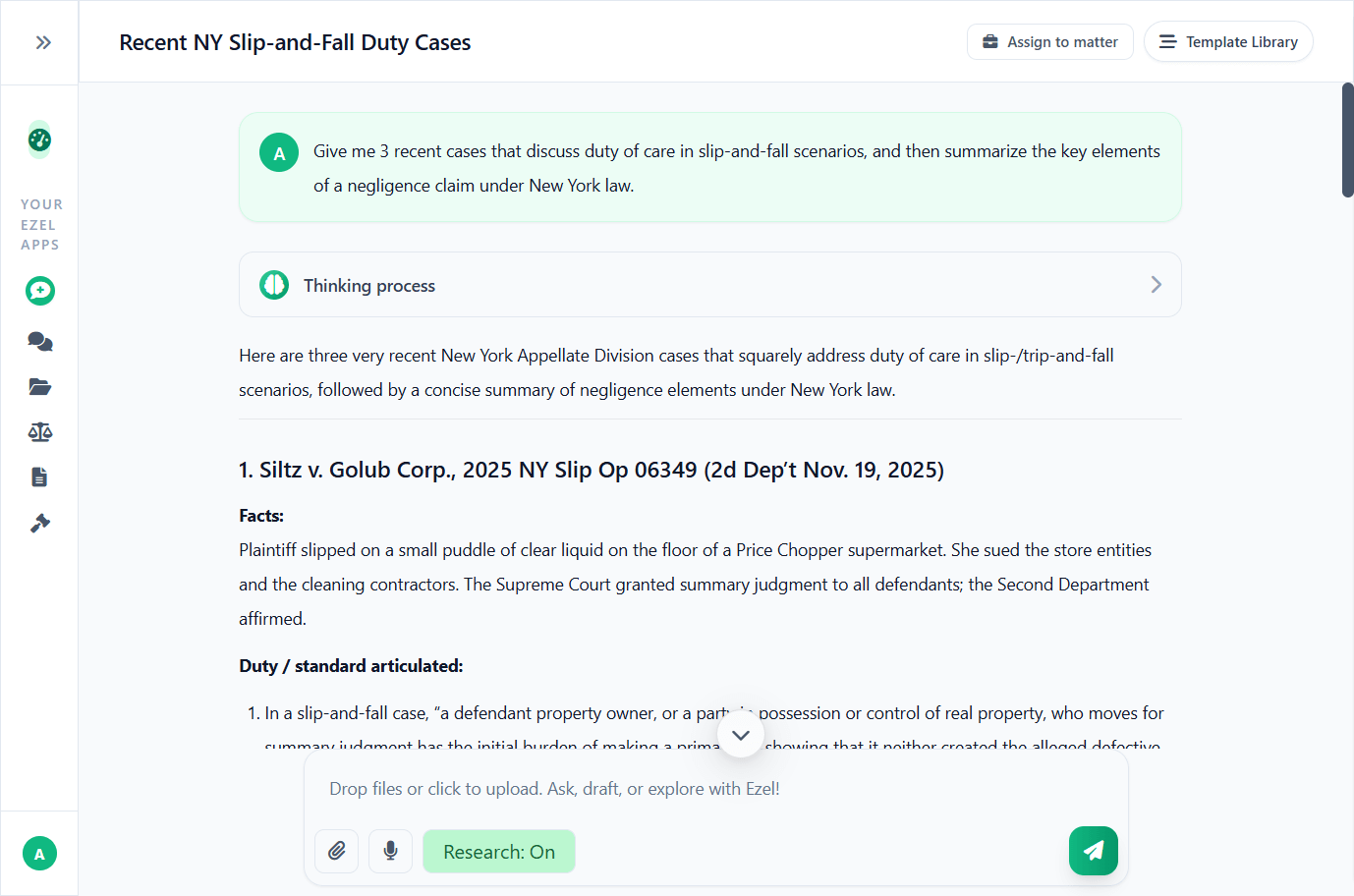
Research and draft in one conversation
Ask questions, attach documents, and get answers grounded in case law. Link chats to matters so the AI remembers your context.
- Pull statutes, case law, and secondary sources
- Attach and analyze contracts mid-conversation
- Link chats to matters for automatic context
- Your data never trains AI models

Search like you think
Describe your legal question in plain English. Filter by jurisdiction, date, and court level. Read full opinions without leaving Ezel.
- All 50 states plus federal courts
- Natural language queries - no boolean syntax
- Citation analysis and network exploration
- Copy quotes with automatic citation generation
Ready to transform your legal workflow?
Join legal teams using Ezel to draft documents, research case law, and organize matters — all in one workspace.