PERFORMANCE BOND
[// GUIDANCE: This Performance Bond template is designed for construction contracts and complies with the federal Miller Act (40 U.S.C. §§ 3131-3134) for federal projects exceeding $150,000 and state "Little Miller Acts" for state/local public projects. The Miller Act requires contractors on federal construction projects to post both performance and payment bonds. Performance bonds protect the project owner (Obligee) against the contractor's failure to perform. This template should be adapted to specific project requirements.]
PERFORMANCE BOND
Bond Number: [BOND NUMBER]
Effective Date: [EFFECTIVE DATE]
Penal Sum: [DOLLAR AMOUNT IN WORDS] Dollars ($[NUMERICAL AMOUNT])
PARTIES
PRINCIPAL:
[CONTRACTOR/PRINCIPAL LEGAL NAME]
[ADDRESS]
[CITY, STATE ZIP]
(hereinafter "Principal")
SURETY:
[SURETY COMPANY LEGAL NAME]
[ADDRESS]
[CITY, STATE ZIP]
(hereinafter "Surety")
OBLIGEE:
[PROJECT OWNER/GOVERNMENT AGENCY LEGAL NAME]
[ADDRESS]
[CITY, STATE ZIP]
(hereinafter "Obligee" or "Owner")
RECITALS
WHEREAS, Principal has entered into a contract with Obligee dated [CONTRACT DATE], Contract Number [CONTRACT NUMBER], for the following project:
Project Name: [PROJECT NAME]
Project Location: [PROJECT ADDRESS/LOCATION]
Project Description: [BRIEF DESCRIPTION OF WORK]
Contract Amount: $[CONTRACT AMOUNT]
(the "Contract" or "Construction Contract"), a copy of which is attached hereto as Exhibit A and incorporated herein by reference; and
WHEREAS, the Contract requires Principal to furnish a performance bond guaranteeing the faithful performance of the Contract in accordance with:
☐ Federal Miller Act (40 U.S.C. §§ 3131-3134) - for federal construction projects exceeding $150,000
☐ State Little Miller Act - [STATE NAME], [STATUTORY CITATION], for state/local public construction projects exceeding $[THRESHOLD AMOUNT]
☐ Private Project - as required by the Contract Documents
NOW, THEREFORE, Principal and Surety, jointly and severally, bind themselves, their heirs, executors, administrators, successors, and assigns to Obligee for the faithful performance of the Contract in the Penal Sum stated above.
BOND PROVISIONS
Section 1. Obligation
Principal and Surety, jointly and severally, bind themselves to Obligee for the performance of the Contract, which is incorporated herein by reference, subject to the following terms and conditions.
Section 2. Condition of Bond
If Principal:
(a) performs the Contract in accordance with its terms, conditions, and specifications;
(b) completes the work within the time specified, including any authorized extensions;
(c) pays all lawful claims for labor, materials, equipment, and supplies;
(d) performs and fulfills all obligations under the Contract;
(e) indemnifies and holds harmless Obligee from all costs, expenses, and damages arising from Principal's failure to perform; and
(f) remedies all defects in workmanship and materials that appear within any warranty or guaranty period specified in the Contract;
THEN this Bond shall be void; otherwise, it shall remain in full force and effect.
Section 3. Penal Sum
The Penal Sum of this Bond is [DOLLAR AMOUNT IN WORDS] Dollars ($[NUMERICAL AMOUNT]), which equals [100% / ____%] of the original Contract Amount.
The Penal Sum shall be adjusted by change order or modification to the Contract that increases or decreases the Contract Amount, without notice to or consent of Surety, provided that the total adjustment does not exceed [25%] of the original Penal Sum.
[// GUIDANCE: The Miller Act requires the performance bond to be in an amount the contracting officer considers adequate for protection of the United States. Standard practice is 100% of the contract amount. State thresholds vary - e.g., Alabama requires only 50% of contract value.]
Section 4. Surety's Obligations Upon Default
If Principal defaults in performance of the Contract, Surety shall, at Obligee's option and in Surety's sole discretion, either:
(a) Complete the Contract - Arrange for completion of the Contract by:
(i) completing the Contract itself, with or without the involvement of Principal;
(ii) procuring a replacement contractor acceptable to Obligee to complete the Contract; or
(iii) tendering to Obligee a completing contractor acceptable to Obligee;
(b) Pay Obligee - Pay Obligee the reasonable cost of completion, less the balance of the unpaid Contract Amount;
(c) Tender the Penal Sum - Tender to Obligee the Penal Sum; or
(d) Deny Liability - Deny liability in whole or in part and notify Obligee citing reasons therefor.
[// GUIDANCE: These four options mirror the AIA A312 Performance Bond standard. Surety typically has discretion to choose the remedy, but Obligee's reasonable approval of any replacement contractor is standard.]
Section 5. Notice and Opportunity to Cure
5.1 Notice of Default. Obligee shall provide Surety and Principal with written notice of any default or claimed default under the Contract within [15] days after Obligee's knowledge thereof.
5.2 Opportunity to Investigate. Upon receipt of notice, Surety shall have [15] days to:
(a) investigate the claimed default;
(b) meet with Obligee and Principal;
(c) arrange for cure of the default; or
(d) notify Obligee of Surety's position.
5.3 Obligee's Termination Right. If Surety fails to respond or fails to cure the default within the investigation period, Obligee may:
(a) declare Principal in default under the Contract;
(b) terminate Principal's right to proceed; and
(c) make demand upon Surety under this Bond.
Section 6. Obligee's Obligations
Obligee shall:
(a) promptly notify Surety and Principal of any default or material breach;
(b) permit Surety reasonable access to the project site and Contract documents;
(c) cooperate with Surety in investigating and resolving any default;
(d) mitigate damages where reasonably possible; and
(e) make payment to Principal or Surety for work properly performed.
Section 7. Limitation on Liability
7.1 Penal Sum Limit. Surety's total liability under this Bond shall not exceed the Penal Sum, regardless of the number of claims, claimants, or suits.
7.2 Reduction. The Penal Sum shall be reduced by any payment made by Surety under this Bond or the Payment Bond (if separate), if applicable.
7.3 No Consequential Damages. Surety shall not be liable for consequential, punitive, or exemplary damages, except to the extent such damages are recoverable against Principal under the Contract.
Section 8. No Action Prior to Notice
No action shall be maintained against Surety unless:
(a) Obligee has provided written notice to Surety as required herein;
(b) Surety has had reasonable opportunity to investigate and respond; and
(c) action is commenced within the time limitations set forth in Section 9.
Section 9. Limitations Period
Federal Projects (Miller Act): Any action on this Bond must be brought within one (1) year after the day on which the last of the labor was performed or materials supplied (40 U.S.C. § 3133).
State/Local Projects: Action must be brought within the limitations period specified by the applicable state Little Miller Act or, if none, within [TWO (2) YEARS] after the date of final completion or termination of the Contract.
Private Projects: Action must be brought within [TWO (2) YEARS] after the date of final completion, termination, or last work performed, whichever is latest.
[// GUIDANCE: The Miller Act has a one-year limitations period. State statutes vary significantly - confirm applicable state requirements.]
Section 10. Modifications and Changes
Surety consents to modifications, changes, extensions of time, alterations, deletions, and additions to the Contract or the work to be performed thereunder, without notice to Surety and without affecting the obligations of Surety under this Bond, provided that the aggregate of such changes does not increase the Contract Amount by more than [25%].
Section 11. No Impairment of Surety's Rights
Nothing in this Bond shall impair Surety's rights of subrogation, contribution, or indemnity against Principal or any other party.
Section 12. Assignment
This Bond may not be assigned without the written consent of Surety, except that Obligee may assign this Bond to any successor or assignee of the Contract upon written notice to Surety.
REGULATORY COMPLIANCE
Federal Miller Act Compliance (40 U.S.C. §§ 3131-3134)
☐ If this Bond is for a federal construction project, the following apply:
(a) This Bond is required because the Contract is for construction, alteration, or repair of any public building or public work of the United States;
(b) The Contract Amount exceeds $150,000;
(c) This Performance Bond is furnished in accordance with 40 U.S.C. § 3131;
(d) A separate Payment Bond is also required and furnished; and
(e) Surety is a surety company authorized by the U.S. Treasury Department (listed on Treasury Circular 570).
State Little Miller Act Compliance
☐ If this Bond is for a state or local public project, the following Little Miller Act applies:
State: [STATE NAME]
Statutory Citation: [e.g., Texas Gov't Code § 2253.021; California Civil Code § 9550; Florida Stat. § 255.05]
Bond Threshold: $[AMOUNT] (varies by state)
Special Requirements: [DESCRIBE ANY STATE-SPECIFIC REQUIREMENTS]
[// GUIDANCE: State "Little Miller Acts" vary significantly. Examples of thresholds:
- Texas: $25,000
- California: $25,000 (public works)
- Florida: $100,000-$200,000 (waivable below $200,000)
- New York: $100,000
- Washington: $35,000
- Nevada: $100,000
Confirm requirements for the specific state and project type.]
SURETY QUALIFICATIONS
Surety represents and warrants that:
(a) Surety is a corporation duly organized and authorized to transact surety business in the state where the project is located;
(b) Surety is listed on the U.S. Treasury Department's Listing of Approved Sureties (Treasury Circular 570), if required for federal projects;
(c) Surety has an A.M. Best rating of [A- / A / A+] or higher;
(d) Surety's underwriting limitation is sufficient to cover the Penal Sum of this Bond;
(e) The person executing this Bond on behalf of Surety has authority to do so; and
(f) Surety has received and reviewed the Contract Documents.
EXECUTION
IN WITNESS WHEREOF, Principal and Surety have executed this Performance Bond under seal as of the Effective Date first written above.
PRINCIPAL:
[CONTRACTOR/PRINCIPAL LEGAL NAME]
By: _____________________________________
Name: ___________________________________
Title: ___________________________________
Date: ____________________________________
[Corporate Seal]
SURETY:
[SURETY COMPANY LEGAL NAME]
By: _____________________________________
Name: ___________________________________
Title: Attorney-in-Fact
Date: ____________________________________
[Surety Seal]
ACKNOWLEDGMENT - PRINCIPAL
STATE OF _____________ )
) ss.
COUNTY OF ____________ )
On this ___ day of __________, 20__, before me, the undersigned Notary Public, personally appeared [PRINCIPAL SIGNATORY NAME], proved to me to be the [TITLE] of [PRINCIPAL NAME] and acknowledged execution of this Bond on behalf of said entity.
_____________________________________
Notary Public
My Commission Expires: _______________
ACKNOWLEDGMENT - SURETY
STATE OF _____________ )
) ss.
COUNTY OF ____________ )
On this ___ day of __________, 20__, before me, the undersigned Notary Public, personally appeared [ATTORNEY-IN-FACT NAME], proved to me to be the Attorney-in-Fact of [SURETY NAME] and acknowledged execution of this Bond on behalf of said Surety pursuant to a valid Power of Attorney.
_____________________________________
Notary Public
My Commission Expires: _______________
REQUIRED ATTACHMENTS
☐ Exhibit A: Copy of the Construction Contract
☐ Exhibit B: Power of Attorney for Surety's Attorney-in-Fact
☐ Exhibit C: Certificate of Authority (if required by state)
☐ Exhibit D: Treasury Circular 570 Listing (for federal projects)
ATTORNEY CHECKLIST (DO NOT INCLUDE IN FINAL DOCUMENT)
☐ Verify project type: federal, state/local, or private
☐ Confirm applicable bond threshold and statutory requirements
☐ Verify Surety is authorized in the project state and on Treasury Circular 570 (if federal)
☐ Obtain and attach valid Power of Attorney for Attorney-in-Fact
☐ Verify Penal Sum equals required percentage of Contract Amount
☐ Coordinate with Payment Bond (usually required simultaneously)
☐ Review Contract provisions regarding bonds
☐ Confirm limitations period under applicable statute
☐ Verify Surety's A.M. Best rating meets Contract requirements
☐ Obtain General Indemnity Agreement from Principal
[// GUIDANCE: The Miller Act (40 U.S.C. § 3131) requires performance bonds on federal construction contracts exceeding $150,000. State "Little Miller Acts" impose similar requirements for state and local public projects, but thresholds and requirements vary significantly by state. Always verify the specific requirements for the project jurisdiction.]
END OF TEMPLATE
Do more with Ezel
This free template is just the beginning. See how Ezel helps legal teams draft, research, and collaborate faster.
AI that drafts while you watch
Tell the AI what you need and watch your document transform in real-time. No more copy-pasting between tools or manually formatting changes.
- Natural language commands: "Add a force majeure clause"
- Context-aware suggestions based on document type
- Real-time streaming shows edits as they happen
- Milestone tracking and version comparison
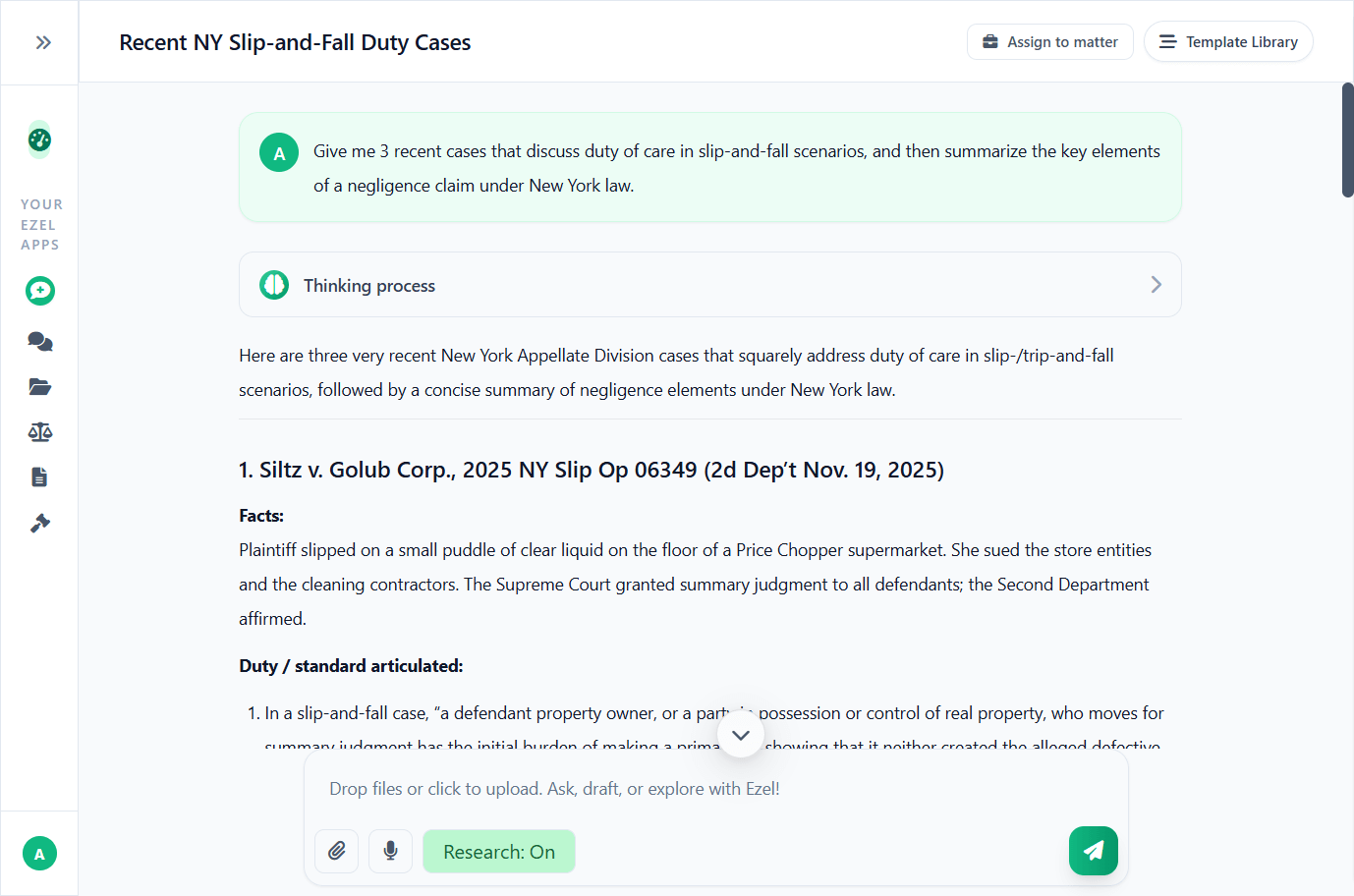
Research and draft in one conversation
Ask questions, attach documents, and get answers grounded in case law. Link chats to matters so the AI remembers your context.
- Pull statutes, case law, and secondary sources
- Attach and analyze contracts mid-conversation
- Link chats to matters for automatic context
- Your data never trains AI models

Search like you think
Describe your legal question in plain English. Filter by jurisdiction, date, and court level. Read full opinions without leaving Ezel.
- All 50 states plus federal courts
- Natural language queries - no boolean syntax
- Citation analysis and network exploration
- Copy quotes with automatic citation generation
Ready to transform your legal workflow?
Join legal teams using Ezel to draft documents, research case law, and organize matters — all in one workspace.