PARENTING PLAN
(Utah)
[// GUIDANCE: This comprehensive parenting plan template provides detailed arrangements for co-parenting after separation or divorce. It goes beyond basic custody schedules to address day-to-day parenting decisions, conflict resolution, and practical logistics. Many states require or strongly encourage detailed parenting plans. This template is designed to be thorough and can be customized based on the children's ages, parents' circumstances, and family dynamics.]
TABLE OF CONTENTS
- Document Header
- Definitions
- Parenting Time Schedule
- Decision-Making & Parental Responsibilities
- Information Sharing & Communication
- Child-Rearing Provisions
- Transitions & Exchanges
- Relocation
- Dispute Resolution
- Financial Provisions
- Modification & Review
- General Provisions
- Execution Block
1. DOCUMENT HEADER
1.1 Title and Parties
This Parenting Plan ("Plan") is entered into by and between [PARENT A NAME] ("Parent A") and [PARENT B NAME] ("Parent B," and together the "Parents") concerning the parenting arrangements for the minor child(ren) listed below.
1.2 Identification of Child(ren)
• Name: [CHILD 1 NAME]; DOB: [MM/DD/YYYY]; Age: [X]
• Name: [CHILD 2 NAME]; DOB: [MM/DD/YYYY]; Age: [X]
(Each individually, a "Child," and collectively, the "Children.")
1.3 Effective Date
This Plan is effective as of [EFFECTIVE DATE].
1.4 Court Jurisdiction
This Plan shall be filed with the [STATE/COUNTY] Family Court ("Court") for incorporation into [a divorce decree / custody order / other]. The Court retains continuing jurisdiction to interpret, enforce, or modify this Plan as necessary to serve the Children's best interests.
1.5 Purpose and Principles
A. Purpose: This Plan establishes a comprehensive framework for co-parenting that prioritizes the Children's emotional security, developmental needs, and relationships with both Parents.
B. Guiding Principles:
• The Children's best interests are paramount in all decisions.
• Frequent and continuing contact with both Parents benefits the Children.
• Parents shall cooperate, communicate respectfully, and resolve conflicts constructively.
• Parents shall shield the Children from parental conflict.
• Consistency, stability, and predictability serve the Children's welfare.
• Parents shall support the Children's relationship with the other Parent.
1.6 Recitals
A. Parents are the natural and legal parents of the Children.
B. Parents have separated or divorced and desire to establish clear parenting arrangements.
C. Parents are committed to effective co-parenting despite the end of their relationship.
D. This Plan is designed to meet the Children's current needs and will be reviewed periodically as circumstances change.
2. DEFINITIONS
2.1 "Best Interests Standard" means the factors considered under Utah law in determining custody and parenting arrangements, prioritizing the Children's health, safety, welfare, and emotional needs.
2.2 "Child-Related Expenses" include education costs, extracurricular activities, childcare, medical expenses not covered by insurance, and other costs related to the Children's upbringing.
2.3 "Legal Custody" means the authority to make major decisions concerning the Children's welfare, including education, healthcare, and religious upbringing.
2.4 "Major Decisions" include selection of schools, authorization of non-emergency medical treatment, mental health services, religious education and practice, extracurricular activities, and travel outside [state/country].
2.5 "Parenting Time" (also called "Physical Custody" or "Time-Sharing") means the time each Parent spends with the Children, including overnight periods.
2.6 "Primary Residence" means [SPECIFY if applicable: the address where the Children primarily reside for school enrollment and mailing purposes]. [OR: "The Children have dual residences"].
2.7 "Routine Decisions" means day-to-day decisions regarding the Children's care, activities, bedtime, meals, homework, discipline, and similar matters, made by the Parent currently exercising parenting time.
3. PARENTING TIME SCHEDULE
3.1 Legal Custody
[SELECT ONE:]
Option A: Joint Legal Custody
The Parents shall share joint legal custody. Major Decisions shall be made by mutual agreement after good-faith consultation, as detailed in Section 4.
Option B: Sole Legal Custody
[PARENT A/PARENT B] shall have sole legal custody and exclusive authority to make Major Decisions. The custodial parent [shall/is encouraged to] consult with the other parent but has final decision-making authority.
3.2 Physical Custody / Parenting Time Arrangement
[SELECT ONE:]
Option A: Shared Physical Custody (Approximately Equal Time)
The Parents shall share physical custody with substantially equal parenting time according to the schedule in Section 3.3.
Option B: Primary Physical Custody with Visitation
[PARENT A/PARENT B] shall have primary physical custody. The other parent shall have parenting time according to the schedule in Section 3.3.
3.3 Regular Parenting Time Schedule
[CUSTOMIZE based on children's ages and parents' circumstances. Common options include:]
OPTION 1: Week On/Week Off
• Parent A: Children reside with Parent A for seven consecutive days, from Monday after school (or 9:00 AM if no school) to Monday morning (school drop-off).
• Parent B: Children reside with Parent B the following week on the same schedule.
• Schedule continues alternating weekly.
OPTION 2: 2-2-3 Schedule
• Monday-Tuesday: Parent A
• Wednesday-Thursday: Parent B
• Friday-Sunday: Alternating (Parent A on Week 1, Parent B on Week 2)
OPTION 3: 5-2-2-5 Schedule
• Monday-Tuesday: Parent A (every week)
• Wednesday-Thursday: Parent B (every week)
• Friday-Monday: Alternating (Parent A on Week 1, Parent B on Week 2)
OPTION 4: Every Other Weekend Plus Midweek
• Primary Parent (Parent A): Weekdays and alternate weekends
• Other Parent (Parent B):
- Alternating weekends: Friday after school to Monday morning (school drop-off)
- One midweek overnight: Wednesday after school to Thursday morning (school drop-off)
OPTION 5: Custom Schedule for Your Family
[INSERT detailed custom schedule with specific days, times, and any unique arrangements]
Parent A Parenting Time:
• [SPECIFY: e.g., Every Monday 3 PM to Wednesday 8 AM]
• [SPECIFY: e.g., Alternate weekends Friday 6 PM to Sunday 6 PM]
• [Continue with complete schedule]
Parent B Parenting Time:
• [SPECIFY complete schedule]
3.4 School Schedule vs. Non-School Schedule
[If different schedules apply during school year vs. summer:]
School Year (approximately [START DATE] to [END DATE] annually):
[INSERT school-year schedule]
Summer Break (approximately [START DATE] to [END DATE] annually):
[INSERT summer schedule - may be different to provide flexibility, extended periods with each parent, or accommodate work schedule changes]
3.5 Holiday Schedule
Holidays supersede the regular schedule. The Parents shall alternate major holidays annually unless otherwise indicated.
[SPECIFY detailed holiday schedule. Sample framework:]
| Holiday | Even Years | Odd Years | Time |
|---|---|---|---|
| New Year's Day | Parent A | Parent B | Dec 31, 10 AM - Jan 1, 6 PM |
| Martin Luther King Day | Parent B | Parent A | Fri 6 PM - Mon 6 PM |
| Presidents' Day | Parent A | Parent B | Fri 6 PM - Mon 6 PM |
| Spring Break | Parent B | Parent A | First day 9 AM - last day 6 PM |
| Easter/Passover | Parent A | Parent B | Sat 9 AM - Sun 7 PM |
| Memorial Day | Parent B | Parent A | Fri 6 PM - Mon 6 PM |
| Independence Day | Parent A | Parent B | July 3, 9 AM - July 5, 6 PM |
| Labor Day | Parent B | Parent A | Fri 6 PM - Mon 6 PM |
| Halloween | Parent A | Parent B | 4 PM - 9 PM |
| Thanksgiving | Parent A | Parent B | Wed 6 PM - Sun 6 PM |
| Winter/Christmas Break | Split: First half/Second half alternating | ||
| Mother's Day | Mother (every year) | Sat 9 AM - Sun 7 PM | |
| Father's Day | Father (every year) | Sat 9 AM - Sun 7 PM | |
| Child's Birthday | [Shared celebration OR alternating years OR parent not otherwise in possession gets 2 hours] | ||
| Parent A Birthday | Parent A (every year) | [SPECIFY time] | |
| Parent B Birthday | Parent B (every year) | [SPECIFY time] |
Winter Break Details:
• First Half: December [DATE] at 9:00 AM through December [DATE] at 2:00 PM
• Second Half: December [DATE] at 2:00 PM through January [DATE] at 6:00 PM
• Christmas Eve/Day Split: [SPECIFY if splitting Christmas Eve and Christmas Day differently]
Religious Holidays: [ADD: Hanukkah, Eid, Diwali, or other religious observances important to the family, with specific dates and times]
3.6 Summer Vacation / Extended Parenting Time
a. Each Parent may exercise up to [SPECIFY: e.g., two (2) weeks] of uninterrupted vacation time with the Children during the summer, with the following conditions:
• Written notice provided to the other Parent by [DATE, e.g., May 1]
• Dates mutually agreed or, if not, selected by [alternating first choice in even/odd years]
• Vacation time supersedes regular schedule but not holiday schedule
• The non-vacationing parent shall have [phone/video] contact [daily/every other day] for [duration]
b. If a Parent does not exercise vacation time by [DATE], the right is waived for that year.
3.7 School Breaks
Spring Break: [Alternating annually per holiday schedule above OR split OR default to regular schedule]
Fall Break / Teacher Workdays / Short School Breaks: [Default to regular schedule OR specify alternate arrangements]
3.8 Special Circumstances Schedule
[If applicable, address:]
• Infant/Toddler Schedule: [For very young children, specify shorter, more frequent transitions]
• Breastfeeding Considerations: [If applicable]
• Special Needs Considerations: [If applicable, specify accommodations]
4. DECISION-MAKING & PARENTAL RESPONSIBILITIES
4.1 Day-to-Day Decisions
Each Parent shall have sole authority to make routine, day-to-day decisions while the Children are in that Parent's care, including:
• Daily schedules, bedtime, meals
• Discipline (consistent with Section 6.3)
• Permission for age-appropriate activities
• Routine hygiene and grooming
• Homework supervision
• Social activities with friends
4.2 Major Decisions (Joint Legal Custody)
[IF JOINT LEGAL CUSTODY:]
Major Decisions require mutual agreement of both Parents. The Parents shall consult in good faith and reach decisions based on the Children's best interests.
A. Education Decisions:
• School selection and enrollment (public, private, charter, homeschool)
• Changes in schools
• Special education services, IEPs, 504 plans
• Tutoring or remedial services
• Educational testing and evaluations
• Gifted programs or grade acceleration/retention
• College selection and applications [for older children]
Process: Either Parent may initiate discussion. Parents shall exchange relevant information, discuss options, and reach consensus. Both Parents may attend school meetings. [If no agreement: proceed to dispute resolution per Section 9]
B. Medical Decisions:
• Selection of primary care physician, dentist, specialists
• Non-emergency medical procedures
• Medications (ongoing/regular use)
• Mental health treatment (therapy, counseling, psychiatric care)
• Elective procedures (e.g., orthodontics, elective surgeries)
• Vision care (glasses, contacts)
• Alternative medicine or treatments
Emergency Medical Care: The Parent with the Children may authorize emergency medical treatment. The other Parent shall be notified immediately. Emergency is defined as a condition requiring immediate attention to prevent serious harm.
Routine Medical Care: Scheduled check-ups, vaccinations per CDC schedule, treatment of minor illnesses during parenting time do not require advance consultation but the other Parent should be informed promptly.
Process: Either Parent may schedule appointments. Both Parents shall receive medical information and may speak directly with healthcare providers. For major medical decisions, both Parents shall consult and agree. [If no agreement: proceed to dispute resolution per Section 9]
C. Religious Upbringing:
[SELECT ONE:]
Option 1: The Children shall be raised in the [SPECIFY RELIGION/FAITH] tradition. Both Parents shall support this upbringing and cooperate regarding religious education, ceremonies, and observances.
Option 2: Each Parent may expose the Children to his/her own religious beliefs and practices during that Parent's parenting time. Neither Parent shall denigrate the other's faith. Major religious ceremonies (baptism, confirmation, bar/bat mitzvah, etc.) require mutual agreement.
Option 3: The Parents shall not provide formal religious instruction. Each parent may practice his/her own faith but shall not enroll the Children in religious education programs without mutual agreement.
D. Extracurricular Activities:
• Enrollment in sports, music, arts, clubs, or other activities
• Level of commitment (recreational vs. competitive)
• Schedule and time commitment
• Cost (if significant)
Process: Parents shall consult before enrolling Children in new activities. Both Parents should consider: Child's interest and aptitude; time commitment and impact on parenting schedule; cost and ability to pay; family time available. Once enrolled, both Parents shall cooperate to transport Children and attend performances/games when possible.
Ongoing Activities: Activities the Children are currently participating in shall continue absent mutual agreement to discontinue or good cause (Child's lack of interest, time conflicts, financial hardship).
E. Travel:
• Domestic Travel (within U.S.): Either Parent may travel with the Children during that Parent's parenting time without the other Parent's consent, provided [48-72] hours' advance notice is given with itinerary and contact information.
• International Travel: Requires written consent of the other Parent provided at least [30-60] days in advance. Consent shall not be unreasonably withheld. Traveling Parent shall provide: itinerary, flight information, lodging, contact information, return date/time. Each Parent shall provide the other with necessary passport consent and travel authorization letters.
F. Other Major Decisions:
• Driver's education and licensing [for teenagers]
• Employment [for teenagers]
• Motor vehicle ownership/use [for teenagers]
• Body modification (tattoos, piercings) [for older children]
• Access to social media and electronic devices [see Section 6.5]
4.3 Decision-Making Allocation (If Sole Legal Custody or Divided Decision-Making)
[IF SOLE LEGAL CUSTODY OR DIVIDED DECISION-MAKING, specify which parent has authority for each category:]
• Education: [Parent A / Parent B]
• Medical: [Parent A / Parent B]
• Religious: [Parent A / Parent B]
• Extracurricular: [Parent A / Parent B]
The decision-making parent [shall/should] consult with the other parent but has final authority.
4.4 Consulting and Information Sharing
Even when one Parent has decision-making authority, that Parent shall:
• Inform the other Parent of major decisions;
• Provide the other Parent opportunity to share input;
• Consider the other Parent's views in good faith;
• Keep the other Parent informed of outcomes.
5. INFORMATION SHARING & COMMUNICATION
5.1 Parent-to-Parent Communication
a. Method: Parents shall communicate primarily through [SELECT: text message / email / co-parenting app such as OurFamilyWizard, Talking Parents, etc. / phone calls].
b. Tone: All communications shall be respectful, child-focused, and business-like. Parents shall refrain from inflammatory language, insults, or discussion of their past relationship.
c. Response Time: Each Parent shall respond to communications regarding the Children within [24-48] hours.
d. Topics: Parent-to-parent communication should address:
• Schedule changes or conflicts
• The Children's health, education, and welfare
• Upcoming events or activities
• Behavioral or developmental concerns
• Logistics (exchanges, transportation, belongings)
e. Prohibited Topics: Parents shall NOT discuss [child support payments, financial matters between parents, dating relationships, or other non-child-related topics] through child-focused communication channels.
5.2 Communication with Children
a. Phone/Video Contact: The Parent not currently exercising parenting time may have [daily/every other day] phone or video contact with the Children at [SPECIFY TIME, e.g., 7:00 PM for up to 20 minutes], or at another mutually convenient time.
b. Facilitating Contact: The Parent with the Children shall:
• Ensure the Children are available at the scheduled time;
• Provide privacy for the conversation;
• Provide a device with adequate connectivity;
• Not monitor, listen to, or interfere with the call;
• Encourage the Children to participate.
c. Respect for Parenting Time: The calling Parent shall:
• Call at agreed times and keep calls reasonably brief;
• Not interrogate the Children about the other Parent's household;
• Not undermine the other Parent's authority;
• Not call at unreasonable times.
d. Additional Contact: Children may initiate contact with either Parent at any reasonable time, and such contact shall be facilitated.
e. Older Children's Devices: [If children have their own phones/devices] The Children may contact either Parent at will. Neither Parent shall monitor, restrict, or punish such contact except for reasonable screen time management.
5.3 Access to Records and Information
a. Educational Records: Both Parents shall have direct access to school records, online portals, report cards, progress reports, and teacher communications. Both Parents are entitled to attend parent-teacher conferences, school events, and activities.
b. Medical Records: Both Parents shall have direct access to medical, dental, and mental health records. Both Parents may communicate directly with healthcare providers and may attend medical appointments.
c. Extracurricular Information: Both Parents shall receive schedules, communications, and information about the Children's extracurricular activities.
d. Information Sharing Between Parents: Each Parent shall promptly provide the other with copies of:
• Report cards and progress reports
• Medical reports, test results, and treatment plans
• IEPs, 504 plans, and educational evaluations
• Extracurricular schedules and team/group communications
• School calendars and event notices
• Any emergency or significant incident involving the Children
e. Direct Access: Each Parent shall provide the other Parent's contact information to schools, healthcare providers, and activity coordinators to ensure both Parents receive direct communications.
5.4 Notice of Significant Events
Each Parent shall promptly notify the other (within 24 hours) of:
• Serious illness or injury requiring medical attention
• Hospitalization or emergency room visits
• Behavioral incidents or school disciplinary actions
• Accidents or injuries
• Significant changes in the Children's emotional state or behavior
• Changes in the Parent's address, phone number, or employment
• Introduction of a new romantic partner to the Children [see Section 6.4]
• Any incident involving police, CPS, or protective services
6. CHILD-REARING PROVISIONS
6.1 Consistency in Parenting
While recognizing that each household may have different routines, the Parents shall strive for consistency in:
• Bedtimes and sleep schedules (age-appropriate)
• Homework expectations and supervision
• Screen time rules and device use
• Discipline approaches
• Healthy eating habits
• Important rules and values
6.2 Rules and Discipline
a. Each Parent's Authority: Each Parent may establish reasonable rules and expectations in his/her own household.
b. Discipline Methods: Discipline shall be age-appropriate and may include time-outs, loss of privileges, natural consequences, and verbal correction. Corporal punishment / spanking is [prohibited / discouraged / permitted only as a last resort with reasonable force].
c. Prohibited Discipline: Neither Parent shall use discipline that is physically harmful, emotionally abusive, degrading, or involves withholding necessities (food, shelter, medical care).
d. Undermining: Neither Parent shall undermine the other Parent's discipline or allow the Children to avoid consequences imposed by the other Parent.
6.3 Introduce New Partners
[SELECT APPROACH:]
Option A: Neither Parent shall introduce a romantic partner to the Children until the relationship has been exclusive for at least [6-12] months and the Parent reasonably believes it may become long-term.
Option B: A Parent may introduce a new partner to the Children when the Parent deems appropriate, but shall provide [30] days' advance notice to the other Parent including the partner's full name.
Option C: No restrictions on introducing new partners, but both Parents shall be respectful of the Children's adjustment and not expose the Children to a series of casual relationships.
Overnight Guests: [A romantic partner shall not stay overnight while the Children are present until [engaged/married / 12 months have passed] OR no restriction OR requires other parent's consent].
Notification: A Parent introducing a new partner shall provide the other Parent with the partner's full name and notify the other Parent before or promptly after the introduction.
6.4 Technology and Social Media
a. Screen Time: Each Parent may set screen time limits in his/her home, but Parents shall strive for consistency.
b. Devices: [Specify whether children have phones, tablets, computers. Specify who provides devices and who pays for service plans.]
c. Social Media: [If children are old enough] Children may/may not have social media accounts. [Specify platforms, age restrictions, parental monitoring arrangements, privacy settings requirements.] Both Parents shall have access to usernames and passwords.
d. Monitoring and Safety: Both Parents shall ensure age-appropriate online safety, parental controls, and monitoring. Parents shall discuss and agree on internet and device rules.
e. Communication Devices: Devices used for parent-child communication shall not be taken away as punishment unless absolutely necessary, and then only for brief periods.
6.5 Alcohol, Tobacco, and Substances
a. Neither Parent shall consume alcohol to impairment or use illegal substances during parenting time or within [12] hours before parenting time begins.
b. Neither Parent shall allow the Children to be exposed to illegal drug use.
c. Prescription medications shall be used only as prescribed.
d. Neither Parent shall smoke tobacco or use e-cigarettes/vaping products in the presence of the Children or in enclosed spaces (vehicles, homes) where the Children will be present.
e. As the Children mature, Parents shall discuss and agree upon age-appropriate education regarding alcohol, tobacco, drugs, and shall present a united front regarding expectations and consequences.
6.6 Firearms and Weapons
All firearms and weapons in either Parent's home shall be:
• Stored unloaded
• Locked in a secure container or safe
• With ammunition stored separately in a locked container
• Inaccessible to the Children
Each Parent shall comply with all applicable firearms safety laws.
6.7 Childcare and Third-Party Care
a. Right of First Refusal: [SELECT:]
Option A: If a Parent requires childcare for more than [X] hours during parenting time, that Parent shall first offer the other Parent the opportunity to care for the Children before arranging third-party childcare. The other Parent shall respond within [2] hours or the offer is deemed declined.
Option B: No right of first refusal. Each Parent may arrange childcare as needed during parenting time.
b. Childcare Providers: Each Parent may select childcare providers (babysitters, daycare, after-school care) but shall ensure providers are responsible, safe, and age-appropriate. Each Parent shall provide the other with names and contact information for regular childcare providers.
c. Overnight Care: Neither Parent shall leave the Children in the overnight care of any person other than a [family member / approved list of people / the other Parent] without advance notice to the other Parent.
6.8 Parental Alienation Prohibited
Neither Parent shall:
• Make negative, denigrating, or disparaging remarks about the other Parent in the Children's presence or hearing;
• Allow others (family members, friends, new partners) to disparage the other Parent in the Children's presence;
• Interrogate the Children about the other Parent's household, activities, relationships, or finances;
• Encourage the Children to disobey, disrespect, or reject the other Parent;
• Interfere with the Children's communications with the other Parent;
• Suggest that the other Parent does not love the Children or does not want to spend time with them;
• Share age-inappropriate information about the divorce/separation, court proceedings, or conflicts between the Parents;
• Use the Children as messengers, spies, or mediators between the Parents.
6.9 Adult Issues
Parents shall not discuss with the Children or in the Children's hearing:
• Court proceedings, custody disputes, or litigation
• Child support, financial matters between the parents, or money owed
• Blame or fault for the separation/divorce
• Dating relationships or intimate details of adult relationships
• Negative information about the other Parent
• Other adult matters inappropriate for the Children's ages
7. TRANSITIONS & EXCHANGES
7.1 Exchange Location
[SPECIFY:]
Option A: Exchanges shall occur at [SPECIFY ADDRESS OR LOCATION, e.g., Parents' respective homes, neutral public location, children's school, etc.]
Option B: Exchanges shall occur at the following locations:
• School days: At the Children's school (pick-up from after-school care or drop-off at school)
• Non-school days: At [SPECIFY NEUTRAL LOCATION]
7.2 Transportation Responsibility
[SELECT:]
Option A: The Parent beginning his/her parenting time shall pick up the Children from the other Parent (or designated location).
Option B: The Parent ending his/her parenting time shall transport the Children to the other Parent (or designated location).
Option C: Parents shall share transportation equally by [SPECIFY ARRANGEMENT].
Option D: Each Parent is responsible for transportation from his/her residence to the exchange location and back.
7.3 Exchange Time
Exchanges shall occur at the times specified in Section 3. The delivering Parent shall have the Children ready at the scheduled time. The receiving Parent shall arrive on time.
Punctuality: Both Parents shall be punctual for exchanges.
Late Arrival: If a Parent will be more than [15] minutes late, that Parent shall notify the other Parent immediately. Chronic lateness (more than [3] instances in [60] days without reasonable excuse) is a material breach.
No-Show: If a Parent fails to appear for a scheduled exchange within [30] minutes of the scheduled time and has not communicated a delay, the other Parent may consider the parenting time forfeited for that occasion.
7.4 Exchange Conduct
a. Respectful Behavior: Parents shall be courteous and civil during exchanges. Hostile, threatening, or inappropriate behavior is prohibited.
b. Brief and Child-Focused: Exchanges are not an appropriate time for extended conversations between Parents. Communications should be brief, child-focused, and logistical. Substantive discussions should occur separately.
c. Appropriate Attire: Parents shall be appropriately dressed during exchanges.
d. No Third Parties: Generally, only the Parents and Children should be present at exchanges, unless [new partners/family members are permitted OR supervised exchanges require a third party OR by mutual agreement].
e. Positive Transition: Parents shall prepare the Children positively for transitions and help them adjust. Neither Parent shall make the Children feel guilty about leaving or express sadness or anger about the transition in the Children's presence.
7.5 Children's Belongings
a. Clothing: Sufficient clean, weather-appropriate clothing shall be sent with the Children for the duration of the parenting time. Clothing should be returned clean.
b. Special Items: Comfort items (favorite toys, blankets, stuffed animals) shall travel with young children. School-age children's items (backpacks, homework, books, sports equipment, musical instruments) shall travel as needed.
c. Medications: All necessary medications shall be sent with the Children along with written instructions for administration.
d. Not Withheld: Neither Parent shall withhold the Children's belongings, clothing, or special items as a means of conflict or punishment.
e. Supplies in Both Homes: Each Parent shall maintain appropriate clothing, toiletries, and supplies for the Children in that Parent's home to minimize the need to transport belongings.
7.6 School Transitions
[If applicable:] When exchanges occur at school:
• The Parent with morning responsibility shall ensure the Children arrive at school on time with completed homework, necessary supplies, and appropriate clothing.
• The Parent with afternoon responsibility shall pick up the Children from school or after-school care by [TIME].
• Parents shall communicate directly with the school regarding pick-up authorization and emergency contacts.
8. RELOCATION
8.1 Geographic Restriction
[SELECT:]
Option A: Neither Parent shall relocate the Children's primary residence outside of [SPECIFY: County, School District, Metropolitan Area, State] without the other Parent's written consent or court approval.
Option B: The [primary custodial parent / Parent with sole legal custody] may relocate within the state of Utah with [30-60] days' written notice to the other Parent. Relocation outside Utah requires the other Parent's written consent or court approval.
Option C: No geographic restriction, but the relocating Parent must comply with notice and modification requirements below.
8.2 Notice of Relocation
a. A Parent intending to relocate must provide written notice to the other Parent at least [60-90] days before the proposed relocation date (or as soon as possible if an emergency requires shorter notice).
b. The notice shall include:
• The new address and phone number
• The date of the proposed move
• The reason for the relocation
• A proposed revised parenting plan accommodating the new distance
• The Children's new school, if applicable
8.3 Objection to Relocation
a. The non-relocating Parent may object to the relocation by providing written notice within [30] days of receiving the relocation notice.
b. If the non-relocating Parent objects, the Parents shall first attempt mediation to resolve the dispute and modify the parenting plan.
c. If mediation is unsuccessful, either Parent may petition the Court. The Court will consider the Children's best interests, including:
• The reason for the relocation
• The educational and economic opportunities in the new location
• The feasibility of preserving the relationship between the Children and the non-relocating Parent
• The Children's preferences (if age-appropriate)
• The impact on the Children's stability and development
d. Until the Court rules, the current parenting plan remains in effect, and the relocation may not proceed without court approval.
8.4 Modification of Parenting Plan Upon Relocation
If relocation is approved (by consent or court order), the Parents shall modify this Plan to address:
• Revised parenting time schedule (extended weekend/holiday periods, school breaks, summer vacation)
• Transportation and travel costs
• Communication and virtual visitation schedule
• Any other necessary adjustments
9. DISPUTE RESOLUTION
9.1 Good-Faith Communication
Parents shall first attempt to resolve disagreements through respectful, direct communication, keeping the Children's best interests paramount.
9.2 Mediation
If the Parents cannot resolve a dispute through direct communication within [7-14] days, they shall submit the matter to mediation with a qualified family mediator before seeking court intervention (except in emergencies).
Mediation Process:
• Mediator selection: [by mutual agreement / from court-approved list / other]
• Costs: [shared equally / allocated based on ability to pay / other]
• Timeline: Mediation shall be scheduled within [30] days
• Confidentiality: Mediation is confidential; statements made in mediation are not admissible in court
9.3 Parenting Coordinator [OPTIONAL]
[If applicable:] The Parents may agree to retain a parenting coordinator (PC), a neutral professional who can help resolve day-to-day disputes and make recommendations or binding decisions (as authorized) regarding implementation of this Plan. [Specify PC's authority, costs, and appointment process.]
9.4 Court Intervention
If mediation (and PC involvement, if applicable) fails to resolve the dispute, either Parent may file a motion with the Court. The Court retains jurisdiction to interpret, enforce, and modify this Plan.
9.5 Attorneys' Fees
[SELECT:]
Option A: Each Parent shall bear his/her own attorneys' fees and costs in any dispute.
Option B: In any court proceeding, the prevailing Parent shall be entitled to reasonable attorneys' fees and costs from the non-prevailing Parent, subject to the Court's discretion.
Option C: If a Parent unnecessarily causes a dispute through willful violation of this Plan, that Parent may be ordered to pay the other Parent's reasonable attorneys' fees.
9.6 Emergency Relief
Nothing in this section prohibits a Parent from seeking immediate court intervention in an emergency affecting the Children's health, safety, or welfare.
10. FINANCIAL PROVISIONS
[GUIDANCE: This section addresses child-related expenses beyond basic child support. Delete or customize based on your situation. Child support orders are typically separate documents but can be referenced here.]
10.1 Child Support
[OPTION 1:] Child support shall be addressed in a separate Child Support Order [cite case number if applicable].
[OPTION 2:] [Parent A/Parent B] shall pay child support of $[AMOUNT] per [month/week] pursuant to [state guidelines / agreement]. Child support shall be paid [directly to the other parent / through the state disbursement unit] by [payment method].
10.2 Health Insurance
[SPECIFY PARENT] shall maintain comprehensive health, dental, and vision insurance for the Children through [employer-provided plan / private plan / Marketplace plan].
The insuring Parent shall provide the other Parent with:
• Insurance cards or copies
• Policy information and contact numbers
• Explanation of benefits for any claims
10.3 Unreimbursed Medical Expenses
Medical, dental, and vision expenses not covered by insurance ("Unreimbursed Medical Expenses") shall be allocated as follows:
• Parent A: [XX]%
• Parent B: [XX]%
Procedure:
• The Parent incurring the expense shall provide the other Parent with documentation within [30] days.
• The other Parent shall reimburse his/her share within [30] days of receiving documentation.
• Both Parents should attempt to consult before incurring significant unreimbursed expenses (other than emergencies).
10.4 Extracurricular Activities
Costs for extracurricular activities (sports, music lessons, arts, clubs, camps) shall be:
[OPTION A:] Shared between the Parents [equally / proportionally XX%-XX% / other], with mutual agreement required before enrolling the Children in any activity with costs exceeding $[AMOUNT] per year.
[OPTION B:] The Parent enrolling the Child in an activity shall be solely responsible for the cost, unless the other Parent agrees in advance to share the cost.
Transportation: Each Parent shall transport the Children to/from activities during that Parent's parenting time.
Attendance: Both Parents are encouraged to attend games, performances, and events regardless of whose parenting time it is.
10.5 Educational Expenses
School-related costs:
• Tuition (if private school): [SPECIFY allocation]
• School supplies, fees, lunches: [Shared equally / each parent provides during their time / other]
• School trips and enrichment: [SPECIFY allocation and approval process]
[For older children - college planning:]
• [The parents agree to contribute to college expenses to the extent able / No agreement regarding college expenses / Specify any college savings plan contributions]
10.6 Childcare Expenses
Work-related or education-related childcare expenses shall be [shared equally / shared proportionally / borne by the parent incurring them].
10.7 Other Shared Expenses
[Specify any other shared expenses, e.g.,]
• Travel costs for long-distance parenting time: [SPECIFY]
• Technology (phones, tablets, computers): [SPECIFY]
• Special needs services or equipment: [SPECIFY]
10.8 Tax Exemptions
[SELECT:]
Option A: The [Parent A/Parent B] shall claim the child(ren) as dependents for federal and state income tax purposes each year.
Option B: The Parents shall alternate claiming the Children annually, with [Parent A/Parent B] claiming in even years and the other in odd years. [If more than one child, specify how exemptions are split.]
Option C: Tax treatment shall be addressed in the divorce decree or a separate agreement.
The Parent entitled to the exemption shall provide the other Parent any necessary IRS Form 8332 or equivalent.
11. MODIFICATION & REVIEW
11.1 Periodic Review
The Parents agree to review this Parenting Plan [annually / every two years] or whenever significant changes occur in the Children's lives or Parents' circumstances. The review should assess whether the Plan continues to meet the Children's needs and make adjustments as appropriate.
11.2 Modification by Agreement
This Plan may be modified at any time by written agreement of both Parents. Significant modifications should be filed with the Court for approval.
11.3 Modification by Court Order
Either Parent may petition the Court to modify this Plan based on:
• A material change in circumstances affecting the Children's best interests
• The Children's changing developmental needs
• Chronic non-compliance with the Plan by the other Parent
• Other good cause
11.4 Developmental Adjustments
The Parents acknowledge that as the Children grow and mature, their needs and schedules will change. The Parents commit to adjusting this Plan flexibly to accommodate:
• School schedules and academic demands
• Extracurricular commitments
• Social development and peer relationships
• Age-appropriate increased input from the Children
• Driving and independence for teenagers
• College preparation and transitions
12. GENERAL PROVISIONS
12.1 Governing Law
This Plan is governed by the family law of Utah.
12.2 Court Jurisdiction
The [SPECIFY COURT], Utah, shall have continuing, exclusive jurisdiction over this Plan pursuant to the Uniform Child Custody Jurisdiction and Enforcement Act (UCCJEA).
12.3 Severability
If any provision of this Plan is found invalid or unenforceable, the remaining provisions remain in full effect.
12.4 Entire Agreement
This Plan constitutes the entire agreement between the Parents regarding parenting arrangements and supersedes all prior agreements (except as incorporated into court orders).
12.5 Counterparts and Electronic Signatures
This Plan may be executed in counterparts and by electronic signature, each constituting an original.
12.6 Notice Addresses
All notices required under this Plan shall be provided to:
Parent A:
Address: [STREET ADDRESS]
City, State ZIP: [CITY, STATE, ZIP]
Phone: [PHONE]
Email: [EMAIL]
Parent B:
Address: [STREET ADDRESS]
City, State ZIP: [CITY, STATE, ZIP]
Phone: [PHONE]
Email: [EMAIL]
Either Parent shall provide written notice of any change in contact information within [7] days.
12.7 Best Interests Paramount
In all matters, the Children's best interests shall be paramount. Where this Plan is ambiguous or silent, the Parents shall resolve the matter based on the Children's welfare.
12.8 Flexibility and Cooperation
While this Plan provides structure and predictability, the Parents recognize that flexibility is sometimes necessary. The Parents agree to cooperate reasonably regarding schedule adjustments, special occasions, and unforeseen circumstances, always prioritizing the Children's needs.
13. EXECUTION BLOCK
IN WITNESS WHEREOF, the Parents have executed this Parenting Plan as of the date(s) below.
| Parent A | Parent B |
|---|---|
| _______________________________ | _______________________________ |
| [PARENT A NAME] | [PARENT B NAME] |
| Date: _________________________ | Date: _________________________ |
ACKNOWLEDGMENT
State of Utah )
County of __________ )
On ________________ before me, _________________________, a Notary Public, personally appeared [PARENT A NAME] and [PARENT B NAME], who proved to me on the basis of satisfactory evidence to be the persons whose names are subscribed to the within instrument and acknowledged to me that they executed the same.
WITNESS my hand and official seal.
_________________________________
Notary Public
[Seal]
COURT APPROVAL [IF APPLICABLE]
ORDER
The Court, having reviewed the foregoing Parenting Plan and finding that it serves the best interests of the minor child(ren), hereby APPROVES and ADOPTS this Plan. The parties shall comply with all provisions herein.
IT IS SO ORDERED.
Date: _________________________
_________________________________
Judge, [COURT NAME]
[OPTIONAL ATTACHMENTS/SCHEDULES:]
• Schedule A: Detailed Holiday Schedule
• Schedule B: Transportation Plan
• Schedule C: Extracurricular Activities and Costs
• Schedule D: Contact Information for Schools, Doctors, Emergency Contacts
• Schedule E: Parenting Time Calendar [visual calendar showing the regular schedule]
[// GUIDANCE: This comprehensive parenting plan addresses most common co-parenting situations. Customize extensively based on your children's ages, special needs, geographic proximity, work schedules, and family dynamics. Delete sections that don't apply and expand sections that need more detail for your situation. Consider attaching schedules and calendars for visual clarity. Both parents should retain copies and provide copies to schools, childcare providers, and other relevant parties.]
Do more with Ezel
This free template is just the beginning. See how Ezel helps legal teams draft, research, and collaborate faster.
AI that drafts while you watch
Tell the AI what you need and watch your document transform in real-time. No more copy-pasting between tools or manually formatting changes.
- Natural language commands: "Add a force majeure clause"
- Context-aware suggestions based on document type
- Real-time streaming shows edits as they happen
- Milestone tracking and version comparison
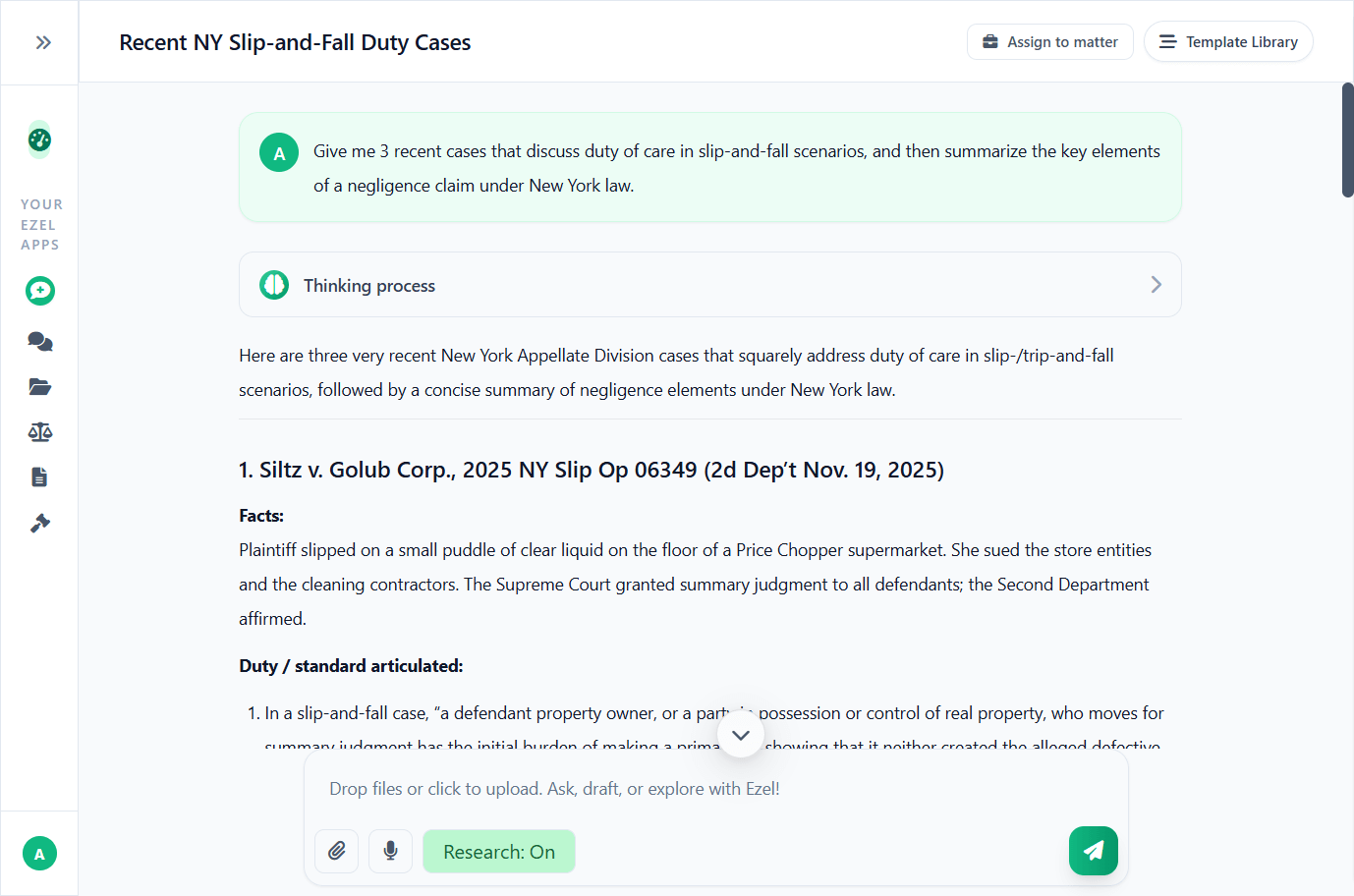
Research and draft in one conversation
Ask questions, attach documents, and get answers grounded in case law. Link chats to matters so the AI remembers your context.
- Pull statutes, case law, and secondary sources
- Attach and analyze contracts mid-conversation
- Link chats to matters for automatic context
- Your data never trains AI models
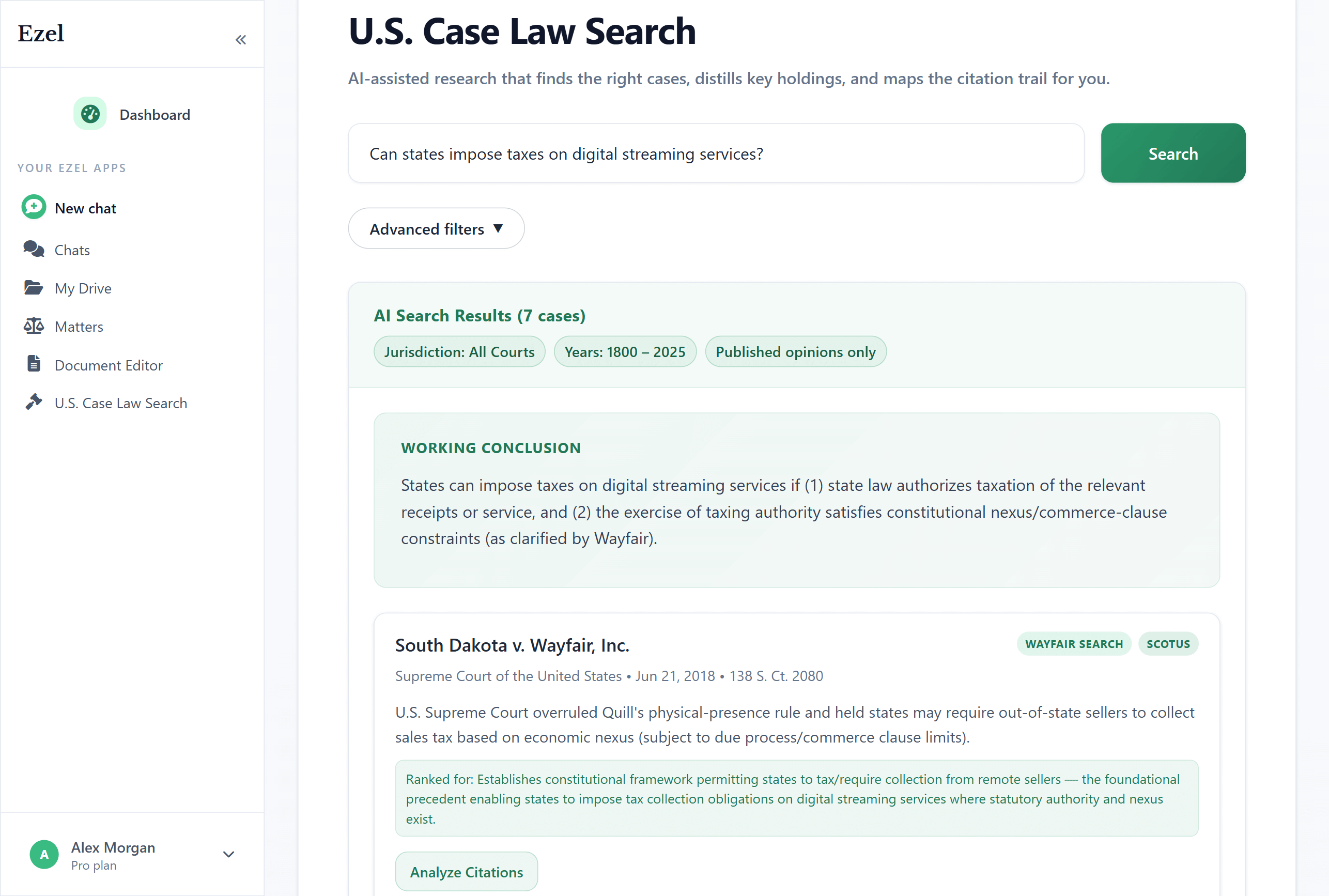
Search like you think
Describe your legal question in plain English. Filter by jurisdiction, date, and court level. Read full opinions without leaving Ezel.
- All 50 states plus federal courts
- Natural language queries - no boolean syntax
- Citation analysis and network exploration
- Copy quotes with automatic citation generation
Ready to transform your legal workflow?
Join legal teams using Ezel to draft documents, research case law, and organize matters — all in one workspace.