BYLAWS
OF [ORGANIZATION NAME]
(a [State] Nonprofit Corporation)
Adopted: [ADOPTION DATE]
TABLE OF CONTENTS
Article I - Organization
Article II - Purposes
Article III - Members (or Non-Membership)
Article IV - Board of Directors
Article V - Officers
Article VI - Committees
Article VII - Meetings
Article VIII - Conflicts of Interest
Article IX - Indemnification
Article X - Financial Administration
Article XI - Records and Reports
Article XII - Amendments
Article XIII - Miscellaneous Provisions
ARTICLE I - ORGANIZATION
Section 1.1 Name
The name of this corporation is [ORGANIZATION NAME] (hereinafter referred to as the "Organization" or "Corporation").
Section 1.2 Principal Office
The principal office of the Organization shall be located at:
[STREET ADDRESS]
[CITY], [STATE] [ZIP CODE]
The Organization may have such other offices as the Board of Directors may determine.
Section 1.3 Registered Office and Agent
The Organization shall maintain a registered office and registered agent in the State of [STATE] as required by law. The registered agent and office may be changed by the Board of Directors.
Section 1.4 Fiscal Year
The fiscal year of the Organization shall end on [MONTH] [DAY] of each year.
[// GUIDANCE: Common fiscal year ends are December 31 (calendar year) or June 30. Choose based on operational considerations and funding cycles.]
ARTICLE II - PURPOSES
Section 2.1 Nonprofit Purpose
This Organization is organized exclusively for charitable, religious, educational, and scientific purposes under Section 501(c)(3) of the Internal Revenue Code, or the corresponding section of any future federal tax code.
Section 2.2 Specific Purposes
The specific purposes for which this Organization is organized include:
[LIST SPECIFIC CHARITABLE, EDUCATIONAL, OR SCIENTIFIC PURPOSES]
Section 2.3 Limitations
No part of the net earnings of the Organization shall inure to the benefit of, or be distributable to its members, trustees, officers, or other private persons, except that the Organization shall be authorized and empowered to pay reasonable compensation for services rendered and to make payments and distributions in furtherance of Section 501(c)(3) purposes.
No substantial part of the activities of the Organization shall be the carrying on of propaganda, or otherwise attempting to influence legislation, and the Organization shall not participate in, or intervene in (including the publishing or distribution of statements) any political campaign on behalf of (or in opposition to) any candidate for public office.
Notwithstanding any other provision of these Bylaws, the Organization shall not carry on any other activities not permitted to be carried on by an organization exempt from federal income tax under Section 501(c)(3) of the Internal Revenue Code.
ARTICLE III - MEMBERS
Option A: Non-Membership Corporation
☐ Non-Membership Structure
Section 3.1 No Members
This Organization shall have no members within the meaning of the [STATE] Nonprofit Corporation Act. Any action which would otherwise require approval by a majority of all members shall require only the approval of the Board of Directors.
Section 3.2 Honorary Designations
The Board of Directors may establish categories of supporters, donors, or affiliates who may be referred to as "members" for purposes of fundraising or recognition, but such persons shall have no membership rights, including no right to vote or to participate in the governance of the Organization.
Option B: Membership Corporation
☐ Membership Structure
Section 3.1 Classes of Members
The Organization shall have the following classes of members:
| Class | Voting Rights | Annual Dues |
|---|---|---|
| [VOTING MEMBER] | Yes | $[AMOUNT] |
| [ASSOCIATE MEMBER] | No | $[AMOUNT] |
| [HONORARY MEMBER] | No | None |
Section 3.2 Qualifications for Membership
Any person or entity who supports the purposes of this Organization may become a member upon:
(a) Completing a membership application;
(b) Payment of applicable dues; and
(c) Approval by [Board of Directors / Membership Committee].
Section 3.3 Rights of Members
Each voting member shall have the right to:
(a) Vote in the election of Directors;
(b) Vote on matters submitted to the membership;
(c) Attend membership meetings;
(d) Receive notice of meetings and other communications.
Section 3.4 Termination of Membership
Membership may be terminated:
(a) By voluntary resignation;
(b) By failure to pay dues within [NUMBER] days of the due date;
(c) By expulsion for cause upon a two-thirds (2/3) vote of the Board of Directors after notice and opportunity to be heard.
Section 3.5 Annual Meeting of Members
The annual meeting of members shall be held on [DATE/TIME DESCRIPTION] at a location designated by the Board of Directors, for the purpose of electing Directors and transacting other business.
Section 3.6 Special Meetings of Members
Special meetings of members may be called by the Board of Directors, the President, or upon written request of [PERCENTAGE]% of voting members.
Section 3.7 Quorum for Member Meetings
[PERCENTAGE]% of the voting members present in person or by proxy shall constitute a quorum.
ARTICLE IV - BOARD OF DIRECTORS
Section 4.1 General Powers
The business and affairs of the Organization shall be managed by its Board of Directors. The Board shall have full power to conduct, manage, and direct the business and affairs of the Organization, and all powers of the Organization are vested in and shall be exercised by the Board, except as otherwise provided by law, the Articles of Incorporation, or these Bylaws.
[// GUIDANCE: The board has ultimate fiduciary responsibility for the organization. Board members owe duties of care, loyalty, and obedience.]
Section 4.2 Number of Directors
The Board of Directors shall consist of not less than [MINIMUM NUMBER] and not more than [MAXIMUM NUMBER] directors. The exact number shall be fixed by the Board from time to time.
[// GUIDANCE: IRS best practice suggests a minimum of three unrelated directors. Many states require at least three directors for nonprofits. An odd number can help avoid tie votes.]
Section 4.3 Qualifications
Directors must:
(a) Be at least [18/21] years of age;
(b) Support the mission and purposes of the Organization;
(c) Not be related by blood or marriage to more than [one/two] other director(s);
(d) [OTHER QUALIFICATIONS AS APPROPRIATE]
[// GUIDANCE: The IRS views independent boards favorably. Limit family relationships and financial relationships between board members.]
Section 4.4 Election and Term
(a) Election: Directors shall be elected by [the Board of Directors / the voting members at the annual meeting].
(b) Term: Each Director shall serve a term of [NUMBER] year(s).
(c) Term Limits:
☐ Term Limits Apply: Directors may serve no more than [NUMBER] consecutive terms. After a one-year absence, a former Director may be re-elected.
☐ No Term Limits: Directors may serve unlimited consecutive terms.
(d) Staggered Terms: To ensure continuity, the Board may be divided into [two/three] classes, with terms staggered so that approximately [one-half/one-third] of the Directors are elected each year.
[// GUIDANCE: Term limits are considered a governance best practice but are not required. Staggered terms ensure continuity.]
Section 4.5 Resignation
A Director may resign at any time by delivering written notice to the Chair or Secretary. The resignation is effective upon receipt or at a later time specified in the notice.
Section 4.6 Removal
(a) Removal for Cause: A Director may be removed for cause by a two-thirds (2/3) vote of the Directors then in office, after notice and an opportunity to be heard.
(b) Cause Defined: Cause for removal includes:
- Failure to attend [NUMBER] consecutive Board meetings without excuse;
- Violation of the Conflict of Interest Policy;
- Conduct detrimental to the Organization;
- Breach of fiduciary duty;
- Conviction of a felony.
☐ Removal Without Cause: A Director may be removed without cause by a [two-thirds / three-fourths] vote of the Directors then in office.
Section 4.7 Vacancies
A vacancy on the Board may be filled by a majority vote of the remaining Directors, even if less than a quorum. A Director elected to fill a vacancy shall serve for the unexpired term of the predecessor.
Section 4.8 Compensation
Directors shall not receive compensation for their services as Directors. Directors may be reimbursed for reasonable expenses incurred in the performance of their duties, as approved by the Board.
[// GUIDANCE: While some nonprofits compensate board members, uncompensated service is the norm for 501(c)(3) organizations and demonstrates public benefit.]
ARTICLE V - OFFICERS
Section 5.1 Officers
The officers of the Organization shall be:
(a) Chair (or President)
(b) Vice Chair (or Vice President)
(c) Secretary
(d) Treasurer
The Board may create additional officer positions as needed. Any two or more offices may be held by the same person, except that the Chair and Secretary may not be the same person.
[// GUIDANCE: Some states prohibit certain combinations of officers. Check state law.]
Section 5.2 Election and Term
Officers shall be elected by the Board of Directors at the first meeting following the annual meeting [or annual election of Directors]. Each officer shall serve a term of [NUMBER] year(s) and until a successor is elected and qualified.
Section 5.3 Removal
Any officer may be removed by the Board of Directors at any time, with or without cause, by a majority vote.
Section 5.4 Vacancies
A vacancy in any office may be filled by the Board of Directors for the unexpired portion of the term.
Section 5.5 Chair (or President)
The Chair shall:
(a) Preside at all meetings of the Board of Directors and membership;
(b) Serve as the chief volunteer officer of the Organization;
(c) Execute contracts and other instruments on behalf of the Organization;
(d) Perform such other duties as assigned by the Board.
Section 5.6 Vice Chair (or Vice President)
The Vice Chair shall:
(a) Perform the duties of the Chair in the Chair's absence;
(b) Assist the Chair as requested;
(c) Perform such other duties as assigned by the Board.
Section 5.7 Secretary
The Secretary shall:
(a) Keep minutes of all Board and membership meetings;
(b) Maintain the corporate records;
(c) Give notice of meetings as required;
(d) Maintain a register of Directors and their contact information;
(e) Authenticate records of the Organization when required;
(f) Perform such other duties as assigned by the Board.
Section 5.8 Treasurer
The Treasurer shall:
(a) Have charge of and be responsible for all funds and securities of the Organization;
(b) Oversee the receipt and disbursement of funds;
(c) Present financial reports to the Board;
(d) Ensure proper financial records are maintained;
(e) Oversee the annual budget process;
(f) Ensure required tax filings are made (Form 990, etc.);
(g) Perform such other duties as assigned by the Board.
Section 5.9 Executive Director (Staff Position)
The Board may hire an Executive Director to serve as the chief executive officer and manage the day-to-day operations of the Organization. The Executive Director shall:
(a) Be an employee of the Organization, not an officer or Director;
(b) Report to the Board of Directors;
(c) Implement policies and programs established by the Board;
(d) Hire, supervise, and terminate staff within approved budgets;
(e) Serve as an ex-officio, non-voting member of the Board and its committees.
[// GUIDANCE: The Executive Director is typically a paid staff position, distinct from volunteer Board officers.]
ARTICLE VI - COMMITTEES
Section 6.1 Standing Committees
The Board may establish the following standing committees:
(a) Executive Committee: Consisting of the officers and [NUMBER] additional Directors, authorized to act on behalf of the Board between meetings on matters requiring immediate action, subject to Board ratification.
(b) Finance Committee: To oversee financial planning, budgeting, and financial reporting.
(c) Governance/Nominating Committee: To identify and recruit Board candidates and oversee governance matters.
(d) Audit Committee: To oversee the annual audit or financial review and internal controls.
(e) [OTHER COMMITTEES AS NEEDED]
Section 6.2 Ad Hoc Committees
The Board may establish ad hoc committees for specific purposes and limited durations.
Section 6.3 Committee Composition
Each committee shall have at least [NUMBER] members. Committee members need not be Directors, except that the Executive Committee shall consist solely of Directors.
Section 6.4 Committee Authority
Committees may make recommendations to the Board but shall not have authority to:
(a) Amend the Articles of Incorporation or Bylaws;
(b) Elect or remove Directors or officers;
(c) Adopt the annual budget;
(d) Approve merger, dissolution, or sale of substantially all assets;
(e) Take any action outside the scope of authority delegated by the Board.
ARTICLE VII - MEETINGS
Section 7.1 Regular Board Meetings
The Board of Directors shall meet at least [quarterly / NUMBER times per year]. Regular meetings shall be held at such times and places as determined by the Board.
Section 7.2 Annual Meeting
The annual meeting of the Board of Directors shall be held in [MONTH] for the purpose of electing officers, receiving annual reports, and transacting other business.
Section 7.3 Special Meetings
Special meetings of the Board may be called by the Chair, Vice Chair, or any [two/three] Directors, upon [NUMBER] days' written notice.
Section 7.4 Notice
(a) Regular Meetings: If a regular meeting schedule is established, no additional notice is required.
(b) Special Meetings: Written notice stating the date, time, place, and purpose of any special meeting shall be given at least [NUMBER] days in advance.
(c) Method of Notice: Notice may be given by mail, email, or other electronic means.
(d) Waiver: A Director may waive notice before or after a meeting by written waiver signed by the Director. Attendance at a meeting shall constitute waiver unless the Director objects at the beginning of the meeting.
Section 7.5 Quorum
A majority of the Directors then in office shall constitute a quorum for the transaction of business.
Section 7.6 Voting
Each Director shall have one vote. The act of a majority of Directors present at a meeting at which a quorum is present shall be the act of the Board, unless a greater vote is required by law, the Articles of Incorporation, or these Bylaws.
Section 7.7 Remote Participation
Directors may participate in meetings by telephone, video conference, or other communications technology by which all persons participating can hear each other. Participation by such means shall constitute presence in person.
Section 7.8 Action Without Meeting
Any action required or permitted to be taken at a Board meeting may be taken without a meeting if all Directors consent in writing (including email) to the action. Such written consent shall have the same force and effect as a unanimous vote and shall be filed with the minutes.
[// GUIDANCE: Many states require unanimous written consent for action without a meeting. Check state law.]
ARTICLE VIII - CONFLICTS OF INTEREST
Section 8.1 Purpose
The purpose of this conflict of interest policy is to protect the Organization's interest when it is contemplating entering into a transaction or arrangement that might benefit the private interest of a Director, officer, or key employee.
[// GUIDANCE (IRS): Form 1023 asks whether the organization has adopted a conflict of interest policy. The IRS provides a sample policy in the Form 1023 instructions.]
Section 8.2 Definitions
(a) Interested Person: Any Director, officer, or member of a committee with Board-delegated powers who has a direct or indirect financial interest.
(b) Financial Interest: A person has a financial interest if the person has, directly or indirectly, through business, investment, or family:
- An ownership or investment interest in any entity with which the Organization has a transaction or arrangement;
- A compensation arrangement with the Organization or with any entity or individual with which the Organization has a transaction or arrangement; or
- A potential ownership or investment interest in, or compensation arrangement with, any entity or individual with which the Organization is negotiating a transaction or arrangement.
Section 8.3 Duty to Disclose
An Interested Person must disclose the existence and nature of any financial interest to the Board or relevant committee.
Section 8.4 Procedures
(a) An Interested Person shall disclose any actual or potential conflict before the Board or committee discusses the matter.
(b) After disclosure, the Interested Person shall leave the meeting during discussion and voting on the matter.
(c) The remaining Board or committee members shall determine whether a conflict exists and whether the proposed transaction is fair and in the Organization's best interest.
(d) The Board or committee may approve the transaction only after determining in good faith, after reasonable investigation, that the transaction is fair and in the Organization's best interest.
Section 8.5 Documentation
Minutes of Board and committee meetings shall contain:
(a) The names of persons who disclosed a financial interest;
(b) The nature of the financial interest;
(c) Any action taken to determine whether a conflict existed;
(d) The Board's or committee's decision as to whether a conflict existed;
(e) The names of persons present for discussion and voting;
(f) The content of the discussion and a record of the vote.
Section 8.6 Annual Statements
Each Director, officer, and key employee shall annually sign a statement that:
(a) They have received a copy of the Conflict of Interest Policy;
(b) They have read and understand the policy;
(c) They agree to comply with the policy; and
(d) They disclose any known financial interests.
Section 8.7 Violations
If the Board has reasonable cause to believe a Director, officer, or key employee has failed to disclose an actual or potential conflict, it shall inform the individual and afford an opportunity to explain. If the Board determines a failure to disclose has occurred, it shall take appropriate corrective action.
ARTICLE IX - INDEMNIFICATION
Section 9.1 Right to Indemnification
The Organization shall indemnify, to the fullest extent permitted by law, any person who was or is a party to any threatened, pending, or completed action, suit, or proceeding by reason of the fact that such person is or was a Director, officer, employee, or agent of the Organization, against expenses (including attorneys' fees), judgments, fines, and amounts paid in settlement actually and reasonably incurred.
Section 9.2 Advancement of Expenses
Expenses incurred in defending a civil or criminal action may be paid by the Organization in advance of the final disposition upon receipt of an undertaking by or on behalf of the indemnified person to repay such amount if it is ultimately determined that such person is not entitled to indemnification.
Section 9.3 Insurance
The Organization may purchase and maintain insurance on behalf of any person who is or was a Director, officer, employee, or agent against any liability asserted against such person, whether or not the Organization would have the power to indemnify such person.
Section 9.4 Non-Exclusivity
The indemnification provided by this Article shall not be exclusive of any other rights to which those indemnified may be entitled under any agreement, vote of the Board, or otherwise.
ARTICLE X - FINANCIAL ADMINISTRATION
Section 10.1 Financial Records
The Organization shall keep correct and complete books and records of account.
Section 10.2 Fiscal Controls
(a) All checks, drafts, or orders for payment exceeding $[AMOUNT] shall require two signatures.
(b) The Board shall annually review and approve the budget.
(c) Expenditures exceeding the approved budget by more than [PERCENTAGE]% or $[AMOUNT] shall require Board approval.
Section 10.3 Annual Audit/Review
☐ Annual Audit: The Organization shall have its financial statements audited annually by an independent certified public accountant.
☐ Financial Review: The Organization shall have its financial statements reviewed annually by an independent certified public accountant.
☐ Internal Review: The Board shall conduct an annual review of financial statements and internal controls.
[// GUIDANCE: Many state laws and funders require audited financial statements for organizations above certain revenue thresholds.]
Section 10.4 Tax Filings
The Organization shall file all required federal, state, and local tax returns, including IRS Form 990 (or 990-EZ or 990-N as applicable), by the due dates, including extensions.
Section 10.5 Deposit and Investment of Funds
All funds shall be deposited in accounts in the name of the Organization at financial institutions approved by the Board. The Board shall adopt an investment policy for any funds not needed for current operations.
ARTICLE XI - RECORDS AND REPORTS
Section 11.1 Required Records
The Organization shall keep at its principal office:
(a) Articles of Incorporation and all amendments;
(b) Bylaws and all amendments;
(c) Minutes of all Board and membership meetings;
(d) Names and addresses of Directors and officers;
(e) Financial records and statements;
(f) IRS Form 1023 application and determination letter;
(g) Annual information returns (Form 990) for the past three years.
Section 11.2 Public Inspection
The Organization shall make the following documents available for public inspection as required by law:
(a) Form 1023 application (or Form 1023-EZ);
(b) IRS determination letter;
(c) Form 990 returns for the three most recent years.
Section 11.3 Annual Report
The Board shall receive an annual report containing:
(a) Financial statements for the fiscal year;
(b) Summary of significant activities;
(c) Names of Directors and officers;
(d) Other information required by state law.
ARTICLE XII - AMENDMENTS
Section 12.1 Amendment by Board
These Bylaws may be amended, altered, or repealed by a [two-thirds / majority] vote of the Directors present at a meeting at which a quorum is present, provided that:
(a) Written notice of the proposed amendment is given to all Directors at least [NUMBER] days in advance; and
(b) The proposed amendment is consistent with the Articles of Incorporation and applicable law.
Section 12.2 Limitations
No amendment shall be made that would cause the Organization to lose its status as an organization exempt from federal income tax under Section 501(c)(3) of the Internal Revenue Code.
Section 12.3 Notice to IRS
Any amendment affecting the Organization's exempt status shall be reported on the next annual information return (Form 990).
ARTICLE XIII - MISCELLANEOUS PROVISIONS
Section 13.1 Non-Discrimination
The Organization shall not discriminate on the basis of race, color, religion, sex, national origin, age, disability, or any other protected characteristic in its programs, activities, or governance.
Section 13.2 Dissolution
Upon dissolution of the Organization, after paying or making provision for all liabilities, the Board shall distribute all remaining assets to one or more organizations organized and operated exclusively for charitable, educational, religious, or scientific purposes and exempt under Section 501(c)(3) of the Internal Revenue Code, or to the federal, state, or local government for a public purpose.
Section 13.3 Severability
If any provision of these Bylaws is held invalid or unenforceable, the remaining provisions shall remain in full force and effect.
Section 13.4 Interpretation
These Bylaws shall be interpreted in accordance with the [STATE] Nonprofit Corporation Act and, where applicable, federal tax law.
Section 13.5 Parliamentary Authority
Robert's Rules of Order (current edition) shall govern meetings of the Organization in all matters not covered by these Bylaws or applicable law.
CERTIFICATION
The undersigned, being the duly elected Secretary of [ORGANIZATION NAME], hereby certifies that the foregoing Bylaws were duly adopted by the Board of Directors as the Bylaws of the Organization on [DATE].
_________________________________________
[NAME], Secretary
Date: ___________________________________
AMENDMENTS LOG
| Date | Article/Section | Description of Amendment | Approved By |
|---|---|---|---|
| [DATE] | [SECTION] | [DESCRIPTION] | Board |
[END OF DOCUMENT]
Do more with Ezel
This free template is just the beginning. See how Ezel helps legal teams draft, research, and collaborate faster.
AI that drafts while you watch
Tell the AI what you need and watch your document transform in real-time. No more copy-pasting between tools or manually formatting changes.
- Natural language commands: "Add a force majeure clause"
- Context-aware suggestions based on document type
- Real-time streaming shows edits as they happen
- Milestone tracking and version comparison
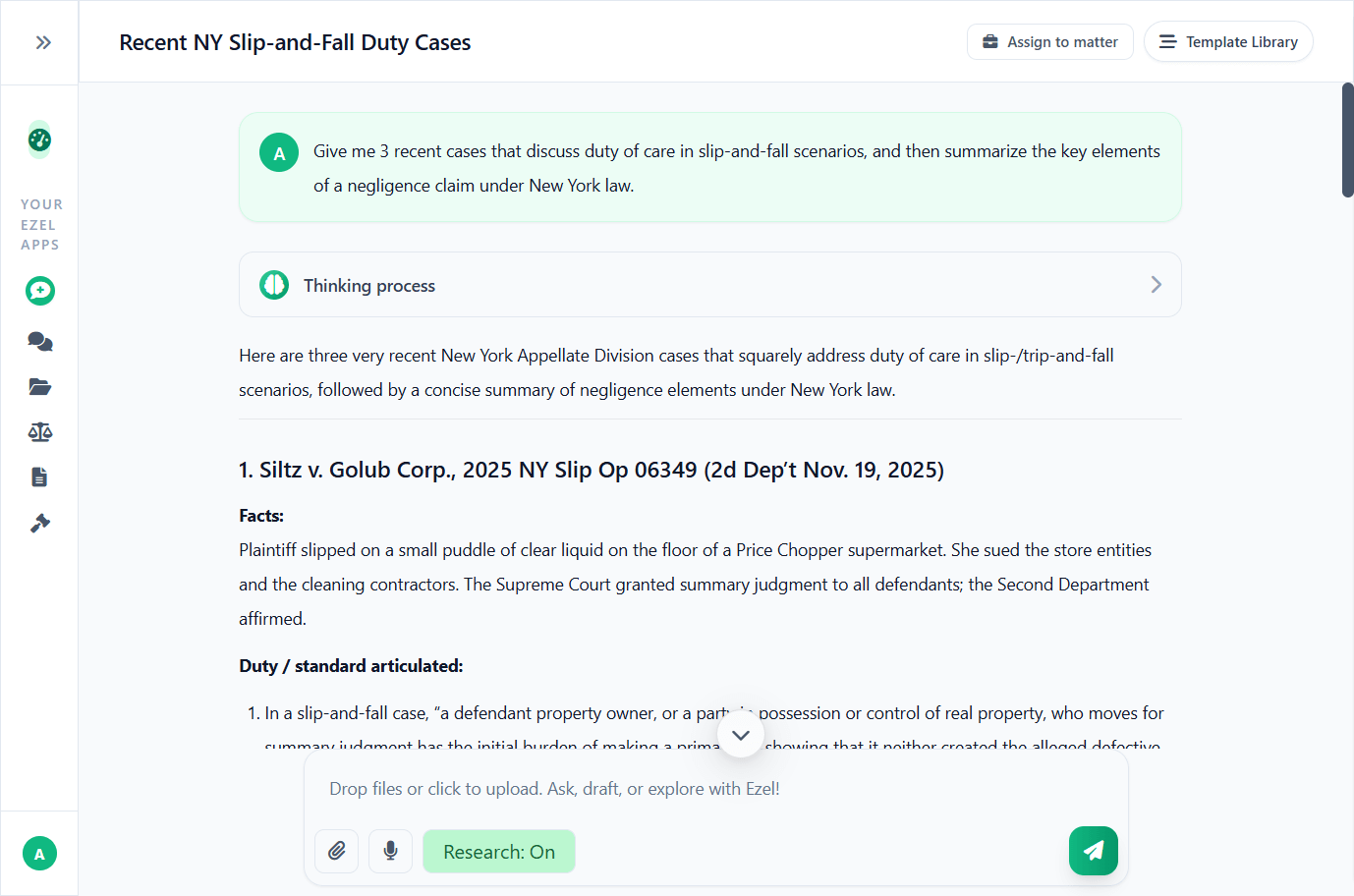
Research and draft in one conversation
Ask questions, attach documents, and get answers grounded in case law. Link chats to matters so the AI remembers your context.
- Pull statutes, case law, and secondary sources
- Attach and analyze contracts mid-conversation
- Link chats to matters for automatic context
- Your data never trains AI models

Search like you think
Describe your legal question in plain English. Filter by jurisdiction, date, and court level. Read full opinions without leaving Ezel.
- All 50 states plus federal courts
- Natural language queries - no boolean syntax
- Citation analysis and network exploration
- Copy quotes with automatic citation generation
Ready to transform your legal workflow?
Join legal teams using Ezel to draft documents, research case law, and organize matters — all in one workspace.