STATE OF MICHIGAN
IN THE [________________________________] COURT
[COUNTY OF ________________________________]
[PLAINTIFF'S FULL NAME],
Plaintiff,
v.
Case No.: [____________________]
[DEFENDANT'S FULL NAME],
Hon.: [________________________________]
Defendant.
DEFENDANT'S MOTION FOR SUMMARY DISPOSITION
PURSUANT TO MCR 2.116
IMPORTANT NOTE ON MICHIGAN PROCEDURE: Michigan does not use a standard "Motion to Dismiss" under a rule equivalent to Federal Rule 12(b). Instead, Michigan employs a "Motion for Summary Disposition" under MCR 2.116, which encompasses both early dismissal grounds (analogous to Rule 12(b)) and summary judgment grounds (analogous to Federal Rule 56). Practitioners must identify the specific subsection(s) of MCR 2.116(C) under which relief is sought, as each subsection carries different procedural requirements, standards of review, and evidentiary rules.
INTRODUCTION AND SUMMARY OF GROUNDS
NOW COMES Defendant, [________________________________] ("Defendant"), by and through counsel, [________________________________], and pursuant to MCR 2.116, moves this Court for summary disposition of Plaintiff's claims on the following grounds (check all that apply):
☐ MCR 2.116(C)(1): The Court lacks jurisdiction over the person of Defendant or over the property that is the subject of the action.
☐ MCR 2.116(C)(2): The claim is beyond the jurisdiction of the Court. The amount claimed is either too small or too large for this Court's jurisdictional threshold.
☐ MCR 2.116(C)(3): Plaintiff's claim is barred because it was disposed of before commencement of the action by: ☐ Release ☐ Payment ☐ Prior judgment ☐ Immunity granted by law ☐ Other: [________________________________].
☐ MCR 2.116(C)(4): The Court lacks subject matter jurisdiction to hear and determine this claim.
☐ MCR 2.116(C)(5): The opposing party lacks legal capacity to sue.
☐ MCR 2.116(C)(6): Another action between the same parties involving the same claim is pending in this or another court.
☐ MCR 2.116(C)(7): Plaintiff's claim is barred by: ☐ Statute of limitations ☐ Statute of frauds ☐ Agreement to arbitrate ☐ Infancy or other disability ☐ Assignment or other disposition of claim ☐ Other: [________________________________].
☐ MCR 2.116(C)(8): Plaintiff has failed to state a claim upon which relief can be granted. The motion is tested on the pleadings alone; Defendant may not rely on affidavits or other documentary evidence under this subsection.
☐ MCR 2.116(C)(9): Plaintiff has failed to state a valid defense to the counterclaim asserted against Plaintiff by Defendant. [Use when Defendant asserts a counterclaim.]
☐ MCR 2.116(C)(10): There is no genuine issue as to any material fact, and Defendant is entitled to judgment as a matter of law. Supporting affidavits, depositions, admissions, and other documentary evidence are attached.
PROCEDURAL HISTORY AND BACKGROUND
-
Plaintiff filed the Complaint in this matter on [__/__/____].
-
Defendant was served with the Summons and Complaint on [__/__/____].
-
Defendant's answer or responsive pleading is due on or before [__/__/____].
-
This Motion is filed in accordance with MCR 2.116(D) timing requirements.
-
This Motion is set for hearing on [__/__/____] at [____]:[____] ☐ a.m. / ☐ p.m. before the Honorable [________________________________].
-
Pursuant to MCR 2.119(C), this Motion was filed and served at least [21] days before the date set for hearing.
TIMING AND WAIVER UNDER MCR 2.116(D)
PRACTITIONER'S NOTE — MCR 2.116(D) Waiver Rules:
The timing for asserting each ground for summary disposition is strictly governed by MCR 2.116(D), and failure to timely raise certain grounds results in permanent waiver:
-
MCR 2.116(C)(1), (2), (3), (5), (6): Must be raised in the party's first responsive pleading or by motion before the party's first responsive pleading. These grounds are waived if not timely raised. MCR 2.116(D)(1).
-
MCR 2.116(C)(7): The ground of statute of limitations or other bar must be raised in the party's first responsive pleading or by motion before the first responsive pleading. MCR 2.116(D)(2).
-
MCR 2.116(C)(4) and governmental immunity: May be raised at any time, even after the scheduling order cutoff deadline. MCR 2.116(D)(3). The Court may consider these grounds at any time.
-
MCR 2.116(C)(8), (9), (10): Must be raised within the time set by the scheduling order, or if no scheduling order, before the date set for trial. MCR 2.116(D)(4).
STATEMENT OF FACTS
[Set forth a concise, numbered statement of the material facts relevant to each ground asserted. For C(8) motions, facts are limited to those appearing on the face of the pleadings. For C(10) motions, facts may be supported by attached affidavits, depositions, answers to interrogatories, admissions, and other documentary evidence.]
-
[________________________________]
-
[________________________________]
-
[________________________________]
-
[________________________________]
-
[________________________________]
ARGUMENT
I. LEGAL STANDARD FOR SUMMARY DISPOSITION UNDER MCR 2.116
Michigan does not employ a Rule 12(b) "motion to dismiss" as used in federal courts. Instead, MCR 2.116 provides the procedural mechanism for early termination of claims before or in lieu of trial. The standard of review varies by subsection:
Standard for MCR 2.116(C)(8) — Failure to State a Claim:
A motion under MCR 2.116(C)(8) tests the legal sufficiency of the claim by the pleadings alone. The motion may only be granted when the claim is so clearly unenforceable as a matter of law that no factual development could possibly justify recovery. All well-pleaded factual allegations are accepted as true and construed in the light most favorable to the nonmoving party. Maiden v. Rozwood, 461 Mich. 109, 119-120 (1999). Unlike a C(10) motion, a C(8) motion does not permit consideration of affidavits or other documentary evidence outside the pleadings.
Michigan is a fact-pleading state. MCR 2.111(B)(1) requires that a complaint contain "[a] statement of the facts, without repetition, on which the pleader relies in stating the cause of action, with the specific allegations necessary reasonably to inform the adverse party of the nature of the claims the adverse party is called on to defend." Bare legal conclusions, even if recited in the complaint, are insufficient to survive a C(8) motion.
Standard for MCR 2.116(C)(10) — No Genuine Issue of Material Fact:
A motion under MCR 2.116(C)(10) tests the factual support for a claim. The court must consider the affidavits, pleadings, depositions, admissions, and documentary evidence submitted by the parties in the light most favorable to the opposing party. Quinto v. Cross & Peters Co., 451 Mich. 358 (1996). Summary disposition is appropriate when there is no genuine issue of material fact and the moving party is entitled to judgment as a matter of law. A genuine issue of material fact exists when reasonable minds could differ on a fact necessary to resolve an issue. Smith v. Globe Life Ins. Co., 460 Mich. 446 (1999).
Standard for Jurisdictional Grounds (C(1), C(2), C(4)):
Jurisdictional defects may be established by affidavit or other documentary evidence and are not limited to the pleadings. The burden of establishing personal jurisdiction rests on the plaintiff once a defendant challenges jurisdiction by motion. Jeffrey v. Rapid American Corp., 448 Mich. 178 (1995).
II. GROUND 1: LACK OF PERSONAL JURISDICTION — MCR 2.116(C)(1)
[Complete this section if asserting C(1) ground.]
Michigan's long-arm statute, MCL 600.705 (limited personal jurisdiction over individuals) and MCL 600.711 (corporations), governs the reach of Michigan courts over nonresident defendants. Due process requires that a defendant have minimum contacts with Michigan such that maintenance of the suit does not offend traditional notions of fair play and substantial justice. Int'l Shoe Co. v. Washington, 326 US 310 (1945).
Defendant is a resident of [________________________________], domiciled at [________________________________], and:
☐ Has never been physically present in the State of Michigan.
☐ Has not transacted any business in Michigan relevant to this dispute.
☐ Has not committed a tortious act or omission in Michigan.
☐ Has not owned, used, or possessed real property in Michigan.
☐ Has not contracted to supply services or goods in Michigan.
☐ Has no other contacts with Michigan sufficient to confer personal jurisdiction.
[State specific facts regarding lack of contacts: ________________________________]
Accordingly, this Court lacks personal jurisdiction over Defendant, and the Complaint must be dismissed pursuant to MCR 2.116(C)(1).
III. GROUND 2: LACK OF SUBJECT MATTER JURISDICTION — MCR 2.116(C)(4)
[Complete this section if asserting C(4) ground.]
Subject matter jurisdiction defines the court's power to hear a particular type of case. This Court lacks subject matter jurisdiction because:
☐ The amount in controversy is below/above this Court's jurisdictional threshold. [Michigan District Courts have jurisdiction over civil claims up to $25,000; Circuit Courts have general jurisdiction.]
☐ This claim falls within the exclusive jurisdiction of [________________________________] [e.g., the Workers' Compensation Agency, the Court of Claims, federal court].
☐ This action involves a federal question over which only federal courts have jurisdiction.
☐ Plaintiff lacks standing to bring this claim under applicable Michigan law.
☐ Other jurisdictional defect: [________________________________].
A motion based on MCR 2.116(C)(4) may be raised at any time, including after the scheduling order deadline, because subject matter jurisdiction cannot be conferred by the parties' consent or waiver.
IV. GROUND 3: CLAIM BARRED BY STATUTE OF LIMITATIONS — MCR 2.116(C)(7)
[Complete this section if asserting C(7) ground.]
Plaintiff's claim is time-barred under the applicable statute of limitations. The relevant limitation period and accrual date are:
Cause of Action: [________________________________]
Applicable Statute of Limitations: [________________________________]
(Common Michigan limitation periods: Contract — MCL 600.5807 (6 years for written contracts); Tort/Negligence — MCL 600.5805 (3 years); Fraud — MCL 600.5805 (6 years); Medical Malpractice — MCL 600.5805(8) (2 years); Legal Malpractice — MCL 600.5805(4) (2 years); Products Liability — MCL 600.5805 (3 years); Wrongful Death — MCL 600.5852 (3 years from death or 2 years from personal representative appointment).)
Date of Accrual: [__/__/____]
(Under MCL 600.5827, a claim accrues at the time the wrong upon which the claim is based was done, regardless of when the resulting damage occurs, unless otherwise provided by statute.)
Last Date to File: [__/__/____]
Date Plaintiff Filed Complaint: [__/__/____]
Plaintiff's complaint was filed [____] days/months/years after the expiration of the applicable statute of limitations. This claim is therefore time-barred and must be dismissed pursuant to MCR 2.116(C)(7).
[Address any tolling arguments Plaintiff may raise: ________________________________]
V. GROUND 4: FAILURE TO STATE A CLAIM — MCR 2.116(C)(8)
[Complete this section if asserting C(8) ground. Remember: only the pleadings may be considered; no affidavits or external evidence.]
Plaintiff's Complaint fails to state a claim upon which relief can be granted because:
☐ Insufficient Factual Allegations: Michigan is a fact-pleading jurisdiction under MCR 2.111(B). Plaintiff's Complaint contains only legal conclusions and lacks the specific factual allegations required to state a cognizable cause of action. A complaint that alleges only ultimate conclusions without the specific facts underlying each element is insufficient. Churella v. Pioneer State Mut. Ins. Co., 258 Mich. App. 260 (2003).
☐ Failure to Plead Essential Elements: Plaintiff's [________________________________] claim requires proof of: [list elements]. The Complaint fails to allege: [________________________________].
☐ Legal Insufficiency: Even accepting all allegations as true, Plaintiff's claim fails as a matter of law because [________________________________].
☐ Claim Not Recognized Under Michigan Law: Plaintiff attempts to assert a cause of action that Michigan courts do not recognize: [________________________________].
The elements of Plaintiff's claim for [________________________________] are:
1. [________________________________]
2. [________________________________]
3. [________________________________]
4. [________________________________]
Plaintiff's Complaint, at paragraphs [____] through [____], fails to adequately plead elements [____] and [____] because [________________________________].
VI. GROUND 5: NO GENUINE ISSUE OF MATERIAL FACT — MCR 2.116(C)(10)
[Complete this section if asserting C(10) ground. Attach supporting evidence.]
Summary disposition under MCR 2.116(C)(10) is appropriate when there is no genuine issue as to any material fact and Defendant is entitled to judgment as a matter of law. Maiden v. Rozwood, 461 Mich. 109 (1999).
The following material facts are not in genuine dispute, as established by the attached documentary evidence:
Undisputed Material Fact 1: [________________________________]
(Supported by: [________________________________] — attached as Exhibit [____])
Undisputed Material Fact 2: [________________________________]
(Supported by: [________________________________] — attached as Exhibit [____])
Undisputed Material Fact 3: [________________________________]
(Supported by: [________________________________] — attached as Exhibit [____])
Undisputed Material Fact 4: [________________________________]
(Supported by: [________________________________] — attached as Exhibit [____])
Based on the undisputed material facts, Defendant is entitled to judgment as a matter of law because [________________________________].
Once Defendant has presented documentary evidence establishing the absence of a genuine issue, the burden shifts to Plaintiff to establish that a genuine issue of material fact exists. Plaintiff may not rest on mere allegations or denials in the pleadings but must come forward with specific facts showing a genuine issue for trial. MCR 2.116(G)(4); Quinto v. Cross & Peters Co., 451 Mich. 358 (1996).
VII. GOVERNMENTAL IMMUNITY — MCR 2.116(C)(7) [If Applicable]
[Include this section only if Defendant is a governmental entity or governmental employee.]
Defendant [________________________________] is entitled to governmental immunity under the Governmental Tort Liability Act (GTLA), MCL 691.1401 et seq. Governmental agencies are immune from tort liability when engaged in a governmental function. MCL 691.1407(1).
☐ Defendant is a governmental agency as defined by MCL 691.1401(d).
☐ The activity at issue constitutes a governmental function because [________________________________].
☐ No statutory exception to governmental immunity applies.
☐ Individual defendant is entitled to individual governmental immunity under MCL 691.1407(2) because the acts or omissions were not undertaken in bad faith and do not constitute gross negligence.
A claim of governmental immunity may be raised at any time under MCR 2.116(D)(3) and is not subject to the scheduling order deadline.
RELIEF REQUESTED
WHEREFORE, Defendant respectfully requests that this Court:
-
Grant Defendant's Motion for Summary Disposition pursuant to MCR 2.116(C)([____]);
-
Dismiss Plaintiff's Complaint with prejudice;
-
Award Defendant costs and attorney fees as permitted by MCR 2.625 and applicable law;
-
Grant such other and further relief as the Court deems just and equitable.
CONCURRENCE REQUIREMENT — MCR 2.119(A)(2)
Pursuant to MCR 2.119(A)(2), Defense counsel [☐ sought / ☐ was unable to obtain] Plaintiff's concurrence in this Motion. [If concurrence was sought, state when and the result. If concurrence was not sought, explain why it would not be required or was impractical.]
Defense counsel contacted Plaintiff's counsel on [__/__/____] via [☐ telephone / ☐ email / ☐ written correspondence] to seek concurrence. Plaintiff's counsel [☐ declined to concur / ☐ did not respond / ☐ other: ________________________________].
BRIEF IN SUPPORT
A Brief in Support of this Motion is attached hereto and incorporated herein by reference. [Note: MCR 2.119(A) requires that a motion which presents a question of law must be accompanied by a brief. The brief should contain the argument, citation of authorities, and any required exhibits.]
LIST OF EXHIBITS
☐ Exhibit A: [________________________________]
☐ Exhibit B: [________________________________]
☐ Exhibit C: [________________________________]
☐ Exhibit D: Affidavit of [________________________________]
☐ Exhibit E: [________________________________]
☐ Exhibit F: [________________________________]
E-FILING INFORMATION
This Motion is filed through MiFILE, Michigan's electronic filing system. All filings in this matter are subject to the Michigan Electronic Filing and Service Standards promulgated by the State Court Administrative Office (SCAO).
SIGNATURE BLOCK
Respectfully submitted,
[LAW FIRM NAME]
By: [________________________________]
[Attorney Name]
Michigan Bar No.: [____________________]
[Law Firm Name]
[Street Address]
[City, Michigan ZIP]
Telephone: ([____]) [____]-[________]
Facsimile: ([____]) [____]-[________]
Email: [________________________________]
Attorney for Defendant [________________________________]
Dated: [__/__/____]
BRIEF IN SUPPORT OF DEFENDANT'S MOTION FOR SUMMARY DISPOSITION
TABLE OF CONTENTS
I. Introduction
II. Statement of Facts
III. Legal Standard
IV. Argument
V. Conclusion
I. INTRODUCTION
[Provide a concise 1-2 paragraph overview of the case and the basis for the motion.]
II. STATEMENT OF FACTS
[Set forth numbered paragraphs presenting the relevant facts. For C(8) motions, rely exclusively on facts appearing in the pleadings. For C(10) motions, cite to attached documentary evidence.]
-
[________________________________]
-
[________________________________]
-
[________________________________]
III. LEGAL STANDARD
[Restate and elaborate upon the applicable standard under the specific MCR 2.116(C) subsection invoked.]
Michigan courts apply the following standard to a motion for summary disposition under MCR 2.116(C)([____]):
[________________________________]
IV. ARGUMENT
A. [First Ground for Summary Disposition]
[Develop the legal argument for the first ground, with citation to Michigan statutes, Michigan court rules, and Michigan case law. For each element of the argument, apply the law to the specific facts of this case.]
[________________________________]
B. [Second Ground for Summary Disposition, If Applicable]
[________________________________]
C. [Third Ground for Summary Disposition, If Applicable]
[________________________________]
V. CONCLUSION
For the foregoing reasons, Defendant respectfully requests that this Court grant Defendant's Motion for Summary Disposition pursuant to MCR 2.116(C)([____]), dismiss Plaintiff's Complaint with prejudice, and award Defendant costs and attorney fees as permitted by law.
Respectfully submitted,
[LAW FIRM NAME]
By: [________________________________]
[Attorney Name]
Michigan Bar No.: [____________________]
Dated: [__/__/____]
CERTIFICATE OF SERVICE
I hereby certify that on [__/__/____], I served a copy of the foregoing Motion for Summary Disposition, Brief in Support, and all exhibits upon:
[Name of Plaintiff's Counsel / Plaintiff Pro Se]
[________________________________]
[________________________________]
[________________________________]
by the following method(s):
☐ Electronic service via MiFILE (if opposing party is registered for e-service)
☐ First-class U.S. mail, postage prepaid
☐ Hand delivery
☐ Electronic mail, with consent: [________________________________]
☐ Other: [________________________________]
[________________________________]
[Attorney Name]
Michigan Bar No.: [____________________]
Dated: [__/__/____]
SOURCES AND REFERENCES
- Michigan Court Rules (MCR), Chapter 2: https://www.courts.michigan.gov/siteassets/rules-instructions-administrative-orders/michigan-court-rules/
- MCR 2.116 Summary Disposition Table: https://www.courts.michigan.gov/4aaab2/siteassets/publications/benchbooks/qrms/civil/pretrial-issues/summary-disposition-table.pdf
- Michigan Judicial Institute Civil Bench Book — Summary Disposition: https://www.courts.michigan.gov/
- MiFILE Electronic Filing: https://mifile.courts.michigan.gov/
- Maiden v. Rozwood, 461 Mich. 109 (1999)
- Quinto v. Cross & Peters Co., 451 Mich. 358 (1996)
- MCL 600.5805 et seq. (Statutes of Limitations)
- MCL 691.1401 et seq. (Governmental Tort Liability Act)
Do more with Ezel
This free template is just the beginning. See how Ezel helps legal teams draft, research, and collaborate faster.
AI that drafts while you watch
Tell the AI what you need and watch your document transform in real-time. No more copy-pasting between tools or manually formatting changes.
- Natural language commands: "Add a force majeure clause"
- Context-aware suggestions based on document type
- Real-time streaming shows edits as they happen
- Milestone tracking and version comparison
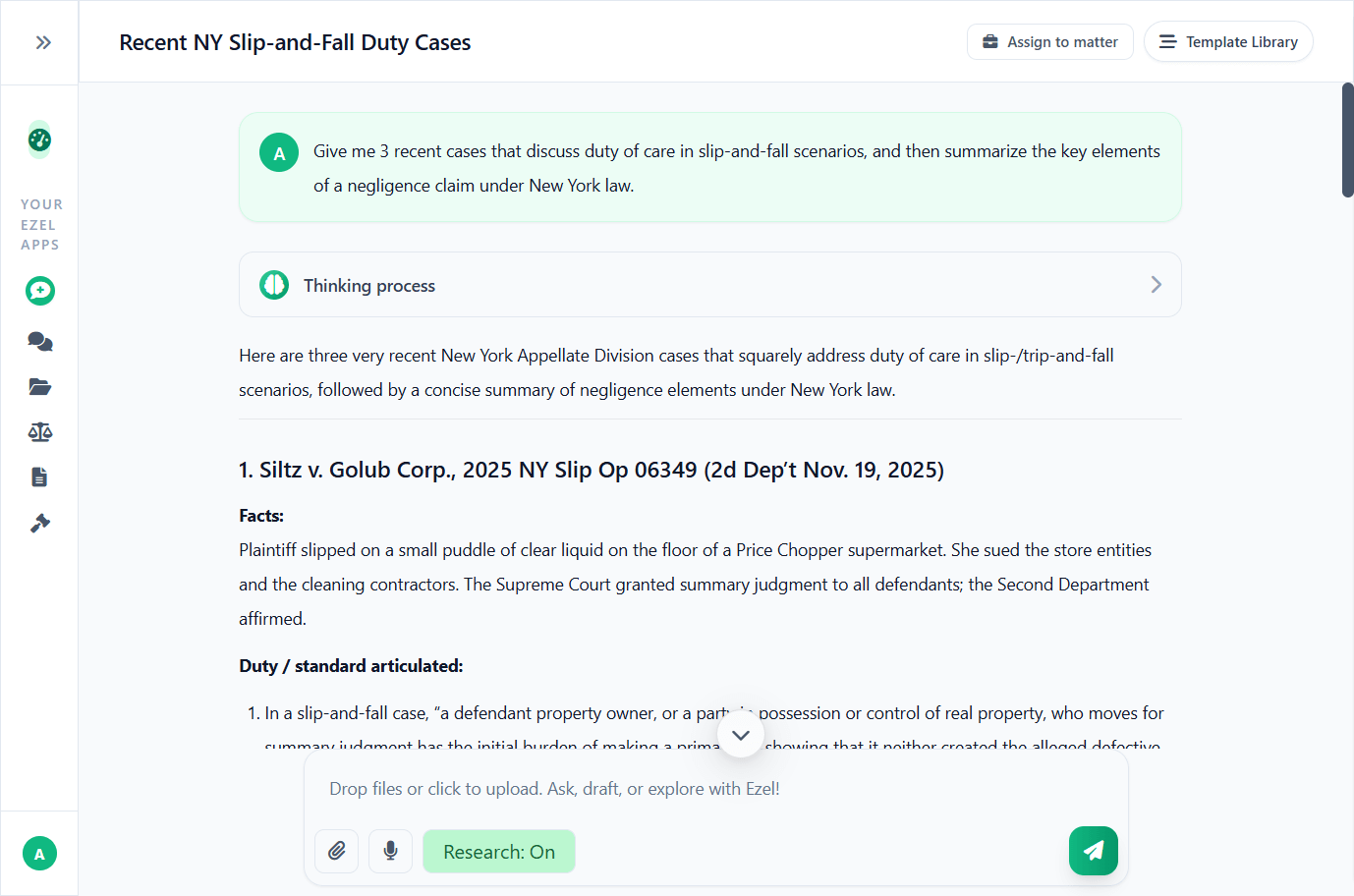
Research and draft in one conversation
Ask questions, attach documents, and get answers grounded in case law. Link chats to matters so the AI remembers your context.
- Pull statutes, case law, and secondary sources
- Attach and analyze contracts mid-conversation
- Link chats to matters for automatic context
- Your data never trains AI models
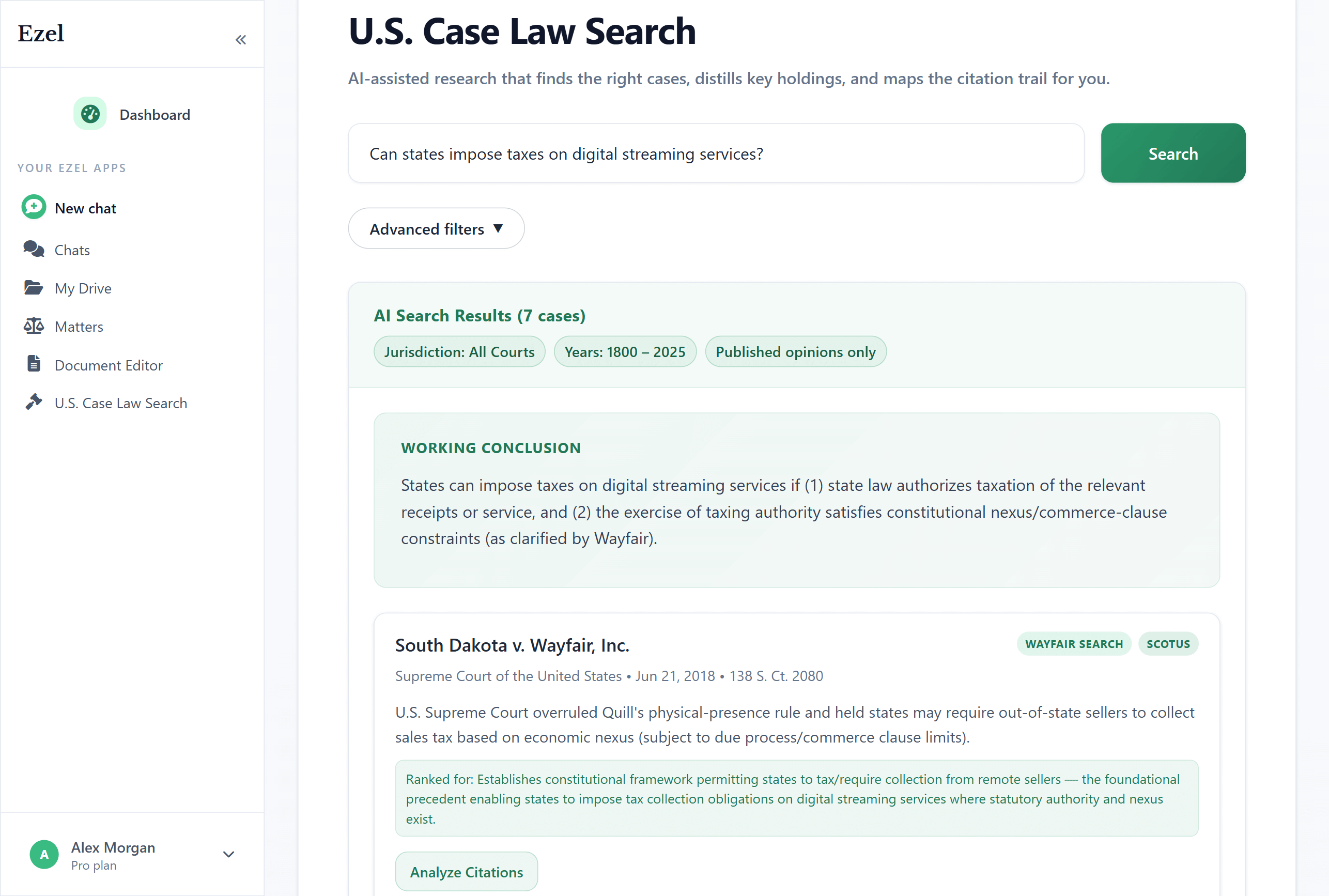
Search like you think
Describe your legal question in plain English. Filter by jurisdiction, date, and court level. Read full opinions without leaving Ezel.
- All 50 states plus federal courts
- Natural language queries - no boolean syntax
- Citation analysis and network exploration
- Copy quotes with automatic citation generation
Ready to transform your legal workflow?
Join legal teams using Ezel to draft documents, research case law, and organize matters — all in one workspace.