DEMAND FOR SETTLEMENT - MEDICAL MALPRACTICE
STATE OF WISCONSIN
[FIRM NAME]
Attorneys at Law
[Street Address]
[City, Wisconsin ZIP]
Telephone: [Phone]
Facsimile: [Fax]
Email: [Email]
Licensed in the State of Wisconsin
DATE: [Date]
VIA CERTIFIED MAIL, RETURN RECEIPT REQUESTED
AND FIRST-CLASS MAIL
[Risk Management / Claims Administrator / Insurance Carrier]
[Hospital / Medical Group / Insurance Company Name]
[Street Address]
[City, State ZIP]
RE: MEDICAL MALPRACTICE CLAIM - SETTLEMENT DEMAND
Patient/Claimant: [Client Full Name]
Date(s) of Negligent Care: [Date or Date Range]
Healthcare Provider(s): [Provider Name(s)]
Facility: [Hospital/Clinic Name]
Claim Number: [If assigned]
Dear [Recipient Name]:
This firm represents [Client Name] in connection with the medical malpractice that occurred during [his/her] care and treatment at [Facility Name] by [Healthcare Provider Name(s)]. This letter constitutes formal notice of our client's claim and our demand for settlement pursuant to Wisconsin Statutes governing medical malpractice.
I. WISCONSIN-SPECIFIC LEGAL FRAMEWORK
A. Governing Law
This claim is governed by Wisconsin Statutes, including Chapter 655 (Health Care Liability and Injured Patients and Families Compensation Fund) and Section 893.55 (limitations), which establish the standards and procedures for medical malpractice actions in Wisconsin.
B. Injured Patients and Families Compensation Fund - IMPORTANT
Wisconsin has a unique system involving the Injured Patients and Families Compensation Fund (IPFCF). Healthcare providers covered by the Fund have primary liability coverage plus excess coverage from the Fund. The Fund pays damages exceeding the provider's primary coverage limits.
C. Statute of Limitations and Repose
Statute of Limitations: Under Wis. Stat. Section 893.55, actions for medical malpractice must be commenced within the later of:
1. Three (3) years from the date of injury; or
2. One (1) year from the date the injury was discovered or reasonably should have been discovered.
Discovery Rule: Wisconsin applies a discovery rule. The one-year discovery period does not begin until the plaintiff discovers or should have discovered the injury and its cause. Hansen v. A.H. Robins, Inc., 113 Wis. 2d 550 (1983).
Statute of Repose: Wis. Stat. Section 893.55(2) imposes an absolute five (5) year statute of repose from the date of the act or omission. No action may be brought more than five years after the date of the act giving rise to the claim.
Foreign Object Exception: The statute of repose does not apply to claims involving a foreign object unintentionally left in the body. Wis. Stat. Section 893.55(3).
Minors: For minors, the statute of limitations is tolled during minority but the five-year statute of repose still applies. Wis. Stat. Section 893.55(2).
Relevant Dates in This Matter:
- Date(s) of negligent care: [Date(s)]
- Date of discovery: [Date]
- Three-year/one-year limitations period expires: [Date]
- Five-year repose period expires: [Date]
D. Modified Comparative Fault
Wisconsin follows modified comparative fault with a 51% bar. Under Wis. Stat. Section 895.045, a plaintiff may not recover damages if their negligence was greater than the combined negligence of all defendants and third parties. If the plaintiff's negligence is 50% or less, damages are reduced proportionally.
Our investigation has determined that our client was in no way negligent or at fault for the injuries sustained.
E. Standard of Care Under Wisconsin Law
Under Wisconsin law, a healthcare provider must exercise that degree of care and skill which is exercised by the average practitioner in the class to which the provider belongs, acting in the same or similar circumstances. Sawyer v. Midelfort, 227 Wis. 2d 124 (1999).
National Standard: Wisconsin generally applies a national standard of care. Shier v. Freedman, 58 Wis. 2d 269 (1973).
F. Expert Witness Requirements
Under Wis. Stat. Section 907.02 and case law, expert testimony is required to establish the standard of care, its breach, and causation. The expert must:
- Be qualified by knowledge, skill, experience, training, or education;
- Be familiar with the applicable standard of care; and
- Be competent to render opinions on the relevant medical issues.
Carney-Hayes v. Nw. Wis. Home Care, Inc., 2005 WI 118.
G. Damage Caps - CRITICAL
Under Wis. Stat. Section 893.55(4)(d), Wisconsin imposes a cap on noneconomic damages of $750,000.
Constitutionality: This cap has been upheld by the Wisconsin Supreme Court. Mayo v. Wisconsin Injured Patients & Families Comp. Fund, 2018 WI 78.
Economic Damages: No cap applies to economic damages.
Wrongful Death: Different provisions may apply for wrongful death claims. Wis. Stat. Section 895.04.
H. Mandatory Mediation Panel - IMPORTANT
Under Wis. Stat. Section 655.44, medical malpractice claims must be submitted to a mediation panel before trial. The panel consists of three members: a judge (chair), an attorney, and a healthcare provider.
The panel reviews the claim and issues a written decision, which is admissible at trial but not conclusive. Either party may proceed to trial regardless of the panel's decision.
I. Informed Consent
Wisconsin recognizes informed consent as a basis for medical malpractice liability under Wis. Stat. Section 448.30. A physician must disclose:
- The nature of the diagnosis;
- The nature of the proposed treatment or procedure;
- The risks involved;
- The alternatives; and
- The risks of alternatives.
The standard is what a reasonable patient would want to know. Martin v. Richards, 192 Wis. 2d 156 (Ct. App. 1995).
J. Vicarious Liability
Hospital Liability: Wisconsin hospitals may be held vicariously liable for the negligence of their employees under respondeat superior. Pamperin v. Trinity Mem'l Hosp., 144 Wis. 2d 188 (1988).
Apparent Agency: Wisconsin recognizes apparent agency liability when patients reasonably believe physicians are hospital employees. Pamperin v. Trinity Mem'l Hosp., 144 Wis. 2d 188 (1988).
K. Loss of Chance Doctrine
Wisconsin has adopted the loss of chance doctrine. Under Meracle v. Children's Serv. Soc'y, 149 Wis. 2d 19 (1989), a plaintiff may recover for the loss of a chance of survival or better outcome, with damages proportional to the lost chance.
L. Res Ipsa Loquitur
Wisconsin recognizes res ipsa loquitur in medical malpractice cases where the injury is of a kind that does not ordinarily occur without negligence, the instrumentality was under the defendant's exclusive control, and the plaintiff did not contribute to the injury. Fehrman v. Smirl, 20 Wis. 2d 1 (1963).
M. Government Immunity
Claims against Wisconsin governmental entities are subject to Wis. Stat. Section 893.80 with notice requirements and damage limitations. Claims against the State of Wisconsin are brought before the Claims Board under Wis. Stat. Section 16.007.
II. PRESERVATION OF EVIDENCE - LITIGATION HOLD
YOU ARE HEREBY DIRECTED TO PRESERVE ALL EVIDENCE relating to the care and treatment of [Client Name], including but not limited to:
- Complete medical records (paper and electronic)
- All versions of electronic medical records (including audit trails)
- Nursing notes, medication administration records, and flow sheets
- All diagnostic imaging studies and reports
- Laboratory results and pathology reports
- Operative reports and anesthesia records
- Consultation notes
- Informed consent documents
- Incident/occurrence reports
- Peer review materials (to the extent discoverable)
- Policies, procedures, and protocols in effect at the time of treatment
- Credentialing files for involved healthcare providers
- Staffing records and schedules
- Equipment maintenance records
- Any recorded statements
Modification, destruction, or concealment of any records will result in claims for spoliation, sanctions, and adverse inference instructions under Wisconsin law. Garfoot v. Fireman's Fund Ins. Co., 228 Wis. 2d 707 (Ct. App. 1999).
III. FACTUAL BACKGROUND
A. Patient History and Presentation
[Client Name], a [age]-year-old [male/female], presented to [Facility/Provider] on [Date] with [chief complaint/reason for visit]:
Relevant Medical History:
- [Relevant past medical history]
- [Relevant surgical history]
- [Current medications]
- [Allergies]
Presenting Symptoms:
- [Symptom 1]
- [Symptom 2]
- [Symptom 3]
B. Chronology of Negligent Care
[Date/Time]: [Describe what occurred]
[Date/Time]: [Describe what occurred]
[Date/Time]: [Describe what occurred]
C. The Medical Error(s)
[Describe specifically what the healthcare provider(s) did wrong]
D. Discovery of Malpractice
Our client [did not discover / could not have reasonably discovered] the malpractice until [Date], when [describe discovery circumstances].
IV. STANDARD OF CARE VIOLATIONS
A. Applicable Standard of Care
Under Wisconsin law, [Defendant Healthcare Provider] was required to exercise that degree of care and skill exercised by the average practitioner in the class to which the provider belongs, acting in the same or similar circumstances.
Based on our expert's analysis, the applicable standard of care required [Defendant] to:
- [Standard 1]
- [Standard 2]
- [Standard 3]
B. Breaches of the Standard of Care
Breach 1: [Detailed description of breach]
Breach 2: [Detailed description of breach]
Breach 3: [Detailed description of breach]
C. Expert Opinion
We have retained [Expert Name, M.D.], a board-certified [Specialty] physician licensed in [State] with [number] years of experience. [Dr./Expert Name] has concluded, to a reasonable degree of medical probability, that:
- [Defendant Provider] breached the applicable standard of care;
- These breaches were a proximate cause of [Client Name]'s injuries; and
- Had appropriate care been rendered, [describe avoided outcome].
V. CAUSATION
A. Factual and Proximate Causation
But for the defendant's breach of the standard of care, our client would not have suffered the injuries described herein. Under Wisconsin law, the plaintiff must prove that the defendant's negligence was a substantial factor in causing the injury. Merco Distrib. Corp. v. Commercial Police Alarm Co., 84 Wis. 2d 455 (1978).
B. Loss of Chance (If Applicable)
[If applicable:] The defendant's negligence substantially reduced our client's chance of [survival/recovery/better outcome], constituting compensable injury under Wisconsin's loss of chance doctrine. Meracle v. Children's Serv. Soc'y, 149 Wis. 2d 19 (1989).
VI. DAMAGES
A. Physical Injuries
As a direct and proximate result of the defendant's medical negligence, our client has suffered:
Primary Injuries:
- [Injury 1]
- [Injury 2]
- [Injury 3]
Current Medical Status:
[Describe current condition and prognosis]
B. Medical Expenses
Past Medical Expenses:
| Provider | Service | Amount |
|---|---|---|
| [Provider] | [Service] | $[Amount] |
| [Provider] | [Service] | $[Amount] |
| TOTAL PAST MEDICAL | $[Total] |
Future Medical Expenses: $[Amount]
C. Lost Earnings
| Category | Amount |
|---|---|
| Past Lost Wages | $[Amount] |
| Future Lost Earning Capacity | $[Amount] |
| TOTAL LOST EARNINGS | $[Total] |
D. Non-Economic Damages
- Physical pain and suffering
- Mental anguish
- Loss of enjoyment of life
- Permanent disability/disfigurement
- Loss of consortium (spouse's claim)
- Emotional distress
E. Summary of Damages
| Category | Amount |
|---|---|
| Past Medical Expenses | $[Amount] |
| Future Medical Expenses | $[Amount] |
| Past Lost Wages | $[Amount] |
| Future Lost Earnings | $[Amount] |
| TOTAL ECONOMIC DAMAGES | $[Subtotal] |
| Pain and Suffering | $[Amount] |
| Mental Anguish | $[Amount] |
| Loss of Enjoyment | $[Amount] |
| Loss of Consortium | $[Amount] |
| TOTAL NON-ECONOMIC DAMAGES | $[Subtotal] |
| TOTAL DAMAGES | $[Grand Total] |
VII. SETTLEMENT DEMAND
Based upon the clear breach of the standard of care, the severity of our client's injuries, and the substantial damages incurred, we hereby demand:
$[DEMAND AMOUNT]
This demand will remain open for thirty (30) days from the date of this letter, expiring at 5:00 p.m. Central Time on [Expiration Date].
VIII. RESPONSE AND ADDITIONAL INFORMATION REQUESTED
Please provide:
- All professional liability insurance policies applicable to this claim
- Policy limits for each applicable policy
- Any self-insured retention amounts
- IPFCF (Injured Patients and Families Compensation Fund) coverage information
- Excess/umbrella coverage information
- Hospital liability coverage (if applicable)
IX. DOCUMENTATION ENCLOSED
- Medical records supporting the claim
- Medical bills and itemized statements
- Employment and wage documentation
- Expert curriculum vitae
- Photographs (if applicable)
- HIPAA authorizations
X. CONCLUSION
This case presents clear medical negligence that caused significant harm to our client. We recognize that this matter will be subject to the mandatory mediation panel review under Wis. Stat. Section 655.44 if suit is filed.
We are prepared to litigate this matter through trial in the Circuit Court of [County] County, Wisconsin if necessary. However, we believe early resolution serves all parties' interests and may avoid the expense and delay of the mediation panel process.
Please respond by the deadline stated above.
Respectfully submitted,
[FIRM NAME]
By: _________________________________
[Attorney Name]
State Bar of Wisconsin No. [Number]
Attorney for [Client Name]
ENCLOSURES: As noted above
cc: [Client Name]
File
WISCONSIN MEDICAL MALPRACTICE PRACTICE NOTES
-
IPFCF System: Wisconsin's unique Injured Patients and Families Compensation Fund provides excess coverage over providers' primary insurance.
-
$750,000 Noneconomic Cap: Upheld by Wisconsin Supreme Court in 2018.
-
Mandatory Mediation Panel: Required before trial; panel decision admissible but not conclusive.
-
Modified Comparative Fault: 51% bar - plaintiff cannot recover if more negligent than combined defendants.
-
5-Year Statute of Repose: Shorter than many states; important to monitor closely.
-
Loss of Chance Recognized: Wisconsin allows recovery for loss of chance of survival or recovery.
-
National Standard of Care: Wisconsin generally applies a national, not local, standard.
-
No Certificate of Merit: Wisconsin does not require a certificate of merit at filing.
-
Venue: Proper venue is the county where the cause of action arose or where defendant resides. Wis. Stat. Section 801.50.
-
Collateral Source Rule: Modified - court may reduce damages by collateral source payments. Wis. Stat. Section 893.55(7).
This template is specific to Wisconsin law. Medical malpractice claims in Wisconsin involve the IPFCF system and mandatory mediation panels. Always verify current law and consult with qualified Wisconsin medical malpractice counsel.
Do more with Ezel
This free template is just the beginning. See how Ezel helps legal teams draft, research, and collaborate faster.
AI that drafts while you watch
Tell the AI what you need and watch your document transform in real-time. No more copy-pasting between tools or manually formatting changes.
- Natural language commands: "Add a force majeure clause"
- Context-aware suggestions based on document type
- Real-time streaming shows edits as they happen
- Milestone tracking and version comparison
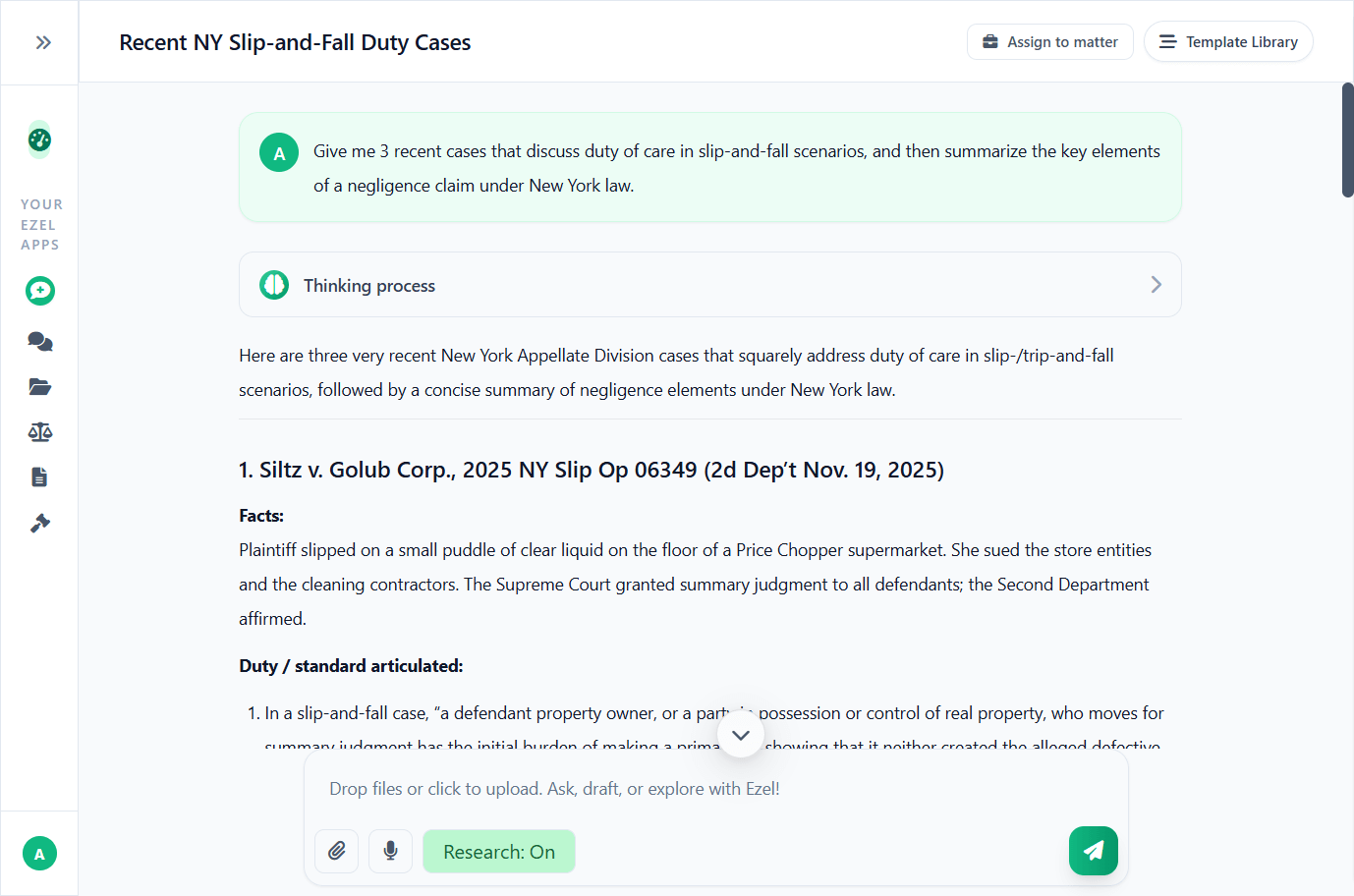
Research and draft in one conversation
Ask questions, attach documents, and get answers grounded in case law. Link chats to matters so the AI remembers your context.
- Pull statutes, case law, and secondary sources
- Attach and analyze contracts mid-conversation
- Link chats to matters for automatic context
- Your data never trains AI models
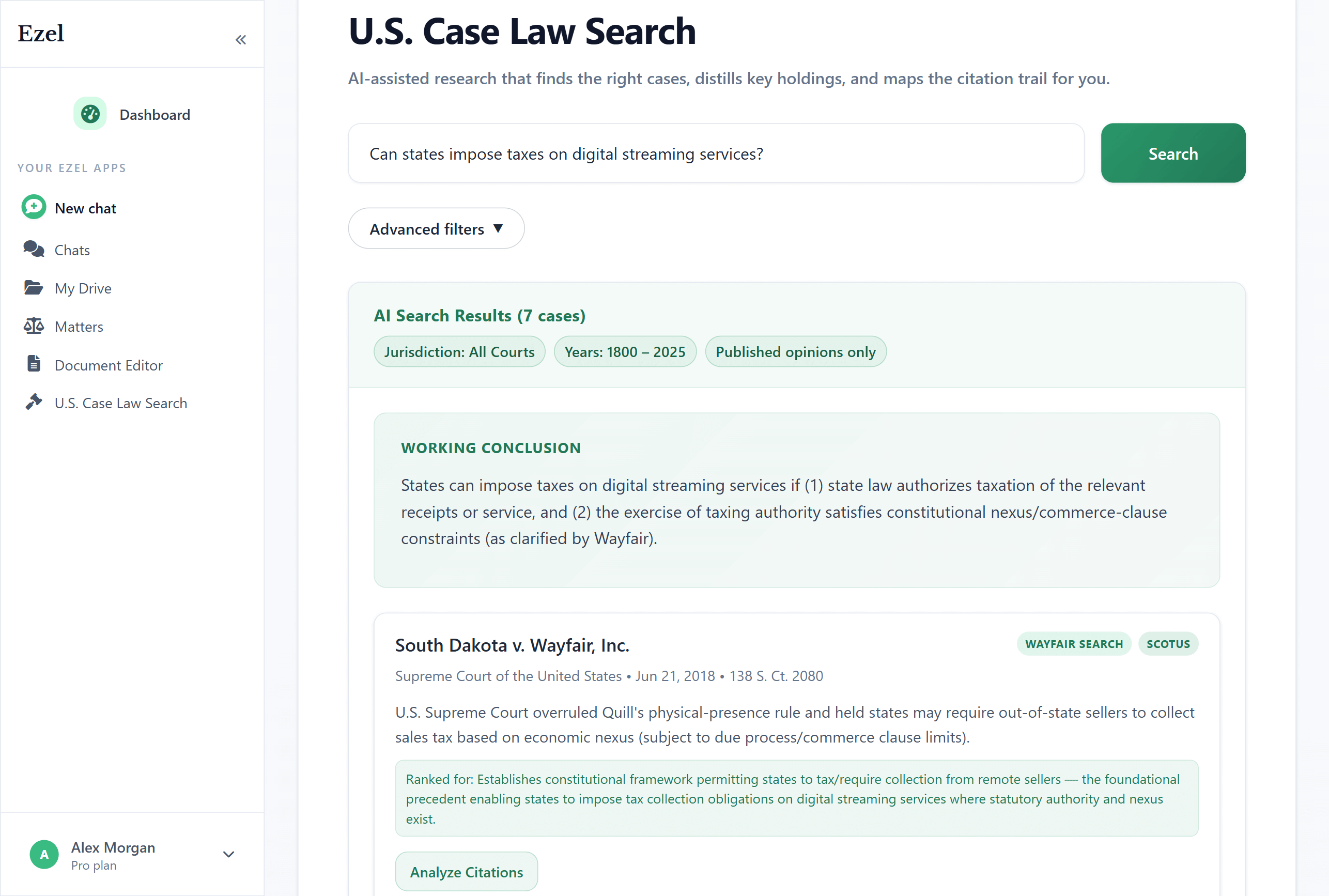
Search like you think
Describe your legal question in plain English. Filter by jurisdiction, date, and court level. Read full opinions without leaving Ezel.
- All 50 states plus federal courts
- Natural language queries - no boolean syntax
- Citation analysis and network exploration
- Copy quotes with automatic citation generation
Ready to transform your legal workflow?
Join legal teams using Ezel to draft documents, research case law, and organize matters — all in one workspace.