GENERATIVE AI ACCEPTABLE USE POLICY
DOCUMENT CONTROL
| Field | Information |
|---|---|
| Organization | [ORGANIZATION NAME] |
| Policy Owner | [NAME, TITLE] |
| Approved By | [NAME, TITLE] |
| Approval Date | [DATE] |
| Effective Date | [DATE] |
| Next Review Date | [DATE] |
| Version | [VERSION NUMBER] |
| Classification | ☐ Internal ☐ Confidential |
1. INTRODUCTION
1.1 Purpose
This Generative AI Acceptable Use Policy ("Policy") establishes rules, guidelines, and expectations for the use of generative artificial intelligence (GenAI) tools by [ORGANIZATION NAME] employees, contractors, and other authorized personnel.
The purpose of this Policy is to:
- Enable productive and innovative use of GenAI tools
- Protect confidential and sensitive information
- Ensure compliance with legal and regulatory requirements
- Manage intellectual property and data security risks
- Maintain quality standards for AI-assisted work
- Promote responsible and ethical AI use
1.2 Scope
This Policy applies to:
- All employees (full-time, part-time, temporary)
- Contractors, consultants, and contingent workers
- Interns and volunteers
- Anyone using [ORGANIZATION NAME] systems or data
This Policy covers:
- External GenAI services (e.g., ChatGPT, Claude, Gemini, Midjourney, DALL-E)
- GenAI features in existing tools (e.g., Microsoft Copilot, GitHub Copilot)
- Internally deployed GenAI systems
- Personal use of GenAI that involves company information
1.3 Definitions
Generative AI (GenAI): Artificial intelligence systems that can generate text, images, audio, video, code, or other content based on user inputs (prompts).
Prompt: Input provided to a GenAI system to generate output.
Output: Content generated by a GenAI system in response to a prompt.
Hallucination: False or fabricated information generated by AI that appears plausible but is factually incorrect.
Shadow AI: Unauthorized or untracked use of AI tools within an organization.
2. APPROVED TOOLS AND ACCESS
2.1 Tool Categories
[ORGANIZATION NAME] categorizes GenAI tools as follows:
Category A: Approved for General Use
These tools have been evaluated and approved for general business use with appropriate precautions:
| Tool | Approved Use Cases | Restrictions |
|---|---|---|
| [TOOL 1, e.g., ChatGPT Enterprise] | [USE CASES] | [RESTRICTIONS] |
| [TOOL 2, e.g., Microsoft Copilot] | [USE CASES] | [RESTRICTIONS] |
| [TOOL 3] | [USE CASES] | [RESTRICTIONS] |
Category B: Approved for Specific Use Cases
These tools are approved for specific, documented use cases with additional controls:
| Tool | Approved Use Cases | Required Approvals |
|---|---|---|
| [TOOL 1] | [USE CASES] | [APPROVAL REQUIRED] |
| [TOOL 2] | [USE CASES] | [APPROVAL REQUIRED] |
Category C: Prohibited
These tools are not approved for use with company information:
| Tool | Reason |
|---|---|
| [TOOL 1] | [REASON, e.g., data retention concerns] |
| [TOOL 2] | [REASON] |
☐ Consumer/free versions of tools that retain user data for training
☐ Tools from vendors without adequate security certifications
☐ Tools in jurisdictions with inadequate data protection
☐ [OTHER PROHIBITED CATEGORIES]
2.2 Requesting New Tools
To request approval for a new GenAI tool:
- Submit request to [IT/SECURITY/DESIGNATED TEAM]
- Provide business justification and use cases
- Complete vendor security questionnaire
- Await security and privacy review
- Obtain required management approval
Do not use unapproved tools with company information without authorization.
2.3 Enterprise vs. Consumer Versions
☐ Enterprise versions required: For any use involving company data, you must use enterprise/business versions of GenAI tools that provide:
- Data not used for model training
- Enhanced security and access controls
- Audit logging capabilities
- Business associate agreements (if applicable)
☐ Consumer versions prohibited: Do not use free/consumer versions of GenAI tools for work purposes as your data may be used for training.
3. DATA CLASSIFICATION AND HANDLING
3.1 Data Classification Rules
What you CAN input into approved GenAI tools:
☐ Publicly available information
☐ General knowledge questions
☐ De-identified, non-sensitive content
☐ Drafts without confidential information
☐ Generic code snippets without proprietary logic
☐ Content you created that contains no sensitive data
What you CANNOT input into GenAI tools:
☐ Confidential Information:
- Trade secrets and proprietary business information
- Non-public financial data
- Strategic plans and M&A information
- Unpublished product information
☐ Personal Data:
- Customer personal information
- Employee personal information
- Health information (PHI)
- Financial account information
☐ Regulated Data:
- Data subject to HIPAA, GLBA, FERPA, etc.
- Export-controlled information
- Attorney-client privileged information
- Data subject to confidentiality agreements
☐ Security-Sensitive Information:
- Passwords, API keys, credentials
- Security configurations
- Vulnerability information
- Internal network details
☐ Third-Party Information:
- Information received under NDA
- Customer proprietary information
- Vendor confidential information
- Partner business information
3.2 Data Handling Checklist
Before using any GenAI tool, ask yourself:
☐ Is this information public or non-sensitive?
☐ Would I be comfortable if this appeared in a competitor's report?
☐ Does this contain any personal information?
☐ Is this covered by any confidentiality obligation?
☐ Am I using an approved enterprise tool?
If you answer "No" to any question, do not input the data into GenAI tools.
3.3 Sanitization Requirements
Before inputting content:
- Remove all personally identifiable information (PII)
- Remove confidential business details
- Generalize specific references (e.g., "a major customer" instead of customer name)
- Remove code comments with sensitive information
- Replace proprietary terms with generic placeholders
4. ACCEPTABLE USE GUIDELINES
4.1 Permitted Uses
GenAI tools may be used for:
☐ Writing Assistance:
- Drafting and editing documents
- Grammar and style improvements
- Summarizing public information
- Translation of non-sensitive content
☐ Research and Learning:
- Exploring concepts and ideas
- Learning new technologies
- Understanding industry trends
- Professional development
☐ Productivity Tasks:
- Creating templates and frameworks
- Formatting assistance
- Brainstorming ideas
- Meeting preparation
☐ Technical Tasks (with approved tools):
- Code completion and suggestions
- Debugging assistance
- Documentation generation
- Test case creation
☐ Creative Work:
- Marketing copy drafts
- Design concept exploration
- Content ideation
- Presentation outlines
4.2 Prohibited Uses
GenAI tools must NOT be used for:
☐ Deceptive Practices:
- Creating misleading content
- Impersonating individuals
- Generating fake reviews or testimonials
- Spreading misinformation
☐ Harmful Content:
- Harassment or discriminatory content
- Illegal activities
- Malicious code or hacking
- Content that violates policies
☐ Bypassing Controls:
- Circumventing security measures
- Accessing unauthorized information
- Evading compliance requirements
- Shadow AI activities
☐ Inappropriate Automation:
- Automated decision-making affecting individuals without human oversight
- Mass content generation without review
- Replacing required human judgment
☐ Misrepresentation:
- Submitting AI outputs as solely your own work in academic contexts
- Claiming AI-generated content as original without disclosure when required
- Using AI for work prohibited by client contracts
☐ Legal/Regulated Activities Without Oversight:
- Legal advice without attorney review
- Medical advice without clinician oversight
- Financial advice without qualified review
- Regulatory submissions without expert review
4.3 Department-Specific Guidelines
Engineering/Development
| Activity | Permitted | Conditions |
|---|---|---|
| Code completion | ☐ Yes ☐ No | [CONDITIONS] |
| Code review assistance | ☐ Yes ☐ No | [CONDITIONS] |
| Documentation generation | ☐ Yes ☐ No | [CONDITIONS] |
| Architecture suggestions | ☐ Yes ☐ No | [CONDITIONS] |
| Security code review | ☐ Yes ☐ No | [CONDITIONS] |
Additional Requirements:
- Code generated by AI must pass all standard code review processes
- Do not input proprietary algorithms or trade secrets
- Review AI-generated code for security vulnerabilities
- [ADDITIONAL REQUIREMENTS]
Legal
| Activity | Permitted | Conditions |
|---|---|---|
| Research assistance | ☐ Yes ☐ No | [CONDITIONS] |
| Document drafting | ☐ Yes ☐ No | [CONDITIONS] |
| Contract review | ☐ Yes ☐ No | [CONDITIONS] |
| Legal advice generation | ☐ Yes ☐ No | [CONDITIONS] |
Additional Requirements:
- All legal outputs must be reviewed by licensed attorney
- Do not input privileged communications
- Verify all legal citations independently
- [ADDITIONAL REQUIREMENTS]
Human Resources
| Activity | Permitted | Conditions |
|---|---|---|
| Job description drafting | ☐ Yes ☐ No | [CONDITIONS] |
| Policy drafting assistance | ☐ Yes ☐ No | [CONDITIONS] |
| Resume screening | ☐ Yes ☐ No | [CONDITIONS] |
| Employee communications | ☐ Yes ☐ No | [CONDITIONS] |
Additional Requirements:
- Never input employee personal information
- Review for bias in HR-related outputs
- Comply with employment AI disclosure laws
- [ADDITIONAL REQUIREMENTS]
Marketing/Communications
| Activity | Permitted | Conditions |
|---|---|---|
| Content drafting | ☐ Yes ☐ No | [CONDITIONS] |
| Social media assistance | ☐ Yes ☐ No | [CONDITIONS] |
| Image generation | ☐ Yes ☐ No | [CONDITIONS] |
| Customer communications | ☐ Yes ☐ No | [CONDITIONS] |
Additional Requirements:
- Review for brand consistency and accuracy
- Disclose AI involvement as required by regulations
- Ensure generated images don't infringe rights
- [ADDITIONAL REQUIREMENTS]
Finance
| Activity | Permitted | Conditions |
|---|---|---|
| Analysis assistance | ☐ Yes ☐ No | [CONDITIONS] |
| Report drafting | ☐ Yes ☐ No | [CONDITIONS] |
| Financial projections | ☐ Yes ☐ No | [CONDITIONS] |
| Audit documentation | ☐ Yes ☐ No | [CONDITIONS] |
Additional Requirements:
- Do not input non-public financial data
- Verify all numerical outputs
- Maintain audit trails
- [ADDITIONAL REQUIREMENTS]
5. QUALITY AND ACCURACY REQUIREMENTS
5.1 Human Review Requirement
All GenAI outputs must be reviewed by a qualified human before:
- External communication or publication
- Submission to clients or customers
- Use in decision-making
- Incorporation into products or services
- Regulatory or legal submissions
5.2 Verification Requirements
| Content Type | Verification Required |
|---|---|
| Factual claims | Verify from authoritative sources |
| Statistics and data | Confirm from original sources |
| Legal citations | Verify in legal databases |
| Technical specifications | Test and validate |
| Code | Review, test, and security scan |
| Quotations | Verify attribution and accuracy |
5.3 Addressing AI Limitations
Be aware that GenAI systems may:
- Generate plausible-sounding but incorrect information ("hallucinations")
- Lack knowledge of recent events (training cutoff dates)
- Reflect biases present in training data
- Provide inconsistent responses
- Fail to understand nuanced context
- Generate content that may infringe others' rights
Your responsibility:
☐ Treat AI outputs as drafts requiring verification
☐ Apply professional judgment to all outputs
☐ Question and fact-check AI-generated content
☐ Do not blindly trust AI outputs for important decisions
5.4 Attribution and Disclosure
When attribution is required:
☐ Academic or educational submissions
☐ Published works where disclosure expected
☐ Client deliverables (per contract requirements)
☐ Regulatory submissions
☐ Content subject to transparency regulations
Disclosure language example:
"This [document/content] was created with AI assistance and has been reviewed and edited by [human author/team]."
6. INTELLECTUAL PROPERTY CONSIDERATIONS
6.1 Ownership of Outputs
☐ AI-generated outputs created in the course of employment are owned by [ORGANIZATION NAME]
☐ Employees should not claim personal ownership of AI-assisted work products created for the company
☐ AI outputs may not be eligible for copyright protection—do not rely solely on AI-generated content for IP-protected deliverables
6.2 Third-Party IP Concerns
Be aware that:
- AI outputs may inadvertently incorporate third-party copyrighted material
- AI-generated images may resemble existing copyrighted works
- AI-generated code may reflect open-source code with licensing requirements
Mitigations:
☐ Review outputs for potential IP issues
☐ Do not use AI outputs that closely resemble known protected works
☐ Scan AI-generated code for license compliance
☐ Consult legal if unsure about IP implications
6.3 Protecting Company IP
☐ Do not input trade secrets or proprietary algorithms
☐ Do not input unpublished innovations or inventions
☐ Consider IP implications before inputting any proprietary content
☐ Remember that inputs may be logged by AI providers
7. SECURITY AND PRIVACY
7.1 Security Requirements
☐ Use only approved GenAI tools with appropriate security controls
☐ Access GenAI tools only through approved methods (corporate accounts, VPN if required)
☐ Do not share login credentials for GenAI tools
☐ Report any security incidents involving GenAI
☐ Follow all standard security policies when using GenAI
7.2 Privacy Requirements
☐ Comply with all privacy laws and policies
☐ Do not input personal data without appropriate safeguards
☐ Consider GDPR, CCPA/CPRA, and other applicable requirements
☐ Conduct privacy assessments for new GenAI use cases involving personal data
7.3 Logging and Monitoring
[ORGANIZATION NAME] may:
☐ Monitor use of enterprise GenAI tools
☐ Log prompts and outputs for security and compliance purposes
☐ Audit GenAI usage patterns
☐ Review usage for policy compliance
8. REGULATORY COMPLIANCE
8.1 Applicable Regulations
Be aware of and comply with:
☐ EU AI Act: Transparency obligations, high-risk AI requirements
☐ California AI Transparency Act (SB 942): Disclosure requirements for AI-generated content
☐ Illinois AI Employment Laws: Notice requirements for AI in employment
☐ Colorado AI Act: Requirements for high-risk AI systems
☐ NYC Local Law 144: Requirements for AI in hiring
☐ Sector-specific regulations: HIPAA, GLBA, FINRA, FDA, etc.
☐ Consumer protection laws: FTC Act, state UDAP laws
8.2 Industry-Specific Considerations
Healthcare
- Do not input PHI into non-HIPAA-compliant tools
- AI outputs cannot replace clinical judgment
- Follow FDA guidance on AI in medical devices
Financial Services
- Comply with model risk management requirements
- Document AI use in customer-facing applications
- Follow fair lending considerations
Legal
- Maintain attorney-client privilege
- Verify all legal research and citations
- Comply with professional responsibility rules
8.3 Client Contract Compliance
Before using GenAI on client work:
☐ Review client contract for AI restrictions
☐ Obtain client consent if required
☐ Comply with client confidentiality requirements
☐ Disclose AI use as required by contract
9. TRAINING AND AWARENESS
9.1 Required Training
| Audience | Training | Frequency |
|---|---|---|
| All employees | GenAI Acceptable Use | Upon hire + Annual |
| Power users | Advanced GenAI Training | Upon designation + Annual |
| Managers | GenAI Management Training | Upon promotion + Annual |
| IT/Security | GenAI Security Training | Quarterly updates |
9.2 Training Topics
Training will cover:
☐ This Policy and its requirements
☐ Approved tools and access procedures
☐ Data classification and handling
☐ Security and privacy considerations
☐ Quality and accuracy requirements
☐ IP and legal considerations
☐ Recognizing and reporting issues
9.3 Staying Current
Employees should:
☐ Complete all required training
☐ Stay informed about policy updates
☐ Attend offered GenAI training sessions
☐ Seek guidance when uncertain
10. REPORTING AND ENFORCEMENT
10.1 Reporting Obligations
Report the following to [DESIGNATED CONTACT/EMAIL]:
☐ Accidental disclosure of sensitive data to GenAI tools
☐ Suspected security incidents involving GenAI
☐ Discovery of shadow AI usage
☐ Concerns about inappropriate GenAI use
☐ Questions about policy interpretation
No retaliation for good-faith reporting of concerns.
10.2 Policy Violations
Violations of this Policy may result in:
- Verbal or written warning
- Required additional training
- Restricted access to GenAI tools
- Disciplinary action up to and including termination
- Legal action in cases of willful misconduct
10.3 Incident Response
For GenAI-related incidents:
- Stop the activity immediately
- Report to [DESIGNATED CONTACT]
- Preserve relevant information
- Cooperate with investigation
- Implement corrective actions
11. EXCEPTIONS AND APPROVALS
11.1 Requesting Exceptions
Exceptions to this Policy require:
- Written request to [APPROVING AUTHORITY]
- Business justification
- Risk assessment
- Proposed safeguards
- Time-limited approval
11.2 Exception Documentation
Approved exceptions must be:
☐ Documented in writing
☐ Time-limited with review date
☐ Subject to specified conditions
☐ Monitored for compliance
12. POLICY MAINTENANCE
12.1 Review Cycle
This Policy will be reviewed:
- At least annually
- When significant new regulations take effect
- When significant new GenAI capabilities emerge
- After material incidents
12.2 Feedback
Employees may provide feedback on this Policy to [CONTACT].
12.3 Version History
| Version | Date | Changes | Approved By |
|---|---|---|---|
| 1.0 | [DATE] | Initial policy | [NAME] |
13. CONTACTS AND RESOURCES
| Topic | Contact |
|---|---|
| Policy questions | [EMAIL/CONTACT] |
| Tool approval requests | [EMAIL/CONTACT] |
| Security concerns | [EMAIL/CONTACT] |
| Privacy questions | [EMAIL/CONTACT] |
| Legal questions | [EMAIL/CONTACT] |
| Training | [EMAIL/CONTACT] |
Resources:
- [Link to approved tools list]
- [Link to training materials]
- [Link to FAQ]
- [Link to request forms]
ACKNOWLEDGMENT
I acknowledge that I have read, understand, and agree to comply with the Generative AI Acceptable Use Policy.
Name: _________________________________
Signature: _________________________________
Date: _________________________________
Department: _________________________________
QUICK REFERENCE CARD
Before Using GenAI, Ask:
- ☐ Am I using an approved tool?
- ☐ Is the data appropriate to input?
- ☐ Will I verify the output?
- ☐ Am I complying with all policies?
Data You CAN'T Input:
- Personal information (customer, employee)
- Confidential business data
- Regulated data (PHI, financial, etc.)
- Third-party confidential information
- Security credentials or configurations
Always Remember:
- AI can be wrong—verify everything
- You are responsible for outputs you use
- When in doubt, ask
- Report concerns immediately
Need Help?
Contact: [EMAIL/PHONE]
This Generative AI Acceptable Use Policy template is provided for informational purposes. Organizations should customize based on their specific needs, industry requirements, and legal counsel advice.
Do more with Ezel
This free template is just the beginning. See how Ezel helps legal teams draft, research, and collaborate faster.
AI that drafts while you watch
Tell the AI what you need and watch your document transform in real-time. No more copy-pasting between tools or manually formatting changes.
- Natural language commands: "Add a force majeure clause"
- Context-aware suggestions based on document type
- Real-time streaming shows edits as they happen
- Milestone tracking and version comparison
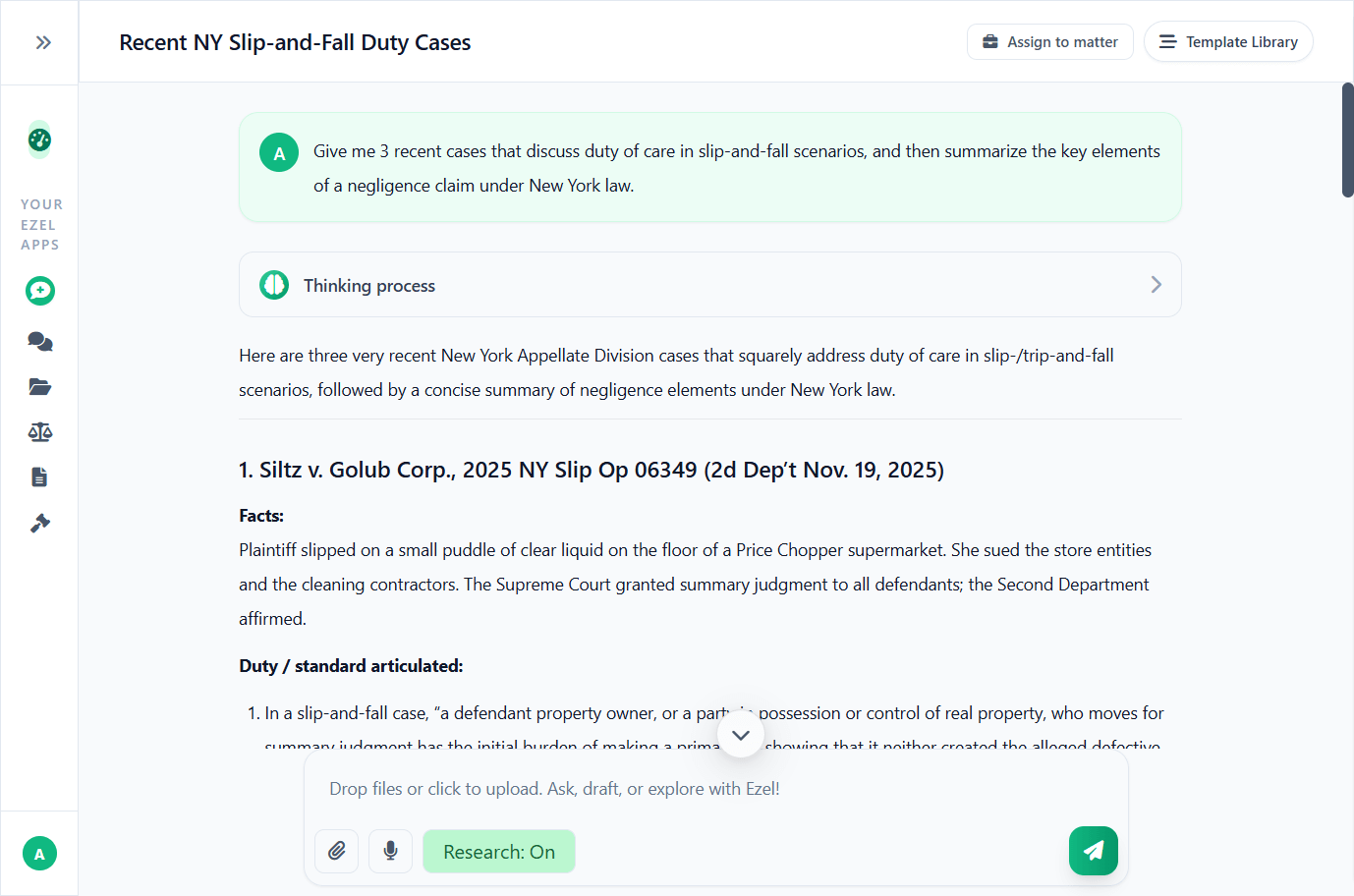
Research and draft in one conversation
Ask questions, attach documents, and get answers grounded in case law. Link chats to matters so the AI remembers your context.
- Pull statutes, case law, and secondary sources
- Attach and analyze contracts mid-conversation
- Link chats to matters for automatic context
- Your data never trains AI models
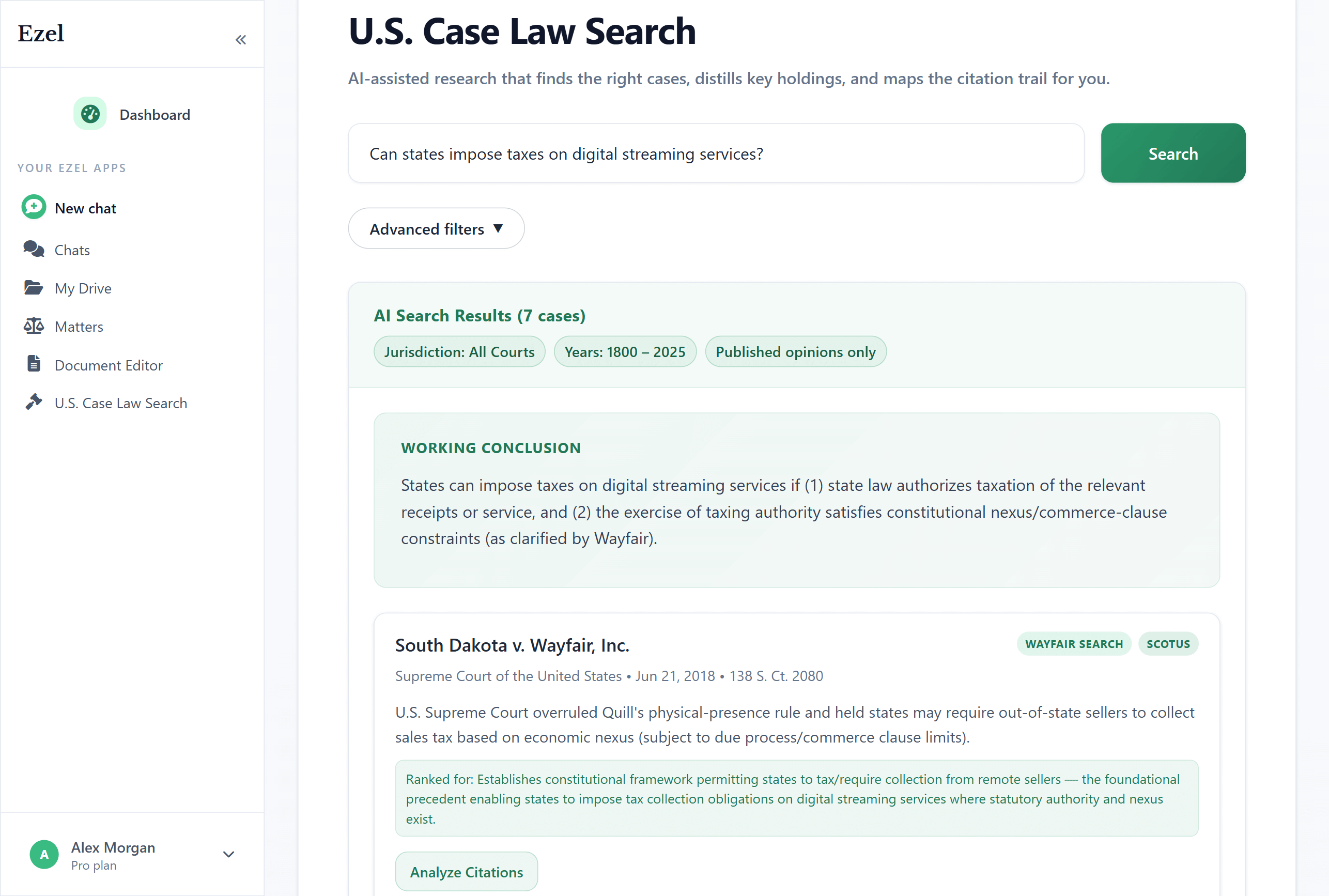
Search like you think
Describe your legal question in plain English. Filter by jurisdiction, date, and court level. Read full opinions without leaving Ezel.
- All 50 states plus federal courts
- Natural language queries - no boolean syntax
- Citation analysis and network exploration
- Copy quotes with automatic citation generation
Ready to transform your legal workflow?
Join legal teams using Ezel to draft documents, research case law, and organize matters — all in one workspace.