FORM INTERROGATORIES -- INTELLECTUAL PROPERTY INFRINGEMENT
IN THE UNITED STATES DISTRICT COURT
FOR THE [________________________________] DISTRICT OF [________________________________]
| [________________________________], | Case No.: [________________________________] |
| Plaintiff, | |
| v. | Judge: [________________________________] |
| [________________________________], | |
| Defendant. |
PROPOUNDING PARTY INFORMATION
| Field | Entry |
|---|---|
| Propounding Party: | [________________________________] |
| Responding Party: | [________________________________] |
| Set Number: | [____] |
| Date Served: | [__/__/____] |
| Responses Due: | [__/__/____] |
PRELIMINARY STATEMENT
Pursuant to Federal Rule of Civil Procedure 33, [________________________________] ("Propounding Party") hereby propounds the following interrogatories upon [________________________________] ("Responding Party"). These interrogatories are continuing in nature, and the Responding Party is required to supplement responses as additional information becomes available, consistent with Fed. R. Civ. P. 26(e).
DEFINITIONS
For purposes of these interrogatories, the following definitions apply:
-
"YOU," "YOUR," or "RESPONDING PARTY" means the party to whom these interrogatories are directed, including all officers, directors, employees, agents, representatives, consultants, attorneys, predecessors, successors, subsidiaries, parent companies, affiliates, and all persons acting or purporting to act on behalf of said party.
-
"DOCUMENT" or "DOCUMENTS" means all writings and recordings of every kind in your possession, custody, or control, including but not limited to electronically stored information ("ESI"), correspondence, memoranda, notes, emails, text messages, instant messages, social media posts, reports, studies, analyses, presentations, contracts, agreements, invoices, receipts, purchase orders, financial statements, spreadsheets, databases, calendars, day planners, photographs, drawings, sketches, prototypes, blueprints, designs, specifications, technical manuals, source code, object code, metadata, and any other tangible or electronic thing on which information is recorded.
-
"COMMUNICATION" or "COMMUNICATIONS" means every manner or means of disclosure, transfer, or exchange of information, whether oral, written, or electronic, including but not limited to face-to-face conversations, telephone calls, video conferences, letters, emails, text messages, instant messages, social media messages, posts, and comments.
-
"IDENTIFY" (as to a person) means to state the person's full name, last known residential and business addresses, telephone numbers, email addresses, and the person's relationship to you or the subject matter of the litigation.
-
"IDENTIFY" (as to a document) means to state the type of document, the date, the author(s), the addressee(s), the recipient(s) of copies, the subject matter, and the present location and custodian of the document, or, if no longer in existence, the date and manner of its destruction or disposition.
-
"IDENTIFY" (as to a communication) means to state the date of the communication, the identity of each person who participated, the means of the communication (oral, written, electronic), the subject matter, and, if written or recorded, the present location and custodian of any record of the communication.
-
"INTELLECTUAL PROPERTY" or "IP" means any and all patents, patent applications, trademarks, service marks, trade names, trade dress, copyrights, copyright registrations, trade secrets, know-how, and any other intellectual property rights at issue in this litigation.
-
"ACCUSED PRODUCT(S)" or "ACCUSED INSTRUMENTALITY(IES)" means all products, services, processes, methods, systems, or instrumentalities that are alleged to infringe, misappropriate, dilute, or otherwise violate the Intellectual Property at issue.
-
"RELEVANT PERIOD" means the time period from [__/__/____] to the present, unless otherwise specified.
-
"MARK" means any trademark, service mark, trade name, trade dress, logo, slogan, domain name, social media handle, or other source identifier at issue in this litigation.
-
"PATENT-IN-SUIT" means the patent(s) asserted in this litigation, including all claims thereof.
-
"WORK" means the copyrighted work(s) at issue in this litigation.
-
"TRADE SECRET" means any information, including but not limited to formulas, patterns, compilations, programs, devices, methods, techniques, or processes, that derives independent economic value from not being generally known and is the subject of reasonable efforts to maintain its secrecy, as alleged in this litigation.
-
"CONCERNING" or "RELATING TO" means referring to, describing, evidencing, constituting, mentioning, reflecting, discussing, analyzing, or in any way pertaining to.
-
"PERSON" means any natural person, corporation, partnership, limited liability company, joint venture, association, governmental entity, or any other legal entity.
-
"PRIOR ART" means any patent, published patent application, printed publication, public use, sale, offer for sale, or other disclosure that predates the priority date of the Patent-in-Suit, including any art considered during prosecution of the Patent-in-Suit.
-
"CLAIM LIMITATION" means each individual element or step recited in a patent claim.
-
"FIRST USE IN COMMERCE" means the first bona fide use of a Mark in the ordinary course of trade in connection with the goods or services identified in any registration or application at issue.
INSTRUCTIONS
-
Oath Requirement. Each interrogatory must be answered separately and fully in writing under oath, in accordance with Fed. R. Civ. P. 33(b)(3).
-
Objections. If you object to any interrogatory, state the specific grounds for the objection and answer the interrogatory to the extent the objection does not apply. General or boilerplate objections are disfavored and may be deemed waivers. See Fed. R. Civ. P. 33(b)(4).
-
Business Records Option. If the answer to an interrogatory may be derived from your business records and the burden of deriving the answer is substantially the same for either party, you may answer by specifying the records from which the answer may be derived and making those records available for inspection, in accordance with Fed. R. Civ. P. 33(d). You must provide sufficient detail to enable the propounding party to locate and identify the responsive records.
-
Duty to Supplement. Pursuant to Fed. R. Civ. P. 26(e), you have a continuing obligation to supplement your responses if you learn that a response is in some material respect incomplete or incorrect.
-
Scope of Knowledge. Your responses must include all information known to you personally or available to you upon reasonable inquiry, including information in the possession, custody, or control of your attorneys, agents, employees, representatives, and any other persons acting on your behalf.
-
Privileges. If you withhold any information based on a claim of privilege or work product protection, you must provide a privilege log identifying each document or communication withheld, the privilege asserted, and sufficient information to evaluate the claim, as required by Fed. R. Civ. P. 26(b)(5).
-
Numerical Limit. These interrogatories are subject to the 25-interrogatory limit of Fed. R. Civ. P. 33(a)(1), unless otherwise stipulated or ordered by the Court. Select the interrogatories applicable to your case. Each interrogatory below, including subparts, should be counted as a single interrogatory for purposes of the numerical limit, unless the Court's local rules or standing order provides otherwise.
PART I: GENERAL BACKGROUND INTERROGATORIES
INTERROGATORY NO. 1: IDENTIFY yourself fully, including your full legal name, all trade names and d/b/a names, state of incorporation or organization, principal place of business, and the names and titles of all officers, directors, and managing members during the Relevant Period.
INTERROGATORY NO. 2: IDENTIFY all persons who have knowledge of any facts relevant to the claims or defenses in this action, and for each such person, state the subject matter of the information known to that person and the basis for your belief that the person has such knowledge.
INTERROGATORY NO. 3: IDENTIFY all DOCUMENTS and tangible things that you intend to use or may use to support your claims, defenses, or counterclaims in this action.
INTERROGATORY NO. 4: IDENTIFY each expert witness you have retained or expect to call at trial, and for each expert, state: (a) the expert's full name and address; (b) the expert's qualifications and areas of expertise; (c) the subject matter on which the expert is expected to testify; (d) the facts and data considered by the expert; (e) the opinions the expert is expected to offer; and (f) the compensation to be paid for the expert's testimony.
INTERROGATORY NO. 5: IDENTIFY all prior or pending lawsuits, administrative proceedings, inter partes reviews, post-grant reviews, oppositions, cancellation proceedings, or other disputes involving the Intellectual Property at issue in this litigation, including the forum, case number, parties, and outcome or current status.
INTERROGATORY NO. 6: Describe in detail all COMMUNICATIONS between the parties (or their agents, representatives, or counsel) concerning the Intellectual Property at issue, including cease-and-desist letters, licensing inquiries, settlement discussions (to the extent not protected by Rule 408), and any other correspondence or discussions.
INTERROGATORY NO. 7: IDENTIFY all insurance policies, indemnification agreements, or other agreements that may provide coverage or contribution for any judgment, settlement, or legal fees arising from this litigation.
PART II: TRADEMARK INFRINGEMENT INTERROGATORIES
INTERROGATORY NO. 8: IDENTIFY each MARK that you contend is at issue in this litigation, and for each Mark, state: (a) the exact form of the Mark (word mark, design mark, trade dress, etc.); (b) all federal and state registration numbers and filing dates; (c) the date of First Use in Commerce; (d) the goods and/or services with which the Mark is used; (e) the International Class(es) under the Nice Classification; and (f) whether the registration is on the Principal or Supplemental Register.
INTERROGATORY NO. 9: Describe in detail the chain of title and ownership history for each Mark at issue, including all assignments, licenses, mergers, name changes, or other transfers, and IDENTIFY all DOCUMENTS evidencing such transactions.
INTERROGATORY NO. 10: For each Mark at issue, describe all efforts you have undertaken to police, protect, and enforce the Mark, including: (a) all cease-and-desist letters sent or received; (b) all opposition or cancellation proceedings filed or defended; (c) all enforcement actions or lawsuits; (d) all instances where you became aware of potentially infringing use and the actions taken; and (e) all agreements (coexistence, settlement, consent-to-use, etc.) with third parties.
INTERROGATORY NO. 11: Describe the factual basis for your contention that the Accused Product(s) or Accused Instrumentality(ies) create a likelihood of confusion with the Mark, including the specific Polaroid, Sleekcraft, or other circuit-specific likelihood-of-confusion factors you contend are satisfied. For each factor, state the supporting facts and evidence, including:
- (a) The strength and distinctiveness of the Mark (inherent and acquired);
- (b) The degree of similarity between the marks;
- (c) The proximity or relatedness of the goods/services;
- (d) Evidence of actual confusion (surveys, consumer complaints, misdirected communications);
- (e) The marketing channels used;
- (f) The degree of consumer care and sophistication;
- (g) The defendant's intent in adopting its mark;
- (h) The likelihood of expansion into competing markets.
INTERROGATORY NO. 12: IDENTIFY all surveys, studies, consumer research, focus groups, or other evidence of actual confusion or likelihood of confusion that you have conducted, commissioned, or are aware of, and for each, state the methodology, sample size, results, and the identity of the person or entity that conducted the survey or study.
INTERROGATORY NO. 13: Describe in detail any claim of trademark dilution (blurring or tarnishment) under 15 U.S.C. Section 1125(c), including the factual basis for asserting that the Mark is "famous" within the meaning of the statute and the evidence of dilution.
INTERROGATORY NO. 14: IDENTIFY all licensing agreements, franchise agreements, or other agreements granting any third party the right to use the Mark, and for each agreement, state the parties, the effective dates, the scope of the license, any quality control provisions, and the royalty or compensation terms.
PART III: PATENT INFRINGEMENT INTERROGATORIES
INTERROGATORY NO. 15: IDENTIFY each Patent-in-Suit, including: (a) the patent number; (b) the title; (c) the named inventor(s); (d) the assignee or current owner; (e) the filing date, priority date, and issue date; (f) the prosecution history, including all continuations, continuations-in-part, divisionals, reissues, and reexaminations; and (g) the specific claims asserted in this litigation.
INTERROGATORY NO. 16: For each asserted claim of the Patent-in-Suit, state your proposed claim construction for each disputed term or phrase, and IDENTIFY all intrinsic and extrinsic evidence you intend to rely upon to support your proposed constructions, including: (a) the patent specification; (b) the prosecution history; (c) prior art references; (d) expert testimony; (e) dictionaries, treatises, or technical references; and (f) any positions taken in prior proceedings (inter partes review, other litigation, or before the USPTO) concerning the same or related patent claims.
INTERROGATORY NO. 17: For each asserted claim of the Patent-in-Suit, describe in detail how each Claim Limitation of the asserted claim is met by each Accused Product or Accused Instrumentality, identifying the specific structure, feature, step, or process that corresponds to each limitation. If you contend infringement under the doctrine of equivalents, specify the function, way, and result for each equivalent element.
INTERROGATORY NO. 18: IDENTIFY all Prior Art of which you are aware that is relevant to the validity of the Patent-in-Suit, including: (a) prior art patents and published applications; (b) printed publications; (c) prior public uses or sales; (d) prior art considered during prosecution; (e) prior art identified in any inter partes review, post-grant review, or reexamination; and (f) for each item, the specific claims of the Patent-in-Suit to which the prior art is relevant and the grounds of invalidity (anticipation under 35 U.S.C. Section 102, obviousness under 35 U.S.C. Section 103, written description or enablement under 35 U.S.C. Section 112, or other grounds).
INTERROGATORY NO. 19: Describe in detail any contention that infringement of the Patent-in-Suit was willful, including: (a) the date on which the Responding Party first became aware of the Patent-in-Suit; (b) the circumstances of that awareness; (c) any opinions of counsel obtained regarding infringement, validity, or enforceability; (d) any design-around efforts undertaken; and (e) the factual basis for contending that the Responding Party's conduct rises to the level of willful infringement warranting enhanced damages under 35 U.S.C. Section 284.
INTERROGATORY NO. 20: IDENTIFY all licenses, covenants not to sue, or other agreements granting rights under the Patent-in-Suit to any third party, and for each, state the parties, effective dates, scope, and financial terms (including lump-sum payments, running royalties, and royalty base and rate).
PART IV: COPYRIGHT INFRINGEMENT INTERROGATORIES
INTERROGATORY NO. 21: IDENTIFY each copyrighted Work at issue, including: (a) the title and description; (b) the author(s); (c) the date of creation; (d) the date of first publication; (e) the Copyright Office registration number and registration date; (f) the nature of the work (literary, musical, dramatic, pictorial, audiovisual, sound recording, architectural, or other); and (g) the current owner and all prior owners.
INTERROGATORY NO. 22: Describe in detail the factual basis for your claim that the Responding Party had access to the copyrighted Work, including: (a) the distribution, publication, or public availability of the Work; (b) any direct or indirect contact between the parties; (c) any intermediaries through whom access may have occurred; (d) any evidence of copying (e.g., identical errors, artifacts, or unique creative choices appearing in both the Work and the Accused Product); and (e) any circumstantial evidence from which access may be inferred.
INTERROGATORY NO. 23: Describe in detail the factual basis for your claim of substantial similarity between the copyrighted Work and the Accused Product, including: (a) the specific protectable elements of the Work that are alleged to be substantially similar; (b) the specific portions of the Accused Product that are alleged to be substantially similar; (c) whether you rely on an "extrinsic test" (objective comparison of specific expressive elements), an "intrinsic test" (subjective assessment of overall look and feel), or both; and (d) the identity of any expert who has conducted a comparison analysis.
INTERROGATORY NO. 24: State whether you contend that the infringement was willful within the meaning of 17 U.S.C. Section 504(c)(2), and if so, describe the factual basis for that contention, including: (a) any notice of copyright ownership provided to the Responding Party; (b) any cease-and-desist communications; (c) any other evidence that the Responding Party knew or should have known its conduct constituted copyright infringement; and (d) whether you seek statutory damages under 17 U.S.C. Section 504(c) and, if so, the amount sought and the basis for that amount.
INTERROGATORY NO. 25: IDENTIFY all licenses, assignments, or permissions you have granted or received with respect to the copyrighted Work, and for each, state the parties, effective dates, scope of the license, territory, and compensation terms.
PART V: TRADE SECRET MISAPPROPRIATION INTERROGATORIES
INTERROGATORY NO. 26: IDENTIFY with reasonable particularity each Trade Secret that you allege has been misappropriated, including: (a) a description of the Trade Secret sufficient to distinguish it from matters of general knowledge in the trade or industry; (b) the date(s) on which the Trade Secret was developed or acquired; (c) the persons who developed or contributed to the development of the Trade Secret; and (d) the independent economic value the Trade Secret derives from not being generally known.
INTERROGATORY NO. 27: Describe in detail all reasonable measures you took to maintain the secrecy of each alleged Trade Secret, as required by 18 U.S.C. Section 1839(3)(A) (DTSA) and applicable state trade secret laws, including: (a) physical security measures; (b) electronic security measures (encryption, access controls, firewalls, password protections); (c) confidentiality and non-disclosure agreements; (d) non-compete and non-solicitation agreements; (e) employee training and policies regarding confidential information; (f) exit interview procedures; (g) restrictions on visitors and third-party access; and (h) any other measures.
INTERROGATORY NO. 28: Describe in detail how you contend the misappropriation occurred, including: (a) the identity of the person(s) who allegedly misappropriated the Trade Secret; (b) the method by which the Trade Secret was allegedly acquired, disclosed, or used; (c) the dates of the alleged misappropriation; (d) whether the misappropriation involved improper means (theft, bribery, misrepresentation, breach of duty, espionage, or electronic intrusion) or breach of a duty to maintain secrecy; and (e) whether you contend the Responding Party knew or had reason to know that the Trade Secret was acquired by improper means.
INTERROGATORY NO. 29: IDENTIFY all persons who had authorized access to the Trade Secret during the Relevant Period, and for each person, state: (a) the person's role and position; (b) the dates and scope of access; (c) any confidentiality or non-disclosure agreements signed by that person; and (d) whether that person subsequently left your employ or engagement, and if so, the date and circumstances of departure.
PART V-A: TRADE SECRET -- COMPETITIVE HARM AND INJUNCTIVE RELIEF
INTERROGATORY NO. 30: Describe in detail the competitive harm you have suffered or will suffer as a result of the alleged misappropriation, including: (a) the loss of competitive advantage; (b) the loss of business opportunities, contracts, or customers; (c) the threat of continued misappropriation or disclosure; and (d) the factual basis for any claim of irreparable harm supporting injunctive relief.
INTERROGATORY NO. 31: IDENTIFY each person or entity to whom the Responding Party disclosed or provided access to the Trade Secret, whether directly or indirectly, and for each such disclosure, state: (a) the date; (b) the circumstances; (c) the information disclosed; and (d) any confidentiality restrictions imposed on the recipient.
PART V-B: INTERNET AND E-COMMERCE INTERROGATORIES
INTERROGATORY NO. 32: IDENTIFY all websites, domain names, social media accounts, online marketplace listings, and other internet-based channels through which the Accused Product(s) have been marketed, advertised, offered for sale, sold, or distributed during the Relevant Period, and for each, state: (a) the URL or account identifier; (b) the dates of activity; (c) the operator of the account or listing; and (d) the total revenue generated through that channel.
INTERROGATORY NO. 33: Describe in detail all search engine optimization (SEO), pay-per-click (PPC), social media advertising, influencer marketing, or other digital marketing activities undertaken to promote the Accused Product(s), including: (a) the keywords or search terms used; (b) whether any of those keywords include the Intellectual Property at issue (e.g., the Mark, the patent number, or the title of the Work); (c) the advertising platforms used; (d) the advertising spend; and (e) the click-through and conversion rates.
PART V-C: IMPORTATION AND SUPPLY CHAIN INTERROGATORIES
INTERROGATORY NO. 34: IDENTIFY all manufacturers, assemblers, component suppliers, and subcontractors involved in the production of the Accused Product(s), and for each, state: (a) the name and address; (b) the country of manufacture or assembly; (c) the components or processes supplied; (d) the contractual relationship; and (e) any provisions regarding intellectual property indemnification.
INTERROGATORY NO. 35: Describe in detail all importation of the Accused Product(s) into the United States during the Relevant Period, including: (a) the country or countries of origin; (b) the ports of entry; (c) the customs broker used; (d) the Harmonized Tariff Schedule (HTS) classification; (e) the volume and value of imports; and (f) whether any shipment was detained, seized, or subjected to an exclusion order by U.S. Customs and Border Protection.
PART VI: DAMAGES INTERROGATORIES
INTERROGATORY NO. 36: Describe in detail all categories of damages you claim in this action, including but not limited to: (a) lost profits; (b) reasonable royalties; (c) unjust enrichment or disgorgement of profits; (d) statutory damages; (e) actual damages; (f) compensatory damages; (g) consequential damages; (h) punitive or enhanced damages; and (i) attorneys' fees and costs. For each category, state the amount or range of damages claimed and the method of calculation.
INTERROGATORY NO. 37: For any claim of lost profits, describe in detail: (a) the but-for world analysis (what sales, revenues, and profits you would have earned absent the alleged infringement or misappropriation); (b) the Panduit factors or other framework relied upon (demand for the product, absence of acceptable non-infringing substitutes, manufacturing and marketing capability, amount of profit); (c) the time period for which lost profits are claimed; (d) the profit margin applied; and (e) all assumptions and data used in the calculation.
INTERROGATORY NO. 38: For any claim of a reasonable royalty, describe in detail: (a) the Georgia-Pacific factors or other framework relied upon; (b) the proposed royalty base; (c) the proposed royalty rate; (d) comparable license agreements and their terms; (e) the hypothetical negotiation analysis; and (f) all assumptions and data used in the calculation.
INTERROGATORY NO. 39: IDENTIFY all revenues, profits, and financial data associated with the Accused Product(s) during the Relevant Period, including: (a) gross revenues; (b) net revenues; (c) cost of goods sold; (d) gross profits; (e) net profits; (f) units sold; (g) average selling price; and (h) all overhead and expense allocations.
PART VII: AFFIRMATIVE DEFENSES AND COUNTERCLAIMS
INTERROGATORY NO. 40: For each affirmative defense asserted, describe in detail the factual basis supporting the defense, including but not limited to: (a) invalidity; (b) unenforceability (including inequitable conduct); (c) exhaustion; (d) laches; (e) estoppel; (f) acquiescence; (g) license or authorization; (h) fair use (copyright) or nominative/descriptive fair use (trademark); (i) independent development (trade secrets); (j) statute of limitations; (k) lack of standing; and (l) any other defense.
INTERROGATORY NO. 41: If you contend that the asserted Intellectual Property is invalid, unenforceable, or otherwise not protectable, describe in detail the factual and legal basis for each such contention, including: (a) for patents, all grounds of invalidity (anticipation, obviousness, written description, enablement, indefiniteness, patent-eligible subject matter under 35 U.S.C. Section 101) and all prior art or other evidence relied upon; (b) for trademarks, all grounds for cancellation or invalidity (genericness, descriptiveness without secondary meaning, abandonment, fraud, functionality); (c) for copyrights, all grounds for non-copyrightability (lack of originality, merger, scenes a faire, idea/expression dichotomy, public domain); and (d) for trade secrets, all grounds for non-protectability (general knowledge, failure to take reasonable measures, public disclosure, independent development, reverse engineering).
PART VIII: WILLFULNESS AND ENHANCED DAMAGES
INTERROGATORY NO. 42: Describe in detail the Responding Party's knowledge of the Intellectual Property at issue prior to the commencement of this litigation, including: (a) the date of first awareness; (b) the source of awareness; (c) any investigation or analysis conducted after becoming aware; (d) any opinions of counsel obtained; and (e) any steps taken to avoid infringement or misappropriation.
INTERROGATORY NO. 43: IDENTIFY all opinions of counsel (whether formal written opinions, informal advice, or oral guidance) obtained regarding the Intellectual Property at issue or the Accused Product(s), including: (a) the identity of counsel providing the opinion; (b) the date of the opinion; (c) the subject matter addressed; and (d) whether you intend to assert an advice-of-counsel defense (noting that any claim of privilege over such opinions may be deemed waived if the defense is asserted).
PART IX: LICENSING AND COMMERCIAL RELATIONSHIPS
INTERROGATORY NO. 44: IDENTIFY all licensing, distribution, manufacturing, co-marketing, co-branding, or other commercial agreements relating to the Accused Product(s), and for each agreement, state the parties, effective dates, scope, territory, financial terms, and current status.
INTERROGATORY NO. 45: IDENTIFY all third parties who manufacture, distribute, sell, offer for sale, import, advertise, or promote the Accused Product(s), and for each third party, describe the nature and scope of the relationship.
PART X: ELECTRONIC DISCOVERY AND DOCUMENT PRESERVATION
INTERROGATORY NO. 46: Describe in detail your document retention and preservation practices with respect to materials relevant to this litigation, including: (a) the date on which a litigation hold was issued; (b) the scope of the litigation hold; (c) the custodians to whom the hold was directed; (d) the ESI sources covered by the hold; (e) any documents, ESI, or other materials that were destroyed, deleted, overwritten, or otherwise disposed of after the duty to preserve arose; and (f) any third-party vendors or cloud service providers involved in data preservation.
PART XI: COUNTERCLAIM INTERROGATORIES
INTERROGATORY NO. 47: If you have asserted any counterclaim in this action, IDENTIFY the factual basis for each counterclaim, including but not limited to: (a) declaratory judgment of non-infringement or invalidity; (b) unfair competition; (c) tortious interference; (d) antitrust violations; (e) patent misuse; (f) trademark misuse; (g) copyright misuse; and (h) any other counterclaim.
INTERROGATORY NO. 48: For any counterclaim of inequitable conduct or fraud on the USPTO, describe in detail: (a) the specific misrepresentation or omission alleged; (b) the materiality of the misrepresentation or omission; (c) the intent to deceive the USPTO; (d) the identity of the person(s) who made the misrepresentation or omission; and (e) the specific proceeding or filing in which the alleged inequitable conduct occurred.
PART XII: INJUNCTIVE RELIEF INTERROGATORIES
INTERROGATORY NO. 49: Describe in detail the factual basis for any claim of irreparable harm supporting a request for preliminary or permanent injunctive relief, including: (a) the nature and extent of the ongoing harm; (b) why monetary damages would be inadequate to compensate for the harm; (c) the balance of hardships between the parties; and (d) whether the public interest would be served by the issuance of an injunction.
INTERROGATORY NO. 50: IDENTIFY all steps that the Responding Party would need to take to comply with an injunction prohibiting the continued manufacture, sale, distribution, marketing, or use of the Accused Product(s), including the estimated time and cost required and the impact on the Responding Party's business operations.
INTERROGATORY NO. 51: Describe in detail all efforts, if any, the Responding Party has made to modify, redesign, rebrand, or otherwise alter the Accused Product(s) to avoid infringement or misappropriation of the Intellectual Property at issue, and for each such effort, state the date commenced, the nature of the modification, whether the modified product is currently in use or available, and whether you contend the modified product does not infringe or misappropriate.
FRCP RULE 33 COMPLIANCE NOTES
| Requirement | Citation | Notes |
|---|---|---|
| Maximum 25 interrogatories (including subparts) | Fed. R. Civ. P. 33(a)(1) | Court may grant leave for additional interrogatories |
| Responses due within 30 days of service | Fed. R. Civ. P. 33(b)(2) | Parties may stipulate to extensions |
| Answers must be under oath | Fed. R. Civ. P. 33(b)(3) | Individual verification required |
| Objections must state grounds with specificity | Fed. R. Civ. P. 33(b)(4) | Boilerplate objections disfavored |
| Business records option available | Fed. R. Civ. P. 33(d) | Must specify records with sufficient detail |
| Duty to supplement | Fed. R. Civ. P. 26(e) | Material or incomplete responses must be supplemented |
| Scope limited to Rule 26(b)(1) | Fed. R. Civ. P. 26(b)(1) | Relevant to claims or defenses, proportional to needs |
STATE-SPECIFIC VARIATION NOTES
California
- California state courts use Judicial Council Form Interrogatories (DISC-001) in addition to specially prepared interrogatories. See Cal. Code Civ. Proc. Sections 2030.010-2030.410.
- No numerical limit on form interrogatories; 35 specially prepared interrogatories per set absent court order. Cal. Code Civ. Proc. Section 2030.030.
- Responses due within 30 days (35 days if served by mail). Cal. Code Civ. Proc. Section 2030.260.
- California trade secret plaintiffs may be required to identify trade secrets with "reasonable particularity" before discovery. See Cal. Code Civ. Proc. Section 2019.210.
- California follows the Sleekcraft test for trademark likelihood of confusion (Ninth Circuit).
Texas
- Texas state courts follow Tex. R. Civ. P. 197. Interrogatories limited to 25 (including subparts) absent court order.
- Responses due within 30 days (50 days if served with citation). Tex. R. Civ. P. 197.2.
- Texas follows the digits-of-confusion test for trademark cases. See Service Center Stores, Inc. v. T.S.C.I., Inc., 5th Cir.
- Texas Uniform Trade Secrets Act (TUTSA), Tex. Civ. Prac. & Rem. Code Chapter 134A, governs state trade secret claims.
Florida
- Florida state courts follow Fla. R. Civ. P. 1.340. Standard interrogatories limited to 30, including subparts.
- Responses due within 30 days (45 days if served with process). Fla. R. Civ. P. 1.340(a).
- Florida follows the Eleventh Circuit likelihood of confusion factors for trademark cases.
- Florida Uniform Trade Secrets Act, Fla. Stat. Sections 688.001-688.009.
New York
- New York state courts follow CPLR Section 3130. Interrogatories limited to use alongside other discovery devices (depositions generally preferred in New York practice).
- In commercial division courts, interrogatories are allowed only with court permission in certain counties. See 22 NYCRR Section 202.70 (Rule 11-a).
- New York follows the Polaroid test for trademark likelihood of confusion (Second Circuit).
- New York courts may order trade secret identification before full discovery.
PRACTICE TIPS AND STRATEGIC NOTES
Objection-Proof Drafting
☐ Avoid compound interrogatories. Each interrogatory should seek a single category of information to avoid objections that the interrogatory contains discrete subparts exceeding the numerical limit.
☐ Define key terms in the Definitions section. This avoids vagueness and ambiguity objections and ensures consistent interpretation throughout the interrogatories.
☐ Track the language of the pleadings. Frame interrogatories in terms that mirror the claims and defenses in the complaint or answer to avoid relevance objections.
☐ Include a temporal scope. Define the "Relevant Period" to avoid objections that the interrogatory is overbroad in time.
☐ Request identification of witnesses and documents. Contention interrogatories asking for "all facts" supporting a claim are permissible but may be deferred until after other discovery is substantially complete.
Timing and Sequencing
☐ Serve interrogatories early to obtain background information, identify witnesses and custodians, and frame subsequent document requests and depositions.
☐ Use contention interrogatories strategically. Courts may permit deferral of contention interrogatories (asking the opposing party to state the factual basis for claims or defenses) until the close of discovery or after expert reports.
☐ Coordinate with Rule 26(a) initial disclosures. Review the opposing party's initial disclosures before propounding interrogatories to avoid duplicative requests and focus on gaps.
IP-Specific Considerations
☐ Patent cases: Coordinate interrogatories with local patent rules requiring infringement and invalidity contentions (e.g., N.D. Cal. Patent Local Rules 3-1 through 3-7, E.D. Tex. Patent Rules).
☐ Trademark cases: Focus early interrogatories on dates of first use, registration history, and channels of trade to build the likelihood-of-confusion analysis.
☐ Copyright cases: Use interrogatories to establish the chain of access and identify the specific protectable elements alleged to be copied.
☐ Trade secret cases: Interrogatories compelling identification of trade secrets with particularity are critical early in the case. Consider whether the jurisdiction requires early identification (e.g., California).
☐ Markman/claim construction: In patent cases, interrogatories on proposed claim constructions may be subject to the court's scheduling order and claim construction briefing timeline.
Local Patent Rules Interaction
Many federal districts have adopted local patent rules that require the exchange of infringement and invalidity contentions on a schedule separate from general discovery. Key districts include:
| District | Local Patent Rules | Contention Exchange |
|---|---|---|
| N.D. California | Patent L.R. 3-1 to 3-7 | Infringement contentions within 14 days after initial case management conference |
| E.D. Texas | Patent Rules 3-1 to 3-7 | Infringement contentions per scheduling order |
| D. Delaware | Default Standard for Discovery | Per scheduling order |
| C.D. California | L.R. 83-13 (Patent) | Infringement contentions per scheduling order |
| S.D. New York | Local Patent Rules 1-12 | Infringement contentions within 14 days after initial pretrial conference |
☐ Coordinate interrogatories with local patent rule contention deadlines. In some districts, contention interrogatories may be redundant with mandatory contention disclosures. In others, interrogatories may be used to supplement or clarify contentions.
☐ Address the interplay between interrogatories and Markman briefing. Some courts stay contention discovery until after claim construction. Others permit interrogatories on proposed constructions as part of the claim construction process.
Common Pitfalls to Avoid
☐ Do not propound more than 25 interrogatories without leave. Courts strictly enforce the 25-interrogatory limit. If your case requires more, file a motion to exceed the limit with a showing of good cause, or stipulate with opposing counsel.
☐ Avoid overbroad "identify all documents" interrogatories. Such interrogatories may be objectionable as duplicative of Rule 34 document requests. Focus interrogatories on identifying persons, facts, and contentions rather than documents.
☐ Do not use interrogatories as a substitute for depositions. Interrogatories are best for obtaining factual background and forcing identification of witnesses and documents. Depositions are better for probing the details of complex technical or factual issues.
☐ Beware of premature contention interrogatories. While contention interrogatories are permitted under FRCP Rule 33(a)(2), courts have discretion to defer answers until after other discovery is complete. Time them strategically.
Interrogatory Selection Guide by Case Type
The following guide assists practitioners in selecting the most relevant interrogatories based on the type(s) of IP at issue. Interrogatories marked with a bullet are recommended for the respective case type.
| Interrogatory | Patent | Trademark | Copyright | Trade Secret |
|---|---|---|---|---|
| Nos. 1-7 (General Background) | Recommended | Recommended | Recommended | Recommended |
| Nos. 8-14 (Trademark) | -- | Recommended | -- | -- |
| Nos. 15-20 (Patent) | Recommended | -- | -- | -- |
| Nos. 21-25 (Copyright) | -- | -- | Recommended | -- |
| Nos. 26-31 (Trade Secret) | -- | -- | -- | Recommended |
| Nos. 32-33 (Internet/E-Commerce) | As applicable | Recommended | Recommended | As applicable |
| Nos. 34-35 (Importation/Supply Chain) | Recommended | Recommended | As applicable | As applicable |
| Nos. 36-39 (Damages) | Recommended | Recommended | Recommended | Recommended |
| Nos. 40-41 (Affirmative Defenses) | Recommended | Recommended | Recommended | Recommended |
| Nos. 42-43 (Willfulness) | Recommended | Recommended | Recommended | Recommended |
| Nos. 44-45 (Licensing/Commercial) | Recommended | Recommended | Recommended | As applicable |
| No. 46 (Document Preservation) | Recommended | Recommended | Recommended | Recommended |
| Nos. 47-48 (Counterclaims) | As applicable | As applicable | As applicable | As applicable |
| Nos. 49-51 (Injunctive Relief) | Recommended | Recommended | Recommended | Recommended |
Key Case Law on Interrogatory Practice
| Case | Holding | Relevance |
|---|---|---|
| Markman v. Westview Instruments, Inc., 517 U.S. 370 (1996) | Claim construction is a question of law for the court | Patent interrogatories on claim construction feed the Markman process |
| Polaroid Corp. v. Polarad Elecs. Corp., 287 F.2d 492 (2d Cir. 1961) | Established multi-factor likelihood-of-confusion test | Framework for trademark interrogatories in the Second Circuit |
| AMF, Inc. v. Sleekcraft Boats, 599 F.2d 341 (9th Cir. 1979) | Established Sleekcraft eight-factor likelihood-of-confusion test | Framework for trademark interrogatories in the Ninth Circuit |
| Georgia-Pacific Corp. v. U.S. Plywood Corp., 318 F. Supp. 1116 (S.D.N.Y. 1970) | Established 15-factor reasonable royalty analysis | Framework for damages interrogatories in patent cases |
| Panduit Corp. v. Stahlin Bros. Fibre Works, 575 F.2d 1152 (6th Cir. 1978) | Established four-factor lost profits test | Framework for damages interrogatories in patent cases |
| Halo Electronics, Inc. v. Pulse Electronics, Inc., 579 U.S. 93 (2016) | Clarified willful infringement standard for enhanced patent damages | Basis for willfulness interrogatories in patent cases |
| Defend Trade Secrets Act, 18 U.S.C. Section 1836 (2016) | Created federal civil cause of action for trade secret misappropriation | Statutory framework for trade secret interrogatories |
| Feist Publications, Inc. v. Rural Tel. Serv. Co., 499 U.S. 340 (1991) | Originality required for copyright; facts not copyrightable | Relevant to copyright interrogatories on protectable expression |
| eBay Inc. v. MercExchange, L.L.C., 547 U.S. 388 (2006) | Four-factor test for permanent injunctions in patent cases | Framework for injunctive relief interrogatories |
| Star Athletica, L.L.C. v. Varsity Brands, Inc., 580 U.S. 405 (2017) | Separability test for copyrightability of design elements | Relevant to copyright interrogatories on protectable elements |
Discovery Timeline Summary for IP Cases
The following table summarizes typical discovery milestones and recommended timing for interrogatory service:
| Milestone | Typical Timeline | Interrogatory Strategy |
|---|---|---|
| Rule 26(f) conference | 21 days before scheduling conference | Discuss scope, ESI, and protective order needs |
| Initial disclosures (Rule 26(a)) | 14 days after Rule 26(f) conference | Review disclosures before finalizing interrogatories |
| Service of first set of interrogatories | After initial disclosures | Focus on background, identification of witnesses and documents |
| Infringement/invalidity contentions (patent) | Per local patent rules | Coordinate with contention interrogatories |
| Claim construction briefing (patent) | Per scheduling order | Interrogatories on proposed constructions may precede |
| Expert discovery | Per scheduling order | Serve expert identification interrogatories before report deadline |
| Contention interrogatories | Mid-to-late discovery | Courts may defer until other discovery is substantially complete |
| Close of fact discovery | Per scheduling order | Ensure all interrogatory responses received and supplemented |
VERIFICATION
I, [________________________________], declare under penalty of perjury under the laws of the United States of America that the foregoing answers to interrogatories are true and correct to the best of my knowledge, information, and belief.
Executed on: [__/__/____]
At: [________________________________] (City, State)
Signature: ________________________________
Printed Name: [________________________________]
Title: [________________________________]
CERTIFICATE OF SERVICE
I hereby certify that on [__/__/____], I served the foregoing Form Interrogatories -- Intellectual Property Infringement upon all counsel of record via:
☐ CM/ECF electronic filing system
☐ Email to: [________________________________]
☐ First-class U.S. mail, postage prepaid
☐ Hand delivery
☐ Overnight courier service
Served upon:
[________________________________]
[________________________________]
[________________________________]
[________________________________]
Signature: ________________________________
[________________________________]
Attorney for [________________________________]
[________________________________] (Firm Name)
[________________________________] (Address)
[________________________________] (City, State, ZIP)
[________________________________] (Telephone)
[________________________________] (Email)
Bar No.: [________________________________]
SOURCES AND REFERENCES
- Fed. R. Civ. P. 33 -- Interrogatories to Parties
- Fed. R. Civ. P. 26 -- Duty to Disclose; General Provisions Governing Discovery
- 35 U.S.C. Sections 271-289 -- Patent Infringement
- 15 U.S.C. Sections 1114, 1125 -- Lanham Act
- 17 U.S.C. Sections 501-513 -- Copyright Infringement
- 18 U.S.C. Sections 1836-1839 -- Defend Trade Secrets Act
- Markman v. Westview Instruments, Inc., 517 U.S. 370 (1996)
- Polaroid Corp. v. Polarad Elecs. Corp., 287 F.2d 492 (2d Cir. 1961)
- AMF, Inc. v. Sleekcraft Boats, 599 F.2d 341 (9th Cir. 1979)
Do more with Ezel
This free template is just the beginning. See how Ezel helps legal teams draft, research, and collaborate faster.
AI that drafts while you watch
Tell the AI what you need and watch your document transform in real-time. No more copy-pasting between tools or manually formatting changes.
- Natural language commands: "Add a force majeure clause"
- Context-aware suggestions based on document type
- Real-time streaming shows edits as they happen
- Milestone tracking and version comparison
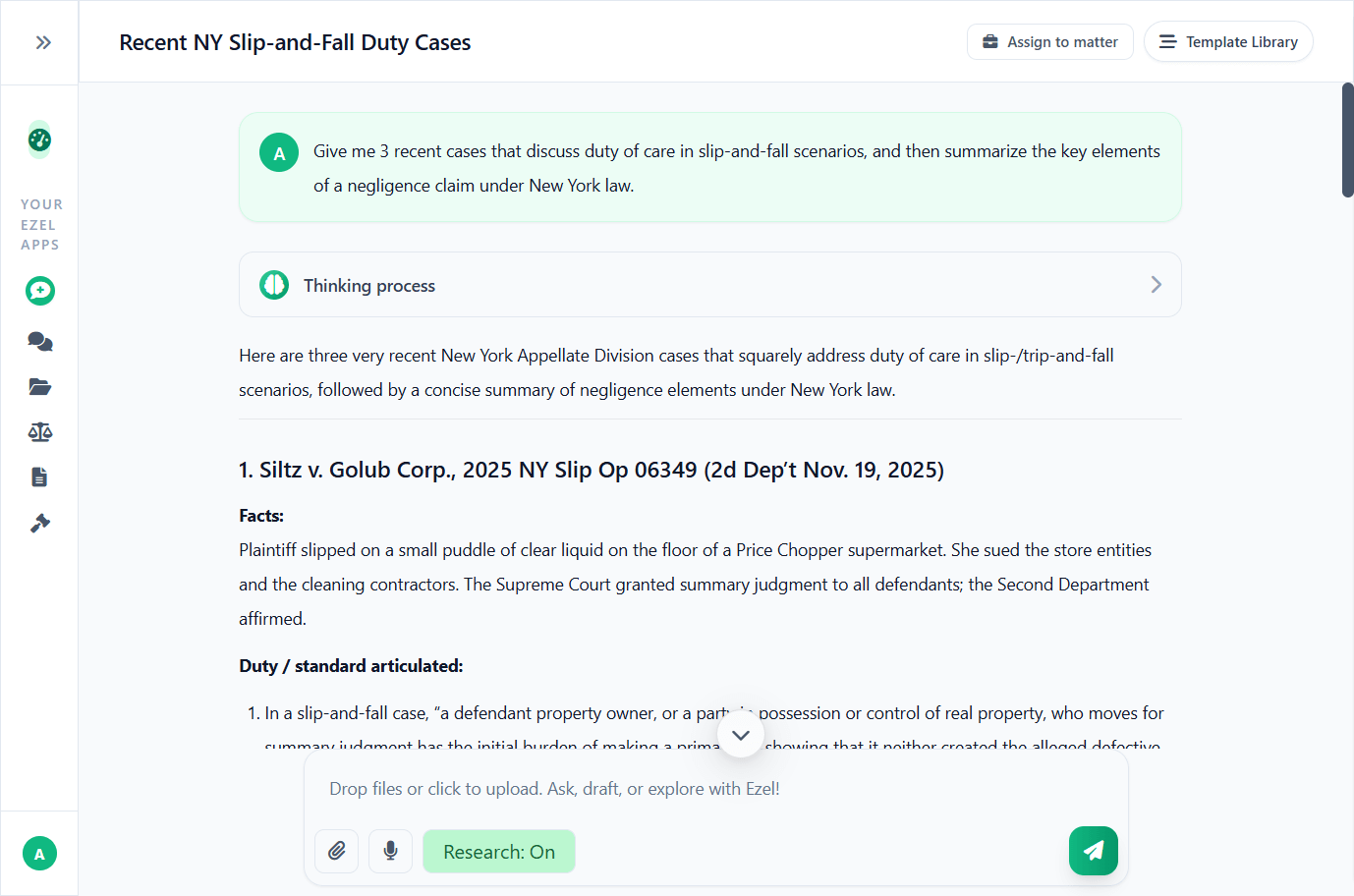
Research and draft in one conversation
Ask questions, attach documents, and get answers grounded in case law. Link chats to matters so the AI remembers your context.
- Pull statutes, case law, and secondary sources
- Attach and analyze contracts mid-conversation
- Link chats to matters for automatic context
- Your data never trains AI models
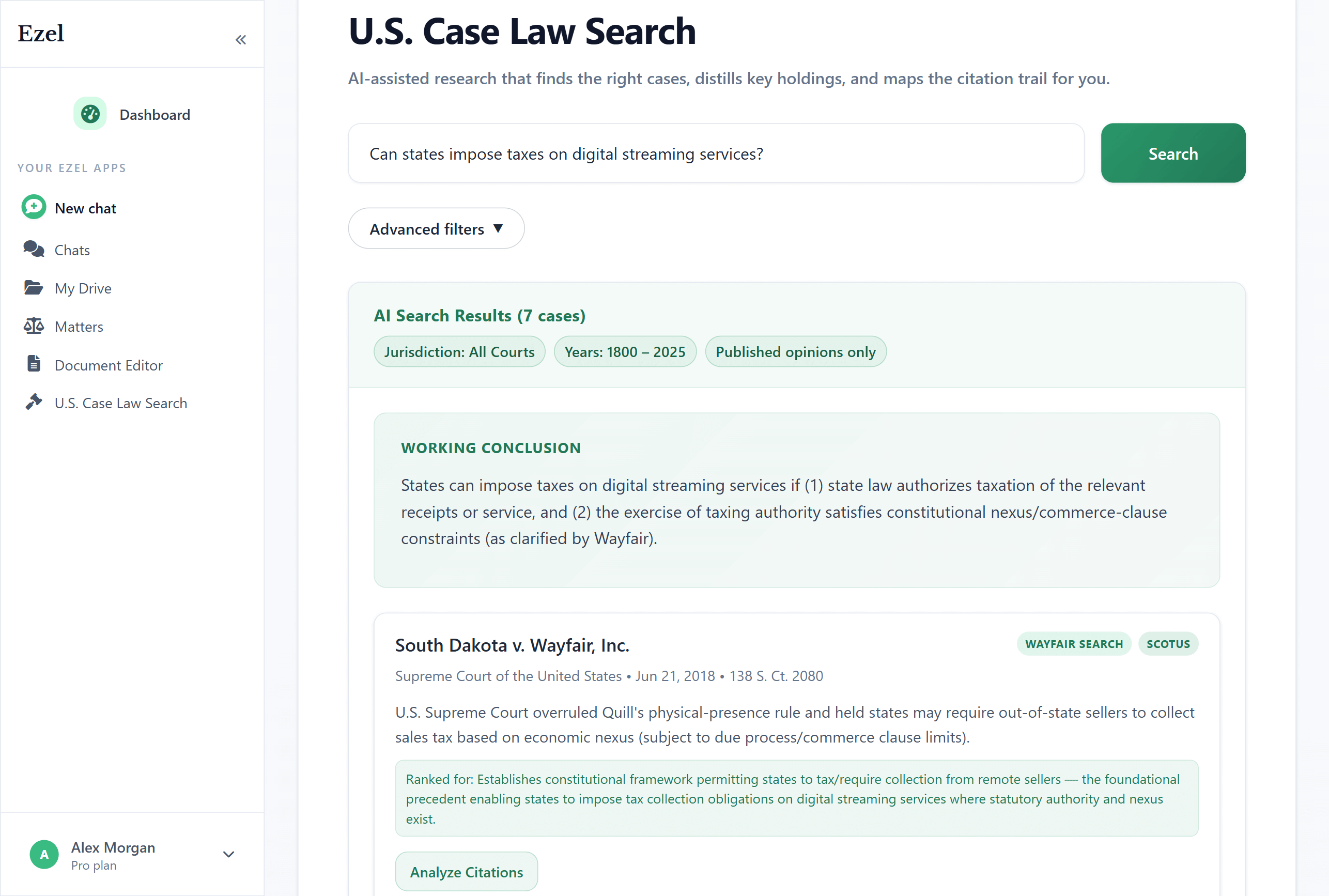
Search like you think
Describe your legal question in plain English. Filter by jurisdiction, date, and court level. Read full opinions without leaving Ezel.
- All 50 states plus federal courts
- Natural language queries - no boolean syntax
- Citation analysis and network exploration
- Copy quotes with automatic citation generation
Ready to transform your legal workflow?
Join legal teams using Ezel to draft documents, research case law, and organize matters — all in one workspace.