FORM INTERROGATORIES — INSURANCE COVERAGE
IN THE [________________________________] COURT
[____] JUDICIAL DISTRICT / CIRCUIT / DIVISION
COUNTY OF [________________________________], STATE OF [____]
[________________________________],
Plaintiff,
v. Case No. [________________________________]
[________________________________],
Defendant.
PROPOUNDING PARTY INFORMATION
| Field | Details |
|---|---|
| Propounding Party | [________________________________] |
| Responding Party | [________________________________] |
| Set Number | ☐ First ☐ Second ☐ Third ☐ ____ |
| Date Served | [__/__/____] |
| Response Due Date | [__/__/____] |
INSTRUCTIONS TO RESPONDING PARTY
-
Governing Rule. These Interrogatories are propounded pursuant to Federal Rule of Civil Procedure 33. Each Interrogatory must be answered separately and fully in writing under oath within thirty (30) days of service, unless a different time is set by stipulation or court order. Fed. R. Civ. P. 33(b)(2).
-
Duty to Investigate. Each answer must set forth all information known to the responding party, its attorneys, agents, employees, investigators, adjusters, and all other persons acting on its behalf. Where information is not within your personal knowledge, identify the source of the information. Fed. R. Civ. P. 33(b)(1).
-
Objections. If you object to any Interrogatory, state the grounds for each objection with specificity. If an objection pertains to only part of an Interrogatory, you must answer the remaining part. A general objection without specific grounds is insufficient. Fed. R. Civ. P. 33(b)(4).
-
Business Records Option. If the answer to an Interrogatory may be derived from your business records (including electronically stored information) and the burden of ascertaining the answer is substantially the same for either party, you may specify the records from which the answer may be derived and afford the propounding party a reasonable opportunity to examine them. Fed. R. Civ. P. 33(d).
-
Continuing Duty to Supplement. You have a continuing obligation to supplement your responses if you learn that a prior response is in some material respect incomplete or incorrect and the additional or corrective information has not otherwise been made known to the propounding party during discovery or in writing. Fed. R. Civ. P. 26(e).
-
Number of Interrogatories. Federal Rule 33(a)(1) limits interrogatories to 25, including discrete subparts, absent stipulation or court order. Because insurance coverage disputes frequently require detailed inquiry into claim-handling procedures, reserves, and coverage determinations, the propounding party may seek leave to serve additional interrogatories under Rule 26(b)(1). Select the interrogatories applicable to your case and, if necessary, file a motion to exceed the presumptive limit.
-
Privilege Log. If you withhold any information on the basis of privilege or work product protection, you must provide a privilege log identifying the nature of the document, the author, the recipient(s), the date, and the privilege asserted. Fed. R. Civ. P. 26(b)(5)(A).
DEFINITIONS
As used in these Interrogatories, the following terms shall have the meanings set forth below:
-
"YOU," "YOUR," or "RESPONDING PARTY" means [________________________________] (the insurance company), including its present and former officers, directors, employees, agents, adjusters, investigators, attorneys, consultants, representatives, predecessors, successors, assigns, parents, subsidiaries, affiliates, and any persons acting or purporting to act on its behalf.
-
"INSURED" means [________________________________], the named insured(s) under the policy at issue, and any additional insureds, omnibus insureds, or persons claimed to qualify as insureds.
-
"POLICY" or "POLICY AT ISSUE" means the insurance policy bearing number [________________________________], and all declarations pages, endorsements, riders, amendments, renewals, and binders associated therewith.
-
"CLAIM" means the claim or occurrence forming the basis of this action, including all related claims, suits, demands, or notices arising from the same or related events.
-
"CLAIM FILE" means all documents, records, notes, memoranda, correspondence, and electronically stored information maintained by you in connection with the Claim, including but not limited to adjuster notes, supervisor notes, diary entries, activity logs, reserve reports, evaluation forms, settlement authority requests, and coverage opinions.
-
"DOCUMENT" has the broadest meaning permitted under Fed. R. Civ. P. 34(a) and includes writings, drawings, graphs, charts, photographs, sound recordings, images, electronically stored information, and other data compilations stored in any medium from which information can be obtained either directly or after translation into a reasonably usable form.
-
"COMMUNICATION" means any oral, written, or electronic exchange of information, including but not limited to letters, emails, text messages, instant messages, voicemails, telephone calls, video conferences, and in-person conversations.
-
"IDENTIFY" when referring to a natural person means to state the person's full name, last known address, telephone number, employer, and job title. When referring to an entity, state the entity's full legal name, address, and the name of a contact person.
-
"IDENTIFY" when referring to a document means to state the document's title or description, author, recipient(s), date, Bates number (if produced), and current location or custodian.
-
"COVERAGE DETERMINATION" means any decision, recommendation, opinion, or analysis regarding whether the Policy provides coverage, a defense, or indemnity for the Claim, and includes any reservation of rights, declination, denial, or rescission.
-
"BAD FAITH" means any conduct by an insurer that constitutes an unreasonable or unfair denial, delay, or underpayment of a claim, or a failure to properly investigate, evaluate, or process a claim in accordance with the implied covenant of good faith and fair dealing, applicable statutes, or the insurer's own policies and procedures.
-
"RESERVE" means any amount set aside or established by you to cover anticipated payments on the Claim, including indemnity reserves, expense reserves, defense cost reserves, and any adjustments thereto.
-
"REINSURANCE" means any agreement under which another insurer agrees to indemnify you for all or part of a loss under the Policy, including treaty reinsurance, facultative reinsurance, and excess-of-loss reinsurance.
-
"PERSON" means any natural person, corporation, partnership, limited liability company, association, joint venture, trust, governmental entity, or any other legal entity.
-
"RELATE TO" or "RELATING TO" means referring to, concerning, pertaining to, reflecting, evidencing, describing, constituting, or being connected with the matter described, directly or indirectly.
-
"UNDERWRITING FILE" means all documents and information gathered, created, or maintained in connection with the evaluation, acceptance, rating, or issuance of the Policy, including the application, risk assessment, loss history, inspection reports, and correspondence with agents or brokers.
INTERROGATORIES
PART A: POLICY IDENTIFICATION AND TERMS
INTERROGATORY NO. 1: Identify each and every insurance policy issued by you to the Insured that was in effect at any time during the period from [__/__/____] to [__/__/____] that may provide coverage for the Claim, including the policy number, policy period, type of coverage, limits of liability (per occurrence and aggregate), deductible or self-insured retention amounts, and the name of the insured(s).
INTERROGATORY NO. 2: For each policy identified in response to Interrogatory No. 1, identify all endorsements, riders, amendments, or modifications to the policy, including the date of each endorsement, a description of the change it made to the base policy, and whether it was added at inception, renewal, or mid-term.
INTERROGATORY NO. 3: Identify the declarations page(s) in effect at the time of the Claim, including the named insured(s), policy period, premium amount, coverage parts purchased, applicable limits and sublimits, and any scheduled locations, vehicles, or other scheduled items.
INTERROGATORY NO. 4: Identify every exclusion, limitation, or condition in the Policy that you contend applies to or may affect coverage for the Claim, and for each, state the specific policy language you rely upon and explain how you contend it applies to the facts of the Claim.
INTERROGATORY NO. 5: State whether the Policy contains any of the following provisions, and if so, identify the specific section: (a) duty to defend; (b) duty to indemnify; (c) reservation of rights provisions; (d) cooperation clause; (e) voluntary payments clause; (f) no-action clause; (g) other insurance clause; (h) subrogation clause; (i) consent-to-settle clause; (j) choice of law provision; (k) arbitration or appraisal clause; (l) suit limitations provision.
INTERROGATORY NO. 6: Identify all persons or entities who qualify as "insureds" under the Policy, including named insureds, additional insureds, and any person or entity who qualifies as an insured under an omnibus clause or by endorsement, and for each, state the basis for their insured status.
PART B: COVERAGE HISTORY AND PREMIUM PAYMENTS
INTERROGATORY NO. 7: State the complete history of the Policy, including the original effective date, each renewal date, any lapse or cancellation, any reinstatement, and the premium charged for each policy period.
INTERROGATORY NO. 8: Identify every prior version of the Policy issued to the Insured, including predecessor policies, and for each, state the policy number, policy period, limits, and any material differences in coverage terms from the Policy at issue.
INTERROGATORY NO. 9: State whether any premium payments were late, missed, or returned, and if so, describe the circumstances, including dates, amounts, and any notice of cancellation or non-renewal issued as a result.
INTERROGATORY NO. 10: Identify any agent, broker, managing general agent, or surplus lines broker involved in the placement, marketing, or servicing of the Policy, and describe each such person's or entity's role in connection with the Policy.
PART C: CLAIMS HANDLING AND INVESTIGATION
INTERROGATORY NO. 11: State the date on which you first received notice of the Claim, identify the person who provided the notice, describe the method of notice (written, oral, electronic), and identify the person at your company who received the notice.
INTERROGATORY NO. 12: Identify every person who participated in the investigation of the Claim, including adjusters, supervisors, managers, independent adjusters, investigators, experts, and consultants, and for each person, state their name, title, employer, and the nature and dates of their involvement.
INTERROGATORY NO. 13: Describe in detail every step taken by you to investigate the Claim, including each interview conducted, inspection performed, document reviewed, expert retained, and analysis completed, and state the date of each investigative step.
INTERROGATORY NO. 14: Identify every Communication between you and the Insured regarding the Claim, including the date, method, participants, and a summary of the substance of each Communication.
INTERROGATORY NO. 15: Identify every Communication between you and any attorney (whether coverage counsel, defense counsel, monitoring counsel, or any other attorney) regarding the Claim, including the date, participants, and general subject matter. For any Communication withheld on the basis of attorney-client privilege, provide a privilege log entry in accordance with Fed. R. Civ. P. 26(b)(5)(A).
INTERROGATORY NO. 16: Identify every expert, consultant, independent adjuster, engineer, accountant, or other specialist retained or consulted by you in connection with the Claim, and for each, state the person's name, qualifications, the subject matter of the retention, the date retained, and a description of any report or opinion provided.
INTERROGATORY NO. 17: Describe the process by which you assigned the Claim to an adjuster, including any criteria used for assignment (such as complexity, reserve amount, or line of business), and identify any reassignment of the Claim and the reason for each reassignment.
INTERROGATORY NO. 18: State whether the Claim was referred to a Special Investigations Unit (SIU) or any fraud investigation unit, and if so, state the date of referral, the reason for referral, the results of any investigation, and identify all persons involved.
PART D: COVERAGE DETERMINATION AND DENIAL
INTERROGATORY NO. 19: Describe in detail the basis for your Coverage Determination, including every policy provision, factual finding, and legal analysis you relied upon in reaching your decision.
INTERROGATORY NO. 20: If you issued a reservation of rights letter, state the date it was sent, identify the addressee(s), describe the rights reserved, and identify the specific policy provisions cited in the letter.
INTERROGATORY NO. 21: If you denied coverage in whole or in part, state the date of each denial, identify the person who made the denial decision, describe the factual and legal basis for the denial, and identify each policy provision relied upon.
INTERROGATORY NO. 22: State whether your Coverage Determination changed at any time after the initial determination, and if so, describe each change, the date of the change, the reason for the change, and the person who authorized the change.
INTERROGATORY NO. 23: Identify every person who participated in or approved the Coverage Determination, including the adjuster, supervisor, manager, coverage counsel, and any committee or authority level involved in the decision.
INTERROGATORY NO. 24: State whether you sought or obtained a coverage opinion from outside counsel, in-house counsel, or any other attorney regarding the Claim, and if so, identify the attorney, the date of the opinion, and the general subject matter. If you assert privilege, provide a privilege log entry.
INTERROGATORY NO. 25: State whether you contend that the Insured failed to comply with any condition precedent to coverage, including but not limited to timely notice, cooperation, submission of a proof of loss, or examination under oath, and if so, describe the alleged failure in detail.
PART E: RESERVES AND FINANCIAL INFORMATION
INTERROGATORY NO. 26: Identify the initial Reserve established for the Claim, including the date set, the amount (broken down by indemnity, expense, and defense costs), and the identity of the person who set the Reserve.
INTERROGATORY NO. 27: Describe each change to the Reserve for the Claim, including the date of the change, the prior amount, the new amount, the reason for the change, and the identity of the person who approved the change.
INTERROGATORY NO. 28: State whether any Reserve established for the Claim exceeded your authority level, and if so, describe the authority level structure applicable to the Claim and identify the person or committee that approved the Reserve.
INTERROGATORY NO. 29: Identify any payments made on the Claim, including the date, amount, payee, and purpose of each payment (e.g., indemnity, defense costs, independent adjuster fees, expert fees).
INTERROGATORY NO. 30: State whether any Reserve or payment information for the Claim was reported to a reinsurer, excess insurer, or any other entity, and if so, identify the entity, the date of reporting, and the information reported.
PART F: REINSURANCE
INTERROGATORY NO. 31: Identify every reinsurance agreement or treaty applicable to the Policy, including the name of the reinsurer, the type of reinsurance (treaty, facultative, excess-of-loss), the attachment point, the limits of reinsurance coverage, and the policy period.
INTERROGATORY NO. 32: Describe every Communication between you and any reinsurer regarding the Claim, including the date, participants, and general substance.
INTERROGATORY NO. 33: State whether any reinsurer participated in, supervised, or directed any aspect of the investigation, evaluation, or handling of the Claim, and if so, describe the nature and extent of the reinsurer's involvement.
PART G: SIMILAR CLAIMS AND PATTERNS
INTERROGATORY NO. 34: Identify every other claim made under the Policy during the policy period at issue, including the claimant's name, the nature of the claim, the date of the claim, the outcome, and any payments made.
INTERROGATORY NO. 35: State whether you have received, investigated, or resolved any other claims involving the same or similar facts, the same type of loss, or the same policy provision(s) at issue in this case during the five (5) years preceding the Claim, and if so, provide the details of each such claim, including the claim number, claimant, outcome, and the coverage position taken.
INTERROGATORY NO. 36: State whether any regulatory authority, including any state department of insurance, has investigated, examined, or taken any action against you related to your handling of claims of the type at issue in this case within the past ten (10) years, and if so, describe the investigation or action, identify the regulatory authority, and describe the outcome.
PART H: BAD FAITH CONDUCT
INTERROGATORY NO. 37: State whether you have any written claims handling guidelines, manuals, best practices documents, or standard operating procedures that apply to claims of the type at issue, and identify each such document, including the title, date, and current custodian.
INTERROGATORY NO. 38: Describe your standard claims handling process for the type of claim at issue, including the steps from initial receipt of notice through coverage determination and resolution.
INTERROGATORY NO. 39: State whether you complied with all provisions of the applicable Unfair Claims Settlement Practices Act (or equivalent state statute) in handling the Claim, and if you contend you did, describe the specific steps you took to ensure compliance.
INTERROGATORY NO. 40: State whether you have been the subject of any market conduct examination or other regulatory action by any state insurance department relating to claims handling practices within the past ten (10) years, and if so, describe the examination or action and its outcome.
INTERROGATORY NO. 41: Identify any complaints filed against you with any state department of insurance or regulatory body by the Insured or any other person relating to the Claim, and describe the disposition of each complaint.
INTERROGATORY NO. 42: State whether any employee, adjuster, or representative involved in handling the Claim was subject to any performance metrics, incentive programs, bonuses, or evaluations tied to claims closure rates, reserve accuracy, loss ratios, or denial rates, and if so, describe the metrics or programs.
INTERROGATORY NO. 43: State whether you conducted any peer review, file review, or quality assurance review of the handling of the Claim, and if so, describe the review, identify the reviewer(s), and state the findings.
PART I: UNDERWRITING FILE AND APPLICATION
INTERROGATORY NO. 44: Describe the underwriting process for the Policy, including any risk assessment, inspection, loss history review, or information gathering conducted before issuing or renewing the Policy.
INTERROGATORY NO. 45: State whether the Insured's application for the Policy contained any alleged misrepresentation or omission, and if so, identify the specific misrepresentation or omission, the date it was discovered, and describe why you contend it is material to coverage.
INTERROGATORY NO. 46: State whether you conducted any investigation into the accuracy of the Insured's application prior to issuing the Policy, and if so, describe the investigation and its results.
PART J: AGENT AND BROKER COMMUNICATIONS
INTERROGATORY NO. 47: Identify all Communications between you and any agent or broker regarding the Policy or the Claim, including the date, participants, and general subject matter of each Communication.
INTERROGATORY NO. 48: State whether any agent or broker provided you with any information relevant to the Claim, coverage, or the Insured's risk, and if so, describe the information provided.
PART K: DEFENSE AND INDEMNITY
INTERROGATORY NO. 49: If you provided a defense to the Insured, identify all defense counsel retained, the date of retention, the scope of the representation, and any limitations or guidelines imposed on defense counsel.
INTERROGATORY NO. 50: State whether you issued any litigation management guidelines, billing guidelines, or reporting requirements to defense counsel, and if so, identify each such document.
INTERROGATORY NO. 51: State whether there was any conflict of interest between you and the Insured regarding the defense or coverage of the Claim, and if so, describe the nature of the conflict and the steps taken to address it.
INTERROGATORY NO. 52: State the total amount of defense costs incurred to date on the Claim, broken down by category (e.g., attorney fees, expert fees, court costs), and identify each defense counsel firm and the amounts paid to each.
PART L: DOCUMENT DESTRUCTION AND RETENTION
INTERROGATORY NO. 53: Describe your document retention and destruction policies applicable to claims files, underwriting files, and policy records, including the retention period for each category of document and the method of destruction.
INTERROGATORY NO. 54: State whether any documents relating to the Claim, the Policy, or the Insured have been destroyed, lost, discarded, overwritten, or are otherwise no longer available, and if so, identify each document, the date it was destroyed or became unavailable, the reason, and the identity of the person who authorized the destruction.
INTERROGATORY NO. 55: State whether a litigation hold or preservation notice was issued in connection with the Claim, and if so, identify the date it was issued, the person who issued it, the persons to whom it was directed, and the categories of documents and electronically stored information subject to the hold.
PART M: SETTLEMENT AND VALUATION
INTERROGATORY NO. 56: Describe the methodology used to evaluate and value the Claim, including any formulas, software tools (e.g., Colossus, Xactimate), or evaluation frameworks applied, and identify the person(s) who performed the evaluation.
INTERROGATORY NO. 57: State whether any settlement demand or offer was made by any party in connection with the Claim, and for each, state the date, the amount, the person who made or authorized the offer or demand, and the response.
INTERROGATORY NO. 58: State whether you sought or obtained settlement authority for the Claim, and if so, identify the date authority was sought, the amount requested, the person who granted or denied authority, and the amount ultimately authorized.
INTERROGATORY NO. 59: State whether you made any payment to the Insured or any third party in connection with the Claim that you contend was gratuitous, extra-contractual, or not required under the Policy, and if so, describe each payment.
PART N: GENERAL
INTERROGATORY NO. 60: Identify every person known to you who has knowledge of facts relevant to the Claim, the coverage issues, or the claims handling, and for each person, describe the subject matter of their knowledge.
INTERROGATORY NO. 61: Identify every Document you reviewed, considered, or relied upon in making your Coverage Determination, and state how each Document was relevant to the determination.
INTERROGATORY NO. 62: State whether you contend that any other insurer has a duty to defend or indemnify the Insured for the Claim, and if so, identify the insurer, the policy, and the basis for your contention.
INTERROGATORY NO. 63: Describe any allocation methodology you have applied or propose to apply regarding defense costs, indemnity payments, or covered versus non-covered claims, and state the factual and legal basis for the methodology.
INTERROGATORY NO. 64: State whether any mediation, arbitration, or alternative dispute resolution proceeding has been conducted or is pending regarding the Claim or coverage issues, and if so, describe the proceeding, the participants, and the outcome.
INTERROGATORY NO. 65: Identify all databases, information systems, or industry resources (such as ISO ClaimSearch, NICB, or similar databases) you consulted or queried in connection with the Claim, and describe the information obtained from each.
STATE-SPECIFIC VARIATION NOTES
California (Cal. Civ. Proc. Code §§ 2030.010-2030.410)
- Interrogatory Limit. California limits specially prepared interrogatories to 35 in an unlimited civil case. Cal. Civ. Proc. Code § 2030.030(a)(1). To exceed 35, the propounding party must include a declaration of necessity stating that each additional interrogatory is warranted. Cal. Civ. Proc. Code § 2030.040.
- Form Interrogatories. California has approved form interrogatories (Judicial Council Form DISC-001) that do not count toward the 35-interrogatory limit. Cal. Civ. Proc. Code § 2030.030(a)(2).
- Insurance Discovery. Under Cal. Civ. Proc. Code § 2017.210, the existence and contents of any insurance agreement that may satisfy a judgment are discoverable, including limits, endorsements, and defense-cost-eroding provisions.
- Bad Faith Discovery. In insurance bad faith cases, California courts apply the rule from Brandt v. Superior Court, 37 Cal.3d 813 (1985), permitting recovery of attorney fees incurred to compel payment of policy benefits unreasonably withheld ("Brandt fees"). Discovery may therefore extend to all facts supporting bad faith claims.
- Response Deadline. 30 days from service (35 days if served by mail within California). Cal. Civ. Proc. Code § 2030.260.
Texas (Tex. R. Civ. P. 197)
- Interrogatory Limit. Texas limits interrogatories to 25, including discrete subparts, under Level 2 discovery. Tex. R. Civ. P. 190.3(b)(3). Level 1 discovery (cases under $250,000) limits interrogatories to 15. Tex. R. Civ. P. 190.2(b)(3).
- Response Deadline. 30 days from service. Tex. R. Civ. P. 197.2(a).
- Insurance Discovery. Texas mandates initial disclosures of insurance agreements under Tex. R. Civ. P. 194.2(h). An insurer must produce the complete policy upon request.
- Bad Faith. Texas recognizes common-law bad faith causes of action under Universe Life Insurance Co. v. Giles, 950 S.W.2d 48 (Tex. 1997), and statutory claims under the Texas Insurance Code Chapter 541 and Chapter 542 (Prompt Payment of Claims Act).
Florida (Fla. R. Civ. P. 1.340)
- Interrogatory Limit. Florida limits interrogatories to 30, including subparts. Fla. R. Civ. P. 1.340(a).
- Response Deadline. 30 days from service (45 days if served with process). Fla. R. Civ. P. 1.340(a).
- Initial Disclosures. Florida now requires initial disclosures including insurance policy information under Fla. R. Civ. P. 1.280(a)(1).
- Claims File Discovery. Florida does not recognize a general "claims file privilege." Courts have held that the claims file is a business record subject to discovery, except for materials created in anticipation of litigation. Allstate Indemnity Co. v. Ruiz, 899 So. 2d 1121 (Fla. 2005).
- Bad Faith. Under Fla. Stat. § 624.155, a policyholder must file a Civil Remedy Notice with the Department of Financial Services before bringing a statutory bad faith claim.
New York (N.Y. C.P.L.R. § 3130)
- Interrogatory Practice. New York limits interrogatories in a manner distinct from federal practice. N.Y. C.P.L.R. § 3130 limits interrogatories to 25 in most cases. Court leave is required to exceed the limit.
- Response Deadline. 20 days from service. N.Y. C.P.L.R. § 3133(a).
- Insurance Disclosure. Under the Comprehensive Insurance Disclosure Act (effective 2022), defendants in New York state court must disclose extensive insurance coverage information within 60 days of filing an answer. N.Y. C.P.L.R. § 3101(f) and § 3122-b.
- Bad Faith. New York recognizes bad faith claims in limited circumstances. In first-party coverage disputes, the standard is whether the insurer's denial was without a reasonable basis. Pavia & Harcourt v. Nationwide Mutual Fire Ins. Co., 87 N.Y.2d 99 (1995).
PRACTICE TIPS FOR INSURANCE COVERAGE INTERROGATORIES
☐ Exceed the Limit Strategically. In complex coverage disputes, 25 interrogatories are rarely sufficient. File a motion or obtain a stipulation to propound additional interrogatories, emphasizing the number of policies, coverage issues, and claims handling steps at issue.
☐ Contention Interrogatories. FRCP 33(a)(2) permits opinion and contention interrogatories. Use them to lock the insurer into its coverage position early (e.g., "State every factual and legal basis for your contention that Exclusion J applies to the Claim").
☐ Claims File Privilege Issues. Insurers frequently resist discovery of the claims file by asserting attorney-client privilege and work product protection. In bad faith cases, many jurisdictions hold that the claims file is presumptively discoverable because claims investigation is a business function, not a legal function. Be prepared to argue this distinction.
☐ Claims Handling Manuals. Request interrogatory responses about the existence of claims handling manuals and guidelines. Courts are split on discoverability, but in bad faith cases, these documents are often held discoverable because they show the insurer's own standards for evaluating and handling claims.
☐ Reserve Information. Reserve amounts and changes are generally discoverable in bad faith and coverage cases because they reflect the insurer's internal valuation of the claim. Anticipate objections based on work product and be prepared with case law supporting discoverability.
☐ Reinsurance Discovery. Reinsurance communications and agreements are discoverable when relevant to coverage or claims handling. Courts have recognized that reinsurer involvement in claims decisions is probative of bad faith.
☐ State Farm v. Campbell. The Supreme Court in State Farm Mutual Automobile Insurance Co. v. Campbell, 538 U.S. 408 (2003), addressed the use of similar-claims evidence in bad faith cases. Interrogatories about similar claims and company-wide practices may be relevant to punitive damages but must be tailored to avoid overbreadth objections.
☐ NAIC Model Act Compliance. Interrogatories about compliance with the NAIC Model Unfair Claims Settlement Practices Act (or state equivalents) are powerful tools. Most states have adopted some version of the Act, and violations can support bad faith claims. See NAIC Model Law 900.
☐ ESI and Claims Management Systems. Insurance companies maintain claims data in electronic claims management systems (e.g., Guidewire ClaimCenter, Xactware/Xactimate). Interrogatories should ask the insurer to identify the systems used, the types of data maintained, and the retention periods. Activity logs and diary entries in these systems often contain critical information not reflected in paper files.
☐ Document Destruction Issues. Ask whether any documents were destroyed after the claim was reported. In State Farm v. Campbell, the Supreme Court noted that State Farm destroyed claims handling manuals that were relevant to the bad faith case. Discovery of document destruction can support spoliation arguments and adverse inferences.
☐ Sequence Your Discovery. Serve interrogatories early to identify key facts, persons, and documents. Use the interrogatory responses to target subsequent document requests (FRCP 34) and deposition topics (FRCP 30(b)(6)). Interrogatory responses that identify specific adjusters, supervisors, and experts become the foundation for your deposition plan.
☐ First-Party vs. Third-Party Distinction. Discovery scope may differ in first-party claims (the insured suing its own insurer) versus third-party claims (coverage for liability to a third party). In first-party bad faith cases, the claims file is generally more broadly discoverable because the insurer owes a quasi-fiduciary duty to its insured.
DECLARATION OF NECESSITY FOR ADDITIONAL INTERROGATORIES
[Use this declaration if propounding more than 25 interrogatories in federal court or more than the applicable state limit.]
I, [________________________________], an attorney at law, hereby declare:
-
I am counsel of record for [________________________________] in the above-captioned action.
-
This action involves a dispute over insurance coverage under Policy No. [________________________________], including issues of policy interpretation, claims handling, bad faith, reserves, reinsurance, and regulatory compliance.
-
I have made a reasonable and good faith effort to determine whether the information sought by each interrogatory in excess of the presumptive limit can be obtained from some other source that is more convenient, less burdensome, or less expensive.
-
Each additional interrogatory is warranted because: [________________________________].
-
The complexity of the coverage issues, the number of policy provisions at issue, the length of the claims handling history, and the bad faith allegations in this case necessitate detailed inquiry that cannot be accomplished within the presumptive limit.
I declare under penalty of perjury under the laws of the United States of America that the foregoing is true and correct.
Signature: [________________________________]
Printed Name: [________________________________]
Date: [__/__/____]
VERIFICATION
I, [________________________________], declare under penalty of perjury under the laws of the State of [____] and the United States of America that the foregoing answers to interrogatories are true and correct to the best of my knowledge, information, and belief.
Signature: [________________________________]
Printed Name: [________________________________]
Title: [________________________________]
Date: [__/__/____]
CERTIFICATE OF SERVICE
I hereby certify that on [__/__/____], a true and correct copy of the foregoing Form Interrogatories — Insurance Coverage was served upon the following counsel of record by the method indicated:
☐ Electronic filing / CM-ECF
☐ First-class U.S. Mail
☐ Certified Mail, Return Receipt Requested
☐ Hand Delivery
☐ Overnight Courier
☐ Email (by agreement of the parties)
Served Upon:
[________________________________]
[________________________________]
[________________________________]
[________________________________]
Signature: [________________________________]
Printed Name: [________________________________]
Attorney for: [________________________________]
Bar Number: [________________________________]
Date: [__/__/____]
SOURCES AND REFERENCES
- Federal Rules of Civil Procedure, Rules 26, 33 — https://www.law.cornell.edu/rules/frcp
- NAIC Model Unfair Claims Settlement Practices Act (Model Law 900) — https://content.naic.org/sites/default/files/model-law-900.pdf
- State Farm Mutual Automobile Insurance Co. v. Campbell, 538 U.S. 408 (2003) — https://supreme.justia.com/cases/federal/us/538/408/
- Brandt v. Superior Court, 37 Cal.3d 813 (1985) — https://law.justia.com/cases/california/supreme-court/3d/37/813.html
- California Code of Civil Procedure §§ 2030.010-2030.410 — https://codes.findlaw.com/ca/code-of-civil-procedure/
- Texas Rules of Civil Procedure, Rule 197 — https://www.txcourts.gov/rules-forms/rules-standards/
- Florida Rules of Civil Procedure, Rule 1.340 — https://www.floridabar.org/rules/
- New York C.P.L.R. §§ 3130, 3101(f), 3122-b — https://www.nysenate.gov/legislation/laws/CVP
Prepared using the ezel.ai legal template platform. This template is provided for informational purposes only and does not constitute legal advice. Insurance coverage discovery is a specialized area of practice, and requirements vary significantly by jurisdiction. An attorney licensed in the relevant jurisdiction must review and customize this template before use. Last updated: 2026-02-26.
Do more with Ezel
This free template is just the beginning. See how Ezel helps legal teams draft, research, and collaborate faster.
AI that drafts while you watch
Tell the AI what you need and watch your document transform in real-time. No more copy-pasting between tools or manually formatting changes.
- Natural language commands: "Add a force majeure clause"
- Context-aware suggestions based on document type
- Real-time streaming shows edits as they happen
- Milestone tracking and version comparison
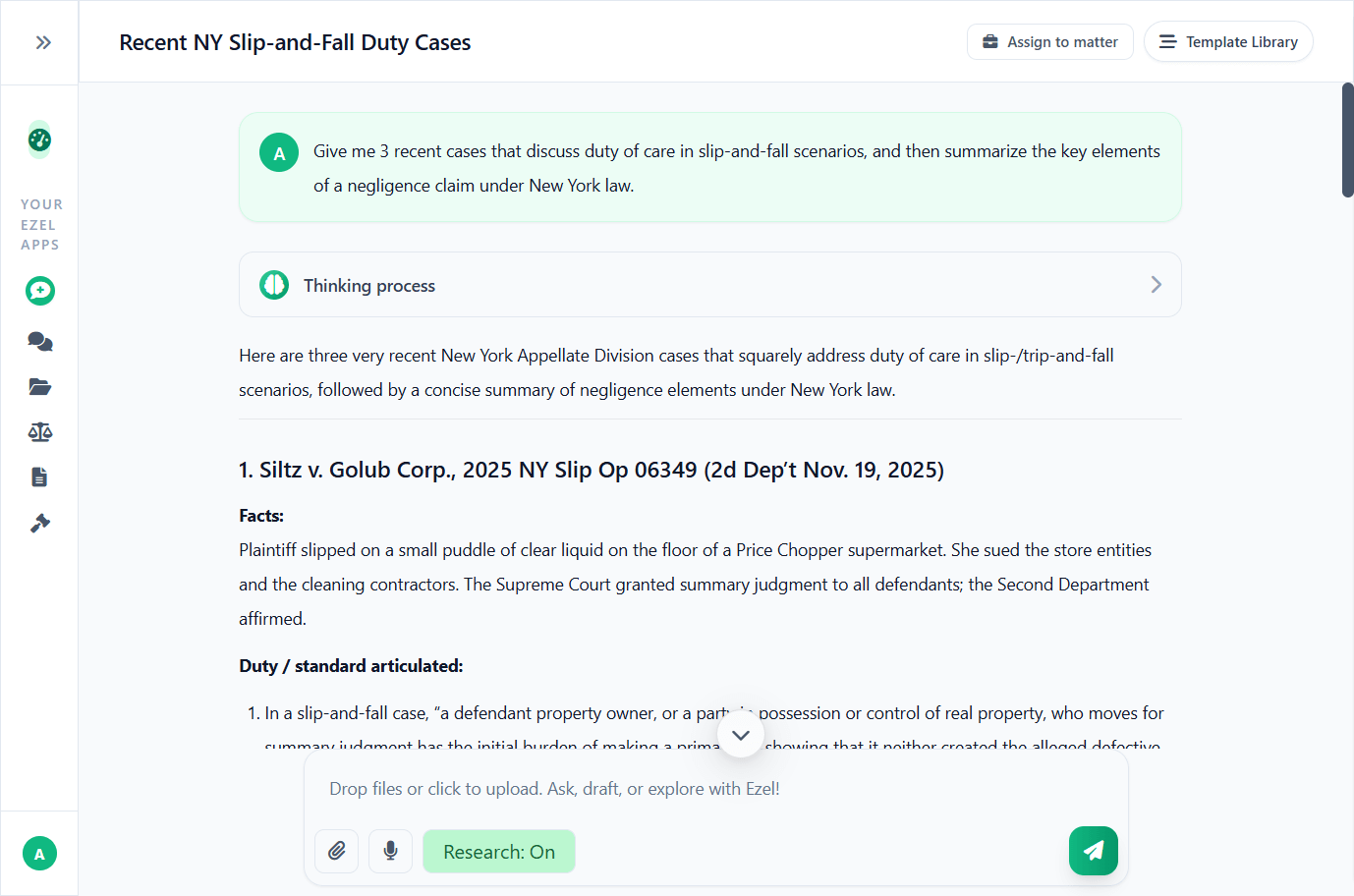
Research and draft in one conversation
Ask questions, attach documents, and get answers grounded in case law. Link chats to matters so the AI remembers your context.
- Pull statutes, case law, and secondary sources
- Attach and analyze contracts mid-conversation
- Link chats to matters for automatic context
- Your data never trains AI models
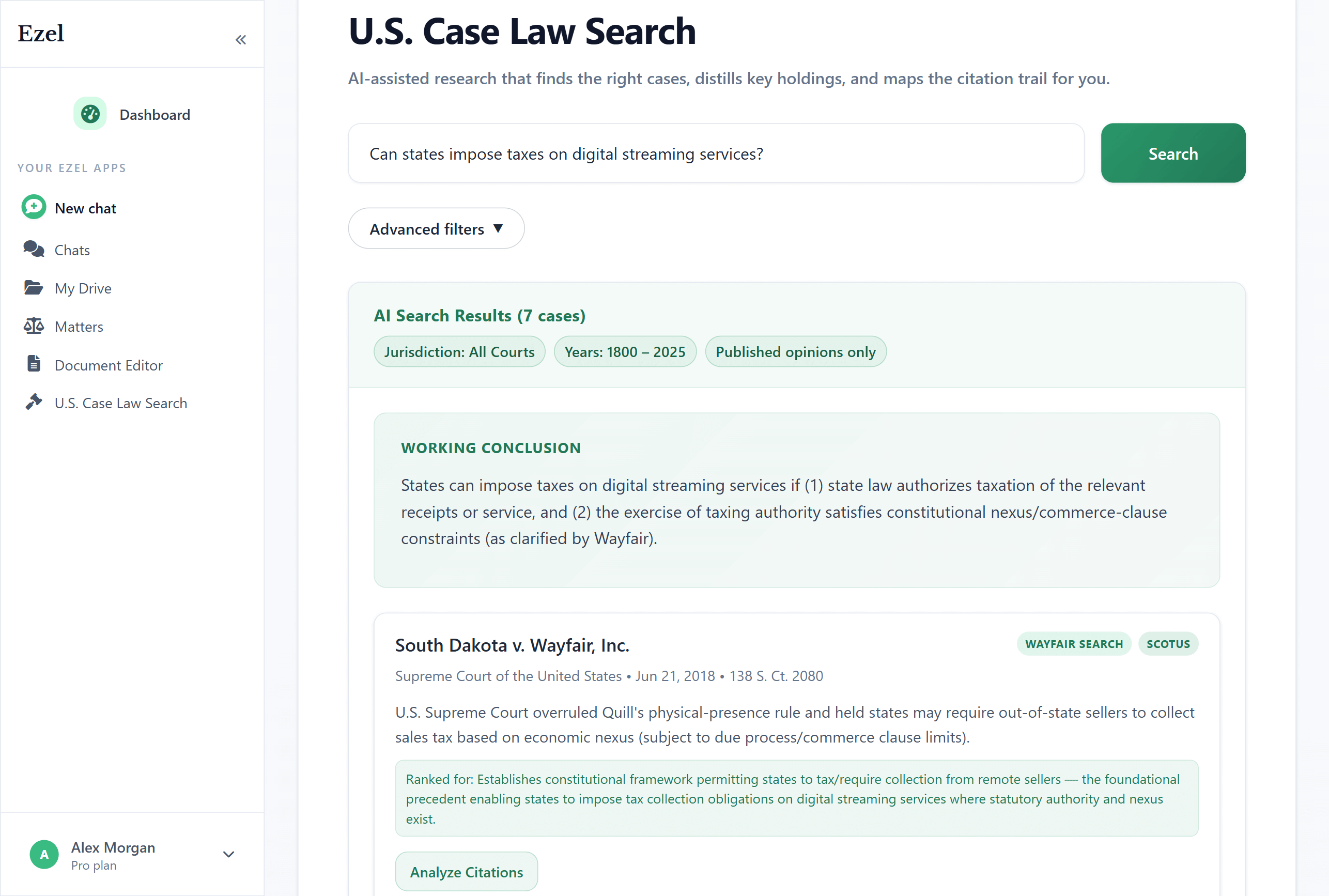
Search like you think
Describe your legal question in plain English. Filter by jurisdiction, date, and court level. Read full opinions without leaving Ezel.
- All 50 states plus federal courts
- Natural language queries - no boolean syntax
- Citation analysis and network exploration
- Copy quotes with automatic citation generation
Ready to transform your legal workflow?
Join legal teams using Ezel to draft documents, research case law, and organize matters — all in one workspace.