FORM INTERROGATORIES — COLLECTIONS
Case Caption
IN THE [________________________________] COURT
[____] JUDICIAL DISTRICT / CIRCUIT
[________________________________] COUNTY, [____] (STATE)
[________________________________], )
Plaintiff, ) Case No. [________________________________]
)
v. ) PLAINTIFF'S / DEFENDANT'S FORM
) INTERROGATORIES — COLLECTIONS
[________________________________], )
Defendant. )
)
Propounding Party Information
| Field | Details |
|---|---|
| Propounding Party | [________________________________] |
| Party Designation | ☐ Plaintiff ☐ Defendant ☐ Cross-Claimant ☐ Counter-Claimant |
| Responding Party | [________________________________] |
| Set Number | [____] |
| Date Served | [__/__/____] |
| Attorney Name | [________________________________] |
| Bar Number | [________________________________] |
| Firm Name | [________________________________] |
| Address | [________________________________] |
| Telephone | [________________________________] |
| [________________________________] |
Preliminary Instructions
TO THE RESPONDING PARTY: You are required to answer each of the following interrogatories separately and fully, in writing and under oath, within thirty (30) days of service of these interrogatories pursuant to Fed. R. Civ. P. 33(b)(2), or within the time prescribed by applicable state rules of civil procedure.
General Instructions
-
Full and Complete Responses. Each interrogatory must be answered separately and fully in writing under oath. If you cannot answer an interrogatory completely after exercising due diligence, so state, answer to the extent possible, and explain the reasons you cannot provide a complete response.
-
Objections. If you object to any interrogatory, state the specific grounds for the objection with particularity. If objecting to part of an interrogatory, specify the objectionable part and answer the remainder. Pursuant to Fed. R. Civ. P. 33(b)(4), the grounds for objecting must be stated with specificity, and any ground not stated in a timely objection is waived unless the court, for good cause, excuses the failure.
-
Continuing Duty to Supplement. Pursuant to Fed. R. Civ. P. 26(e), you have a continuing duty to supplement or correct your responses in a timely manner if you learn that a response is in some material respect incomplete or incorrect and if the additional or corrective information has not otherwise been made known to the other parties during the discovery process or in writing.
-
Business Records Option. If the answer to any interrogatory may be derived or ascertained from the business records of the responding party, and the burden of deriving the answer is substantially the same for either party, you may answer by specifying the records from which the answer may be derived and affording the propounding party a reasonable opportunity to examine such records pursuant to Fed. R. Civ. P. 33(d).
-
Identification of Persons. When asked to "identify" a person, state the person's full legal name, last known residential and business addresses, telephone numbers, email addresses, and relationship to any party in this action.
-
Identification of Documents. When asked to "identify" a document, state the type of document, its date, author(s), recipient(s), subject matter, present location, and the identity of its current custodian.
-
Claims of Privilege. If you withhold any information based on a claim of privilege or work product protection, provide a privilege log identifying each document or communication withheld, the nature of the privilege asserted, the date of the document, the author and recipients, and a description sufficient to assess the claim of privilege without revealing the protected information, pursuant to Fed. R. Civ. P. 26(b)(5).
Definitions
For purposes of these interrogatories, the following definitions apply:
-
"Account" means any credit card account, charge account, retail installment account, revolving credit account, line of credit, loan account, or other financial obligation that is the subject of the claims in this action.
-
"Agreement" means any written or oral contract, credit agreement, cardholder agreement, terms and conditions, promissory note, or other instrument creating, evidencing, or governing the Account.
-
"Assignment" means any sale, transfer, conveyance, assignment, or other disposition of any right, title, or interest in the Account or the alleged debt, including without limitation assignments for collection, outright sales of debt, or transfers by operation of law.
-
"Charge-Off" means the act of writing off an Account as a loss for accounting or regulatory purposes, including classification as uncollectible pursuant to applicable regulatory guidance (e.g., FFIEC Uniform Retail Credit Classification and Account Management Policy).
-
"Collection Activity" means any act or communication undertaken to collect or attempt to collect the alleged debt, including but not limited to telephone calls, letters, emails, text messages, legal filings, credit reporting, or contact with third parties.
-
"Communication" means any oral, written, or electronic transmission of information, including but not limited to letters, emails, text messages, telephone calls, voicemails, facsimiles, social media messages, and in-person conversations.
-
"Creditor" means the entity that originally extended credit or issued the Account to the alleged debtor, as that term is used in 15 U.S.C. § 1692a(4).
-
"Debt" means any obligation or alleged obligation arising from the Account that is the subject of claims in this action.
-
"Debt Buyer" means any person or entity that purchased or otherwise acquired the alleged Debt from the Original Creditor or a subsequent assignee for less than the face value of the Debt.
-
"Debt Collector" means any person or entity who uses any instrumentality of interstate commerce or the mails in any business the principal purpose of which is the collection of any debts, or who regularly collects or attempts to collect, directly or indirectly, debts owed or due or asserted to be owed or due another, as defined in 15 U.S.C. § 1692a(6).
-
"Document" means the broadest definition permitted under Fed. R. Civ. P. 34 and includes writings, drawings, graphs, charts, photographs, sound recordings, images, electronically stored information, and other data or data compilations stored in any medium from which information can be obtained.
-
"Original Creditor" means the entity that first extended credit, issued the Account, or entered into the Agreement with the alleged debtor.
-
"Person" means any natural person, corporation, partnership, limited liability company, association, trust, governmental entity, or any other legal entity.
-
"Servicer" means any entity responsible for managing, collecting on, or administering the Account on behalf of the Account holder, owner, or assignee.
-
"You" / "Your" refers to the responding party, its officers, directors, employees, agents, representatives, subsidiaries, affiliates, predecessors, successors, attorneys, and all other persons acting or purporting to act on its behalf.
Interrogatories
Part A: Identity and Standing
INTERROGATORY NO. 1: State the full legal name, state of incorporation or formation, principal place of business, and all trade names or d/b/a names under which you conduct business related to the collection of the Debt at issue in this action.
INTERROGATORY NO. 2: Identify each and every entity that has held an ownership interest in the Debt from the date the Account was first opened to the present, including the Original Creditor, every intermediate assignee or purchaser, and the current holder, and for each entity provide: (a) its full legal name; (b) the date it acquired the Debt; (c) the date it transferred or sold the Debt; (d) the consideration paid for the Debt; and (e) the nature of each transfer (sale, assignment for collection, or other).
INTERROGATORY NO. 3: Describe in detail the basis for your claim that you have standing to collect the Debt at issue, including identification of all documents that establish or evidence your ownership of or right to collect on the Account.
INTERROGATORY NO. 4: State whether you are a "debt collector" as that term is defined in 15 U.S.C. § 1692a(6), and if you contend you are not, state all facts and identify all documents supporting your contention.
INTERROGATORY NO. 5: Identify the original account number assigned by the Original Creditor, and each subsequent account number assigned by any assignee, servicer, or collector, and state the date each number was assigned.
Part B: Account History and Documentation
INTERROGATORY NO. 6: Describe in detail the nature of the Account (e.g., credit card, personal loan, medical debt, retail installment contract, line of credit), the date it was opened, the credit limit or original principal amount, the applicable interest rate(s), and all material terms of the Agreement governing the Account.
INTERROGATORY NO. 7: Identify each and every statement, invoice, or billing record sent to the alleged debtor from the date the Account was opened through the present, including the date of each statement, the balance reflected, and the minimum payment due.
INTERROGATORY NO. 8: State the total amount you claim is owed as of the date of these interrogatories, and provide an itemized breakdown showing: (a) original principal; (b) interest accrued (stating the rate and method of calculation); (c) late fees; (d) over-limit fees; (e) attorney's fees; (f) collection costs; (g) any other charges or fees; and (h) credits or payments applied.
INTERROGATORY NO. 9: Identify each and every payment received on the Account from any source, stating for each payment: (a) the date received; (b) the amount; (c) the source of payment; (d) the method of payment; and (e) how the payment was applied (principal, interest, fees, etc.).
INTERROGATORY NO. 10: State the date of the last payment received on the Account, the amount of that payment, the identity of the person or entity that made the payment, and whether the payment was voluntary or obtained through legal process.
Part C: Default and Acceleration
INTERROGATORY NO. 11: Identify the specific date on which you contend the alleged debtor first defaulted on the Account, and describe in detail the nature of the alleged default (e.g., failure to make minimum payment, exceeding credit limit, breach of other contractual term).
INTERROGATORY NO. 12: Identify each and every notice of default, demand for payment, acceleration notice, right-to-cure notice, or other written communication sent to the alleged debtor regarding the alleged default, including for each: (a) the date sent; (b) the method of delivery; (c) the content or a summary of the communication; and (d) whether proof of delivery exists.
INTERROGATORY NO. 13: State the date on which the Account was charged off, the balance at the time of charge-off, and identify any insurance proceeds, tax benefits, or other recoveries obtained by any party as a result of or in connection with the charge-off.
INTERROGATORY NO. 14: State whether any entity filed an insurance claim related to the Debt (including credit default insurance, portfolio insurance, or similar coverage), and if so, identify: (a) the insurer; (b) the date of the claim; (c) the amount claimed; and (d) the amount recovered.
Part D: Statute of Limitations
INTERROGATORY NO. 15: Identify the specific statute of limitations you contend applies to this action, including the citation of the applicable statute, the limitations period, and the date on which you contend the limitations period began to run.
INTERROGATORY NO. 16: Identify every fact and circumstance you contend tolled, reset, or extended the applicable statute of limitations, including any alleged acknowledgment of the Debt, partial payment, written promise to pay, or other act by the alleged debtor.
INTERROGATORY NO. 17: State whether any choice-of-law provision in the Agreement specifies which state's law governs the Account, and if so, identify the provision and the state law designated.
Part E: FDCPA Compliance
INTERROGATORY NO. 18: State whether you sent a written validation notice to the alleged debtor within five (5) days of your initial communication regarding the Debt, as required by 15 U.S.C. § 1692g(a), and if so, identify the date sent, the method of delivery, and produce a copy of the notice.
INTERROGATORY NO. 19: State whether the alleged debtor or any person on their behalf disputed the Debt in writing within thirty (30) days of receiving the validation notice, and if so: (a) identify the date of the dispute; (b) describe the substance of the dispute; and (c) describe in detail the steps you took to obtain and provide verification of the Debt pursuant to 15 U.S.C. § 1692g(b).
INTERROGATORY NO. 20: Identify every communication you or your agents made to the alleged debtor or any third party regarding the Debt, including for each: (a) the date; (b) the time; (c) the method (telephone, letter, email, etc.); (d) the identity of the person who initiated the communication; (e) the identity of the person contacted; and (f) a summary of the content.
INTERROGATORY NO. 21: State whether you or any entity in the chain of assignment reported the Debt to any consumer reporting agency, and if so, identify: (a) the reporting entity; (b) the consumer reporting agency; (c) the dates of reporting; (d) the information reported; and (e) whether any disputes were filed with the consumer reporting agency regarding the Debt.
INTERROGATORY NO. 22: Identify all litigation, arbitration, or other legal proceedings initiated by you or any prior holder against the alleged debtor regarding the Debt, including the court, case number, dates, and outcome.
Part F: Debt Validation and Verification
INTERROGATORY NO. 23: Describe in detail the verification of the Debt that you obtained or attempted to obtain, including identification of each document reviewed, the identity of each person who participated in the verification process, and the date of verification.
INTERROGATORY NO. 24: State whether you possess the original signed Agreement or a true and correct copy thereof, and if not, explain the circumstances under which the original was lost, destroyed, or is otherwise unavailable.
INTERROGATORY NO. 25: Identify each and every person employed by or retained by you who has personal knowledge of the Account, the Agreement, the Debt, or any transaction related thereto, and for each person state: (a) their name and title; (b) the nature of their knowledge; and (c) their current contact information.
Part G: Credit Reporting
INTERROGATORY NO. 26: State whether you have reported the Debt to Equifax, Experian, TransUnion, or any other consumer reporting agency, and for each reporting: (a) identify the agency; (b) state the date(s) of reporting; (c) describe the information reported (including the account status, balance, and date of first delinquency reported); and (d) identify any disputes received from the consumer or consumer reporting agency and your response.
INTERROGATORY NO. 27: State whether the alleged debtor has disputed the accuracy of your credit reporting regarding the Debt, and if so, describe: (a) the nature of each dispute; (b) the date of each dispute; (c) the investigation you conducted pursuant to 15 U.S.C. § 1681s-2(b); and (d) the outcome of each investigation.
Part H: Assignment and Purchase Documentation
INTERROGATORY NO. 28: For each Assignment of the Debt, identify: (a) the assignor; (b) the assignee; (c) the date of assignment; (d) whether the Account was sold individually or as part of a portfolio; (e) the total purchase price and the number of accounts in the portfolio, if applicable; (f) the representations and warranties made regarding the Debt; and (g) the specific documents transferred with the Account.
INTERROGATORY NO. 29: State whether any Assignment in the chain of title contained a warranty as to the validity, enforceability, or amount of the Debt, and if so, identify the specific warranty and the party making it.
INTERROGATORY NO. 30: State whether any prior holder or assignee returned, repurchased, or attempted to return or repurchase the Debt, and if so, identify the circumstances, dates, and reasons.
Part I: Damages and Calculations
INTERROGATORY NO. 31: Identify the specific contractual provision or statutory authority that authorizes each category of damages, fees, interest, and costs you seek in this action.
INTERROGATORY NO. 32: State the interest rate you contend applies to the Debt, whether simple or compound, identify the contractual or statutory basis for that rate, and provide a complete interest calculation from the date of default through the date of these interrogatories.
INTERROGATORY NO. 33: Identify each attorney's fee, filing fee, service fee, collection fee, or other cost you seek to recover, the amount of each, and the contractual or statutory basis for each.
Part J: Witnesses and Experts
INTERROGATORY NO. 34: Identify each person you expect to call as a witness at trial, including lay witnesses and expert witnesses, and for each state: (a) their name, address, and telephone number; (b) the subject matter of their expected testimony; and (c) their relationship to you or any party.
INTERROGATORY NO. 35: For each expert witness you expect to call at trial, state: (a) the subject matter of their testimony; (b) the facts and opinions to which they are expected to testify; (c) a summary of the grounds for each opinion; and (d) their qualifications, publications, and prior testimony as required by Fed. R. Civ. P. 26(a)(2).
Part K: Affirmative Defenses and Counterclaims
INTERROGATORY NO. 36: For each affirmative defense asserted in your answer or responsive pleading, identify all facts, witnesses, and documents supporting that defense.
INTERROGATORY NO. 37: Identify all settlements, compromises, or offers of settlement made by any party regarding the Debt, including the date, the terms proposed, and the outcome.
INTERROGATORY NO. 38: State whether any bankruptcy petition has been filed by or against the alleged debtor that affects the Debt, and if so, identify the court, case number, chapter, filing date, discharge date (if any), and whether the Debt was scheduled or discharged.
Jurisdiction-Specific Notes
Federal Court (FRCP)
- Interrogatory Limit: 25 interrogatories including discrete subparts (Fed. R. Civ. P. 33(a)(1)). Leave of court or stipulation required to exceed the limit. Consider which interrogatories are most critical and consolidate subparts where possible.
- Response Deadline: 30 days after service (Fed. R. Civ. P. 33(b)(2)).
- Meet and Confer: Many districts require a meet-and-confer conference before filing a motion to compel (Fed. R. Civ. P. 37(a)(1)).
California
- Interrogatory Limit: 35 specially prepared interrogatories per party as of right (Cal. Code Civ. Proc. § 2030.030). Additional interrogatories require a declaration of necessity under Cal. Code Civ. Proc. § 2030.050.
- Form Interrogatories: California also permits use of Judicial Council Form Interrogatories (DISC-001) in addition to specially prepared interrogatories.
- Response Deadline: 30 days after service; 35 days if served by mail within California (Cal. Code Civ. Proc. § 2030.260).
- State Consumer Law: California Rosenthal Fair Debt Collection Practices Act (Cal. Civ. Code §§ 1788-1788.33) applies to original creditors and debt collectors; consider adding interrogatories regarding Rosenthal Act compliance.
- Limited Civil Cases: In limited civil cases (amount in controversy $35,000 or less), combined discovery requests (interrogatories, RFAs, RFPs) are capped at 35 total (Cal. Code Civ. Proc. § 94(a)).
Texas
- Interrogatory Limit: Level 1 (expedited actions up to $250,000): 15 interrogatories. Level 2 (standard): 25 interrogatories. Level 3 (by court order): as ordered (Tex. R. Civ. P. 190.2, 190.3, 190.4). Each discrete subpart counts as a separate interrogatory.
- Response Deadline: 30 days after service (Tex. R. Civ. P. 197.2).
- State Consumer Law: Texas Debt Collection Act (Tex. Fin. Code Ch. 392) applies to both original creditors and third-party collectors, broader than FDCPA. Consider adding interrogatories regarding TDCA compliance.
Florida
- Interrogatory Limit: 30 interrogatories per party without leave of court (Fla. R. Civ. P. 1.340(a)).
- Response Deadline: 30 days after service (Fla. R. Civ. P. 1.340(a)); 5 additional days if served by mail (Fla. R. Civ. P. 1.090(e)).
- State Consumer Law: Florida Consumer Collection Practices Act (Fla. Stat. §§ 559.55-559.785) provides additional consumer protections; consider interrogatories regarding FCCPA compliance.
- Standard Form Interrogatories: Florida provides standard form interrogatories for certain case types; check local rules.
New York
- Interrogatory Limit: No specific statutory limit, but courts routinely limit interrogatories to 25 including subparts under Uniform Rules. Interrogatories are disfavored in New York state practice; depositions are preferred (CPLR § 3130 limits interrogatories in certain cases).
- Response Deadline: 20 days from service (CPLR § 3133(a)); add 5 days if served by mail (CPLR § 2103(b)(2)).
- State Consumer Law: N.Y. Gen. Bus. Law § 601 et seq. (New York City has additional regulations under the NYC Department of Consumer and Worker Protection rules).
- Note: In New York, interrogatories may not be served on any party in a personal injury, injury to property, or wrongful death action (CPLR § 3130(1)). Collections cases are not subject to this restriction.
Verification
I, [________________________________], declare under penalty of perjury under the laws of [________________________________] (state) and the United States of America that the foregoing answers to interrogatories are true and correct to the best of my knowledge, information, and belief.
Executed on [__/__/____], at [________________________________] (city), [____] (state).
________________________________________
[RESPONDING PARTY NAME / AUTHORIZED REPRESENTATIVE]
[TITLE, if applicable]
Certificate of Service
I, [________________________________], certify that on [__/__/____], I served a true and correct copy of this document on all parties or their counsel of record by the following method:
☐ U.S. Mail, first class, postage prepaid
☐ Certified Mail, Return Receipt Requested
☐ Hand Delivery
☐ Electronic Service (via court e-filing system)
☐ Email (by agreement of the parties)
☐ Facsimile
☐ Other: [________________________________]
To:
[________________________________]
[________________________________]
[________________________________]
[________________________________]
________________________________________
[ATTORNEY NAME]
[BAR NUMBER]
[FIRM NAME]
[ADDRESS]
[TELEPHONE]
[EMAIL]
Sources and References
- Federal Rules of Civil Procedure, Rules 26, 33, 34, 37: https://www.law.cornell.edu/rules/frcp
- Fair Debt Collection Practices Act, 15 U.S.C. §§ 1692-1692p: https://www.law.cornell.edu/uscode/text/15/chapter-41/subchapter-V
- Fair Credit Reporting Act, 15 U.S.C. §§ 1681-1681x: https://www.law.cornell.edu/uscode/text/15/chapter-41/subchapter-III
- UCC Article 3 (Negotiable Instruments): https://www.law.cornell.edu/ucc/3
- California Rosenthal FDCPA, Cal. Civ. Code §§ 1788-1788.33: https://leginfo.legislature.ca.gov/faces/codes_displayexpandedbranch.xhtml?tocCode=CIV&division=3.&title=1.6C.
- Texas Debt Collection Act, Tex. Fin. Code Ch. 392: https://statutes.capitol.texas.gov/Docs/FI/htm/FI.392.htm
- Florida Consumer Collection Practices Act, Fla. Stat. §§ 559.55-559.785: http://www.leg.state.fl.us/statutes/index.cfm?App_mode=Display_Statute&URL=0500-0599/0559/0559.html
- New York General Business Law § 601: https://www.nysenate.gov/legislation/laws/GBS/601
Do more with Ezel
This free template is just the beginning. See how Ezel helps legal teams draft, research, and collaborate faster.
AI that drafts while you watch
Tell the AI what you need and watch your document transform in real-time. No more copy-pasting between tools or manually formatting changes.
- Natural language commands: "Add a force majeure clause"
- Context-aware suggestions based on document type
- Real-time streaming shows edits as they happen
- Milestone tracking and version comparison
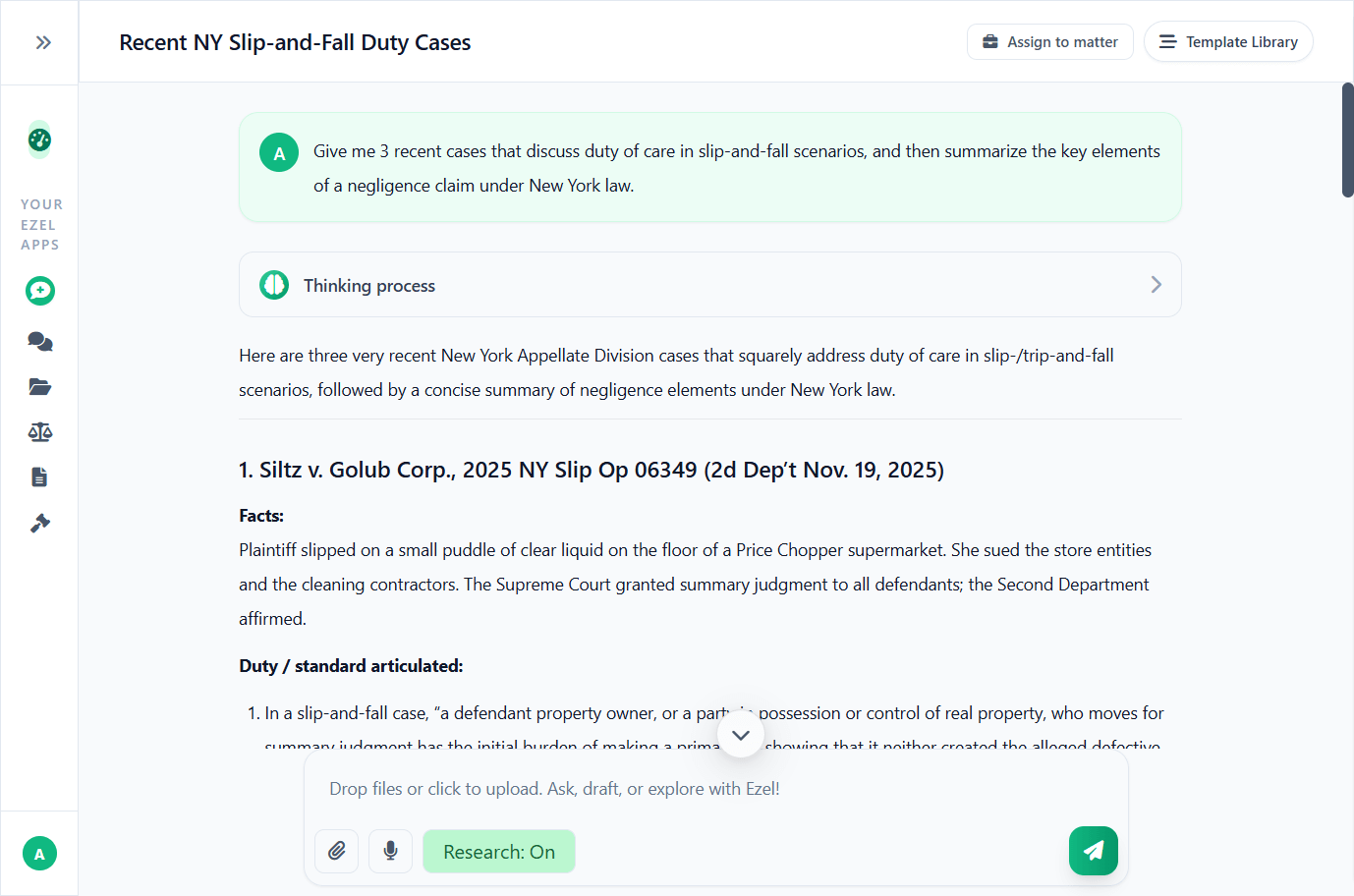
Research and draft in one conversation
Ask questions, attach documents, and get answers grounded in case law. Link chats to matters so the AI remembers your context.
- Pull statutes, case law, and secondary sources
- Attach and analyze contracts mid-conversation
- Link chats to matters for automatic context
- Your data never trains AI models
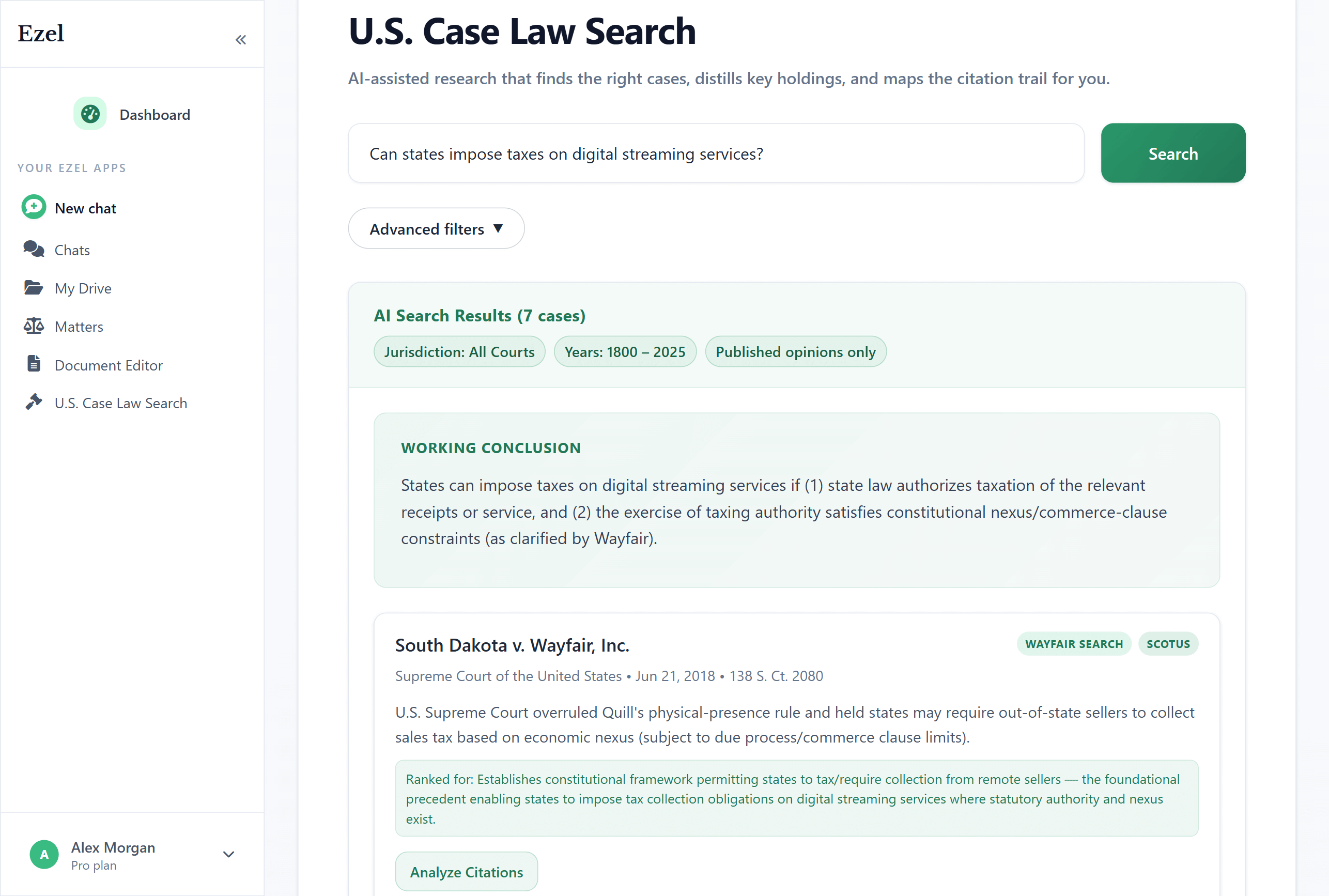
Search like you think
Describe your legal question in plain English. Filter by jurisdiction, date, and court level. Read full opinions without leaving Ezel.
- All 50 states plus federal courts
- Natural language queries - no boolean syntax
- Citation analysis and network exploration
- Copy quotes with automatic citation generation
Ready to transform your legal workflow?
Join legal teams using Ezel to draft documents, research case law, and organize matters — all in one workspace.