OHIO PUBLIC RECORDS REQUEST
Comprehensive Template Under the Ohio Public Records Act
Ohio Revised Code s. 149.43
OVERVIEW OF OHIO'S PUBLIC RECORDS ACT
Ohio's Public Records Act is codified at ORC s. 149.43. The Act provides one of the strongest and most detailed public records frameworks in the nation, with specific provisions for statutory damages ($100 per day), a Court of Claims enforcement option, mandatory training for public office employees, and detailed procedural requirements for both requesters and public offices.
Key Features of the Ohio Public Records Act
- "Reasonable Period of Time" Standard: While there is no fixed statutory deadline, Ohio courts have interpreted "reasonable" as typically 3 to 5 business days for routine requests. ORC s. 149.43(B)(1).
- $100/Day Statutory Damages: A requester who prevails in a mandamus action may recover $100 per business day of noncompliance, beginning from the date the mandamus action is filed, up to a maximum of $1,000. ORC s. 149.43(C)(2).
- Court of Claims Option: Requesters may file complaints with the Court of Claims as an alternative to mandamus. ORC s. 149.43(D).
- Mandatory 3-Day Cure Period: Before filing a mandamus action, the requester must provide the public office written notice and allow at least 3 business days to cure. ORC s. 149.43(C)(1).
- Hand Delivery or Certified Mail: To qualify for statutory damages, the request must be delivered by hand delivery or certified mail. ORC s. 149.43(C)(2).
- Mandatory Training: Public office employees responsible for records must complete certified training in public records responsibilities. ORC s. 149.43(B)(4)-(5).
- Posted Policy: Public offices must maintain and post a public records policy. ORC s. 149.43(B)(3).
- No Identification Required: A requester need not identify themselves, provide a reason for the request, or put the request in writing (though writing is recommended). ORC s. 149.43(B)(4).
- Broad Definition: A "public record" includes records kept by a public office that are not specifically exempted. ORC s. 149.43(A)(1).
SECTION 1: PUBLIC RECORDS REQUEST LETTER
PUBLIC RECORDS REQUEST
Pursuant to the Ohio Public Records Act
Ohio Revised Code s. 149.43
Date: [__/__/____]
DELIVERY METHOD: ☐ Hand Delivery ☐ Certified Mail (Return Receipt Requested)
Important: To preserve eligibility for statutory damages under ORC s. 149.43(C)(2), this request is being delivered by ☐ hand delivery / ☐ certified mail.
TO (Records Custodian):
Name: [________________________________]
Title: [________________________________]
Public Office: [________________________________]
Street Address: [________________________________]
City, State, ZIP: [________________________________]
Email: [________________________________]
Telephone: [________________________________]
FROM (Requester):
Name: [________________________________]
Title/Organization: [________________________________]
Street Address: [________________________________]
City, State, ZIP: [________________________________]
Email: [________________________________]
Telephone: [________________________________]
RE: Public Records Request Concerning [________________________________]
Dear [________________________________]:
I. Legal Basis for Request
Pursuant to the Ohio Public Records Act, ORC s. 149.43, I hereby request access to inspect and/or obtain copies of the public records described below. Under ORC s. 149.43(B)(1), a public office shall promptly prepare and make available for inspection to any person all public records at all reasonable times during regular business hours.
I note that under ORC s. 149.43(B)(4), a public office may not require a requester to provide identification, state the purpose for the request, or put the request in writing. However, I submit this written request to document the request, facilitate identification of records, and preserve my right to statutory damages under ORC s. 149.43(C)(2).
II. Records Requested
I respectfully request that you search for and produce the following records:
Primary Request:
(a) [________________________________]
(b) [________________________________]
(c) [________________________________]
(d) [________________________________]
Additional Related Records:
(e) All indices, logs, databases, or record-keeping systems that would assist in identifying responsive records;
(f) All correspondence, emails, memoranda, and communications related to the above subject matter;
(g) All segregable, non-exempt portions of any records that may contain both exempt and non-exempt information.
Scope of Search:
- Date Range: From [__/__/____] to [__/__/____]
- Departments/Divisions to Search: [________________________________]
- Keywords or Search Terms: [________________________________]
- Record Types: [________________________________]
- Format of Original Records: [________________________________]
III. Format of Production
Pursuant to ORC s. 149.43(B)(6), I request that responsive records be produced in the following format:
☐ Electronic copies in native format (preferred)
☐ Electronic copies in PDF format
☐ Paper copies
☐ Inspection at the public office during regular business hours
☐ Other: [________________________________]
Under ORC s. 149.43(B)(6), if a public record is maintained electronically, the public office shall provide the record in any of the following medium formats: paper copy, the same medium as maintained by the public office, or the medium requested by the requester if available.
IV. Fee Provisions
I understand that under ORC s. 149.43(B)(1), the public office may charge only the actual cost of making copies, including the cost of the medium and delivery. I am willing to pay reasonable copy costs as follows:
- I agree to pay up to $[____] without prior notification.
- If the estimated costs exceed that amount, please provide me with an itemized cost estimate before proceeding.
I note that under Ohio law:
- Fees are limited to the "actual cost" of making copies. ORC s. 149.43(B)(1).
- The public office may not charge for the labor cost of retrieving, searching for, or reviewing records. ORC s. 149.43(B)(1).
- If I request records in the same medium as maintained by the public office, the cost is limited to the cost of the medium.
- The public office may require advance payment if copies are requested.
V. Fee Waiver Request (If Applicable)
☐ I request a waiver or reduction of copy costs for the following reason(s):
[________________________________]
While Ohio law does not contain a formal statutory fee waiver provision, I request a waiver because:
☐ Disclosure is in the public interest and will contribute to public understanding of government operations.
☐ I am a member of the news media.
☐ I am a nonprofit organization seeking records for educational or research purposes.
☐ I am indigent.
☐ Other: [________________________________]
VI. Response Timeline
Under ORC s. 149.43(B)(1), the public office must make records available "promptly." Ohio courts have generally interpreted this to mean a reasonable period of time, which for routine requests is typically 3 to 5 business days. State ex rel. Consumer News Service, Inc. v. Worthington City Board of Education, 97 Ohio St.3d 58, 2002-Ohio-5311.
If the request is voluminous or complex, I understand that additional time may be needed. However, I request that you:
- Acknowledge this request within 3 business days;
- Provide a production timeline for any records requiring extended processing;
- Produce non-complex records immediately while complex records are being processed.
VII. Denial Procedures
Under ORC s. 149.43(B)(2)-(3), if the public office determines that any records are exempt, the public office shall:
(a) Provide an explanation, including legal authority, setting forth why the record or portions thereof are exempt. ORC s. 149.43(B)(3). The explanation must be provided to the requester at the time of the denial;
(b) Redact the exempt information and release the non-exempt portions of the record. ORC s. 149.43(B)(1);
(c) Make a good faith effort to resolve ambiguous requests. ORC s. 149.43(B)(7).
I note that under ORC s. 149.43(B)(3), the public office must have a written public records policy that includes instructions on how to request records and the public office's response procedure.
VIII. Preservation of Records
I hereby request that all records responsive to this request be preserved. Please suspend any routine document destruction or retention schedules that may apply to the requested records.
IX. Notice Regarding Statutory Damages
This request is being delivered by ☐ hand delivery / ☐ certified mail to preserve eligibility for statutory damages under ORC s. 149.43(C)(2). If this request is not fulfilled within a reasonable period of time, I reserve the right to file a mandamus action after providing the required three-business-day cure period notice under ORC s. 149.43(C)(1).
X. Contact Information
If you have questions or need clarification, please contact me at the information listed above. Under ORC s. 149.43(B)(7), I am willing to work with you to resolve any ambiguity in this request.
Thank you for your prompt attention to this matter.
Respectfully submitted,
Signature: ___________________________________________
Name: [________________________________]
Title: [________________________________]
Organization: [________________________________]
Date: [__/__/____]
SECTION 2: RECORDS DESCRIPTION GUIDANCE
Drafting Effective Records Descriptions Under Ohio Law
Under Ohio law, a public office must make a good faith effort to assist the requester in resolving ambiguous or overly broad requests. ORC s. 149.43(B)(7). A well-drafted description will minimize delays and potential disputes.
Sample Records Descriptions
Government Contracts and Procurement:
"All contracts, purchase orders, invoices, payment records, bid documents, proposals, evaluation criteria, and related correspondence between [Public Office Name] and [Vendor Name] from [Start Date] through [End Date], including all amendments, modifications, and change orders."
Personnel and Employment Records:
"All records relating to the hiring, discipline, or termination of [Employee Name/Position Title] within [Department Name] from [Start Date] through [End Date], including job postings, applications, interview records, performance evaluations, disciplinary actions, and separation documents. I note that employee name, compensation, job title, and other non-exempt personnel information are public records under ORC s. 149.43."
Law Enforcement Records:
"All incident reports, arrest records, dispatch logs, body-worn camera footage, dashboard camera footage, use-of-force reports, and related records pertaining to Case/Incident No. [Number] occurring on or about [Date] at [Location], to the extent not exempt under ORC s. 149.43(A)(1) or (A)(2)."
Financial and Budget Records:
"All budget documents, financial statements, expenditure reports, revenue reports, audit reports, and related memoranda for [Public Office/Department] for fiscal years [Year] through [Year], including all line-item detail and supporting documentation."
Emails and Electronic Communications:
"All emails sent to or from [Name/Email Address] during the period of [Start Date] through [End Date] containing the following search terms: [Term 1], [Term 2], [Term 3], including all attachments."
Police Body Camera Footage:
"All body-worn camera footage from officers of [Law Enforcement Agency] relating to [Incident Description] on [Date], including all footage from the period of [Time] through [Time]. Pursuant to ORC s. 149.43(B)(6), I request this footage be provided in electronic format."
Public Meeting Records:
"All agendas, minutes, audio/video recordings, handouts, presentations, and resolutions for meetings of the [Board/Commission/Council Name] held from [Start Date] through [End Date]."
SECTION 3: FEE PROVISIONS
Detailed Analysis of Fee Structure Under ORC s. 149.43
A. Actual Cost Standard
Ohio law limits fees to the "actual cost" of making copies. ORC s. 149.43(B)(1). This includes:
| Cost Category | Allowable Charge | Statutory Basis |
|---|---|---|
| Paper copies | Actual cost per page (typically $0.05-$0.10) | s. 149.43(B)(1) |
| Electronic copies (same medium) | Cost of the medium | s. 149.43(B)(6) |
| Electronic copies (different medium) | Cost of conversion and medium | s. 149.43(B)(6) |
| Mailing/postage | Actual cost | s. 149.43(B)(1) |
| Transmission (email) | No charge if available electronically | s. 149.43(B)(6) |
B. Charges Specifically Prohibited
Under Ohio law, the following charges are not permitted:
- Search fees: No charge for staff time spent searching for records.
- Retrieval fees: No charge for retrieving records from storage.
- Review fees: No charge for reviewing records to determine exemptions.
- Compilation fees: No charge for compiling or sorting records.
- Profit markup: Fees must reflect actual costs only.
C. Free Inspection
Under ORC s. 149.43(B)(1), inspection of records is free of charge. The requester has the right to inspect records at the public office during regular business hours without any fee.
D. Special Fee Provisions
- Electronic records: If records are maintained electronically, the cost of providing an electronic copy should not exceed the cost of the medium. ORC s. 149.43(B)(6).
- Bulk commercial requests: A public office may require a prepayment for bulk commercial requests. ORC s. 149.43(B)(8).
E. Advance Payment
The public office may require advance payment before making copies. However, the office must provide the requester with an estimate of costs.
SECTION 4: RESPONSE TIMELINE
Ohio's "Reasonable Period of Time" Standard
A. Statutory Standard
ORC s. 149.43(B)(1) requires that records be made available "promptly" and prepared for inspection within a "reasonable period of time." There is no fixed statutory deadline.
B. Court Interpretation: 3-5 Business Days
Ohio courts have provided significant guidance on what constitutes a "reasonable period":
- Routine Requests: Generally 3 to 5 business days. State ex rel. Consumer News Service, Inc. v. Worthington City Board of Education, 97 Ohio St.3d 58 (2002).
- Complex/Voluminous Requests: Longer periods may be reasonable if the public office communicates with the requester and provides periodic updates.
- Unreasonable Delay: Delays of weeks or months without explanation are generally unreasonable.
C. What Constitutes an Adequate Response
The public office must provide one of the following within a reasonable time:
- Full production of all responsive records;
- Partial production with an explanation of what remains and when it will be produced;
- Written explanation identifying specific exemptions for any records withheld, with legal authority; or
- Good faith communication about the scope, timeline, or need for clarification.
D. Constructive Denial
Failure to respond within a reasonable period may be treated as a denial, which triggers the requester's right to file a mandamus action (after the 3-business-day cure period).
SECTION 5: EXEMPTIONS OVERVIEW
Comprehensive Guide to Ohio Public Records Act Exemptions
Ohio defines a "public record" broadly but carves out specific categories of exempt records under ORC s. 149.43(A)(1). A record is exempt only if it falls within one of the specifically enumerated exceptions.
A. Primary Exemptions Under ORC s. 149.43(A)(1)
| Exemption | Citation | Description |
|---|---|---|
| Medical records | s. 149.43(A)(1)(a) | Records of patients at hospitals operated by public offices |
| Trial preparation records | s. 149.43(A)(1)(g) | Records prepared in anticipation of litigation |
| Confidential law enforcement investigatory records (CLEIR) | s. 149.43(A)(1)(h) & (A)(2) | Records compiled in the course of investigation of crime |
| DNA records | s. 149.43(A)(1)(p) | DNA records maintained by BCI |
| Attorney-client privilege | s. 149.43(A)(1)(v) | Communications between attorney and client |
| Intellectual property | s. 149.43(A)(1)(o) | Records relating to intellectual property developed by public institutions |
| Infrastructure records | s. 149.43(A)(1)(y) | Security and infrastructure vulnerability records |
| Social security numbers | s. 149.43(A)(1)(dd) | SSNs in public records |
| Personal information of minors | s. 149.43(A)(1)(r) | Records identifying minors |
| Adoption/foster care | s. 149.43(A)(1)(n) | Records of adoption and foster care |
B. Confidential Law Enforcement Investigatory Records (CLEIR)
ORC s. 149.43(A)(2) defines CLEIR as records that meet all four of the following criteria:
1. Pertain to a law enforcement matter;
2. Were compiled in the course of a law enforcement investigation;
3. Relate to the identity of a suspect who has not been charged; AND
4. Disclosure would create a high probability of disclosure of specific confidential investigatory techniques or sources.
Important: Not all law enforcement records are exempt. Routine records such as:
- Incident reports
- Arrest logs
- Basic booking information
- Names of arrested persons
are generally public records and not CLEIR.
C. Trial Preparation Records
Under ORC s. 149.43(A)(1)(g), trial preparation records are exempt. These are records prepared in anticipation of litigation by or on behalf of a public office. However:
- Records that are otherwise public do not become exempt merely because they are used in litigation;
- The exemption applies only to records specifically prepared for litigation purposes.
D. Medical Records
Medical records of patients at hospitals operated by a public office are exempt under ORC s. 149.43(A)(1)(a). This includes:
- Patient treatment records
- Diagnoses
- Billing records containing personal health information
E. Personnel Records
Ohio does not have a blanket exemption for personnel records. The following personnel information is generally public:
- Employee name
- Compensation/salary
- Job title and position
- Work location
- Length of employment
- Disciplinary records (in many circumstances)
The following may be exempt:
- Social security numbers (s. 149.43(A)(1)(dd))
- Medical information
- Home addresses (in certain circumstances for specific employees)
F. Additional Exemptions in Other Statutes
Numerous other Ohio statutes create exemptions, including:
- Tax records: ORC s. 5703.21
- Juvenile records: ORC s. 2151.14
- Sealed records: ORC s. 2953.32
- Grand jury proceedings: ORC s. 2939.13
- Student records: FERPA (20 U.S.C. s. 1232g)
- Mental health records: ORC s. 5122.31
- Workers' compensation: ORC s. 4123.88
G. Segregability and Redaction
If a record contains both exempt and non-exempt information, the public office must redact only the exempt portions and release the remainder. ORC s. 149.43(B)(1). The public office may not withhold an entire record simply because a portion is exempt.
SECTION 6: APPEAL PROCEDURES
Administrative and Judicial Remedies for Records Denials
Ohio provides two distinct enforcement pathways: mandamus action and Court of Claims complaint.
A. Mandatory 3-Business-Day Cure Period
Before filing a mandamus action, the requester must:
- Send the public office written notice that the office has failed to comply with the Public Records Act;
- Allow at least 3 business days for the public office to cure the deficiency. ORC s. 149.43(C)(1).
The cure period begins on the date the notice is received by the public office.
B. Mandamus Action (ORC s. 149.43(C))
Court: Court of Appeals (original jurisdiction) or Common Pleas Court.
Filing Requirements:
- Written notice and 3-business-day cure period must be completed;
- The request must have been delivered by hand delivery or certified mail to qualify for statutory damages. ORC s. 149.43(C)(2).
Standard of Review: The court determines de novo whether the records are public records subject to disclosure.
Burden of Proof: The public office bears the burden of proving that an exemption applies.
Statutory Damages:
- $100 per business day of noncompliance, beginning from the date the mandamus action is filed;
- Maximum of $1,000 in statutory damages;
- The court may reduce or deny damages if the public office reasonably believed its conduct did not violate the Act. ORC s. 149.43(C)(2).
Attorney's Fees:
- The court shall award reasonable attorney's fees if the requester substantially prevails and certain conditions are met.
- The court may award attorney's fees at its discretion in other circumstances.
- The court must award attorney's fees if the public office failed to respond or provide an explanation. ORC s. 149.43(C)(3).
C. Court of Claims Procedure (ORC s. 149.43(D))
As an alternative to mandamus, a requester may file a complaint with the Court of Claims:
Court: Ohio Court of Claims.
Advantages:
- Simpler procedural requirements;
- No need for the request to have been delivered by hand or certified mail;
- Available regardless of delivery method.
Procedure:
1. File complaint with the Court of Claims;
2. The Court appoints a special master to review the matter;
3. The special master issues recommendations;
4. The Court of Claims issues a final determination.
Remedies Available:
- Order compelling production;
- Attorney's fees (in certain circumstances);
- Court costs.
D. Appeal
Decisions of the Court of Common Pleas or Court of Appeals in mandamus may be appealed. Court of Claims decisions may be appealed as provided by law.
SECTION 7: APPEAL / CURE PERIOD NOTICE LETTER
NOTICE OF NONCOMPLIANCE AND DEMAND TO CURE
Pursuant to ORC s. 149.43(C)(1)
Date: [__/__/____]
DELIVERY METHOD: ☐ Hand Delivery ☐ Certified Mail (Return Receipt Requested)
TO:
Name: [________________________________]
Title: [________________________________]
Public Office: [________________________________]
Address: [________________________________]
City, State, ZIP: [________________________________]
FROM:
Name: [________________________________]
Address: [________________________________]
City, State, ZIP: [________________________________]
Email: [________________________________]
RE: Statutory Cure Period Notice -- Public Records Request Dated [__/__/____]
Dear [________________________________]:
NOTICE OF NONCOMPLIANCE
Pursuant to ORC s. 149.43(C)(1), I hereby provide notice that [Public Office Name] has failed to comply with the Ohio Public Records Act, ORC s. 149.43, with respect to my public records request dated [__/__/____], which was delivered by ☐ hand delivery / ☐ certified mail on [__/__/____].
Nature of Noncompliance
☐ The public office failed to respond to my request within a reasonable period of time.
☐ The public office denied access to records without providing an explanation and legal authority as required by ORC s. 149.43(B)(3).
☐ The public office failed to redact exempt information and release non-exempt portions.
☐ The public office charged fees exceeding the "actual cost" permitted by ORC s. 149.43(B)(1).
☐ The public office required identification, a stated purpose, or written request in violation of ORC s. 149.43(B)(4).
☐ Other: [________________________________]
Three-Business-Day Cure Period
Pursuant to ORC s. 149.43(C)(1), you are hereby given three (3) business days from receipt of this notice to cure the noncompliance by producing the requested records or providing a legally sufficient explanation for the denial.
The cure period expires on: [__/__/____]
Notice of Intent to File Mandamus
If the noncompliance is not cured within the three-business-day period, I intend to file a mandamus action pursuant to ORC s. 149.43(C), seeking:
(a) An order compelling disclosure of all responsive public records;
(b) Statutory damages of $100.00 per business day of noncompliance, up to a maximum of $1,000.00, pursuant to ORC s. 149.43(C)(2);
(c) Reasonable attorney's fees pursuant to ORC s. 149.43(C)(3);
(d) Court costs;
(e) Such other relief as the court deems just and proper.
I note that my original request was delivered by ☐ hand delivery / ☐ certified mail, as required by ORC s. 149.43(C)(2) to preserve eligibility for statutory damages.
Respectfully submitted,
Signature: ___________________________________________
Name: [________________________________]
Date: [__/__/____]
SECTION 8: ENFORCEMENT MECHANISMS
Penalties, Civil Actions, and Damages
A. Statutory Damages
Under ORC s. 149.43(C)(2):
| Element | Details |
|---|---|
| Amount | $100.00 per business day of noncompliance |
| Start date | Day the mandamus action is filed |
| Maximum | $1,000.00 |
| Prerequisite | Request delivered by hand or certified mail |
| Reduction | Court may reduce if office reasonably believed compliance |
B. Attorney's Fees
Under ORC s. 149.43(C)(3):
| Scenario | Attorney's Fees |
|---|---|
| Requester substantially prevails and office failed to respond or explain | Mandatory award of reasonable fees |
| Requester substantially prevails (other cases) | Discretionary award of reasonable fees |
| Public office promised deadline then failed to meet it | Mandatory award |
| Office never responded at all | Mandatory award |
C. Court of Claims Enforcement
Under ORC s. 149.43(D):
- The Court of Claims may order production of records;
- A special master reviews the matter and makes recommendations;
- Attorney's fees may be awarded.
D. Additional Enforcement Tools
| Mechanism | Description |
|---|---|
| Contempt of court | Failure to comply with court order |
| Quo warranto | In egregious cases |
| Ethics complaint | For public officers who violate records duties |
| ORC s. 149.351 | Prohibits destruction of records subject to pending request (penalty: felony for certain records) |
E. Criminal Penalties for Records Destruction
Under ORC s. 149.351:
- Knowing destruction of records contrary to retention schedules or pending requests may constitute a criminal offense.
- In certain circumstances, destruction of records may be charged as a felony.
SECTION 9: FOLLOW-UP LETTER TEMPLATE
FOLLOW-UP TO PUBLIC RECORDS REQUEST
Date: [__/__/____]
TO:
Name: [________________________________]
Title: [________________________________]
Public Office: [________________________________]
Address: [________________________________]
FROM:
Name: [________________________________]
Address: [________________________________]
Email: [________________________________]
RE: Follow-Up to Public Records Request Dated [__/__/____]
Dear [________________________________]:
I write to follow up on my public records request submitted on [__/__/____] pursuant to the Ohio Public Records Act, ORC s. 149.43. The request was delivered by ☐ hand delivery / ☐ certified mail on [__/__/____].
☐ To date, I have not received any response to my request.
☐ I received a partial response on [__/__/____] but the following records remain outstanding: [________________________________]
☐ I received a denial on [__/__/____] that did not provide the required explanation and legal authority under ORC s. 149.43(B)(3).
☐ I was charged fees exceeding actual cost.
It has now been [____] business days since my request, which exceeds the reasonable period of time contemplated by ORC s. 149.43(B)(1) and interpreted by Ohio courts as typically 3-5 business days for routine requests.
I respectfully request that you:
☐ Immediately produce all responsive records;
☐ Provide a written explanation with legal authority for any records withheld, as required by ORC s. 149.43(B)(3);
☐ Redact and release non-exempt portions of partially exempt records;
☐ Provide a written timeline for production of remaining records.
If I do not receive a satisfactory response within [____] business days, I will issue a formal cure period notice pursuant to ORC s. 149.43(C)(1) prior to filing a mandamus action.
Respectfully,
Signature: ___________________________________________
Name: [________________________________]
Date: [__/__/____]
SECTION 10: FEE WAIVER REQUEST TEMPLATE
REQUEST FOR WAIVER OR REDUCTION OF COPY COSTS
Date: [__/__/____]
TO:
Name: [________________________________]
Title: [________________________________]
Public Office: [________________________________]
Address: [________________________________]
FROM:
Name: [________________________________]
Organization: [________________________________]
Address: [________________________________]
RE: Fee Waiver Request for Public Records Request Dated [__/__/____]
Dear [________________________________]:
I write to request a waiver or reduction of copy costs associated with my public records request dated [__/__/____], submitted pursuant to the Ohio Public Records Act, ORC s. 149.43.
Basis for Fee Waiver Request
☐ Public Interest Purpose: The records will contribute significantly to public understanding of [________________________________] and will be disseminated to the public.
☐ News Media Purpose: I am a journalist/reporter for [________________________________] and the records are sought for public reporting.
☐ Nonprofit/Educational Purpose: I represent [________________________________], a nonprofit organization, and the records are sought for [________________________________] purposes.
☐ Government Oversight: The records relate to government accountability regarding [________________________________].
☐ Indigency: I am unable to pay the estimated costs of $[____].
☐ Other: [________________________________]
Supporting Facts
[________________________________]
[________________________________]
I note that Ohio law limits fees to actual cost only. I request that even these minimal costs be waived given the public interest in the requested records.
Respectfully,
Signature: ___________________________________________
Name: [________________________________]
Date: [__/__/____]
SECTION 11: DOCUMENTATION CHECKLIST
Pre-Submission Checklist
☐ Identified the correct public office holding the records
☐ Confirmed the entity is a "public office" under ORC s. 149.011(A)
☐ Drafted a clear and specific description of the records requested
☐ Specified a date range for the request
☐ Specified the desired format for production
☐ Included requester's contact information (though not legally required)
☐ Set a fee cap and included fee limitation language
☐ Included fee waiver request (if applicable)
☐ Referenced the Ohio Public Records Act (ORC s. 149.43)
☐ Included request for redaction and release of non-exempt portions
☐ Included records preservation request
☐ Selected delivery method: Hand delivery or certified mail (to preserve statutory damages eligibility)
☐ Reviewed the request for clarity and completeness
☐ Made a copy of the request for your records
☐ Obtained certified mail receipt or hand delivery confirmation
☐ Noted the date of submission for timeline tracking
Post-Submission Tracking Checklist
☐ Logged the date the request was submitted: [__/__/____]
☐ Logged the delivery method: ☐ Hand ☐ Certified Mail
☐ Logged the certified mail tracking number (if applicable): [________________________________]
☐ Logged the date of delivery confirmation: [__/__/____]
☐ Logged the date of any acknowledgment received: [__/__/____]
☐ Assessed whether response was received within a reasonable period (3-5 business days for routine requests)
☐ Logged the date records were produced: [__/__/____]
☐ Reviewed records for completeness and responsiveness
☐ Identified any records withheld and verified explanation/legal authority was provided
☐ Reviewed any redactions for compliance with ORC s. 149.43
☐ Verified fees charged against "actual cost" standard
☐ Filed all correspondence, receipts, and records for future reference
Pre-Mandamus Checklist
☐ Confirmed request was delivered by hand or certified mail (required for statutory damages)
☐ Documented the date of delivery
☐ Allowed a reasonable period for response (3-5 business days for routine requests)
☐ Prepared and sent cure period notice under ORC s. 149.43(C)(1)
☐ Waited the mandatory 3 business days after cure period notice
☐ Documented the public office's response (or lack thereof) to the cure notice
☐ Consulted with an attorney regarding mandamus action or Court of Claims complaint
☐ Decided between mandamus (Court of Appeals/Common Pleas) or Court of Claims
☐ Filed mandamus action or Court of Claims complaint
☐ Preserved all correspondence, receipts, and documentation
SECTION 12: KEY DIFFERENCES FROM FEDERAL FOIA
Comparison: Ohio Public Records Act vs. Federal FOIA
| Feature | Ohio Public Records Act | Federal FOIA (5 U.S.C. s. 552) |
|---|---|---|
| Response Deadline | "Reasonable period" (3-5 days per case law) | 20 business days (with 10-day extension) |
| Administrative Appeal | 3-day cure period (not a formal appeal) | Required before judicial review |
| Judicial Review | Mandamus (Court of Appeals) or Court of Claims | Federal district court |
| Statutory Damages | $100/day, up to $1,000 | No statutory damages |
| Fee Standard | Actual cost of copies only | Commercial, educational/media, other categories |
| Search/Retrieval Fees | Not permitted | Permitted (varies by category) |
| Fee Waiver | No statutory provision | Statutory criteria (public interest) |
| Identification Required | No | Generally not required |
| Written Request Required | No | Required |
| Attorney's Fees | Mandatory in certain circumstances | Discretionary (substantially prevailed) |
| Delivery Requirements | Hand delivery or certified mail for damages | Any method |
| Training Requirement | Mandatory for public employees | Recommended (not mandatory) |
| Posted Policy Requirement | Mandatory | FOIA reference guide required |
| Burden of Proof | On the public office | On the agency |
| Criminal Penalties | Felony for certain records destruction | Criminal penalties for willful concealment |
| Scope | State and local government | Federal agencies only |
Notable Ohio-Specific Features
-
$100/Day Statutory Damages: Ohio is one of the few states with a specific statutory damages provision for public records violations, capped at $1,000.
-
Mandatory Attorney's Fees: In certain situations (e.g., failure to respond at all), attorney's fees are mandatory, not discretionary.
-
No Written Request Required: Ohio does not require requests to be in writing, though written requests are strongly recommended for documentation.
-
No Identification Required: Public offices may not require requesters to identify themselves or state a purpose.
-
Dual Enforcement Pathways: The choice between mandamus and Court of Claims provides flexibility.
-
3-Day Cure Period: The mandatory pre-suit cure period encourages resolution without litigation.
-
Mandatory Training: Ohio requires certified training for public records personnel, which is unusual among states.
-
Hand Delivery/Certified Mail Requirement for Damages: The requirement that requests be delivered by hand or certified mail to qualify for statutory damages is a unique procedural hurdle.
SECTION 13: STATE-SPECIFIC NOTES
Important Ohio-Specific Considerations
A. Delivery Method Matters
Critical: To preserve eligibility for statutory damages under ORC s. 149.43(C)(2), the original records request must be delivered by hand delivery or certified mail. Requests delivered by email, fax, or regular mail do not qualify for statutory damages (though other remedies remain available).
B. No Identification or Purpose Required
Under ORC s. 149.43(B)(4), a public office:
- May not require the requester to provide identification;
- May not require the requester to state the purpose of the request;
- May not limit the number of records a requester may request;
- May not condition access on the requester's identity or purpose.
However, the public office may ask for the requester's identity to facilitate communication and delivery of records.
C. Mandatory Public Records Training
Under ORC s. 149.43(B)(4)-(5):
- All employees who handle public records must complete certified public records training;
- The training is provided by the Ohio Attorney General's office;
- Failure to complete required training may affect the public office's position in litigation.
D. Public Records Policy
Under ORC s. 149.43(B)(3), every public office must:
- Maintain a written public records policy;
- Post the policy in a conspicuous location;
- Include instructions on how to request records and the public office's response procedures.
E. Ambiguous Requests
Under ORC s. 149.43(B)(7), if a request is ambiguous, the public office must:
- Make a good faith effort to seek clarification from the requester;
- Not deny the request on the basis of ambiguity without attempting to resolve it;
- Provide the requester with an opportunity to revise the request.
F. Bulk Commercial Requests
Under ORC s. 149.43(B)(8):
- A public office may require a request be put in writing if it suspects the request is for a "commercial purpose";
- The public office may charge the actual cost of making copies and delivery;
- "Bulk commercial" requests are defined as requests for information to be used for commercial activities.
G. Body-Worn Camera Footage
Ohio treats body-worn camera footage as a public record subject to the same exemptions as other records. However, footage may be exempt if it contains:
- CLEIR information;
- Medical information;
- Information identifying minors;
- Content that falls within other specific exemptions.
H. Public Records and Sunshine Laws
Ohio's Public Records Act (ORC s. 149.43) and the Ohio Open Meetings Act (ORC s. 121.22) are companion statutes. Records of public meetings, including minutes and recordings, are generally public records.
SECTION 14: SOURCES AND REFERENCES
Primary Legal Sources
- ORC s. 149.43 (Public Records Act): Ohio Legislature
- ORC s. 149.011 (Definitions): Ohio Legislature
- ORC s. 149.351 (Preservation of Records): Ohio Legislature
- ORC s. 149.431 (Special Records): Ohio Legislature
Key Case Law
- State ex rel. Steckman v. Jackson, 70 Ohio St.3d 420, 639 N.E.2d 83 (1994)
- State ex rel. Consumer News Service, Inc. v. Worthington City Board of Education, 97 Ohio St.3d 58, 2002-Ohio-5311
- State ex rel. Physicians Commt. for Responsible Medicine v. Ohio State Univ. Bd. of Trustees, 108 Ohio St.3d 288, 2006-Ohio-903
- State ex rel. Glasgow v. Jones, 119 Ohio St.3d 391, 2008-Ohio-4788
- State ex rel. DiFranco v. S. Euclid, 144 Ohio St.3d 571, 2015-Ohio-4915
- State ex rel. Cincinnati Enquirer v. Hamilton Cty., 75 Ohio St.3d 374, 662 N.E.2d 334 (1996)
Government Resources
- Ohio Attorney General - Public Records: AG Website
- Ohio Open Government Guide - Reporters Committee: RCFP
- Ohio Public Records Guide - MuckRock: MuckRock
- Montgomery County Public Records Act Information: Montgomery County
This template is provided for informational purposes only and does not constitute legal advice. Consult with a qualified Ohio attorney before submitting any public records request or pursuing legal action. Laws and procedures may change; verify all citations against current statutory text.
Do more with Ezel
This free template is just the beginning. See how Ezel helps legal teams draft, research, and collaborate faster.
AI that drafts while you watch
Tell the AI what you need and watch your document transform in real-time. No more copy-pasting between tools or manually formatting changes.
- Natural language commands: "Add a force majeure clause"
- Context-aware suggestions based on document type
- Real-time streaming shows edits as they happen
- Milestone tracking and version comparison
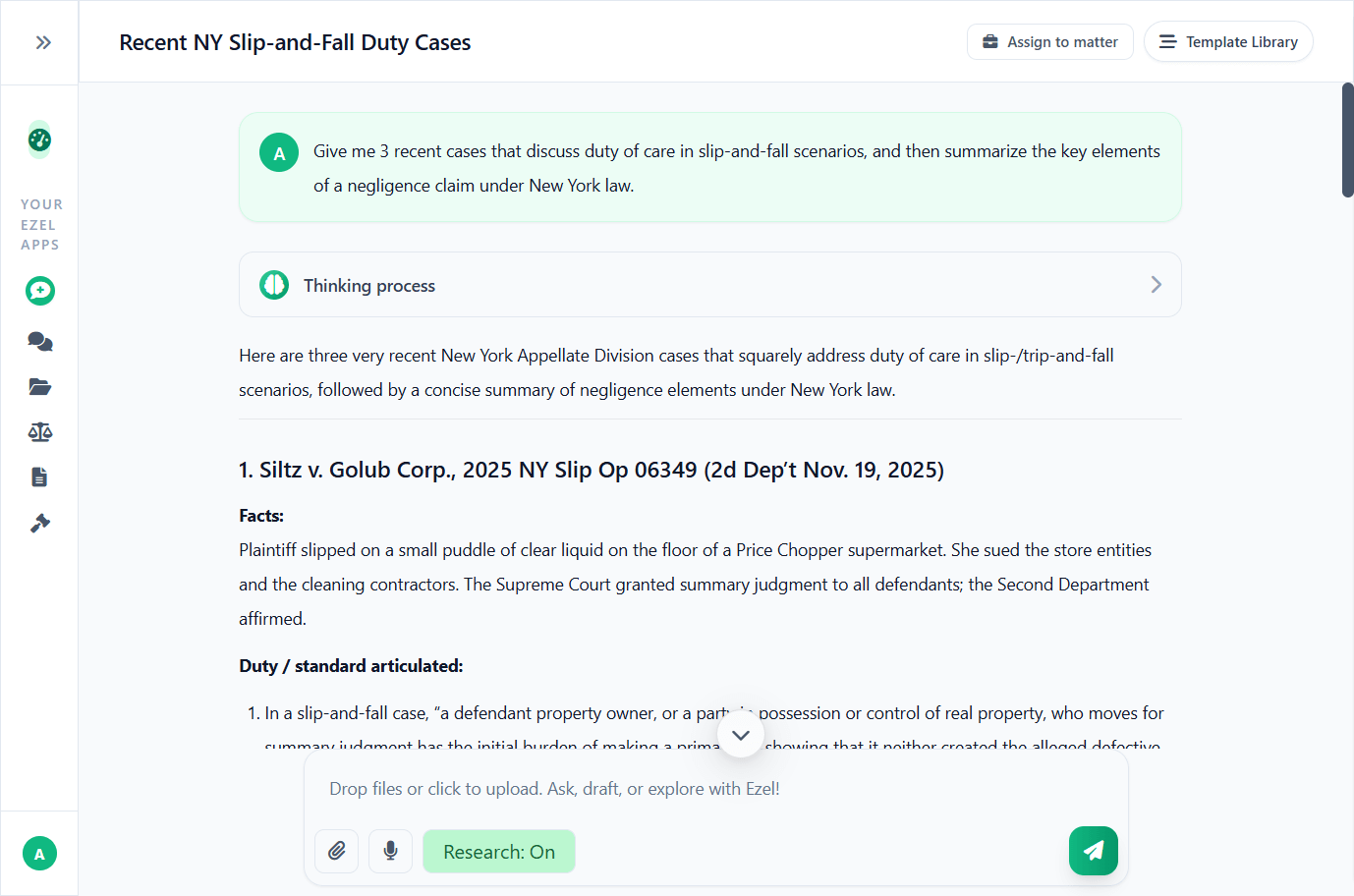
Research and draft in one conversation
Ask questions, attach documents, and get answers grounded in case law. Link chats to matters so the AI remembers your context.
- Pull statutes, case law, and secondary sources
- Attach and analyze contracts mid-conversation
- Link chats to matters for automatic context
- Your data never trains AI models
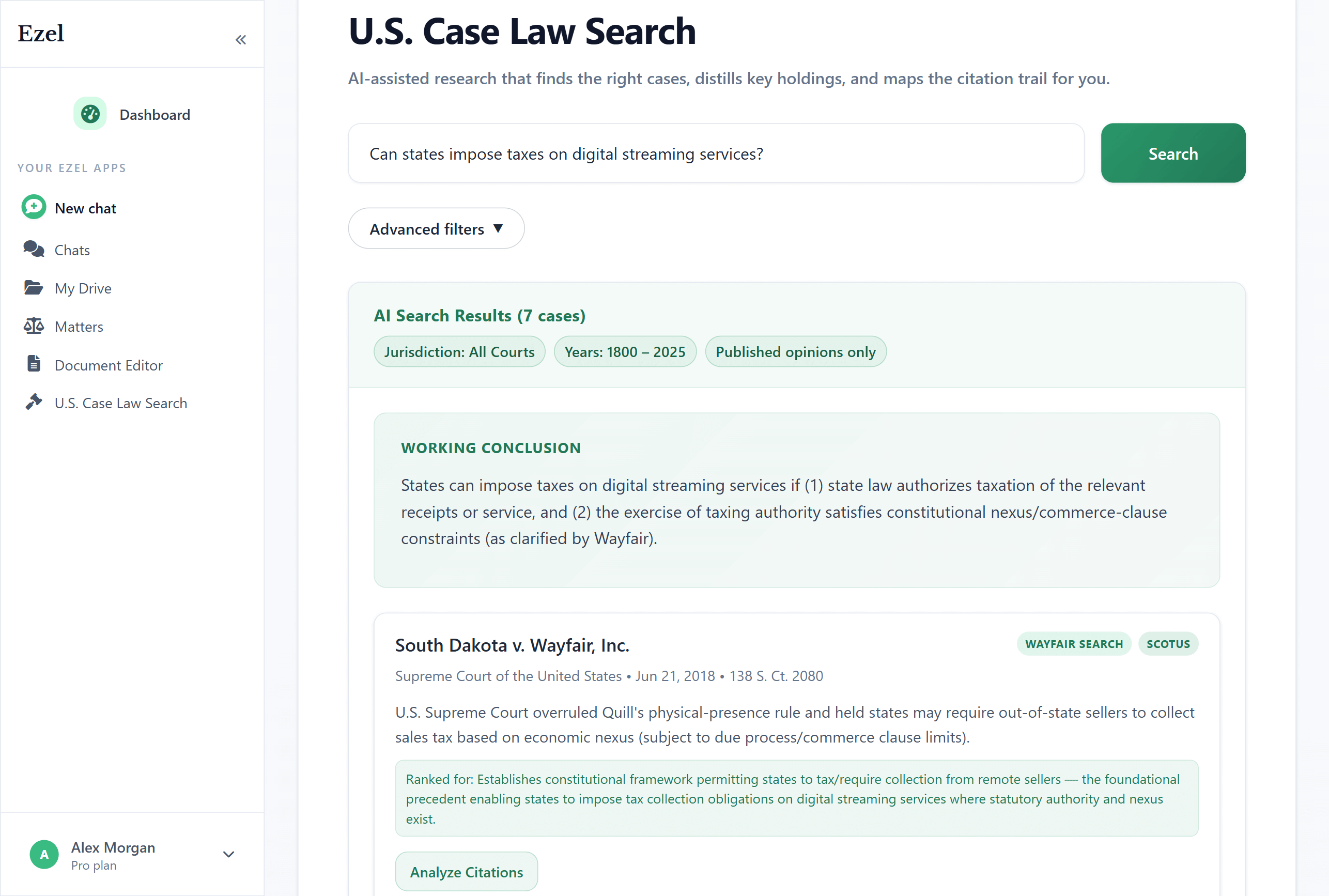
Search like you think
Describe your legal question in plain English. Filter by jurisdiction, date, and court level. Read full opinions without leaving Ezel.
- All 50 states plus federal courts
- Natural language queries - no boolean syntax
- Citation analysis and network exploration
- Copy quotes with automatic citation generation
Ready to transform your legal workflow?
Join legal teams using Ezel to draft documents, research case law, and organize matters — all in one workspace.