EXPENSE REIMBURSEMENT POLICY
Company Name: [________________________________]
Effective Date: [__/__/____]
Last Revised: [__/__/____]
Policy Number: [____]
Approved By: [________________________________]
Department: Finance / Human Resources
1. PURPOSE AND SCOPE
1.1 Purpose
This policy establishes the guidelines and procedures for the reimbursement of reasonable and necessary business expenses incurred by employees of [________________________________] ("Company") in the course of performing their job duties. This policy is designed to:
- Ensure employees are reimbursed fairly and promptly for legitimate business expenses
- Comply with IRS accountable plan rules (Treas. Reg. § 1.62-2) so that reimbursements are not treated as taxable income
- Comply with state laws requiring mandatory reimbursement of business expenses
- Provide clear guidelines on eligible and ineligible expenses, documentation requirements, and approval workflows
- Protect the Company from unauthorized or excessive expenditures
- Maintain proper substantiation for tax and audit purposes
1.2 Scope
This policy applies to:
- All full-time and part-time employees
- Temporary employees and interns (to the extent they incur reimbursable business expenses)
- Employees working on-site, remotely, or in hybrid arrangements
- All Company locations and all states in which the Company has employees
Independent contractors are not covered by this policy; their expense arrangements are governed by their respective contracts.
1.3 Policy Hierarchy
In the event of a conflict between this policy and a more restrictive state law, the state law will control. Employees in states with mandatory reimbursement requirements (see Section 15) are entitled to reimbursement for all necessary business expenses as required by applicable law, regardless of any limitations in this policy.
2. IRS ACCOUNTABLE PLAN COMPLIANCE
2.1 Overview
This policy is intended to qualify as an "accountable plan" under Treas. Reg. § 1.62-2, so that reimbursed expenses are excluded from employees' taxable income and are not subject to income tax withholding or employment taxes.
2.2 Three Requirements
To qualify as an accountable plan, the policy must satisfy three requirements:
Business Connection: All reimbursed expenses must have a legitimate business purpose and must be incurred by the employee in connection with the performance of services as a Company employee.
Adequate Substantiation: Employees must substantiate each expense by providing documentation of the amount, date, time (for travel or entertainment), place, and business purpose of the expense, within a reasonable period of time (see Section 10).
Return of Excess Amounts: Employees who receive advance payments or per diem allowances in excess of substantiated expenses must return the excess to the Company within a reasonable period of time (see Section 11).
2.3 Tax Consequences of Non-Compliance
If an expense reimbursement arrangement fails to meet the accountable plan requirements, the reimbursement will be treated as a "nonaccountable plan" payment. This means:
- The reimbursement amount will be included in the employee's gross income
- The amount will be reported as wages on the employee's Form W-2
- The amount will be subject to federal income tax withholding, Social Security, and Medicare taxes
- The employee will not be able to deduct the expense on their personal tax return (per the Tax Cuts and Jobs Act of 2017, which suspended the deduction for unreimbursed employee business expenses through 2025)
3. ELIGIBLE EXPENSE CATEGORIES
The following categories of expenses are eligible for reimbursement when incurred for a legitimate business purpose, subject to the specific limits and requirements set forth below.
3.1 Travel — Airfare
| Item | Guideline |
|---|---|
| Class of service | Coach/economy class for domestic flights; premium economy permitted for international flights over [____] hours |
| Booking | Employees should book at the lowest reasonable fare available at the time of booking |
| Advance booking | Flights should be booked at least [____] days in advance when practicable |
| Upgrades | First-class or business-class upgrades are not reimbursable unless pre-approved by [________________________________] |
| Baggage fees | Standard checked baggage fees (one bag) are reimbursable; excess baggage requires pre-approval |
| Change/cancellation fees | Reimbursable if the change is due to business necessity; fees due to personal reasons are not reimbursable |
| Frequent flyer programs | Employees may retain personal frequent flyer miles earned on business travel |
3.2 Travel — Lodging
| Item | Guideline |
|---|---|
| Nightly rate limit | Up to $[____] per night (standard room) in non-high-cost locations; up to $[____] per night in high-cost locations |
| Hotel selection | Employees should select reasonably priced accommodations; luxury or resort hotels require pre-approval |
| Extended stays | Stays of [____] or more consecutive nights require pre-approval and consideration of corporate housing or extended-stay options |
| Incidentals | Hotel internet, parking at the hotel, and standard gratuities are reimbursable |
| Non-reimbursable | Room service (unless no other dining option is available), minibar charges, movie rentals, personal phone calls, spa or recreation charges |
3.3 Travel — Ground Transportation
| Item | Guideline |
|---|---|
| Rental cars | Mid-size or smaller; pre-approved by [________________________________]; Company-approved vendors preferred |
| Rental insurance | Decline collision/damage waiver if covered by Company insurance or corporate credit card; verify with [________________________________] |
| Rideshare/taxi | Standard service (not luxury/premium) for airport transfers, client meetings, and other business travel |
| Personal vehicle | Reimbursed at the IRS standard mileage rate (see Section 4) |
| Parking | Reasonable parking fees with receipts |
| Tolls | Toll charges with receipts or electronic toll records |
| Public transit | Reimbursable at actual cost |
3.4 Travel — Meals
| Item | Guideline |
|---|---|
| Daily meal limit | Up to $[____] per day (or applicable per diem rate — see Section 5) |
| Individual meal limits | Breakfast: up to $[____]; Lunch: up to $[____]; Dinner: up to $[____] |
| Alcohol | Alcoholic beverages are [reimbursable with a limit of $[____] per person / not reimbursable] |
| Tips | Gratuities up to [____]% of the pre-tax meal amount are reimbursable |
| Meals included | If a meal is provided by the hotel, conference, or client, the employee should not also claim a reimbursement for that meal |
3.5 Client Entertainment and Business Meals
| Item | Guideline |
|---|---|
| Pre-approval | Required for entertainment expenses exceeding $[____] |
| Documentation | Must include the business purpose, names of attendees, and their business relationship to the Company |
| Per-person limit | Up to $[____] per person per event |
| Allowable activities | Business meals with clients, prospects, or business partners |
| Tax note | Under IRC § 274(k), business meals are generally 50% deductible by the Company when the expense is not lavish or extravagant and the employee or the employee's representative is present |
3.6 Business Supplies and Materials
| Item | Guideline |
|---|---|
| Office supplies | Reimbursable when purchased for Company use and not available through normal procurement |
| Printing and copying | Reimbursable for business documents |
| Postage and shipping | Reimbursable for business mailings |
| Pre-approval | Required for purchases over $[____] |
3.7 Professional Development
| Item | Guideline |
|---|---|
| Conferences and seminars | Reimbursable with pre-approval from [________________________________]; registration fees, travel, and lodging are subject to this policy |
| Continuing education | Reimbursable if required by the employee's job or pre-approved by [________________________________] |
| Professional certifications | Exam fees and study materials reimbursable with pre-approval |
| Professional memberships | Annual dues for job-related professional organizations reimbursable with pre-approval |
| Subscriptions | Job-related publications and online subscriptions reimbursable with pre-approval |
| Books | Job-related books reimbursable up to $[____] per year without pre-approval |
3.8 Communications
| Item | Guideline |
|---|---|
| Business calls | Reimbursable (including international calls for business purposes) |
| Mobile phone | [Company-provided / stipend of $[____] per month / actual business use reimbursed] — see state-specific addenda |
| Internet | See Section 6 (Remote Work Expenses) |
4. MILEAGE REIMBURSEMENT
4.1 IRS Standard Mileage Rate
Employees who use their personal vehicles for Company business will be reimbursed at the IRS standard mileage rate in effect at the time the travel occurs:
| Period | Rate per Mile |
|---|---|
| Calendar Year 2025 | $0.70 per mile |
| Calendar Year 2026 | $0.725 per mile |
Note: Mileage rates are published annually by the IRS and are subject to change. The Company will update this policy as new rates are announced. The 2025 rate is per IRS Notice 2025-05; the 2026 rate is per IRS Notice 2026-10.
4.2 Mileage Calculation
- Mileage is calculated from the employee's regular work location to the business destination, or from the employee's home to the business destination if the employee starts from home, whichever is less
- Commuting mileage (home to regular work location and return) is not reimbursable
- Employees who regularly work from home and must travel to a Company office or other business location will be reimbursed for mileage from their home to the destination, minus their normal commute (if any)
- GPS or mapping application records are acceptable for documenting mileage
4.3 Mileage Log
Employees must maintain a mileage log that includes:
☐ Date of travel
☐ Starting point and destination
☐ Business purpose of the trip
☐ Total miles driven for business purposes
☐ Odometer readings or mapping application screenshots (recommended)
4.4 Depreciation Component
For employees and the Company's records: of the 2026 rate of $0.725, approximately $0.35 per mile is attributable to vehicle depreciation.
5. PER DIEM OPTION
5.1 Overview
In lieu of reimbursing actual expenses for lodging and/or meals and incidental expenses (M&IE), the Company may elect to use the IRS per diem rates. Per diem payments that do not exceed the applicable federal rate do not need to be substantiated with individual receipts (only the time, place, and business purpose must be documented).
5.2 Current Per Diem Rates (High-Low Substantiation Method)
Effective October 1, 2025 through September 30, 2026 (per IRS Notice 2025-54):
| Locality Type | Total Per Diem | Lodging | Meals & Incidental Expenses (M&IE) |
|---|---|---|---|
| High-cost localities | $319 per day | $233 | $86 |
| All other CONUS localities | $225 per day | $151 | $74 |
A locality is designated as "high-cost" if the federal per diem rate for that locality is $272 or more per day. The list of high-cost localities is published annually in IRS notices and updated quarterly by GSA.
5.3 Meals-Only Per Diem
The Company may also elect to reimburse actual lodging costs plus a per diem for meals and incidental expenses only:
| Locality Type | M&IE Per Diem |
|---|---|
| High-cost localities | $86 per day |
| All other CONUS localities | $74 per day |
5.4 Partial Day Per Diem
For the first and last day of travel, the per diem for M&IE is 75% of the applicable rate.
5.5 GSA Locality Rates
As an alternative to the high-low method, the Company may use the GSA locality-specific per diem rates published at https://www.gsa.gov/travel/plan-book/per-diem-rates. Employees should confirm the applicable rate for their destination before travel.
5.6 International Travel
Per diem rates for international travel are published by the U.S. Department of State at https://aoprals.state.gov/web920/per_diem.asp. International travel must be pre-approved by [________________________________].
6. REMOTE WORK EXPENSE REIMBURSEMENT
6.1 Applicability
This section applies to employees who are authorized to work remotely on a regular basis (at least [____] days per week) or full-time. Occasional remote work (e.g., inclement weather days) is generally not covered unless required by state law.
6.2 Reimbursable Remote Work Expenses
The following expenses may be eligible for reimbursement for authorized remote workers:
| Category | Guideline |
|---|---|
| Internet service | Monthly reimbursement up to $[____] or [____]% of the employee's home internet bill, representing the business-use portion |
| Cell phone service | Monthly reimbursement up to $[____] or [____]% of the employee's cell phone bill, if the employee uses a personal phone for business |
| Home office equipment | Desk, chair, monitor, keyboard, mouse, and other equipment necessary for the employee's job function, with pre-approval, up to $[____] |
| Office supplies | Paper, ink, toner, pens, and similar supplies used for Company business |
| Software and subscriptions | Job-related software licenses or subscriptions not provided by the Company |
| Printing | Printing costs for business documents, including printer ink/toner |
6.3 Non-Reimbursable Remote Work Expenses
- Home rent or mortgage payments
- Utilities (electricity, heating, cooling) unless required by state law
- Home office furniture beyond what is necessary and pre-approved
- Home maintenance or renovations
- Personal technology devices used primarily for personal purposes
6.4 State Law Requirements
Several states require reimbursement of necessary remote work expenses incurred at the employer's direction. In particular:
- California (Lab. Code § 2802): Requires reimbursement of all necessary expenditures incurred by the employee in direct consequence of the discharge of their duties. For remote workers, this includes a reasonable portion of internet, phone, and other necessary expenses.
- Illinois (820 ILCS 115/9.5): Requires reimbursement of all necessary expenditures within the employee's scope of employment.
- Other states: See Section 15 for the full list of states with mandatory reimbursement requirements.
The Company will reimburse remote work expenses as required by applicable law, even if the expense is not specifically listed in this policy.
6.5 Stipend Option
In lieu of tracking and reimbursing individual remote work expenses, the Company may provide a monthly remote work stipend of $[____] to cover routine expenses. Stipend amounts should be set at a level that reasonably approximates the actual expenses incurred.
Tax Note: A fixed stipend not requiring substantiation of actual expenses does not satisfy the accountable plan rules and will be treated as taxable income.
7. TECHNOLOGY AND EQUIPMENT EXPENSES
7.1 Company-Provided Equipment
The Company will generally provide employees with the technology and equipment necessary to perform their jobs, including laptops, monitors, phones, and standard software. Company-provided equipment remains the property of the Company.
7.2 Employee-Purchased Equipment
If an employee is authorized to purchase technology or equipment for Company use, the following guidelines apply:
| Item | Pre-Approval Required | Maximum Reimbursement |
|---|---|---|
| Computer/laptop | Yes | $[____] |
| Monitor | Yes | $[____] |
| Printer | Yes | $[____] |
| Peripheral devices (keyboard, mouse, headset, webcam) | No (if under $[____]) | $[____] per item |
| Software licenses | Yes | Actual cost |
| Phone cases and accessories (for business phones) | No (if under $[____]) | $[____] |
7.3 Repairs and Maintenance
Repairs to Company-owned equipment should be coordinated through the IT department. Unauthorized repairs are not reimbursable. Repairs to employee-owned equipment used for Company business may be reimbursable with pre-approval.
8. CORPORATE CREDIT CARD POLICY
8.1 Issuance
Corporate credit cards are issued at the discretion of [________________________________] to employees who regularly incur business expenses on behalf of the Company. Corporate credit cards remain the property of the Company.
8.2 Authorized Use
☐ Corporate credit cards may be used only for authorized Company business expenses
☐ Personal charges on corporate credit cards are strictly prohibited
☐ Employees are responsible for the security of their corporate credit card and must report lost or stolen cards immediately to [________________________________]
8.3 Reconciliation
☐ Employees must reconcile corporate credit card statements within [____] days of the statement date
☐ Each transaction must be supported by an itemized receipt and a description of the business purpose
☐ Any personal charge inadvertently placed on the corporate credit card must be reported immediately and repaid to the Company within [____] days
8.4 Liability
☐ The Company is liable for authorized business charges on corporate credit cards
☐ The employee is personally liable for any unauthorized, personal, or undocumented charges
☐ Failure to reconcile corporate credit card statements or comply with this section may result in revocation of the card and disciplinary action
8.5 Termination
Upon separation from employment, the employee must return the corporate credit card to [________________________________] on or before the last day of employment. Any outstanding unreconciled charges must be resolved prior to or at the time of separation.
9. PRE-APPROVAL REQUIREMENTS
9.1 When Pre-Approval Is Required
Pre-approval is required for the following:
☐ All travel involving overnight stays
☐ International travel
☐ Individual expenses expected to exceed $[____]
☐ Client entertainment exceeding $[____]
☐ Conferences, seminars, and professional development activities
☐ Technology and equipment purchases exceeding $[____]
☐ Home office equipment (for remote workers)
☐ Any expense outside of normal categories described in this policy
9.2 Approval Authority
| Expense Amount | Approver |
|---|---|
| Up to $[____] | [Direct Supervisor / Manager] |
| $[____] to $[____] | [Department Head / Director] |
| $[____] to $[____] | [VP / Senior Leadership] |
| Over $[____] | [CFO / CEO / President] |
9.3 How to Request Pre-Approval
Employees must submit a pre-approval request to their approver (via [email / expense management system / form]) that includes:
☐ Description of the expense and business purpose
☐ Estimated amount
☐ Date(s) of the expected expense
☐ Supporting information (conference agenda, travel itinerary, vendor quote, etc.)
Pre-approval does not guarantee reimbursement of the full estimated amount. Actual reimbursement will be based on documented expenses incurred.
10. SUBSTANTIATION AND DOCUMENTATION REQUIREMENTS
10.1 General Requirements
Under IRC § 274 and Treas. Reg. § 1.62-2(e), all expenses must be substantiated with adequate records. For each expense, the employee must provide:
☐ Amount: The exact amount of the expense (itemized receipt required for expenses of $75 or more; recommended for all expenses)
☐ Date: The date the expense was incurred
☐ Place: The location or vendor where the expense was incurred
☐ Business Purpose: A clear description of the business reason for the expense
☐ Names and Relationships: For business meals and entertainment, the names of the individuals present and their business relationship to the Company
10.2 Receipt Requirements
| Expense Type | Receipt Required |
|---|---|
| Expenses of $75 or more | Original itemized receipt required |
| Expenses under $75 | Receipt strongly recommended; a written record of amount, date, place, and business purpose is acceptable |
| Lodging | Itemized hotel folio required (regardless of amount) |
| Airfare | E-ticket receipt or boarding pass showing fare paid |
| Mileage | Mileage log (no receipt required for mileage reimbursement at IRS standard rate) |
| Per diem | No individual meal receipts required; documentation of travel dates, destination, and business purpose required |
| Tips/gratuities | Note on meal receipt or separate record |
10.3 Lost or Missing Receipts
If an original receipt is lost or unavailable:
- The employee must complete a Lost Receipt Affidavit, providing the date, amount, vendor, and business purpose
- Lost receipt affidavits should be the exception, not the norm
- Repeated inability to provide receipts may result in denial of reimbursement and/or review of the employee's expense privileges
10.4 Currency Conversion
Expenses incurred in foreign currency must be converted to U.S. dollars using the exchange rate in effect on the date of the transaction. Credit card statements showing the converted amount are acceptable documentation.
11. EXPENSE REPORT SUBMISSION AND TIMING
11.1 Submission Deadlines
| Requirement | Timeframe |
|---|---|
| Submit expense report | Within [____] calendar days of incurring the expense or completing the trip |
| Reconcile corporate credit card | Within [____] days of the statement date |
| Return excess advance amounts | Within [____] calendar days of completing the trip or activity |
IRS "Reasonable Period" Safe Harbor: Under Revenue Ruling 2005-52, advances within 30 days before the expense, substantiation within 60 days after, and return of excess within 120 days after the expense are deemed to meet the "reasonable period" standard for accountable plan compliance.
11.2 How to Submit
Employees must submit expense reports through [the Company's expense management system / email to [________________________________] / paper form submitted to [________________________________]].
Each expense report must include:
☐ Employee name, department, and employee ID
☐ Expense period (dates covered by the report)
☐ Itemized list of expenses with amounts, dates, vendors, and business purposes
☐ Attached receipts and supporting documentation
☐ Mileage log (if applicable)
☐ Pre-approval documentation (if applicable)
☐ Employee signature and date
11.3 Late Submissions
Expense reports submitted more than [____] days after the expense was incurred may be denied or treated as nonaccountable plan payments (and included in the employee's taxable income). Employees are encouraged to submit expense reports promptly to avoid delayed reimbursement and adverse tax consequences.
12. APPROVAL AND PAYMENT
12.1 Review and Approval
- Expense reports will be reviewed by [the employee's direct supervisor / the Finance department / [________________________________]]
- The reviewer will verify compliance with this policy, reasonableness of expenses, adequacy of documentation, and proper pre-approval
- Incomplete or non-compliant expense reports will be returned to the employee for correction
12.2 Reimbursement Timing
| Method | Timing |
|---|---|
| Standard reimbursement | Within [____] business days of approval, or on the next regular payroll cycle |
| State law minimum | See Section 15 for state-specific reimbursement timing requirements |
State Law Note: In some states (including California), reimbursement must be made promptly and cannot be unreasonably delayed. Employers must ensure that reimbursement timing complies with applicable state law.
12.3 Payment Method
Approved reimbursements will be paid via [direct deposit to the employee's payroll account / separate check / [________________________________]]. Reimbursements that qualify under the accountable plan will not be reported as wages and will not be subject to tax withholding.
12.4 Disputes
If an expense is denied or reduced, the employee will be notified with an explanation. The employee may appeal the denial by submitting a written explanation to [________________________________] within [____] days of the denial. The appeal will be reviewed by [________________________________], whose decision is final.
13. NON-REIMBURSABLE EXPENSES
The following expenses are generally not reimbursable:
☐ Personal expenses not related to Company business
☐ Commuting costs between home and the regular workplace (except as required by state law for remote workers)
☐ Traffic citations, parking tickets, and moving violations
☐ Late fees, interest charges, or penalties
☐ Personal entertainment, recreation, or leisure activities
☐ Personal clothing (unless required protective or specialized work attire)
☐ Pet care or pet-sitting during business travel
☐ Childcare or dependent care during business travel (unless provided as a Company benefit)
☐ Personal travel, side trips, or travel extensions not related to Company business
☐ Travel companion expenses (spouse, partner, or family member)
☐ Expenses reimbursed by a third party (client, conference organizer, etc.)
☐ Luxury or premium services unless pre-approved (first-class airfare, premium rideshare, luxury hotels)
☐ Personal grooming, spa services, or fitness center fees
☐ Laundry and dry cleaning (unless the trip exceeds [____] consecutive days)
☐ Personal phone calls (beyond reasonable de minimis use)
☐ Gifts to clients or business associates exceeding $[____] per person per year (IRS limit: $25 per person per year for tax deductibility under IRC § 274(b))
☐ Charitable contributions
☐ Expenses without adequate documentation (unless the employee completes a lost receipt affidavit)
☐ Expenses not pre-approved when pre-approval was required
14. ADVANCES
14.1 Eligibility
Employees may request a cash advance for anticipated business expenses when:
- The estimated expenses exceed $[____]
- The expenses are for approved travel or a specific business purpose
- The employee is not able to use a corporate credit card
14.2 Process
☐ Submit advance request to [________________________________] at least [____] business days before the anticipated expense
☐ Include a description of the business purpose and estimated expenses
☐ Obtain approval from [________________________________]
14.3 Reconciliation
☐ Within [____] calendar days of completing the trip or activity, the employee must submit an expense report reconciling the advance against actual expenses
☐ If actual expenses are less than the advance, the employee must return the excess to the Company within [____] calendar days
☐ If actual expenses exceed the advance, the difference will be reimbursed through the normal expense reimbursement process
14.4 Outstanding Advances
Advances not reconciled within the required timeframe will be treated as follows:
- A reminder will be issued to the employee
- If still unreconciled after [____] additional days, the advance may be deducted from the employee's next paycheck (to the extent permitted by applicable state law and with appropriate written authorization)
- Unreconciled advances may be reported as taxable income on the employee's Form W-2
15. STATE MANDATORY REIMBURSEMENT LAWS
The following states have laws requiring employers to reimburse employees for necessary business expenses. The Company will comply with all applicable state reimbursement requirements, which may provide broader coverage than this policy.
15.1 State-by-State Summary
| State | Statute | Key Requirements |
|---|---|---|
| California | Lab. Code § 2802 | Employers must reimburse employees for all necessary expenditures or losses incurred in direct consequence of the discharge of their duties or the employer's directions. No written policy exception. Applies to all employees, including remote workers. Failure to reimburse may result in penalties, interest, and attorney's fees. |
| Illinois | 820 ILCS 115/9.5 (IWPCA) | Employers must reimburse employees for all necessary expenditures or losses within the employee's scope of employment and directly related to services performed for the employer. Employer may establish a written policy setting expense limits, but must reimburse within those limits. Excludes losses due to employee negligence, normal wear, or theft (unless caused by employer negligence). Effective January 1, 2019. |
| District of Columbia | D.C. Code § 32-1331.09 | Employers must reimburse employees for all expenses that the employer authorized the employee to incur. |
| Iowa | Iowa Code § 91A.3 | Employer must reimburse employee for expenses incurred by the employee on behalf of the employer to the extent that the expenses were authorized by the employer. |
| Massachusetts | M.G.L. ch. 149, § 148A | Employers must reimburse employees for transportation expenses incurred by employees in carrying out their employment, if the expenses meet certain criteria. |
| Minnesota | Minn. Stat. § 177.24 | Employers may not require employees to pay the employer's cost of doing business, which courts have interpreted to include necessary business expenses. |
| Montana | Mont. Code Ann. § 39-2-701 | Employer must reimburse employee for all necessary expenses incurred in the course of employment if the employee is required to make the expenditure. |
| New Hampshire | RSA § 275:57 | Employer must reimburse employee for expenses incurred at the request of the employer, including necessary tools and equipment. |
| South Dakota | SDCL § 60-2-1 | Employer-required expenses must be reimbursed. |
15.2 California Compliance Detail (Lab. Code § 2802)
Given the breadth of California's reimbursement requirements, the following additional guidelines apply to employees working in California:
☐ The Company will reimburse all necessary business expenses, including cell phone costs (proportionate to business use), internet costs (for remote workers), personal vehicle use, and other expenses required by or incurred as a result of the employee's job duties
☐ Reimbursement will be made promptly and may not be delayed unreasonably
☐ Employees need not formally submit an expense report for the Company's obligation to attach, but the Company may require submission of expense reports to facilitate timely reimbursement
☐ Failure to reimburse may result in the employee recovering the unreimbursed amount plus interest and reasonable attorney's fees under Lab. Code § 2802(c)
15.3 Illinois Compliance Detail (820 ILCS 115/9.5)
☐ The Company will reimburse Illinois employees for all necessary expenditures within the scope of employment
☐ The Company may establish written expense limits, and employees who fail to comply with the written policy or who exceed policy limits are not entitled to reimbursement for the non-compliant amount
☐ Employees who believe they have been denied reimbursement for a necessary business expense may file a complaint with the Illinois Department of Labor
16. TAX IMPLICATIONS
16.1 Accountable Plan Reimbursements
Reimbursements made under this policy that meet the accountable plan requirements (business connection, substantiation, return of excess) are:
☐ Excluded from the employee's gross income
☐ Not reported as wages on Form W-2
☐ Not subject to federal income tax withholding, Social Security, or Medicare taxes
☐ Deductible by the Company as a business expense
16.2 Nonaccountable Plan Reimbursements
Reimbursements that do not meet accountable plan requirements (including late-submitted expense reports, unsubstantiated expenses, and unreturned excess advances) are:
☐ Included in the employee's gross income
☐ Reported as wages on Form W-2
☐ Subject to federal income tax withholding, Social Security, and Medicare taxes
16.3 Per Diem and Mileage
☐ Per diem payments at or below the federal rate are not taxable to the employee (if the accountable plan requirements are met)
☐ Per diem payments exceeding the federal rate are taxable to the extent of the excess
☐ Mileage reimbursement at or below the IRS standard rate is not taxable to the employee
☐ Mileage reimbursement exceeding the IRS standard rate is taxable to the extent of the excess
16.4 Business Gifts
Under IRC § 274(b), the Company's tax deduction for business gifts is limited to $25 per recipient per year. Gifts exceeding this amount may still be reimbursable but may not be fully deductible by the Company.
17. POLICY VIOLATIONS AND FRAUD
17.1 Prohibited Conduct
The following conduct constitutes a violation of this policy:
☐ Submitting false, fabricated, or altered receipts or expense reports
☐ Claiming reimbursement for personal expenses
☐ Claiming reimbursement for expenses paid by a third party
☐ Intentionally inflating expenses or submitting duplicate claims
☐ Using a corporate credit card for personal purchases
☐ Failing to return excess advance amounts within the required timeframe
☐ Submitting expenses without required pre-approval
17.2 Consequences
Violations of this policy may result in:
- Denial of the expense claim
- Requirement to repay improperly received reimbursements
- Revocation of corporate credit card privileges
- Disciplinary action up to and including termination
- Referral to law enforcement in cases of fraud, theft, or embezzlement
17.3 Audits
The Company reserves the right to audit expense reports and reimbursements at any time. Employees must cooperate with any audit or review of their expense records.
18. POLICY ADMINISTRATION
18.1 Policy Owner
This policy is administered by [________________________________] with support from the Finance and Human Resources departments.
18.2 Annual Review
This policy will be reviewed at least annually and updated to reflect:
☐ Changes in IRS mileage rates and per diem rates
☐ Changes in applicable state or federal law
☐ Changes in Company operations or business practices
☐ Feedback from employees, managers, and auditors
18.3 Questions
Employees who have questions about this policy or the reimbursability of a specific expense should contact [________________________________] before incurring the expense.
EMPLOYEE ACKNOWLEDGMENT
I, [________________________________], acknowledge that:
☐ I have received, read, and understand the Company's Expense Reimbursement Policy.
☐ I understand that I am responsible for complying with this policy when incurring and submitting business expenses.
☐ I understand that submitting false or fraudulent expense claims is a serious violation that may result in disciplinary action, up to and including termination and referral to law enforcement.
☐ I understand that expenses not properly documented or not submitted within the required timeframes may be denied reimbursement or treated as taxable income.
☐ I understand that I must return any excess advance amounts within the timeframes specified in this policy.
☐ I have had an opportunity to ask questions about this policy and have received satisfactory answers.
Employee Signature: [________________________________]
Employee Printed Name: [________________________________]
Date: [__/__/____]
Supervisor/HR Signature: [________________________________]
Date: [__/__/____]
QUICK REFERENCE: CURRENT IRS RATES
Verify rates at irs.gov before relying on these figures.
| Rate | 2025 | 2026 |
|---|---|---|
| Standard Mileage Rate (Business) | $0.70/mile | $0.725/mile |
| Standard Mileage Rate (Medical/Moving) | $0.21/mile | $0.205/mile |
| Standard Mileage Rate (Charitable) | $0.14/mile | $0.14/mile |
| Per Diem — High-Cost (Total) | $319/day | $319/day* |
| Per Diem — Low-Cost (Total) | $225/day | $225/day* |
| Per Diem — High-Cost (M&IE only) | $86/day | $86/day* |
| Per Diem — Low-Cost (M&IE only) | $74/day | $74/day* |
| Business Gift Deduction Limit | $25/person/year | $25/person/year |
Per diem rates shown are from IRS Notice 2025-54 (effective Oct. 1, 2025 through Sept. 30, 2026). New rates for the Oct. 1, 2026 through Sept. 30, 2027 period will be published separately.
SOURCES AND REFERENCES
- IRS Accountable Plan Rules, Treas. Reg. § 1.62-2
- IRC § 274 — Disallowance of Certain Entertainment, Amusement, Recreation, and Travel Expenses
- IRC § 162 — Trade or Business Expenses
- IRS Notice 2026-10, 2026 Standard Mileage Rates
- IRS Notice 2025-54, Special Per Diem Rates (Oct. 1, 2025 – Sept. 30, 2026)
- IRS Revenue Ruling 2005-52 (Reasonable Period Safe Harbor)
- IRS Publication 463, Travel, Gift, and Car Expenses
- IRS Publication 5137, Fringe Benefit Guide
- California Labor Code § 2802
- Illinois Wage Payment and Collection Act, 820 ILCS 115/9.5
- GSA Per Diem Rates: https://www.gsa.gov/travel/plan-book/per-diem-rates
- State Department Per Diem Rates: https://aoprals.state.gov/web920/per_diem.asp
This template is provided for informational purposes only and does not constitute legal advice. It is intended for use on the ezel.ai platform. You must have this document reviewed and customized by a qualified attorney licensed in your jurisdiction before implementation. Tax laws and employment laws vary by jurisdiction and change frequently. IRS rates referenced in this document should be verified at the time of adoption. Do not distribute this policy to employees without professional legal and tax counsel review.
Do more with Ezel
This free template is just the beginning. See how Ezel helps legal teams draft, research, and collaborate faster.
AI that drafts while you watch
Tell the AI what you need and watch your document transform in real-time. No more copy-pasting between tools or manually formatting changes.
- Natural language commands: "Add a force majeure clause"
- Context-aware suggestions based on document type
- Real-time streaming shows edits as they happen
- Milestone tracking and version comparison
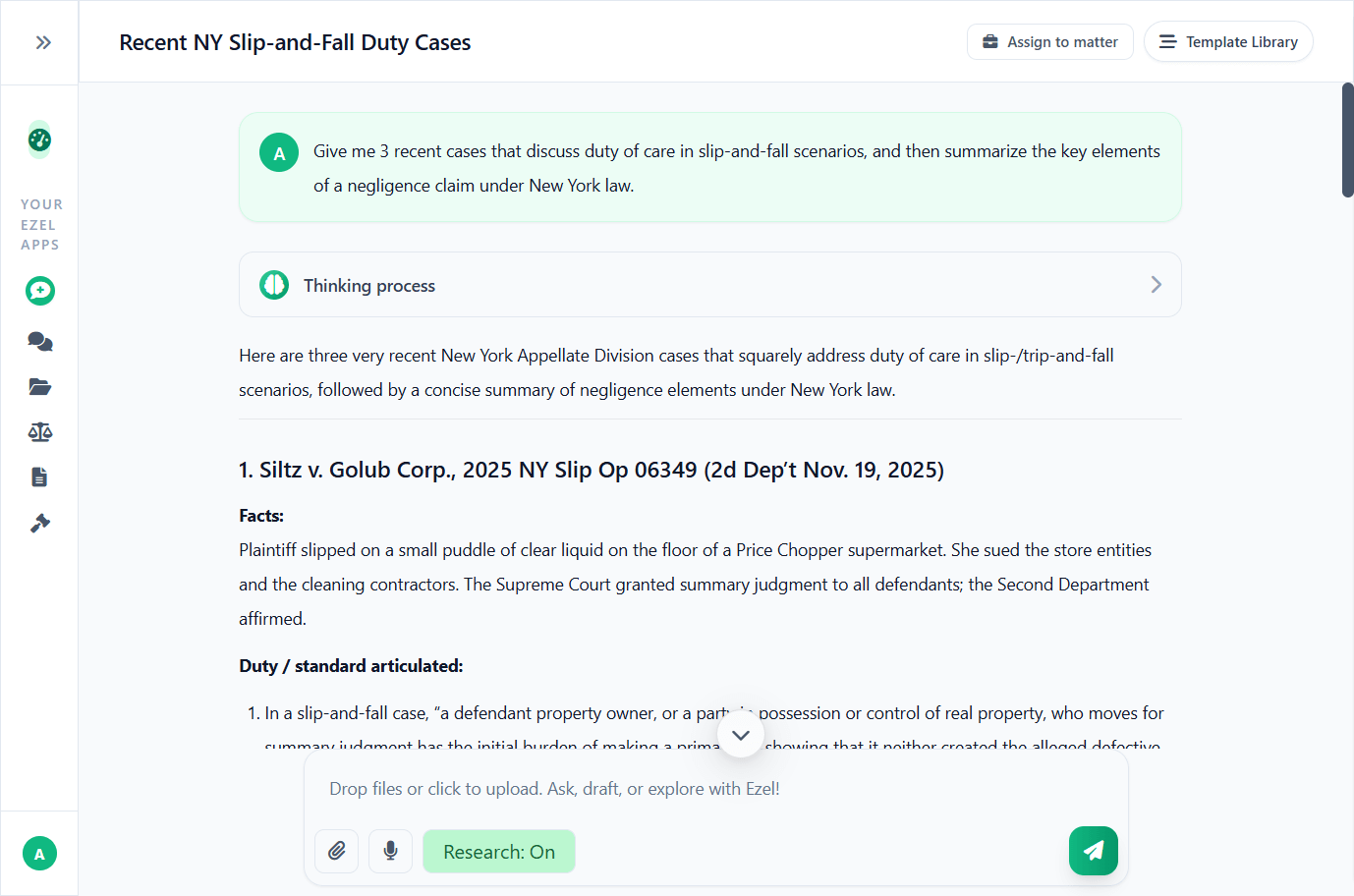
Research and draft in one conversation
Ask questions, attach documents, and get answers grounded in case law. Link chats to matters so the AI remembers your context.
- Pull statutes, case law, and secondary sources
- Attach and analyze contracts mid-conversation
- Link chats to matters for automatic context
- Your data never trains AI models
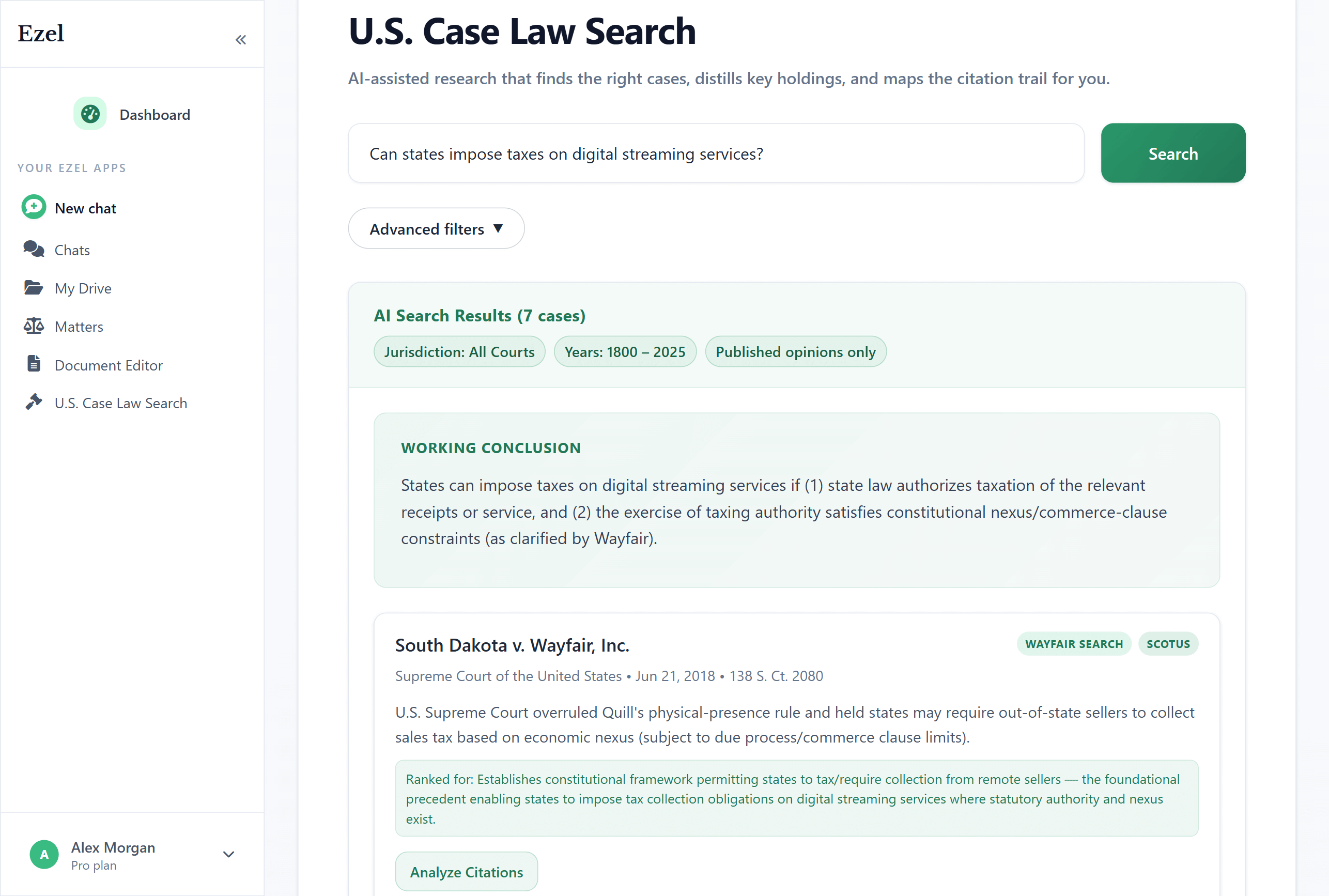
Search like you think
Describe your legal question in plain English. Filter by jurisdiction, date, and court level. Read full opinions without leaving Ezel.
- All 50 states plus federal courts
- Natural language queries - no boolean syntax
- Citation analysis and network exploration
- Copy quotes with automatic citation generation
Ready to transform your legal workflow?
Join legal teams using Ezel to draft documents, research case law, and organize matters — all in one workspace.