ENGAGEMENT LETTER — ESTATE PLANNING
Firm Letterhead
[FIRM NAME]
[FIRM ADDRESS LINE 1]
[FIRM ADDRESS LINE 2]
[CITY], [STATE] [ZIP CODE]
Telephone: [____________________]
Facsimile: [____________________]
Email: [____________________]
Website: [____________________]
Date: [__/__/____]
VIA [HAND DELIVERY / CERTIFIED MAIL / EMAIL]
[CLIENT FULL LEGAL NAME]
[SPOUSE / PARTNER FULL LEGAL NAME (if joint engagement)]
[CLIENT ADDRESS LINE 1]
[CLIENT ADDRESS LINE 2]
[CITY], [STATE] [ZIP CODE]
Re: Engagement for Estate Planning Services
Our File No.: [________________________________]
Dear [CLIENT NAME(S)]:
Thank you for selecting [LAW FIRM NAME] ("Firm," "we," or "us") to assist you with your estate planning needs. This Engagement Letter, together with the attached Fee Agreement, sets forth the terms and conditions under which the Firm will provide legal services to you ("Client" or "you"). Please read this letter carefully and contact us with any questions before signing.
This letter constitutes a binding agreement between you and the Firm. Please retain a copy for your records.
1. SCOPE OF REPRESENTATION
1.1 Client Identification
☐ Individual Client: [________________________________]
☐ Joint Engagement (Married Couple / Domestic Partners):
Client 1: [________________________________]
Client 2: [________________________________]
IMPORTANT — Joint Representation Notice: If this is a joint engagement for a married couple or domestic partners, the Firm represents both individuals. Information shared by one client will be shared with the other unless otherwise agreed. If a conflict of interest arises between the joint clients, the Firm may be required to withdraw from representing one or both clients. See Section 7 for details.
1.2 Estate Planning Documents to Be Prepared
The Firm will prepare the following documents (check all that apply):
Wills and Trusts:
☐ Last Will and Testament
☐ Pour-Over Will (to fund a trust)
☐ Revocable Living Trust (individual)
☐ Revocable Living Trust (joint / A-B / A-B-C trust)
☐ Irrevocable Life Insurance Trust (ILIT)
☐ Special Needs Trust (Supplemental Needs Trust)
☐ Charitable Remainder Trust (CRT) / Charitable Lead Trust (CLT)
☐ Grantor Retained Annuity Trust (GRAT)
☐ Qualified Personal Residence Trust (QPRT)
☐ Minor's Trust / Education Trust
☐ Spendthrift Trust
☐ Pet Trust
☐ Other trust: [________________________________]
☐ Trust amendment or restatement of existing trust
Powers of Attorney and Health Care Directives:
☐ Durable General Power of Attorney (Financial)
☐ Limited / Specific Power of Attorney: [________________________________]
☐ Health Care Power of Attorney / Health Care Proxy
☐ Advance Health Care Directive / Living Will
☐ HIPAA Authorization (compliant with 45 CFR § 164.508)
☐ Mental Health Treatment Directive (where applicable by state law)
☐ Nomination of Guardian for Minor Children
☐ Nomination of Conservator (in case of future incapacity)
Beneficiary Designations and Asset Planning:
☐ Beneficiary designation review and recommendations (retirement accounts, life insurance, TOD/POD accounts)
☐ Trust funding guidance and assistance (retitling assets into trust)
☐ Community property agreement (community property states)
☐ Property agreements (separate property transmutation)
☐ Family LLC or Family Limited Partnership planning
☐ Business succession planning (integrated with estate plan)
☐ Gifting strategy and documentation
Other Documents:
☐ Letter of instruction / personal memorandum
☐ Ethical will / legacy statement
☐ Digital asset inventory and access instructions
☐ Organ donation declaration
☐ Burial / cremation instructions
☐ Other: [________________________________]
1.3 Matters Expressly Excluded
Unless separately agreed to in writing, the following are not included in this engagement:
- Tax return preparation (income, gift, estate, or generation-skipping transfer tax)
- Tax planning beyond general estate tax considerations discussed during the engagement
- Business valuation or appraisal services
- Financial planning, investment advice, or asset management
- Life insurance analysis or procurement
- Real estate transactions (purchase, sale, or transfer of property beyond trust funding guidance)
- Probate, trust administration, or estate administration
- Guardianship or conservatorship proceedings
- Litigation of any kind (will contests, trust disputes, capacity challenges)
- Medicaid / long-term care planning (unless specifically included above)
- Asset protection planning beyond the scope of the estate plan
- Elder law or nursing home planning
- Ongoing monitoring of law changes after document execution
- Annual reviews (unless a separate maintenance agreement is established)
2. FEE ARRANGEMENT
2.1 Fee Structure
The Firm will charge for services under the following arrangement (check one):
☐ Flat Fee — Standard Estate Planning Package:
Total flat fee: $[________] for the documents checked in Section 1.2.
This includes:
- Initial consultation and information gathering
- Preparation of all documents listed in Section 1.2
- One round of revisions based on client feedback
- Document execution meeting (signing ceremony)
- Trust funding guidance letter
Payable as follows:
- $[________] due upon signing this Engagement Letter
- $[________] due at the document execution meeting
☐ Flat Fee — Individual Document:
| Document | Fee |
|---|---|
| Simple Will | $[________] |
| Will with Testamentary Trust | $[________] |
| Revocable Living Trust (individual) | $[________] |
| Revocable Living Trust (joint) | $[________] |
| Irrevocable Trust | $[________] |
| Power of Attorney (Financial) | $[________] |
| Health Care Directive / HIPAA | $[________] |
| Trust Amendment | $[________] |
| Complete Trust Restatement | $[________] |
☐ Hourly Fee (Complex Trusts / Tax Planning):
Attorney rates: $[____]/hour for partners; $[____]/hour for associates; $[____]/hour for paralegals.
Retainer deposit: $[________], to be held in the Firm's client trust account.
Estimated total fee range: $[________] to $[________]
2.2 Costs and Expenses
You are responsible for costs, which may include:
☐ Notary fees
☐ Recording fees (for deeds transferring property to a trust)
☐ Document storage fees (if applicable)
☐ Copying and binding fees
☐ Postage and courier charges
☐ Travel fees for off-site execution ceremonies (e.g., hospital, nursing home)
2.3 Future Amendments and Updates
Future amendments, codicils, or restatements of documents are not included in the current engagement and will require a new fee agreement. The Firm offers the following options for ongoing service:
☐ Annual Review Program: $[________]/year for an annual review meeting and minor document updates
☐ Amendment Pricing: Amendments will be billed at the then-current flat fee or hourly rate
3. CLIENT RESPONSIBILITIES
3.1 Information Gathering
You agree to:
☐ Provide complete and accurate information about your assets, debts, family circumstances, and estate planning objectives
☐ Complete and return the estate planning questionnaire within [____] days
☐ Respond to Firm communications within [____] business days
☐ Review draft documents carefully and provide feedback promptly
☐ Attend the document execution meeting at the scheduled time
☐ Notify the Firm of any material changes in your circumstances before documents are finalized
3.2 Information and Documents to Provide
You must provide the following to the Firm:
Personal and Family Information:
☐ Full legal names and dates of birth for you, your spouse/partner, and all children (including from prior relationships)
☐ Social Security numbers (for trust and beneficiary designation purposes)
☐ Citizenship and residency information
☐ Prior marriage dissolution decrees or separation agreements
☐ Pre-nuptial or post-nuptial agreements
☐ Guardianship or custody orders affecting minor children
Asset Information:
☐ Real property deeds and mortgage statements
☐ Bank and investment account statements
☐ Retirement account statements (401(k), IRA, pension, etc.) with current beneficiary designations
☐ Life insurance policies with face values and current beneficiary designations
☐ Business ownership documents (operating agreements, partnership agreements, stock certificates)
☐ Vehicle titles
☐ Valuable personal property inventory (jewelry, art, collections)
☐ Digital asset inventory (online accounts, cryptocurrency, digital files)
☐ Outstanding debts and liabilities
Existing Estate Planning Documents:
☐ Current will, trust, or codicil
☐ Existing powers of attorney
☐ Existing health care directives
☐ Prior trust amendments
3.3 Trust Funding — Critical Client Obligation
IMPORTANT: If your estate plan includes a revocable living trust, the trust is effective only to the extent that your assets are properly transferred ("funded") into the trust. Unfunded trusts do not avoid probate. Trust funding may include:
☐ Re-titling real property via deed(s) into the trust
☐ Re-titling bank and investment accounts into the trust
☐ Changing beneficiary designations on retirement accounts and life insurance
☐ Assigning tangible personal property to the trust
☐ Assigning business interests to the trust
The Firm will provide a Trust Funding Guide with specific instructions. You are responsible for completing trust funding. The Firm can assist with deed preparation and provide guidance, but contacting financial institutions to re-title accounts is your responsibility unless the Firm specifically agrees to assist.
☐ Client understands trust funding responsibility.
☐ Firm will prepare deed(s) for the following properties: [________________________________]
☐ Firm will assist with account re-titling for an additional fee of $[________].
3.4 Fiduciary Appointments — Important Decisions
You must designate the individuals or entities who will serve in the following fiduciary roles. The Firm will discuss the responsibilities and qualifications for each role:
☐ Executor / Personal Representative (administers your estate under a will)
Primary: [________________________________]
Alternate: [________________________________]
☐ Trustee (manages trust assets)
Primary: [________________________________]
Alternate: [________________________________]
☐ Agent under Power of Attorney — Financial (makes financial decisions if you are incapacitated)
Primary: [________________________________]
Alternate: [________________________________]
☐ Health Care Agent / Proxy (makes health care decisions if you cannot)
Primary: [________________________________]
Alternate: [________________________________]
☐ Guardian for Minor Children (has physical custody of your minor children)
Primary: [________________________________]
Alternate: [________________________________]
☐ Conservator / Guardian for Your Person (cares for you if incapacitated — if separate from POA agent)
Primary: [________________________________]
Alternate: [________________________________]
4. HIPAA AUTHORIZATION
The Health Insurance Portability and Accountability Act (HIPAA), 42 U.S.C. § 1320d et seq., restricts the disclosure of your protected health information. A HIPAA authorization allows your designated agents to access your medical records and communicate with your health care providers. Under 45 CFR § 164.508, a valid HIPAA authorization must:
- Be signed and dated by the individual
- Identify the person(s) authorized to receive health information
- Describe the information to be disclosed
- Include an expiration date or event
- State the right to revoke the authorization
The Firm will prepare a HIPAA authorization as part of your health care planning documents unless you opt out:
☐ Client authorizes preparation of HIPAA authorization form
☐ Client opts out of HIPAA authorization preparation
5. RISKS AND DISCLOSURES SPECIFIC TO ESTATE PLANNING
5.1 No Guarantee of Tax Outcomes
The Firm cannot guarantee any particular tax result. Federal and state tax laws change frequently. The current federal estate tax exemption is $[________] per person (2026: subject to scheduled reduction under the Tax Cuts and Jobs Act sunset). Estate plans designed under current law may need to be updated if tax laws change.
5.2 State Estate and Inheritance Taxes
In addition to the federal estate tax, certain states impose their own estate or inheritance taxes with lower exemption thresholds. Examples include:
- New York: State estate tax with a "cliff" — estates exceeding the exemption by more than 5% are fully taxable (N.Y. Tax Law § 951)
- Massachusetts, Oregon, Minnesota, and others have exemptions significantly lower than the federal exemption
- Several states impose inheritance taxes on beneficiaries (e.g., Iowa, Kentucky, Maryland, Nebraska, New Jersey, Pennsylvania)
California, Texas, and Florida do not impose a separate state estate or inheritance tax.
5.3 Incapacity Planning
A well-drafted estate plan addresses incapacity as well as death. Without proper powers of attorney and health care directives, your family may need to seek court-supervised guardianship or conservatorship to manage your affairs if you become incapacitated — a process that is costly, time-consuming, and public.
5.4 Importance of Updating Your Estate Plan
Your estate plan should be reviewed and potentially updated after any of the following life events:
- Marriage, divorce, or domestic partnership changes
- Birth or adoption of children or grandchildren
- Death of a beneficiary or fiduciary
- Significant change in assets or financial circumstances
- Move to a different state
- Changes in tax law
- Changes in health or capacity
- Changes in your wishes or family relationships
The Firm's engagement is limited to the preparation of the documents described herein and does not include ongoing monitoring or updates unless a separate agreement is established.
5.5 Document Storage and Safekeeping
You should store original signed documents in a secure, accessible location. The Firm recommends:
- Keeping original wills in a fireproof safe or safe deposit box (note: some states restrict access to safe deposit boxes after death)
- Providing your executor/trustee with information about where documents are stored
- NOT placing original documents in locations that may be inaccessible in an emergency
- The Firm ☐ will / ☐ will not store original documents on your behalf
5.6 Digital Assets
Digital assets (email, social media, cryptocurrency, cloud storage, online financial accounts) may require special planning. The Revised Uniform Fiduciary Access to Digital Assets Act (RUFADAA) (adopted in most states) governs fiduciary access to digital assets. You should maintain an inventory of digital assets and access credentials in a secure location.
6. COMMUNICATION POLICY
6.1 Primary Communication Method
☐ Email: [________________________________]
☐ Telephone: [________________________________]
☐ Client portal: [________________________________]
☐ U.S. Mail
6.2 Response Times
The Firm will respond to communications within [____] business days. You should respond to Firm communications within [____] business days.
6.3 Joint Client Communications
If this is a joint engagement, all communications and documents will be shared with both clients unless otherwise agreed. See Section 7 regarding joint representation.
7. CONFLICTS OF INTEREST — JOINT REPRESENTATION
7.1 Individual Client
☐ No joint representation issues. The Firm represents only the individual client identified in Section 1.1.
7.2 Joint Representation of Spouses / Partners
☐ Joint representation acknowledged. You understand and agree to the following:
- The Firm represents both clients as a unit. Information disclosed by either client will be shared with the other client.
- There is no individual attorney-client privilege as between the joint clients in this engagement.
- If a conflict of interest arises (e.g., one client wants different distribution terms, separate trust provisions, or has different objectives than the other client), the Firm may be required to:
- Withdraw from representing one or both clients
- Recommend that one or both clients seek independent counsel
- Common situations that may give rise to conflicts include:
- Differing wishes regarding distribution to children from prior relationships
- Disputes over trust terms, beneficiary designations, or fiduciary appointments
- Separation, divorce, or domestic disputes
- Concerns about one client's capacity or undue influence
By signing below, both clients consent to joint representation with full knowledge of these limitations.
7.3 Third-Party Involvement
If a third party (e.g., adult child, financial advisor, family member) is present during meetings or involved in the planning process, you understand that their presence may waive the attorney-client privilege as to information disclosed in their presence.
8. TERMINATION OF REPRESENTATION
8.1 Client's Right to Terminate
You may terminate this engagement at any time by providing written notice. Under a flat fee arrangement, the Firm will calculate the reasonable value of services rendered and refund any unearned portion. Under an hourly arrangement, all accrued fees are due immediately.
8.2 Firm's Right to Withdraw
The Firm may withdraw from representation as permitted by the applicable Rules of Professional Conduct, including failure to cooperate, failure to pay fees, or the emergence of an irreconcilable conflict between joint clients.
8.3 Completion of Engagement
This engagement concludes upon execution (signing) of all documents listed in Section 1.2 and delivery of the Trust Funding Guide (if applicable). After that point, the attorney-client relationship for this engagement terminates unless a separate agreement for ongoing services is established.
9. FILE RETENTION AND DESTRUCTION
The Firm will retain your file for a period of [____] years after the conclusion of the engagement. After that period, the file may be destroyed. Original executed documents will be returned to you at the conclusion of the engagement (or stored by the Firm if agreed in Section 5.5). You are strongly encouraged to keep original documents in a safe and accessible location.
10. DISPUTE RESOLUTION REGARDING FEES
If a dispute arises regarding the Firm's fees:
☐ State bar fee arbitration program
☐ Mediation followed by arbitration
☐ Other: [________________________________]
11. NO GUARANTEE OF OUTCOME
THE FIRM MAKES NO GUARANTEES REGARDING THE EFFECTIVENESS OF YOUR ESTATE PLAN, TAX SAVINGS, AVOIDANCE OF PROBATE, OR ANY OTHER OUTCOME. Estate plans are based on current law and current facts, both of which are subject to change. The Firm strongly recommends periodic review and updating of your estate plan.
12. MULTI-STATE JURISDICTION NOTES
12.1 California
- Written fee agreements required for matters exceeding $1,000 (Cal. Bus. & Prof. Code § 6148).
- Community property state — community property laws affect estate planning significantly.
- California Probate Code §§ 15000–18204 governs trusts.
- No state estate or inheritance tax.
- Cal. Prob. Code § 4701 governs advance health care directives.
- Cal. Prob. Code § 4400 governs durable powers of attorney.
12.2 New York
- 22 NYCRR Part 1215 requires written engagement letters for matters exceeding $3,000.
- N.Y. EPTL governs wills, trusts, and estates. Two-witness requirement for wills (N.Y. EPTL § 3-2.1).
- New York imposes a state estate tax with a "cliff" provision (N.Y. Tax Law § 951).
- Separate property state — equitable distribution laws may affect planning for married clients.
- N.Y. Public Health Law Art. 29-C governs health care proxies.
12.3 Texas
- Texas Disciplinary Rules of Professional Conduct, Rule 1.04.
- Community property state — extensive community property rules affect estate planning.
- Texas Estates Code governs wills, trusts, and estate administration.
- No state estate or inheritance tax.
- Texas allows holographic (handwritten) wills (Tex. Est. Code § 251.052).
- Medical power of attorney governed by Tex. Health & Safety Code § 166.152.
12.4 Florida
- Florida Bar Rule 4-1.5 governs fee agreements.
- Separate property state (though some community property issues may arise for couples relocating from community property states).
- No state estate or inheritance tax.
- Florida Probate Code (Fla. Stat. Chapters 731–739) and Florida Trust Code (Fla. Stat. Chapter 736) govern wills and trusts.
- Florida has specific homestead restrictions that limit the ability to devise homestead property (Fla. Const. Art. X, § 4(c)).
- Fla. Stat. § 765.101 et seq. governs health care advance directives.
- Two-witness requirement for wills (Fla. Stat. § 732.502).
13. ACKNOWLEDGMENT AND ACCEPTANCE
By signing below, you acknowledge that:
☐ You have read and understand this Engagement Letter and the attached Fee Agreement
☐ You understand the scope of representation, including what is and is not covered
☐ You understand the fee arrangement and your responsibility for costs
☐ You understand the importance of trust funding and your responsibility for completing it
☐ You understand the need to periodically review and update your estate plan
☐ You understand and consent to joint representation (if applicable)
☐ You understand that the Firm cannot guarantee any particular outcome or tax result
☐ You have received a copy of this Engagement Letter and all attachments
Signature Block
AGREED AND ACCEPTED:
CLIENT 1:
____________________________________________
[CLIENT 1 FULL LEGAL NAME] (Printed)
____________________________________________ Date: [__/__/____]
[CLIENT 1 SIGNATURE]
CLIENT 2 (Joint Engagement):
____________________________________________
[CLIENT 2 FULL LEGAL NAME] (Printed)
____________________________________________ Date: [__/__/____]
[CLIENT 2 SIGNATURE]
ATTORNEY:
____________________________________________
[ATTORNEY NAME], Esq.
[LAW FIRM NAME]
____________________________________________ Date: [__/__/____]
[ATTORNEY SIGNATURE]
14. ATTACHMENTS CHECKLIST
☐ Fee Agreement (flat fee schedule or hourly terms)
☐ State-Required Fee Disclosures (CA: Bus. & Prof. Code § 6148; NY: 22 NYCRR 1215; FL: Bar Rule 4-1.5)
☐ Estate Planning Questionnaire (comprehensive intake form)
☐ Conflict of Interest / Joint Representation Consent (if applicable)
☐ Trust Funding Guide and Instructions (to be provided with executed documents)
☐ HIPAA Authorization Form (draft for review)
☐ Document Storage Instructions
☐ Digital Asset Inventory Worksheet
☐ Privacy Policy / Electronic Communication Consent Form
☐ Fee Arbitration Notice (as required by applicable state bar rules)
SOURCES AND REFERENCES
- ABA Model Rules of Professional Conduct: https://www.americanbar.org/groups/professional_responsibility/publications/model_rules_of_professional_conduct/
- ABA Model Rule 1.7 (Conflict of Interest — Current Clients): https://www.americanbar.org/groups/professional_responsibility/publications/model_rules_of_professional_conduct/rule_1_7_conflict_of_interest_current_clients/
- ACTEC Commentaries on the Model Rules of Professional Conduct (estate planning ethics): https://www.actec.org/resources/commentaries-on-the-model-rules-of-professional-conduct/
- HIPAA Authorization Requirements, 45 CFR § 164.508: https://www.law.cornell.edu/cfr/text/45/164.508
- Uniform Trust Code: https://www.uniformlaws.org/committees/community-home?CommunityKey=193ff839-7955-4846-8f3c-ce74ac23938d
- Revised Uniform Fiduciary Access to Digital Assets Act (RUFADAA): https://www.uniformlaws.org/committees/community-home?CommunityKey=f7237fc4-74c2-4b3b-99b6-e1f84a3fca8c
- IRS Estate and Gift Tax Information: https://www.irs.gov/businesses/small-businesses-self-employed/estate-and-gift-taxes
- California Probate Code (Trusts): https://leginfo.legislature.ca.gov/faces/codes_displayexpandedbranch.xhtml?tocCode=PROB
- New York EPTL: https://www.nysenate.gov/legislation/laws/EPT
- Texas Estates Code: https://statutes.capitol.texas.gov/Docs/ES/htm/ES.251.htm
- Florida Trust Code (Fla. Stat. Ch. 736): http://www.leg.state.fl.us/statutes/index.cfm?App_mode=Display_Statute&URL=0700-0799/0736/0736ContentsIndex.html
Do more with Ezel
This free template is just the beginning. See how Ezel helps legal teams draft, research, and collaborate faster.
AI that drafts while you watch
Tell the AI what you need and watch your document transform in real-time. No more copy-pasting between tools or manually formatting changes.
- Natural language commands: "Add a force majeure clause"
- Context-aware suggestions based on document type
- Real-time streaming shows edits as they happen
- Milestone tracking and version comparison
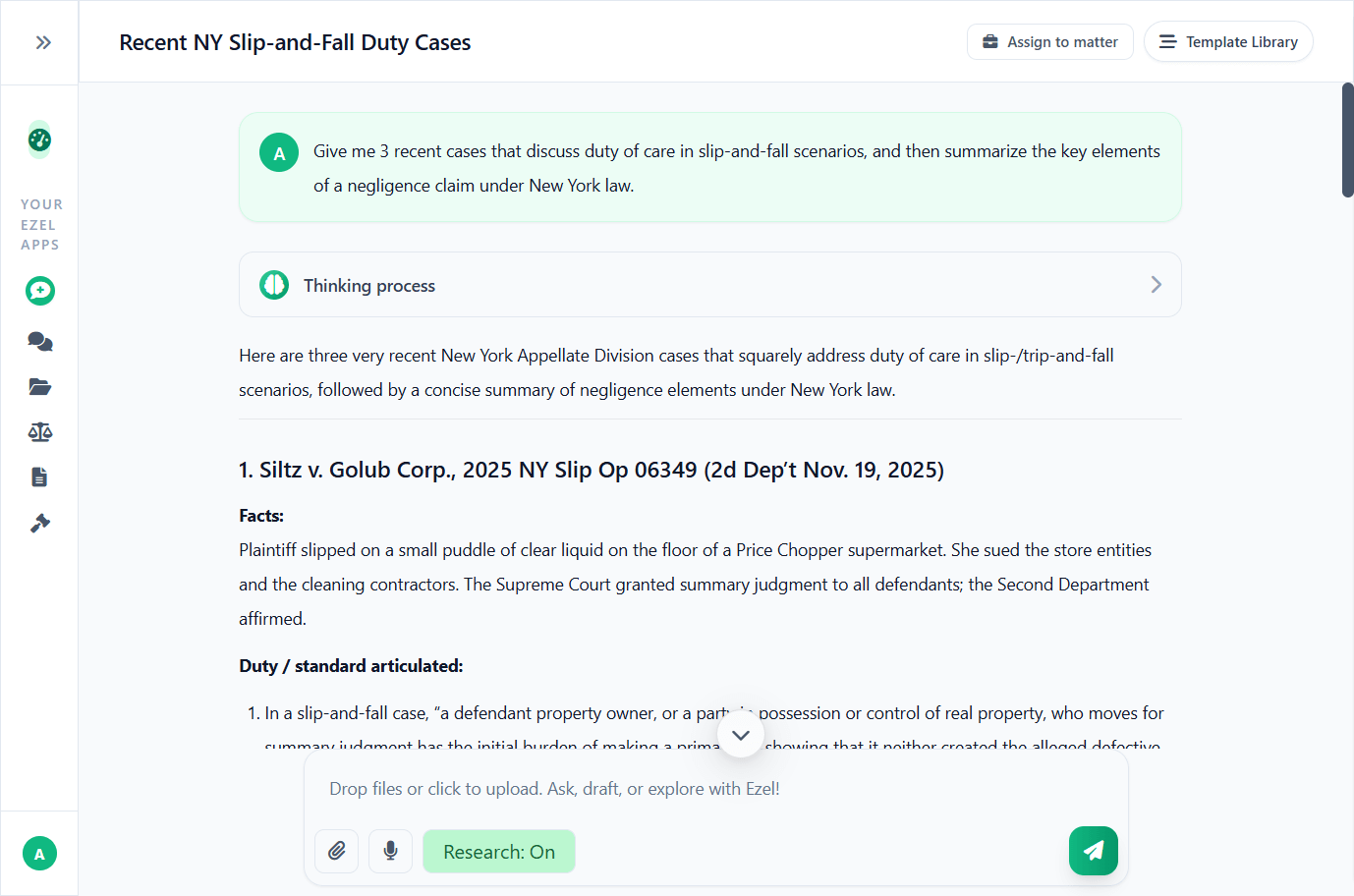
Research and draft in one conversation
Ask questions, attach documents, and get answers grounded in case law. Link chats to matters so the AI remembers your context.
- Pull statutes, case law, and secondary sources
- Attach and analyze contracts mid-conversation
- Link chats to matters for automatic context
- Your data never trains AI models
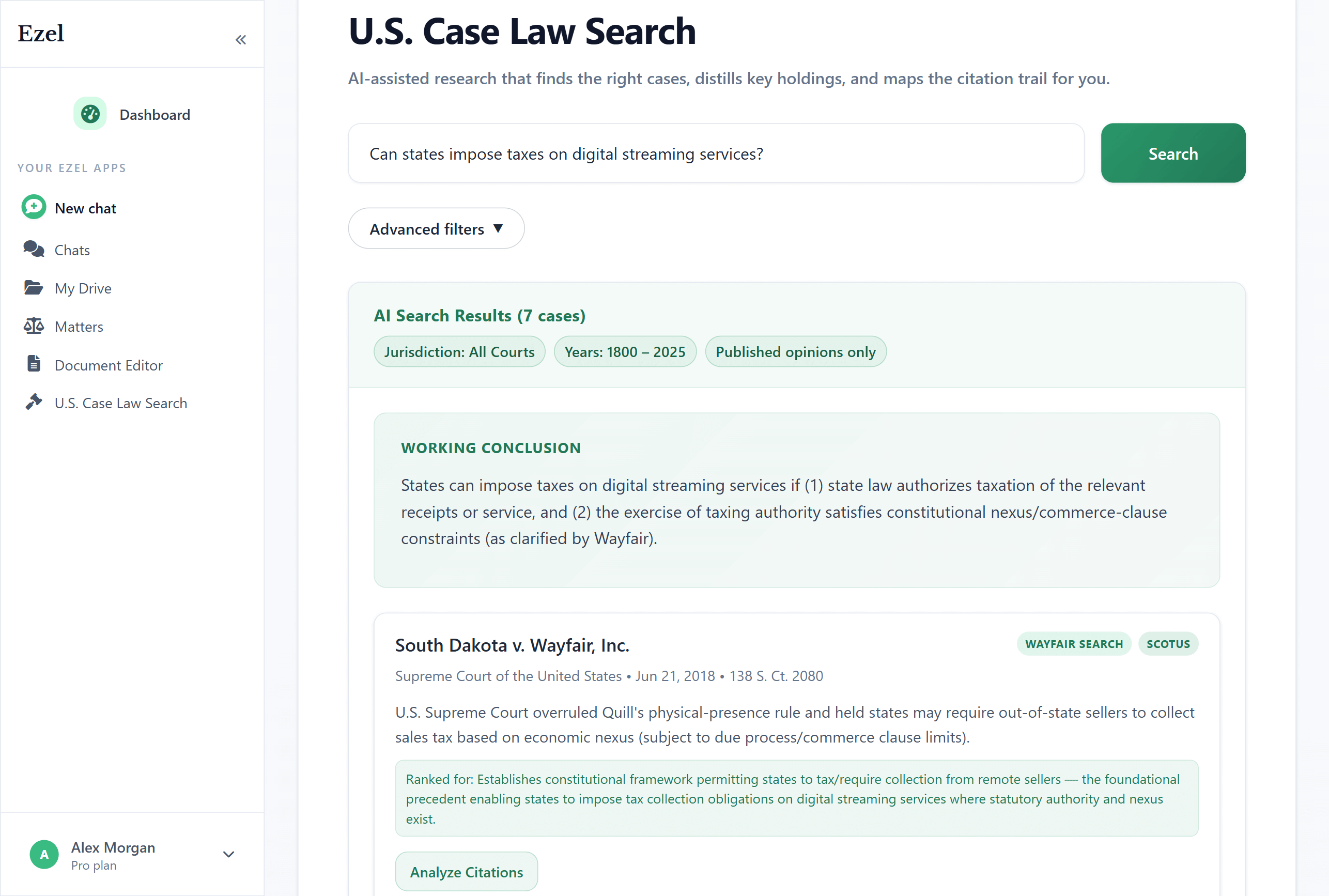
Search like you think
Describe your legal question in plain English. Filter by jurisdiction, date, and court level. Read full opinions without leaving Ezel.
- All 50 states plus federal courts
- Natural language queries - no boolean syntax
- Citation analysis and network exploration
- Copy quotes with automatic citation generation
Ready to transform your legal workflow?
Join legal teams using Ezel to draft documents, research case law, and organize matters — all in one workspace.