EQUAL EMPLOYMENT OPPORTUNITY POLICY
Company: [________________________________]
Policy Number: [________________________________]
Effective Date: [__/__/____]
Last Revised: [__/__/____]
Approved By: [________________________________], [Title]
Applies To: All employees, applicants, contractors, interns, and volunteers
TABLE OF CONTENTS
- Purpose and Policy Statement
- Scope and Applicability
- Federal Protected Categories
- State and Local Protected Categories
- Non-Discrimination in Employment Practices
- Reasonable Accommodation
- Complaint and Reporting Procedures
- Investigation Process
- Anti-Retaliation Protections
- Manager and Supervisor Responsibilities
- Record Retention
- Federal Contractor Addendum
- State-Specific Addenda
- Policy Administration
- Acknowledgment
1. PURPOSE AND POLICY STATEMENT
[________________________________] ("Company") is committed to providing equal employment opportunity to all individuals regardless of any characteristic protected by applicable federal, state, or local law. This policy governs all aspects of the employment relationship, from recruitment and hiring through separation, and reflects the Company's commitment to building and maintaining a diverse, equitable, and inclusive workplace.
The Company prohibits discrimination, harassment, and retaliation in all employment practices. This commitment extends to all persons involved in the Company's operations, including employees, applicants, independent contractors, interns, volunteers, temporary workers, and third parties conducting business with the Company.
This policy shall be interpreted and administered consistently with all applicable federal, state, and local employment laws. Where state or local law provides broader protections than federal law, the Company will comply with the more protective standard.
2. SCOPE AND APPLICABILITY
2.1 Covered Individuals
This policy applies to:
- All full-time, part-time, and temporary employees
- Job applicants and candidates at all stages of the hiring process
- Independent contractors and consultants performing work for the Company
- Interns (paid and unpaid) and apprentices
- Volunteers
- Former employees (with respect to references, benefits continuation, and post-employment obligations)
2.2 Covered Employment Practices
This policy applies to all terms, conditions, and privileges of employment, including but not limited to:
- Recruitment, advertising, and job postings
- Application and selection processes (including use of AI and automated decision-making tools)
- Hiring, placement, and onboarding
- Compensation, pay equity, and benefits
- Promotions, transfers, and reassignments
- Training and professional development opportunities
- Performance evaluations and management
- Discipline and corrective action
- Layoffs, reductions in force, and recalls
- Termination and separation
- Retirement policies and practices
- Leave administration
- Workplace conditions, assignments, and scheduling
- Social and recreational programs sponsored by the Company
2.3 Covered Locations
This policy applies at all Company facilities, worksites, remote work locations, and any location where Company business is conducted, including off-site events, business travel, and virtual work environments.
3. FEDERAL PROTECTED CATEGORIES
The Company prohibits discrimination based on the following characteristics protected under federal law:
3.1 Title VII of the Civil Rights Act of 1964 (42 U.S.C. § 2000e et seq.)
- Race — Including race-related characteristics such as hair texture, protective hairstyles, and racial stereotyping
- Color
- Religion — Including religious observance, practice, dress, and grooming; the duty to accommodate sincerely held religious beliefs
- Sex — Including pregnancy, childbirth, and related medical conditions; sexual orientation; gender identity and expression; sex stereotyping (per Bostock v. Clayton County, 590 U.S. 644 (2020))
- National origin — Including ancestry, ethnicity, accent, and language-related characteristics
3.2 Americans with Disabilities Act (42 U.S.C. § 12101 et seq.)
- Disability — Physical or mental impairment that substantially limits one or more major life activities; record of such impairment; or being regarded as having such impairment
- Covers employers with 15 or more employees
3.3 Age Discrimination in Employment Act (29 U.S.C. § 621 et seq.)
- Age — Protects individuals who are 40 years of age or older
- Covers employers with 20 or more employees
3.4 Genetic Information Nondiscrimination Act (42 U.S.C. § 2000ff et seq.)
- Genetic information — Including genetic tests of the individual or family members, family medical history, requests for or receipt of genetic services, and participation in clinical research involving genetic services
- Covers employers with 15 or more employees
3.5 Equal Pay Act (29 U.S.C. § 206(d))
- Sex-based wage discrimination — Requires equal pay for substantially equal work regardless of sex
- Covers virtually all employers
3.6 Pregnant Workers Fairness Act (42 U.S.C. § 2000gg et seq.)
- Pregnancy, childbirth, and related medical conditions — Requires reasonable accommodation for known limitations unless undue hardship
- Effective June 27, 2023; EEOC final rule effective June 18, 2024
- Covers employers with 15 or more employees
3.7 PUMP for Nursing Mothers Act (29 U.S.C. § 218d)
- Lactation — Requires reasonable break time and private space (other than a bathroom) for expressing breast milk for one year after a child's birth
- Covers virtually all employees (exempt and non-exempt)
3.8 Additional Federal Protections
- Citizenship or immigration status — Immigration and Nationality Act (8 U.S.C. § 1324b)
- Uniformed service membership or veteran status — Uniformed Services Employment and Reemployment Rights Act (38 U.S.C. § 4301 et seq.)
- Bankruptcy filing — 11 U.S.C. § 525(b)
4. STATE AND LOCAL PROTECTED CATEGORIES
In addition to federal protections, the Company complies with all applicable state and local non-discrimination laws. Many jurisdictions protect additional categories beyond those recognized under federal law. Common additional protected categories include but are not limited to:
- Marital status or domestic partnership status
- Sexual orientation (where not already covered by Title VII interpretation)
- Gender identity or expression (where not already covered by Title VII interpretation)
- Reproductive health decision-making
- Political affiliation or activity
- Arrest or conviction record (subject to job-relatedness analysis)
- Credit history (where restricted by law)
- Victims of domestic violence, sexual assault, or stalking
- Source of income
- Military or veteran status (beyond USERRA)
- Caregiver or familial status
- Hair texture and protective hairstyles (CROWN Act jurisdictions)
- Off-duty lawful conduct
- Use of lawful consumable products
- Immigration or citizenship status
- AIDS/HIV status
- Sickle cell trait
- Breastfeeding or lactation status
NOTE TO EMPLOYER: Consult the state-specific addenda in Section 13 and work with legal counsel to identify all protected categories applicable in each jurisdiction where you have employees.
5. NON-DISCRIMINATION IN EMPLOYMENT PRACTICES
5.1 Recruitment and Hiring
The Company shall:
- Post job openings in a manner designed to reach a diverse pool of qualified candidates
- Base hiring decisions solely on job-related qualifications, skills, experience, and legitimate business needs
- Ensure job descriptions accurately reflect essential functions of the position
- Ensure that interview questions and selection criteria are job-related and applied consistently
- Refrain from inquiring about protected characteristics during the application or interview process unless required by law or directly relevant to a bona fide occupational qualification (BFOQ)
- Comply with applicable "ban the box" and fair chance hiring laws
- Review all AI-based and automated screening tools for potential disparate impact in accordance with EEOC guidance on algorithmic fairness
5.2 Compensation and Benefits
The Company shall:
- Establish compensation based on legitimate, non-discriminatory factors such as skill, effort, responsibility, working conditions, experience, education, and market data
- Conduct periodic pay equity audits to identify and remediate unexplained disparities
- Provide equal access to benefits, including health insurance, retirement plans, and leave programs, without regard to any protected characteristic
- Comply with the Equal Pay Act and applicable state pay equity and pay transparency laws
- Refrain from inquiring about salary history where prohibited by law
5.3 Promotions and Advancement
The Company shall:
- Make promotion and advancement decisions based on job-related criteria, performance, and qualifications
- Provide equal access to training, mentoring, and professional development opportunities
- Ensure that evaluation criteria for promotion are documented, consistently applied, and free from bias
5.4 Discipline and Termination
The Company shall:
- Apply disciplinary measures and performance standards consistently and without regard to protected characteristics
- Document all disciplinary actions and the legitimate, non-discriminatory reasons supporting them
- Ensure that termination decisions are reviewed by HR and, where appropriate, legal counsel before implementation
- Refrain from considering an employee's use of protected leave (e.g., FMLA, ADA accommodation, workers' compensation) as a negative factor in any employment decision
5.5 Use of AI and Automated Decision-Making
The Company acknowledges that the use of artificial intelligence, algorithms, and automated tools in employment decisions is subject to federal non-discrimination laws. The Company shall:
- Evaluate all AI and automated hiring or screening tools for potential adverse impact before deployment
- Ensure that vendors of such tools provide documentation regarding validation and bias testing
- Retain human oversight in all final employment decisions
- Comply with applicable state and local AI-in-hiring laws (e.g., New York City Local Law 144)
6. REASONABLE ACCOMMODATION
6.1 Disability Accommodation (ADA)
The Company will provide reasonable accommodation to qualified individuals with disabilities to enable them to perform the essential functions of their position, unless doing so would cause an undue hardship on the Company's operations.
Interactive process. Upon receiving a request for accommodation or becoming aware that an accommodation may be needed, the Company will engage in a timely, good-faith interactive process with the employee or applicant to identify effective accommodations. The Company does not require the use of specific language such as "reasonable accommodation" or "ADA" to initiate this process.
Examples of reasonable accommodations include but are not limited to:
- Modifications to the work environment or workstation
- Schedule adjustments or flexible work arrangements
- Reassignment to a vacant position
- Modified or assistive equipment or technology
- Remote work arrangements (evaluated on a case-by-case basis)
- Leave of absence beyond FMLA entitlement
- Modified job duties or policies (e.g., attendance flexibility)
- Accessible parking and facilities
- Sign language interpreters or readers
Documentation. The Company may request medical documentation to support an accommodation request when the disability or need for accommodation is not obvious. Documentation requests will be limited to information necessary to establish the existence of a disability, the functional limitations, and the need for the requested accommodation.
6.2 Pregnancy and Related Conditions (PWFA)
Under the Pregnant Workers Fairness Act, the Company will provide reasonable accommodation for known limitations related to, affected by, or arising out of pregnancy, childbirth, or related medical conditions, unless such accommodation would impose an undue hardship.
Key provisions:
- The Company will not require an employee to accept an accommodation other than one arrived at through the interactive process
- The Company will not deny employment opportunities to a qualified employee or applicant based on the need for accommodation
- The Company will not require an employee to take leave if another reasonable accommodation can be provided
- The Company will not take adverse action against an employee for requesting or using a reasonable accommodation
- Self-confirmation by the employee is sufficient documentation in many circumstances, including for obvious pregnancy-related needs, pumping/nursing needs, and predictable assessments
6.3 Religious Accommodation
The Company will reasonably accommodate sincerely held religious beliefs, practices, and observances unless doing so would cause undue hardship, defined as more than a de minimis cost to the Company's operations (per Groff v. DeJoy, 600 U.S. 447 (2023), which clarified that undue hardship requires showing substantial increased costs in relation to the conduct of the employer's business).
Examples include:
- Flexible scheduling for religious observances
- Voluntary shift substitutions or swaps
- Exceptions to dress or grooming requirements
- Use of workspace for prayer or religious practice
6.4 Lactation Accommodation (PUMP Act)
The Company will provide:
- Reasonable break time for employees to express breast milk for one year after a child's birth
- A private space, other than a bathroom, that is shielded from view and free from intrusion
- Break time that is compensated if the employee is not completely relieved of duties, or if during an otherwise paid break period
7. COMPLAINT AND REPORTING PROCEDURES
7.1 Internal Reporting
Any employee, applicant, or other covered individual who believes they have experienced or witnessed discrimination, harassment, or retaliation in violation of this policy is encouraged to report the concern promptly through any of the following channels:
| Channel | Contact |
|---|---|
| Immediate Supervisor | [________________________________] |
| Human Resources | [________________________________] |
| HR Director / VP of HR | [________________________________] |
| EEO Officer / Compliance Officer | [________________________________] |
| Anonymous Hotline | [________________________________] |
| [________________________________] |
Reports may be made verbally or in writing. The Company does not require that reports be submitted through a specific channel; any of the above channels will be treated as an official report. Employees who are uncomfortable reporting to their direct supervisor may report to any other channel listed above.
7.2 Information to Include in a Report
To assist in a prompt and thorough investigation, reports should include, to the extent available:
- Name(s) of the individual(s) involved (the person(s) who engaged in the alleged conduct)
- Date(s), time(s), and location(s) of the incident(s)
- Description of the alleged discriminatory conduct
- Name(s) of any witness(es)
- Any documents, emails, messages, or other evidence related to the incident
- Description of the impact on the reporting individual
7.3 External Reporting Options
Employees also have the right to file a charge of discrimination with the following agencies:
U.S. Equal Employment Opportunity Commission (EEOC)
- Website: www.eeoc.gov
- Phone: 1-800-669-4000
- Time limit: Generally 180 days from the date of the alleged violation (extended to 300 days in states with a state or local fair employment practices agency)
State and local fair employment practices agencies — Filing deadlines and procedures vary by jurisdiction. See Section 13 for state-specific agency information.
NOTE: Filing an internal complaint is encouraged but not required before filing a charge with the EEOC or a state agency. The Company's internal process does not replace or extend the deadlines for filing external charges.
8. INVESTIGATION PROCESS
8.1 General Principles
All complaints of discrimination, harassment, or retaliation will be investigated promptly, thoroughly, and impartially. The Company will:
- Acknowledge receipt of the complaint to the reporting individual within [____] business days
- Assign an impartial investigator (internal HR or external investigator as appropriate)
- Ensure the investigator has no conflict of interest with any party involved
- Endeavor to complete investigations within [____] business days, recognizing that complex matters may require additional time
- Maintain confidentiality to the greatest extent possible, consistent with the need to conduct a thorough investigation and take appropriate corrective action
8.2 Investigation Steps
- Intake — Review the complaint, assess the need for interim protective measures (e.g., separation of parties, temporary reassignment, administrative leave), and develop an investigation plan
- Interviews — Interview the complainant, the accused individual(s), and relevant witnesses
- Document review — Collect and review relevant documents, communications, records, and electronic evidence
- Analysis — Evaluate all evidence gathered, assess credibility, and determine whether a policy violation occurred based on a preponderance of the evidence standard
- Findings — Prepare a written summary of findings
- Communication — Notify the complainant and the accused of the outcome, to the extent permitted by law and consistent with privacy obligations
- Corrective action — Implement appropriate remedial measures if a violation is found
8.3 Corrective and Remedial Action
If the investigation determines that a violation of this policy has occurred, the Company will take prompt corrective action proportionate to the severity of the violation. Corrective action may include but is not limited to:
- Verbal or written warning
- Required training or counseling
- Performance improvement plan
- Demotion or loss of supervisory authority
- Suspension (with or without pay)
- Transfer or reassignment
- Termination of employment
- Any other action the Company deems appropriate under the circumstances
9. ANTI-RETALIATION PROTECTIONS
9.1 Prohibited Retaliation
The Company strictly prohibits retaliation against any individual who, in good faith:
- Reports or complains about discrimination, harassment, or a violation of this policy
- Participates in or cooperates with an investigation under this policy
- Files a charge of discrimination or participates in proceedings with the EEOC or any state or local agency
- Opposes any practice that the individual reasonably believes to be discriminatory
- Requests or uses a reasonable accommodation
- Exercises any right protected under applicable employment law
9.2 Definition of Retaliation
Retaliation includes any materially adverse action that would dissuade a reasonable person from engaging in protected activity (Burlington Northern & Santa Fe Railway Co. v. White, 548 U.S. 53 (2006)). Examples include but are not limited to:
- Termination, demotion, or suspension
- Reduction in pay or hours
- Unfavorable reassignment or transfer
- Denial of promotion or training opportunities
- Negative performance evaluations not supported by objective evidence
- Increased scrutiny or micromanagement
- Exclusion from meetings, communications, or team activities
- Threats, intimidation, or hostile conduct
- Spreading rumors or making negative comments about the individual's complaint
9.3 Reporting Retaliation
Any individual who believes they have been subjected to retaliation should report it immediately through the channels identified in Section 7. Retaliation complaints will be investigated using the same procedures outlined in Section 8.
10. MANAGER AND SUPERVISOR RESPONSIBILITIES
Managers and supervisors have a heightened responsibility to uphold this policy. Specifically, managers and supervisors must:
☐ Lead by example and foster an inclusive, respectful work environment
☐ Ensure that all employment decisions within their area of responsibility are based on legitimate, non-discriminatory criteria
☐ Promptly report any complaint or observation of discrimination, harassment, or retaliation to HR or the EEO Officer, even if the affected individual has not filed a formal complaint
☐ Cooperate fully with any investigation conducted under this policy
☐ Refrain from retaliating or permitting retaliation against any individual who has made a report or participated in an investigation
☐ Ensure that reasonable accommodations approved through the interactive process are properly implemented
☐ Attend required EEO and anti-discrimination training
☐ Maintain the confidentiality of complaints, investigations, and accommodations to the extent possible
☐ Consult with HR before taking any adverse employment action to ensure compliance with this policy
Failure by a manager or supervisor to fulfill these responsibilities — including failure to report known or suspected violations — may itself constitute a violation of this policy and result in disciplinary action.
11. RECORD RETENTION
The Company will maintain records related to this policy in accordance with applicable law:
| Record Type | Retention Period | Authority |
|---|---|---|
| Job applications, resumes, and hiring records | 1 year from date of hire or rejection (2 years for federal contractors) | 29 C.F.R. § 1602.14; 41 C.F.R. § 60-1.12 |
| Personnel and employment records | 1 year from date of termination (2 years for federal contractors) | 29 C.F.R. § 1602.14 |
| Payroll records | 3 years | 29 C.F.R. § 1620.32 (EPA) |
| Records related to charges of discrimination | Duration of the charge/litigation plus 1 year | 29 C.F.R. § 1602.14 |
| EEO-1 reports | Current plus 2 prior years | 29 C.F.R. § 1602.7 |
| Accommodation requests and interactive process documentation | Duration of employment plus 3 years | Best practice |
| Investigation files | 7 years from closure | Best practice |
| FMLA records | 3 years | 29 C.F.R. § 825.500 |
NOTE: State law may require longer retention periods. Consult counsel for applicable state-specific requirements.
12. FEDERAL CONTRACTOR ADDENDUM
NOTE TO EMPLOYER: This section applies only to employers that are federal contractors or subcontractors. If you are not a federal contractor, you may remove this section. If you are a federal contractor, consult counsel regarding the current status of these obligations, as regulatory changes are ongoing.
12.1 Section 503 of the Rehabilitation Act of 1973 (29 U.S.C. § 793)
Federal contractors and subcontractors with contracts exceeding $15,000 are required to:
- Take affirmative action to employ and advance in employment qualified individuals with disabilities
- Not discriminate against individuals with disabilities in hiring, promotion, discharge, pay, or other employment actions
- Maintain an affirmative action program (for contracts of $50,000 or more and 50 or more employees)
- Establish a utilization goal of 7% for qualified individuals with disabilities (applied to each job group or, for contractors with fewer than 100 employees, the entire workforce)
- Invite applicants and employees to self-identify as individuals with disabilities
12.2 Vietnam Era Veterans' Readjustment Assistance Act (38 U.S.C. § 4212)
Federal contractors and subcontractors with contracts of $150,000 or more are required to:
- Take affirmative action to employ and advance in employment protected veterans, including:
- Disabled veterans
- Recently separated veterans (within three years of discharge)
- Active duty wartime or campaign badge veterans
- Armed Forces service medal veterans
- Establish a hiring benchmark for protected veterans (currently 5.2%, updated annually by the Office of Federal Contract Compliance Programs)
- List all employment openings with the appropriate state employment service
- Invite applicants and employees to self-identify as protected veterans
12.3 Regulatory Status Note
Executive Order 11246, which previously required federal contractors to take affirmative action regarding race and sex, was revoked by Executive Order 14173 in January 2025. Federal contractors previously subject to EO 11246 should consult counsel regarding the current status of their obligations. Obligations under Section 503 and VEVRAA remain in effect, and OFCCP enforcement of these provisions has resumed.
12.4 EEO Posting Requirements
Federal contractors must display the "EEO is the Law" poster (or its successor) in conspicuous locations accessible to employees and applicants, including electronic posting for remote workers.
13. STATE-SPECIFIC ADDENDA
13.1 California
Governing Law: California Fair Employment and Housing Act (FEHA), Cal. Gov. Code § 12900 et seq.
Additional Protected Categories under FEHA:
- Marital status
- Sexual orientation
- Gender identity and gender expression
- Medical condition (including cancer and genetic characteristics)
- Military or veteran status
- Reproductive health decision-making (effective January 1, 2024, per SB 523)
- Ancestry
- Hair texture and protective hairstyles (CROWN Act, Cal. Gov. Code § 12926)
- Status as a victim of domestic violence, sexual assault, or stalking
- Political affiliation
- Off-duty use of cannabis (Cal. Gov. Code § 12954)
Key California Requirements:
- FEHA applies to employers with 5 or more employees (1 or more for harassment claims)
- CRD (Civil Rights Department, formerly DFEH) complaint filing deadline: 3 years from the date of the alleged violation (Cal. Gov. Code § 12960)
- Mandatory sexual harassment prevention training: 2 hours for supervisors, 1 hour for non-supervisors, every 2 years (Cal. Gov. Code § 12950.1, per SB 1343)
- Pay transparency and pay data reporting requirements (SB 1162)
- Mandatory posting of California Civil Rights Department workplace discrimination poster
Filing Agency: California Civil Rights Department (CRD) — www.calcivilrights.ca.gov
13.2 New York
Governing Law: New York State Human Rights Law (NYSHRL), N.Y. Exec. Law § 290 et seq.; New York City Human Rights Law (NYCHRL), N.Y.C. Admin. Code § 8-101 et seq.
Additional Protected Categories:
- Marital status and partnership status (NYC)
- Familial status
- Sexual orientation
- Gender identity or expression
- Military status
- Arrest or conviction record (subject to Article 23-A analysis)
- Domestic violence victim status
- Salary history (inquiry prohibited, NYC and statewide)
- Credit history (NYC)
- Caregiver status (NYC)
- Reproductive health decision-making (NYC)
- Height and weight (NYC, effective November 2023)
Key New York Requirements:
- NYSHRL applies to all employers regardless of size (as amended in 2019)
- NYCHRL applies to employers with 4 or more employees (all employers for gender-based harassment)
- NYCHRL filing deadline: 3 years for most claims; 1 year for certain administrative complaints
- NYSHRL filing deadline: 3 years (N.Y. CPLR § 214)
- Annual anti-sexual-harassment training required for all employees (N.Y. Lab. Law § 201-g)
- Pay transparency required in job postings (NY Labor Law § 194-b)
Filing Agencies:
- New York State Division of Human Rights (DHR) — www.dhr.ny.gov
- NYC Commission on Human Rights (CCHR) — www.nyc.gov/cchr
13.3 Texas
Governing Law: Texas Commission on Human Rights Act (TCHRA), Tex. Lab. Code § 21.001 et seq.
Protected Categories under TCHRA:
- Race, color, disability, religion, sex, national origin, age (same as federal)
- Genetic information
Key Texas Requirements:
- TCHRA applies to employers with 15 or more employees (20 for age discrimination)
- Filing deadline with Texas Workforce Commission Civil Rights Division (TWC-CRD): 180 days from the alleged violation (extended to 300 days via worksharing agreement with EEOC)
- No state-mandated anti-harassment training (recommended as best practice)
- Texas does not currently add significant protected categories beyond federal law; however, several local ordinances (e.g., Austin, Dallas, San Antonio) provide expanded protections
Filing Agency: Texas Workforce Commission Civil Rights Division (TWC-CRD) — www.twc.texas.gov
13.4 Florida
Governing Law: Florida Civil Rights Act (FCRA), Fla. Stat. § 760.01 et seq.
Protected Categories under FCRA:
- Race, color, religion, sex, pregnancy, national origin, age, disability, marital status
- Sickle cell trait (Fla. Stat. § 448.075)
- AIDS/HIV status (Fla. Stat. § 760.50)
Key Florida Requirements:
- FCRA applies to employers with 15 or more employees
- Filing deadline with Florida Commission on Human Relations (FCHR): 365 days from the alleged violation
- No state-mandated anti-harassment training
- Florida state law preempts local employment ordinances in certain areas
Filing Agency: Florida Commission on Human Relations (FCHR) — www.fchr.myflorida.com
13.5 Additional States
NOTE TO EMPLOYER: If you have employees in states other than those listed above, you must identify and comply with the applicable state and local non-discrimination laws. Key states with expansive protections include but are not limited to:
- Illinois — Illinois Human Rights Act (775 ILCS 5/), applies to employers with 1+ employees; protects sexual orientation, gender identity, military status, arrest record, order of protection status, unfavorable discharge from military; mandatory annual anti-harassment training (SB 75)
- New Jersey — New Jersey Law Against Discrimination (N.J.S.A. 10:5-1 et seq.), applies to all employers; protects marital status, domestic partnership status, sexual orientation, gender identity, atypical hereditary cellular or blood trait, pregnancy, genetic information, liability for military service, nationality
- Colorado — Colorado Anti-Discrimination Act (C.R.S. § 24-34-301 et seq.); protects sexual orientation, gender identity, marital status, lawful off-duty activities
- Washington — Washington Law Against Discrimination (RCW 49.60); protects sexual orientation, gender identity, veteran/military status, use of a service animal, HIV/hepatitis C status
14. POLICY ADMINISTRATION
14.1 Dissemination
This policy shall be:
- Distributed to all employees upon hire and upon any material revision
- Included in the employee handbook or made available on the Company's intranet
- Posted in conspicuous locations at all Company facilities in accordance with applicable posting requirements
- Made available in alternative formats upon request as a reasonable accommodation
- Provided to remote workers electronically
14.2 Training
The Company shall provide EEO and non-discrimination training to all employees, with enhanced training for managers and supervisors. Training frequency shall comply with the most protective applicable state requirement. At minimum:
| Audience | Training Content | Frequency |
|---|---|---|
| All employees | EEO policy overview, protected categories, reporting procedures, anti-retaliation | At hire; annually or as required by state law |
| Managers/supervisors | All of the above, plus: supervisor responsibilities, recognizing discrimination, interactive accommodation process, investigation procedures | At hire/promotion; annually or as required by state law |
14.3 Policy Review
This policy shall be reviewed at least annually by HR and legal counsel to ensure compliance with current law and alignment with Company practices.
14.4 EEO Officer
The Company designates the following individual as EEO Officer with overall responsibility for the administration of this policy:
Name: [________________________________]
Title: [________________________________]
Phone: [________________________________]
Email: [________________________________]
15. ACKNOWLEDGMENT
By signing below, I acknowledge that I have received, read, and understood the Company's Equal Employment Opportunity Policy. I agree to comply with this policy in all aspects of my employment. I understand that violation of this policy may result in disciplinary action, up to and including termination of employment.
I understand that this policy does not create a contract of employment or alter the at-will nature of my employment (where applicable under state law).
Employee Name (Print): [________________________________]
Employee Signature: [________________________________]
Date: [__/__/____]
Manager/Witness Name (Print): [________________________________]
Manager/Witness Signature: [________________________________]
Date: [__/__/____]
SOURCES AND REFERENCES
- Title VII of the Civil Rights Act of 1964, 42 U.S.C. § 2000e et seq.
- Americans with Disabilities Act of 1990, as amended, 42 U.S.C. § 12101 et seq.
- Age Discrimination in Employment Act of 1967, 29 U.S.C. § 621 et seq.
- Genetic Information Nondiscrimination Act of 2008, 42 U.S.C. § 2000ff et seq.
- Equal Pay Act of 1963, 29 U.S.C. § 206(d)
- Pregnant Workers Fairness Act, 42 U.S.C. § 2000gg et seq.; EEOC Final Rule, 89 Fed. Reg. 29,096 (Apr. 19, 2024)
- PUMP for Nursing Mothers Act, 29 U.S.C. § 218d
- Uniformed Services Employment and Reemployment Rights Act, 38 U.S.C. § 4301 et seq.
- Section 503 of the Rehabilitation Act of 1973, 29 U.S.C. § 793; 41 C.F.R. Part 60-741
- Vietnam Era Veterans' Readjustment Assistance Act, 38 U.S.C. § 4212; 41 C.F.R. Part 60-300
- Bostock v. Clayton County, 590 U.S. 644 (2020)
- Burlington Northern & Santa Fe Railway Co. v. White, 548 U.S. 53 (2006)
- Groff v. DeJoy, 600 U.S. 447 (2023)
- California FEHA, Cal. Gov. Code § 12900 et seq.
- New York State Human Rights Law, N.Y. Exec. Law § 290 et seq.
- New York City Human Rights Law, N.Y.C. Admin. Code § 8-101 et seq.
- Texas Commission on Human Rights Act, Tex. Lab. Code § 21.001 et seq.
- Florida Civil Rights Act, Fla. Stat. § 760.01 et seq.
- EEOC Guidance: www.eeoc.gov/eeoc-guidance
This template is provided for informational purposes only and does not constitute legal advice. It must be reviewed and customized by a qualified attorney licensed in your jurisdiction before use. Employment laws vary by jurisdiction and change frequently. Do not implement this policy without professional legal review tailored to your specific circumstances.
Generated by ezel.ai — Last updated 2026-02-26
Do more with Ezel
This free template is just the beginning. See how Ezel helps legal teams draft, research, and collaborate faster.
AI that drafts while you watch
Tell the AI what you need and watch your document transform in real-time. No more copy-pasting between tools or manually formatting changes.
- Natural language commands: "Add a force majeure clause"
- Context-aware suggestions based on document type
- Real-time streaming shows edits as they happen
- Milestone tracking and version comparison
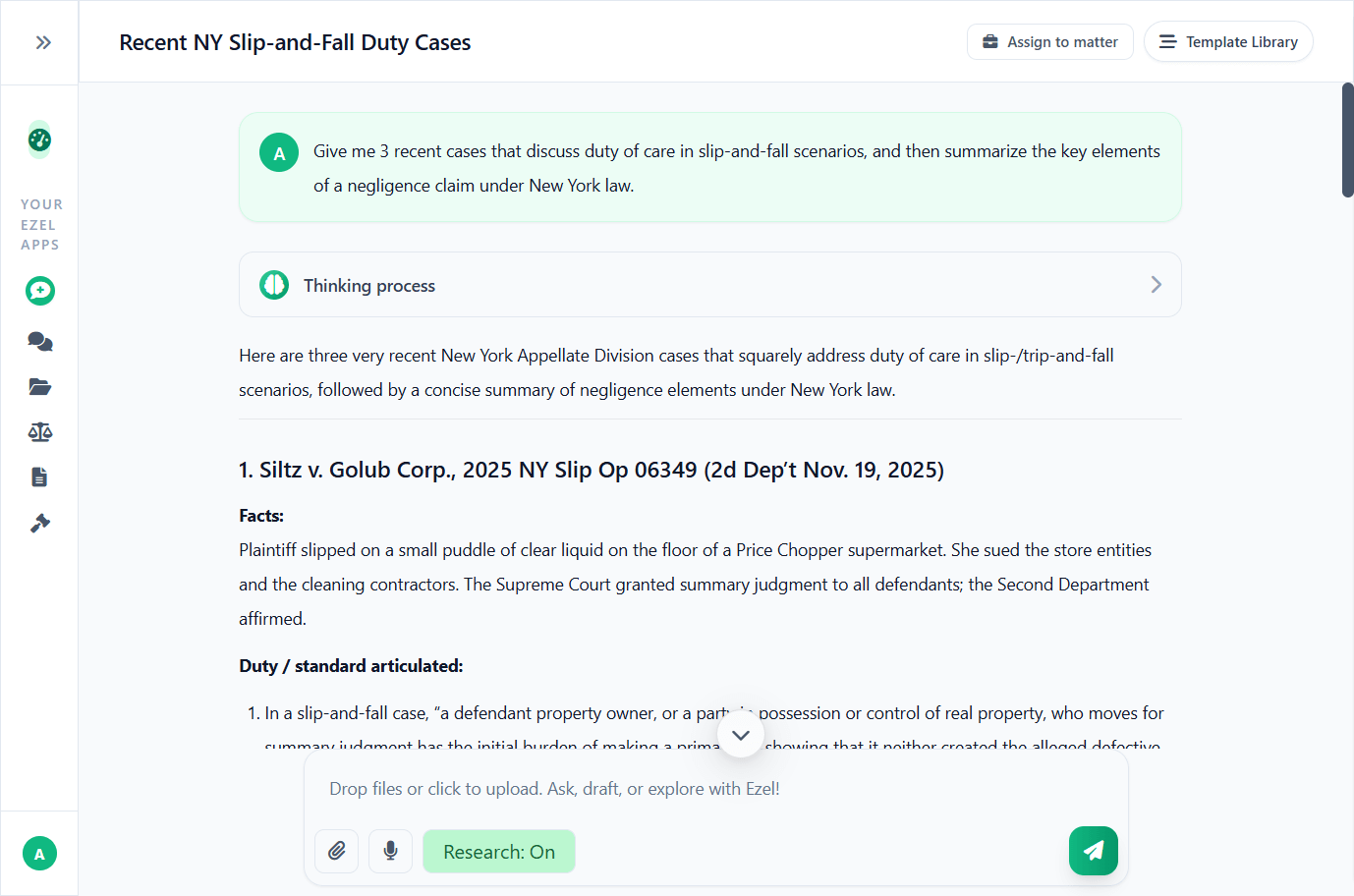
Research and draft in one conversation
Ask questions, attach documents, and get answers grounded in case law. Link chats to matters so the AI remembers your context.
- Pull statutes, case law, and secondary sources
- Attach and analyze contracts mid-conversation
- Link chats to matters for automatic context
- Your data never trains AI models
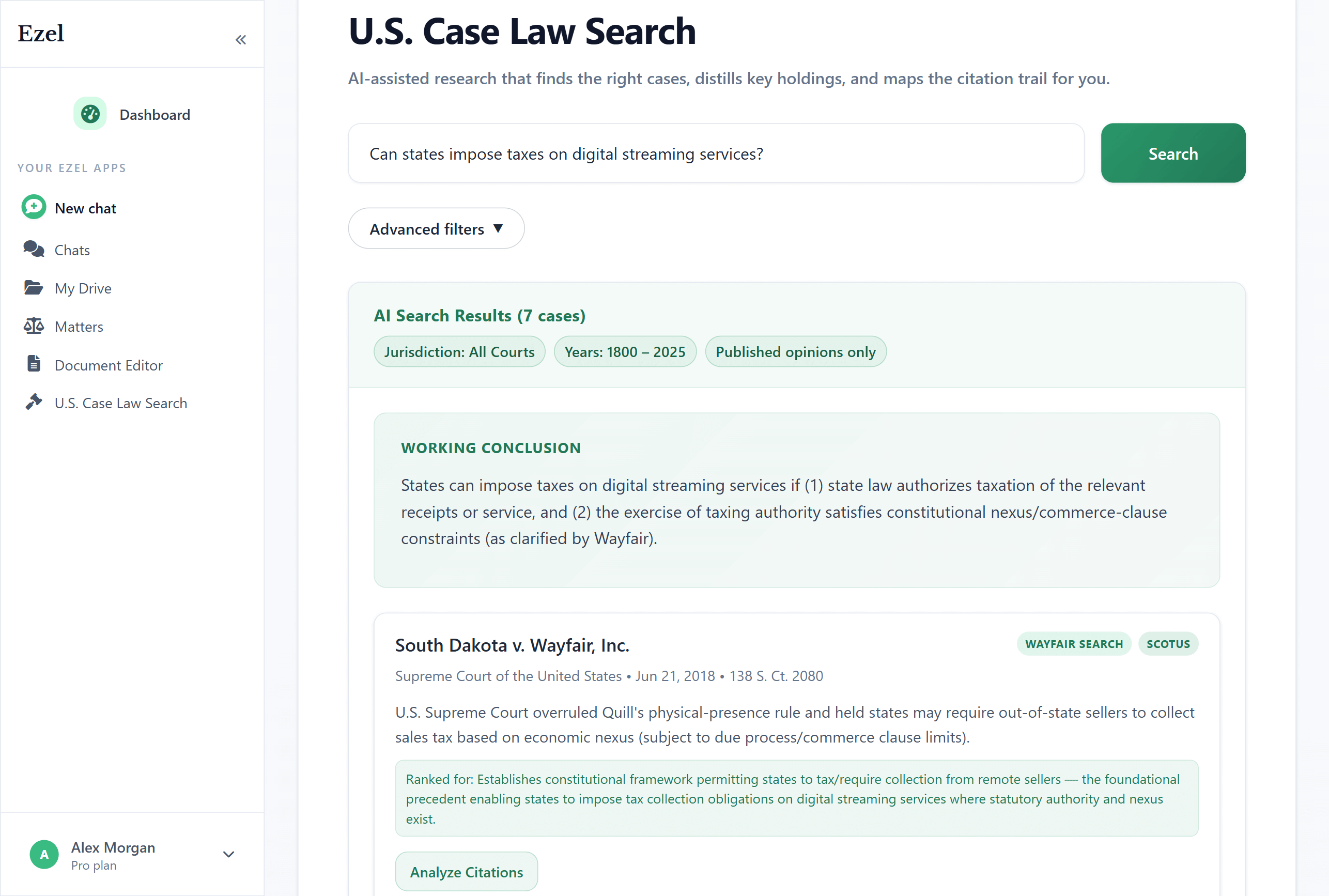
Search like you think
Describe your legal question in plain English. Filter by jurisdiction, date, and court level. Read full opinions without leaving Ezel.
- All 50 states plus federal courts
- Natural language queries - no boolean syntax
- Citation analysis and network exploration
- Copy quotes with automatic citation generation
Ready to transform your legal workflow?
Join legal teams using Ezel to draft documents, research case law, and organize matters — all in one workspace.