Tread depth on newly built steep stairs
Apply this to your situation
This page explains the general guidance. Ask about your specific situation and see what current federal labor law says, with citations.
June 17, 2025
Ray Mallory Kirby
[Recipient address omitted]
Dear Mr. Kirby:
Thank you for your inquiry to the Occupational Safety and Health Administration (OSHA) regarding stair width and handrails. This letter constitutes OSHA's interpretation of only the requirements discussed and may not be applicable to any questions not delineated within your original correspondence. Your paraphrased background, question, and OSHA’s response are below:
Background: The OSHA standards at 1910.25(c)(1) – (c)(3) require that stairs:
(1) are installed at angles between 30 to 50 degrees from the horizontal;
(2) have a maximum riser height of 9.5 inches (24 cm); and
(3) have a minimum tread depth of 9.5 inches (24 cm);
For a 9.5" riser height and 9.5" tread depth the maximum angle would be 45 degrees. For a stair angle of 49 to 50 degrees with a rise of 9.5", gives a run dimension of 8". The exceptions listed in 1910.25(c)(5) for stairs built before 2017 has 8" run minimum.
Question: Would stairs built after January 17, 2017, be in compliance with 29 CFR 1910.25(c)(3) if they have an angle between 49 and 50 degrees and tread depth of 9.5 inches (with 8 inches run and a nosing of 1.5 inches) as shown in the below picture?
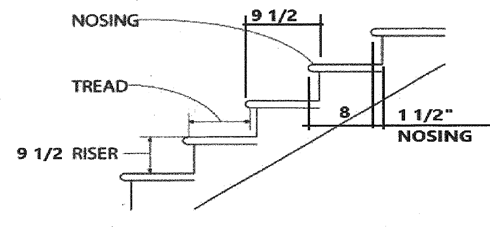
Response: No. OSHA’s intention for the 9.5-inch minimum tread depth requirement is to provide stepping space that is adequate to protect employees from falling, which is consistent with national consensus standards for standard stairs (ANSI A1264.1 and NFPA 101). Therefore, the standard requires tread depth to be measured horizontally between the vertical planes of the foremost projection of adjacent treads, and at a right angle to the tread’s leading edge but excluding beveled or rounded tread surfaces that slope more than 20 degrees.
Thank you for your interest in occupational safety and health. We hope you find this information helpful. OSHA requirements are set by statute, standards, and regulations. Our interpretation letters explain these requirements and how they apply to circumstances, but they cannot create additional employer obligations. This letter constitutes OSHA’s interpretation of the requirements discussed. Note that our enforcement guidance may be affected by changes to OSHA rules. Also, from time to time we update our guidance in response to new information. To keep apprised of such developments, you can consult OSHA’s website at http://www.osha.gov. If you have any further questions, please feel free to contact the Office of General Industry and Agricultural Enforcement at (202) 693-1850.
Sincerely,
Erin P. Gilmore, Acting Director
Directorate of Enforcement Programs
What does federal law require in your situation?
Ezel checks current federal labor law against your facts and answers with citations.
Opens in Ezel Pro.
- Checks the law as it stands today, not only this page
- Cites every source it relies on, so you can verify it
- Chat, drafting and research in one workspace