Stair-rail height under construction and general industry rules
Apply this to your situation
This page explains the general guidance. Ask about your specific situation and see what current federal labor law says, with citations.
OSHA archive notice: "This is an OSHA Archive Document, and may no longer represent OSHA Policy. It is presented here as historical content, for research and review purposes only."
March 8, 1999
Mr. Robert Weaver
Field Safety Coordinator
M&W Contractors, Inc.
[Recipient address omitted]
Dear Mr. Weaver:
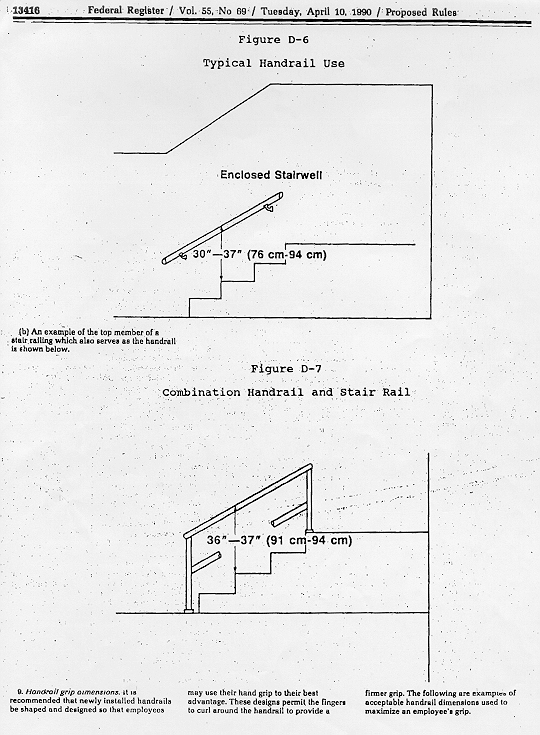
Thank you for your letter of September 8, 1998. I apologize for the delay in response. You indicated a concern that there is a discrepancy in the height requirement of stair railings between the two standards, 1910.23 and 1926.1052. You wrote that 29 CFR 1910.23 (e)(2) states that stairway railings be between 34 and 30 inches in height, while 29 CFR 1926.1052 states that stairway railings built after March, 1991 be 36 inches in height or between 30 and 37 inches high. In actuality, 1926.1052(c)(6) is for height of handrails of 30 to 37 inches not stair rails. Paragraph 1926.1052(c)(7) indicates that the top member of a stair rail used as a handrail must be between 36 to 37 inches.
The proposed rule, 29 CFR Part 1910[.28], (proposed April, 1990) removes any discrepancy between the two standards. Proposed paragraph 29 CFR 1910.28(c)(2)(iv) would require new stair rail systems to be at least 36 inches high at the forward edge of the tread surface. New stair rails may also serve as handrails when the height of the top edge is between 36 and 37 inches when measured as above. This proposed standard has not been finalized yet.
A stair railing which is not in compliance with the existing standard but is in compliance with the proposed standard is considered a "de minimis violation". OSHA Instruction CPL 2.103, the Field Inspection Reference Manual (FIRM), states that one of the criteria for a "de minimis violation" is when: " An employer complies with a proposed standard or amendment or a consensus standard rather than with the standard in effect at the time of the inspection and the employer's action clearly provides equal or greater employee protection or the employer complies with a written interpretation issued by the OSHA Regional or National Office.
With respect to your suggestion that OSHA adopt a singular height requirement in order to provide uniformity, the two standards have different coverage requirements. OSHA's construction industry standards (29 CFR 1926) apply " to every employment and place of employment of every employee engaged in construction work." Construction work is not limited to new construction; it includes the repair of existing facilities. The replacement of structures and their components is also considered construction work. Construction work is distinguished from manufacturing, furnishing of materials, or servicing and maintenance work which would be covered by general industry standards (29 CFR 1910). When the construction activities are completed, the general industry standards would apply to the plant and administration activities.
In summary, the pre-fabricated stairs that you indicated to have a top rail height of 36" are in compliance with the proposed standard and would be acceptable (a "de minimis violation"). (See the attached diagram from the proposed standard). I hope this resolves your concern and thank you for your interest in safety and health. If you have additional questions, please contact Patricia Biles of my staff on (202) 693-1860.
Sincerely,
Richard Fairfax, Director
Directorate of Compliance Programs
Enclosure
What does federal law require in your situation?
Ezel checks current federal labor law against your facts and answers with citations.
Opens in Ezel Pro.
- Checks the law as it stands today, not only this page
- Cites every source it relies on, so you can verify it
- Chat, drafting and research in one workspace