U.S. Department of Housing and Urban Development, Rocky Mountain Area, Denver, Colorado and American Federation of Government Employees, Local 3972 (Authority decision, June 30, 1999)
HUD Denver (FLRA DE-CA-50202): national agreement controls union president’s attendance procedures
Apply this precedent to your situation
This is citable Authority precedent from 1999, and it may have been appealed since. Ezel checks how it stands today and answers your situation, with citations.
Final FLRA decision. This is a final order of the Federal Labor Relations Authority in an unfair-labor-practice proceeding. An aggrieved person may seek judicial review by filing a petition in an appropriate United States court of appeals within 60 days after issuance under 5 U.S.C. § 7123(a). Filing a petition does not stay the Authority's order unless the court orders a stay under 5 U.S.C. § 7123(c).
Plain-English summary
HUD’s Denver office required its union president to resume signing in and out sequentially with other employees after local supervisors had allowed different procedures. The Authority dismissed the unfair-labor-practice complaint because the national agreement required those procedures and Article 34 barred conflicting local arrangements. It adopted the unchallenged interpretation of Article 34 without precedential significance. The evidence did not establish that the national negotiators intended an exception for union representatives on full-time official time. The Authority left open whether local management could establish a contrary binding practice in a future case without a provision like Article 34. The linked ALJ decision is included below, and Appendix F is preserved as the official image of the attendance form.
Decision snapshot
- Authority: National agreement Articles 17 and 34; 5 U.S.C. § 7116(a)(1) and (5).
- Outcome: Unfair-labor-practice complaint dismissed.
- Key point: The national agreement required sequential attendance records and barred the conflicting local arrangement.
Full text (FLRA public release)
[ v55 p571 ]
55 FLRA No. 99
U.S. DEPARTMENT OF HOUSING AND URBAN
DEVELOPMENT, ROCKY MOUNTAIN AREA
DENVER, COLORADO
(Respondent)
and
AMERICAN FEDERATION OF GOVERNMENT
EMPLOYEES, LOCAL 3972
(Charging Party/Union)
DE-CA-50202
______
DECISION AND ORDER
June 30, 1999
______
Before the Authority: Phyllis N. Segal, Chair; Donald S. Wasserman and Dale Cabaniss, Members
I. Statement of the Case
This unfair labor practice case is before the Authority on exceptions to the attached decision of the Administrative Law Judge filed by the General Counsel. The Respondent filed an opposition to the General Counsel's exceptions.
The complaint alleges in relevant part that the Respondent violated section 7116(a)(1) and (5) of the Federal Service Labor-Management Relations Statute (Statute) by unilaterally changing a practice concerning the procedures to be used by a union official in signing in and out of work. The Judge found that the Respondent did not violate the Statute because the disputed past practice was inconsistent with a nationwide collective bargaining agreement, and as a result was not binding.
Upon consideration of the Judge's decision, the exceptions and the response thereto, and the entire record, we adopt the Judge's findings and conclusions to the extent consistent with this decision. In particular, the Judge found that the local practice at issue in this case allowed the union official to follow different sign in/sign out procedures than those established in the nationwide agreement. The Judge further found that an article of the parties' nationwide agreement prohibits local parties from agreeing to modify the terms of the national agreement. This latter finding was not excepted to, and we therefore adopt it without precedential significance. Accordingly, the Respondent was not obligated to bargain on the termination of the unauthorized practice, and we therefore adopt the Judge's recommendation that the complaint be dismissed.
II. Background
A. Facts
The facts are set forth in detail in the Judge's decision, and are briefly summarized here.
In 1990 the Department of Housing and Urban Development National Office (HUD) and the American Federation of Government Employees (AFGE) negotiated a nationwide collective bargaining agreement (agreement). Article 17 of the agreement, regarding duty hours and work time accounting, [n1] requires all bargaining unit employees to sign in and out of work sequentially every day on the same form. [n2] Article 34 of the agreement states that "any [local] supplements to this Agreement shall not delete, modify, or otherwise nullify any provision . . . in this Agreement; nor . . . conflict with . . . any provision of this Agreement . . . ." Judge's Decision at p. 3. [n3]
The Union official (Local President) at issue in this case is the President of AFGE Local 3972 (Union), located at the HUD Denver, Colorado Office (HUD Denver). AFGE Local 3972 is the local agent for AFGE in administering the nationwide collective bargaining agreement at HUD Denver. [ v55 p572 ]
The Local President signed in and out sequentially as required by Article 17 until February 1994, when HUD Denver began a reorganization. To facilitate the reorganization, the Local President began to perform union work for 100 percent of his work time. In connection with this change, his supervisor allowed the Local President to leave a phone number where he could be reached, in lieu of signing in and out sequentially. This deviation by the Local President from the requirements of Article 34 of the agreement continued until the Local President began in December 1994 reporting to another supervisor. On January 3, 1995, this new supervisor instructed the Local President to sign in and out sequentially. The Union requested bargaining over the subject. The supervisor refused, asserting that the nationwide collective bargaining agreement did not allow for arrangements in conflict with the agreement. The Local President complied with his supervisor's order to sign in and out, but did not do so sequentially.
HUD's Acting Deputy Director for Human Resources (ADD) in Washington, D.C., who has responsibility for interpreting and applying the national agreement, learned of the Local President's sign in/sign out practices in February 1995. The ADD immediately took action to eliminate those practices. First, the ADD held a conference call among the Local President, the supervisor, and the ADD, during which the ADD stated that she would not tolerate any arrangements that contradicted the agreement. She ordered the parties to reach agreement within 2 weeks on having the Local President signing in and out under Article 17 procedures. When such agreement was not reached after 2 weeks, the ADD again stated that HUD Denver had no authority to allow any deviation from the national agreement, and directed the Local President to sign in and out sequentially. Soon thereafter, the Local President began to sign in and out sequentially, and the Union filed an unfair labor practice charge. [n4]
The General Counsel issued a complaint alleging that the Respondent unilaterally changed the practice of not requiring the Local President to sign in and out sequentially, and that the change was implemented without notice to or bargaining with the Union in violation of section 7116(a)(1) and (5) of the Statute.
B. Judge's Decision
The Judge found that the Respondent did not violate section 7116(a)(1) and (5) of the Statute by requiring the Local President to comply with Article 17, or by refusing to bargain. As relevant to our disposition of this case, the Judge interpreted Article 17 of the parties' agreement as requiring that the Local President sign in and out sequentially. The Judge noted that Article 17 expressly applied to "all employees." Id. at 10. The Judge found that because Article 17 provided no express exceptions to signing in and out sequentially, it would be erroneous to create an exception where no others existed. The Judge therefore found that the Local President's arrangement contradicted Article 17. The Judge went on to find that under Article 34 of the nationwide agreement, AFGE and HUD "specifically prohibited any local parties from agreeing to modify the terms of the national agreement" by means of a local supplemental agreement. Id. Thus, the Judge found that the sign in/sign out practice initiated by HUD Denver and the Union for the Local President "specifically conflicted" with Article 17 of the agreement, and in the absence of their knowledge and acquiescence, could not constitute a past practice binding upon HUD and AFGE. Id.
In conclusion, the Judge found that the Respondent did not commit ULPs by unilaterally changing a past practice, and therefore dismissed the complaint. [n5] [ v55 p573 ]
III. Positions of the Parties
A. General Counsel's Exception
The General Counsel contends that the Judge incorrectly interpreted Article 17 because he did not give controlling weight to the parties' intent. The General Counsel argues that when an agreement is interpreted, the parties' intent at the time the contract was drafted must be ascertained. Had the Judge done so here, the General Counsel claims, he would have found an exception to the general rule in Article 17 of sequential signing in and out.
Specifically, the General Counsel notes that a member of AFGE's bargaining team on the national agreement was a local union president who served in that capacity for 100% of his official work time and who did not have to sign in and out sequentially. The General Counsel argues that it is "completely implausible" that this official would have negotiated a nationwide agreement that did not allow for exceptions, such as his own "side bar" agreement with local management, to Article 17. Exceptions at 6. The General Counsel notes the existence of a second 100% official time union officer who also had an exception to Article 17 as evidence that the parties intended to allow exceptions.
As for the ADD's testimony regarding interpretation of the agreement, the General Counsel argues that her testimony is of no relevance because the ADD did not work for HUD at the time of agreement negotiations, and thus has no direct knowledge of the contracting parties' intentions.
The General Counsel does not except to the Judge's interpretation of Article 34 of the nationwide agreement as barring any local arrangements that contradict the agreement. Instead, the General Counsel states that Article 34 is inapplicable because there is no conflict between the past practice alleged and Article 17 of the agreement.
B. Respondent's Opposition
The Respondent contends that the Judge properly interpreted Article 17. The Respondent argues that while a Judge may use a variety of sources to help interpret an article, such sources are unnecessary here because Article 17's "plain and unambiguous" language requires all employees to sign in and out sequentially. Opposition at 3. In particular, the Respondent argues that where an article is ambiguous, the parties' bargaining history can be helpful in interpreting the article, but because Article 17 is unambiguous, use of the parties' bargaining history is unnecessary.
Arguing in the alternative, the Respondent contends that if the Authority examines the parties' bargaining history, the Authority should ignore the General Counsel's reference to the "side-bar" agreement with local management concerning sign in/sign out procedures of one of the AFGE negotiators. The Respondent argues that the record does not include negotiators' testimony, bargaining proposals, or notes regarding any intended exception to the sign in/sign out article. In conclusion, the Respondent argues "there is simply no reliable evidence of bargaining history before the Authority to alter the plain meaning of Article 17[.]" Id. at 5. Moreover, as to past practice, the Respondent states that during the years the nationwide agreement was in effect, only the two deviations from the terms of Article 17 cited by the General Counsel, both of short duration, were found. This, Respondent claims, is insufficient to establish the kind of practice that can be used in interpreting an allegedly ambiguous agreement provision.
Further, the Respondent notes the General Counsel's failure to contest the Judge's interpretation of Article 34, and asserts that the Judge properly applied that Article in finding that a local past practice that is contrary to a provision of the nationwide agreement cannot prevail over the agreement provision.
IV. Analysis and Conclusions
A. The Judge's Interpretation of Article 34 of the Nationwide Agreement is Adopted Without Precedential Significance
The Judge interpreted Article 34 of the nationwide agreement as prohibiting local parties from agreeing to modify the terms of the agreement by means of, among other things, a practice such as the one at issue in this case. As previously mentioned, the General Counsel did not file an exception to the Judge's interpretation and application of Article 34. Accordingly, that finding is adopted without precedential significance under section 2423.41 of the Authority's regulations. U.S. Penitentiary, Florence, Colorado, 54 FLRA 30, n.* (April 21, 1998).
B. The Judge Correctly Interpreted the Nationwide Agreement as Requiring Union Officials on 100% Official Time to Observe the Same Sign In/Sign Out Procedures as Other Unit Employees
In Internal Revenue Service, Washington, D.C., 47 FLRA 1091 (1993) (IRS), the Authority described the standards it will use in reviewing a Judge's interpretation and application of specific terms of an agreement: [ v55 p574 ]
In cases where the judge's interpretation of the meaning of the parties' collective bargaining agreement is challenged on exceptions, the Authority will determine whether the judge's interpretation is supported by the record and by the standards and principles of interpreting collective bargaining agreements applied by arbitrators and the Federal courts.
Id. at 1111. For the following reasons, we conclude that the General Counsel has failed to establish that under these standards the Judge's interpretation of Article 17 is erroneous.
The Judge found that the plain language of Article 17 supports the conclusion that the Local President must sign in and out sequentially. We agree that the plain language supports the Judge's conclusion that Article 17 applies to the Local President, as it requires all employees, without exception, to sign in and out sequentially. The General Counsel offers only the circumstances of one of the AFGE negotiators, i.e., a local union president having a "side bar" agreement with his local management allowing special sign in/sign out procedures, and a second union representative on 100% official time, as proof of the parties' intent in negotiating the nationwide agreement. This is an insufficient basis on which to reject the Judge's interpretation of the article. The evidence relied on by the General Counsel falls short of, for example, rejected proposals and minutes of bargaining sessions. Elkouri & Elkouri, How Arbitration Works 502-03 (Marlin M. Volz & Edward P. Goggin eds., 5th ed. 1997).
The General Counsel cites two cases in support of the argument that the Judge misinterpreted the article. Those cases are distinguishable. First, the General Counsel cites IRS for the proposition that the parties' intent must be given controlling weight. IRS lists several criteria for determining the parties' intent, including using extrinsic evidence together with the language of the article itself and inferences drawn from the agreement as a whole. See IRS at 1110. Here, the Judge relied on the language of the article itself and inferences from the agreement as a whole--that is, the fact that Article 17 required everyone to sign in and out sequentially without providing any exceptions--more than the unwritten and disputed bargaining history of the parties. The General Counsel does not establish that the Judge acted contrary to the principles set out in IRS in so ruling, especially in light of his holding that the language of the Article 17 is clear and unambiguous. Thus, the Judge's interpretation is consistent with IRS.
The other case relied on by the General Counsel, Department of Veterans Affairs Medical Center, Denver, Colorado, 52 FLRA 16 (1996) (VAMC), is also distinguishable. It is cited for the proposition that evidence of a practice under the agreement, including a local practice occurring within a larger bargaining unit, is probative of the parties' intent when they negotiated the agreement. See id. at 25-26. However, in VAMC, the practice at issue was engaged in by, or known to, the parties who negotiated the agreement in question, and the practice was not directly contrary to the express terms of the agreement. In the instant case, in contrast, it is undisputed that the level of the agency that negotiated the agreement was unaware that a contrary practice was being used at the local level. And, as we concluded above, the local practice at issue is contrary to the express terms of the agreement. Accordingly, VAMC does not provide support for using an unconsented-to local practice, at variance with a provision of a nationwide agreement, as a means for interpreting the national agreement provision.
Thus, we conclude, in agreement with the Judge, that AFGE and HUD in Article 34 prohibited local parties from agreeing to modify the terms of the nationwide agreement, and that HUD Denver officials engaged in a practice contrary to the terms of Article 17 of that agreement. Accordingly, there is no basis for finding that HUD Denver committed a ULP when it insisted on returning without bargaining to the practice mandated by Article 17.
V. Order
The complaint is dismissed.
File 1: Authority's Decision in 55 FLRA No.
99
File 2: Appendix F
File 3: ALJ's Decision
Footnote # 1 for
55 FLRA No. 99
- Authority's Decision
Article 17 states in pertinent part:
Section 17.01 - Introduction. All employees are covered by this program and shall be governed by the provisions set forth in this Article.
. . . .
Section 17.05 - Timekeeping
(1) Employees shall, on a daily basis, use the Attendance Record Sheet in Appendix F (hereinafter referred to as the sign in/sign out register) to record their arrival and departure times. This form cannot be modified at the local level.
(2) Employees shall sign in immediately prior to beginning work. They shall sign out immediately upon completion of their workday. All sign in and sign out shall be sequential.
. . . .
Section 17.06 - Employee Responsibilities
. . . .
(2) Each employee shall be responsible for recording and certifying his/her arrival and departure times each day on the sign in/ sign out register referred to in Section 17.05(1).
Judge's Decision at 3-4.
Footnote # 2 for
55 FLRA No. 99
- Authority's Decision
"Sequential" signing in and out entails the first employee reporting for work each day signing on the top line of the form and indicating the time of arrival, the second employee reporting signing on the next line, etc. The same procedure is followed at the end of the work day on a separate column on the form: the first employee leaving signs at the top of the form and indicates the time of departure, the second employee leaving signs on the next line, etc. Judge's Decision at 4 n.4. The parties do not dispute these requirements for sequential signing in and out. The form used for this procedure is set out in Appendix F of the agreement, and is reproduced at the end of this decision.
Footnote # 3 for
55 FLRA No. 99
- Authority's Decision
Article 41 of the agreement provides that the agreement would continue in full force and effect after its expiration, until a new agreement goes into effect. The events in this case occurred after expiration of the agreement, but before a new agreement went into effect. However, the applicability of the expired agreement provisions to this case is not contested by the parties.
Footnote # 4 for
55 FLRA No. 99
- Authority's Decision
In June 1995, the Local President was suspended from work for 5 days for failing to follow his supervisor's January 3, 1995, instruction to sign in and out sequentially, and for various other reasons. The record does not disclose whether this discipline was challenged through any appeal or grievance procedure.
Footnote # 5 for
55 FLRA No. 99
- Authority's Decision
To the extent that the Judge also held that local management at HUD Denver could not, in the absence of Article 34, be considered as "responsible management" capable of establishing binding past practices contrary to the nationwide agreement, we do not address the Judge's conclusion on this point. Thus, we do not foreclose the possibility in some future case that, in the absence of an agreement provision like Article 34, local management officials could establish a binding practice that is contrary to the terms of a nationwide agreement.
File 1: Authority's Decision in 55 FLRA No. 99
File 2: Appendix F
File 3: ALJ's Decision
Appendix F
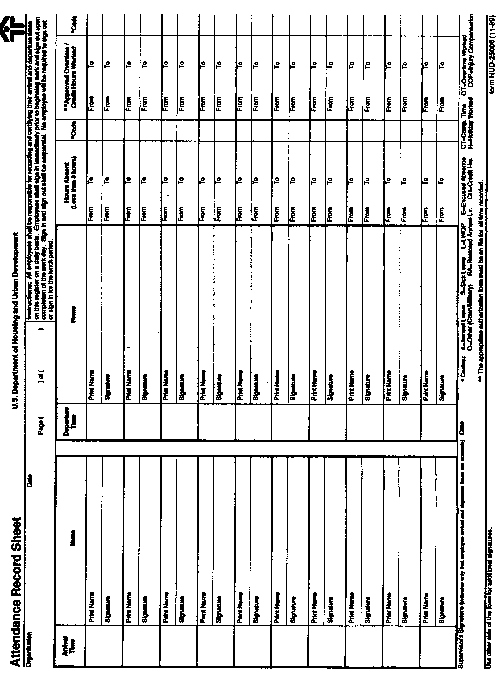
File 1: Authority's Decision in 55 FLRA No. 99
File 2: Appendix F
File 3: ALJ's Decision
[ v55 p576 ]
Office of Administrative Law Judges
U.S. DEPARTMENT OF HOUSING AND URBAN
DEVELOPMENT, ROCK MOUNTAIN AREA
DENVER, COLORADO
Respondent
and
AMERICAN FEDERATION OF GOVERNMENT
EMPLOYEES, LOCAL 3972
Charging Party
Case No. DE-CA-50202
Laurie L. Martin, Esq.
For the Respondent
Timothy J. Sullivan, Esq.
For the General Counsel
Steven L. Hensley, President
For the Charging Party
Before: SAMUEL A. CHAITOVITZ
Chief Administrative Law Judge
DECISION
Statement of the Case
This case arose under the Federal Service Labor-Management Relations Statute, Chapter 71 of Title 5 of the U.S. Code, 5 U.S.C. § 7101, et seq. (the Statute).
Based upon an unfair labor practice charge filed by the Charging Party, American Federation of Government Employees, Local 3972 (the Union), a Complaint and Notice of Hearing was issued by the Regional Director for the Denver Region of the Federal Labor Relations Authority. The complaint alleges that the U.S. Department of Housing and Urban Development, Rocky Mountain Area, Denver, Colorado (the Respondent) violated section 7116(a)(1) and (5) of the Statute by changing the sign-in-out procedure and the timing for signing in and out for the Union's president without providing the Union with notice and an opportunity to negotiate the substance and the impact and implementation of the change. Respondent's answer denies that a breach of the duty to bargain occurred in the circumstances of this case and raises a series of affirmative defenses.
A hearing was held in Denver, Colorado, on March 5, 1996, at which all parties were afforded a full opportunity to be heard, to examine and cross-examine witnesses, and to introduce evidence. [n1] The General Counsel and the Respondent filed timely post-hearing briefs. [n2] Thereafter, over the General Counsel's objection, the undersigned granted the Respondent's motion for special permission to file a reply brief and provided the General Counsel an opportunity to respond thereto. The parties' briefs, the Respondent's reply brief, and the General Counsel's response to the Respondent's reply brief all have been carefully considered. [n3]
Based upon the entire record, including my observation of the witnesses and their demeanor, I make the following findings of fact, conclusions and recommendation.
Findings of Fact
A. The Parties' Relationship and the Terms of Their Agreement
The American Federation of Government Employees, AFL-CIO (AFGE) is the certified exclusive bargaining representative of a nationwide consolidated unit of employees in the Department of Housing and Urban Development (HUD) appropriate for collective bargaining, including the employees located at the Respondent's facilities in the Rocky Mountain Area. The Union, AFGE Local 3972, is an agent of AFGE for purposes of representing the Respondent's employees.
HUD and AFGE negotiated a national collective bargaining agreement which became effective in June 1990 for a three-year period. By its terms (Art. 41), "[t]he provisions of this Agreement shall continue in full force and effect until a new Agreement goes into effect." The national agreement (Art. 34) also provides [ v55 p577 ] that "any [local] supplements to this Agreement shall not delete, modify, or otherwise nullify any provision . . . in this Agreement; nor . . . conflict with . . . any provision of this Agreement . . . ."
As pertinent to the issues in this case, the national agreement further provides as follows:
ARTICLE 17
HOURS OF DUTY - ALTERNATE WORK
SCHEDULES
Section 17.01 - Introduction. All employees are covered by this program and shall be governed by the provisions set forth in this Article.
Section 17.05 - Timekeeping.
(1) Employees shall, on a daily basis, use the Attendance Record Sheet in Appendix F (hereinafter referred to as the sign in/sign out register) to record their arrival and departure times. This form cannot be modified at the local level.
(2) Employees shall sign in immediately prior to beginning work. They shall sign out immediately upon completion of their workday. All sign in and sign out shall be sequential. [n4] Employees shall not be required to sign in or out for the lunch period.
Section 17.06 - Employee Responsibilities.
(2) Each employee shall be responsible for recording and certifying his/her arrival and departure times each day on the sign in/sign out register referred to in Section 17.05(1).
At the time of the hearing in this case, HUD and AFGE were in the process of negotiating a new national agreement. The start of such negotiations was delayed until May 1995, pending completion of a major agency-wide reorganization, although the parties had previously agreed in their ground rules to be bound by the terms of the national agreement which expired in 1993.
B. Respondent's Sign In/Sign Out Procedures
The record evidence indicates that all of Respondent's employees in the Denver office were required to--and in fact did--follow the sign in/sign out procedures specified in Article 17 of the national agreement until late February 1994. At that time, as a result of the nationwide reorganization of HUD referred to above, the Union's president, Steven Hensley, was authorized to be on 100% official time so that he could travel extensively in connection with issues arising from the reorganization. In recognition of Hensley's erratic schedule, his supervisor at that time (Gary Mundt) permitted him to avoid the sign in/sign out requirements as long as Hensley left a telephone number where he could be reached.
That practice ended in July 1994, when the Respondent's Housing Director, Ron Bailey, decided to have Hensley report to Larry Sidebottom (a third-level supervisor) for sign in/sign out purposes since Hensley was traveling so much due to the reorganization. Sidebottom set up a procedure whereby Hensley was required to sign in and out but could do so on a separate form kept in Sidebottom's office rather than sequentially with all of the Respondent's other employees on a sign in/sign out sheet located centrally in an area outside Sidebottom's office. Hensley followed this procedure from July through December 1994, at which time Sidebottom was promoted and Sheryl Miller became Hensley's supervisor.
Miller notified Hensley by memorandum dated January 3, 1995, that she was his new supervisor and that he would be required to sign in and out sequentially with all of the Respondent's other employees effective immediately. Hensley requested bargaining on behalf of the Union, but Miller declined on the basis that the national agreement required all non-supervisory employees to sign in and out sequentially and that the sign in/sign out procedures previously followed by Hensley did not conform to the requirements of the national agreement or accurately reflect his office work time. Hensley thereafter began signing in and out on the centrally-located form used by all the other employees, but not sequentially as directed. [n5] [ v55 p578 ]
C. HUD is Notified of Respondent's Sign In/Sign Out Problem and Takes Action to Resolve the Matter
The record evidence is unclear as to what happened next.Miller testified that Hensley's failure to comply fully with her directive concerning the proper sign in/sign out procedures caused her to telephone Jo Anne Simms, who was then HUD's Acting Deputy Director of Human Resources. [n6] Simms testified that she first became aware of the deviation from the national agreement's sign in/sign out procedures when the matter was brought to her attention by Jim Harrell, AFGE's top official for HUD employees at that time. Harrell was an employee in HUD's Seattle office who also had a side agreement with local management under which he could sign in and out on a separate form rather than sequentially with the other employees in that office. What is undisputed is that Simms learned of the sign in/sign out issue for the first time in February 1995. [n7]
When the matter came to her attention, Simms set up a conference call which included Hensley and Miller, among others, as participants. Simms insisted that there could be no deviations by local parties from the sign in/sign out procedures set forth in the national agreement, and gave Miller and Hensley two weeks to work things out. When they were unable to do so, Simms set up a second conference call which included local management officials as well as Hensley, Harrell and Deborah Dye--a union official on 100% official time as an employee in HUD's Jacksonville office who also was not following the national agreement's sign in/sign out procedures. Simms objected to local management's deviation from the national agreement without consulting and getting approval from HUD headquarters, indicated that they had no authority to do so, and directed that the situation be corrected. Thereafter, Hensley has been complying with the national agreement's sign in/sign out procedures. [n8]
Discussion and Conclusions of Law
A. Preliminary Issues
Respondent moved to dismiss the complaint in this case at the outset of the hearing on two grounds which were not raised in its post-hearing briefs. Nevertheless, rulings on the motions were reserved for discussion in this decision and are appropriate for resolution at this time.
The first ground on which the Respondent asserts that the complaint should be dismissed is that a provision in the parties' national agreement requires the dispute to be resolved through arbitration. More specifically, Respondent contends that under Section 5.05 of the agreement, where a mid-term bargaining proposal is alleged to be inappropriate for local bargaining on the sole ground that it conflicts with the national agreement, the matter must be resolved through arbitration. The argument is that the Union has proposed a different sign in/sign out procedure for employees who are representing the Union on 100% official time; that Respondent has rejected this proposal as inconsistent with Article 17 of the national agreement; and that such dispute must be resolved through arbitration rather than in an unfair labor practice proceeding. The difficulty with this creative assertion is that the complaint herein does not involve an allegation that Respondent unlawfully refused to bargain over a mid-term Union proposal which the Authority has previously found to be substantively negotiable. Rather, the complaint alleges that Respondent changed an established practice of permitting the Union president to deviate from the sign in/sign out procedure set forth in the national agreement without providing the Union notice and an opportunity to bargain over the change. Under these circumstances, the complaint may properly be resolved in this unfair labor practice proceeding.
Respondent's related contention that the dispute in this case involves differing and arguable interpretations of the national agreement and therefore should be resolved by an arbitrator rather than the Authority similarly is wide of the mark. Thus, where an agency seeks to defend its unilateral change in negotiable conditions of employment on the basis that such action is authorized by the terms of a governing agreement, the Authority does not dismiss the complaint as more appropriate for resolution by an arbitrator but instead interprets the language of that agreement to determine whether the agency's assertion is correct. If so, the agency's action does not constitute an unfair labor practice; otherwise it does. See Internal Revenue Service, Washington, D.C., 47 FLRA 1091, 1103-05 (1993). [ v55 p579 ] Accordingly, having rejected the Respondent's motions to dismiss the complaint as more appropriate for resolution by an arbitrator, I now turn to the substance of the alleged violation. [n9]
B. Respondent's Insistence on the Union President's Compliance with the Sign In/Sign Out Procedures Set Forth in the National Agreement Did Not Violate The Duty to Bargain in the Circumstances Presented
As previously indicated, the complaint in this case alleges that since at least July 1994, the Union's president used a separate sign in/sign out sheet to record his time and attendance; that such practice continued with the knowledge and/or acquiescence of the Respondent's management officials and supervisors; that Respondent unilaterally changed the practice in January 1995 by requiring the Union president to sign in and out sequentially with other employees located at the worksite; and that such change was implemented without notice to or bargaining with the Union in violation of section 7116(a)(1) and (5) of the Statute. For the reasons stated below, I conclude that the General Counsel has failed to prove that the Respondent's actions constituted a violation of the Statute as alleged, and that the complaint therefore should be dismissed.
- The General Counsel's theory of a violation rests on unsubstantiated assertions.
The General Counsel asserts that a past practice was created when the Respondent's managers and supervisors allowed Union president Hensley to use a separate form to sign in and sign out between July and December 1994, which practice could not be changed unilaterally to require him to sign in and out sequentially with the other employees at the workplace. In the circumstances of this case, I disagree that a binding past practice was created as alleged.
The General Counsel correctly points out that procedures governing whether and how employees will sign in and sign out are substantively negotiable conditions of employment. See 92 Bomb Wing, Fairchild Air Force Base, Spokane, Washington, 50 FLRA 701, 703-04 (1995); Overseas Education Association, Inc. and Department of Defense Dependents Schools, 29 FLRA 734, 757-60 (1987)(Proposal 15). It is equally well settled that a past practice may be established concerning such a negotiable condition of employment where it is consistently exercised over an extended period of time with the knowledge and express or implied consent of "responsible management" within the agency. See Norfolk Naval Shipyard, 25 FLRA 277, 286-87 (1987); U.S. Department of Labor, Washington, D.C., 38 FLRA 899, 907-10 (1990); Defense Distribution Region West, Tracy, California, 43 FLRA 1539, 1559-60 (1992). Such a past practice may be established under these circumstances even where it is inconsistent with the terms of the parties' agreement. See Defense Distribution Region West, Lathrop, California, 47 FLRA 1131, 1133-34 (1993); U.S. Department of the Navy, Naval Avionics Center, Indianapolis, Indiana, 36 FLRA 567, 570-71 (1990).
In the instant case, therefore, a consistent practice over a period of at least 6 months whereby the Union president was permitted to sign in and out on a separate form rather than sequentially with the Respondent's other employees might have constituted a past practice but for one significant fact: "responsible management" did not know about or acquiesce in such practice. The record clearly establishes that when Hensley was authorized to be on 100% official time as a result of HUD's nationwide reorganization, and Respondent's management officials and supervisors worked out special arrangements for Hensley to follow in reporting his time and attendance, "responsible management" officials at the national level--i.e., HUD headquarters--never were consulted, informed, or asked for their approval. Thus, only Respondent's Housing Director Ron Bailey and Hensley's third-level supervisor Larry Sidebottom were involved in establishing the arrangement whereby Hensley would sign in and out each day on a separate form located in Sidebottom's office rather than sequentially with Respondent's other employees on a form centrally located in the corridor outside Sidebottom's office.
The first time that responsible HUD management learned of Hensley's sign in/sign out arrangement was in February 1995, after Hensley's new supervisor, Sheryl Miller, sought to have Hensley conform to the sign in/sign out procedures set forth in the national agreement between HUD and AFGE. When the issue was escalated to JoAnne Simms, the HUD official with responsibility for interpreting and applying the terms of the national agreement, Simms insisted that Respondent's managers and supervisors enforce the terms of the national agreement by requiring Hensley to sign in and out sequentially with the other employees at the workplace. Moreover, when her investigation revealed [ v55 p580 ] two other instances where employees serving as Union officials in the Seattle and Jacksonville offices also were signing in and out on separate forms rather than sequentially, Simms put a stop to such local practices. As a result, all HUD employees covered by the national agreement negotiated with AFGE were following the sign in/sign out procedures set forth in that agreement.
It is true that the three-year national agreement expired in June 1993 and was not re-negotiated by HUD and AFGE until after the events involved in this case had occurred. Thus, it would be inaccurate to say that the agreement continued in effect. United States Immigration and Naturalization Service, United States Border Patrol, Del Rio, Texas, 51 FLRA 768, 773 (1996)(Del Rio). However, as the Authority recognized in its Del Rio decision, in accordance with long-established case law such as Federal Aviation Administration, Northwest Mountain Region, Seattle, Washington and Federal Aviation Adminis-tration, Washington, D.C., 14 FLRA 644, 647 (1984):
Provisions resulting from bargaining over mandatory subjects survive the expiration of a collective bargaining agreement, "in the absence of either an express agreement to the contrary or the modi-fication of those conditions of employment in a manner consistent with the Statute."
Del Rio, 51 FLRA at 773. Accordingly, the procedures set forth in Article 17 of the expired national agreement continued in full force and effect at all times relevant herein by operation of law, because the parties did not expressly provide to the contrary. Rather, as quoted above, HUD and AFGE expressly provided in Article 41 of their national agreement that "[t]he provisions of this Agreement shall continue in full force and effect [beyond its three-year duration] until a new Agreement goes into effect." [n10]
By the terms of Article 17, which I interpret in accordance with the power vested in me by the Authority's decision in Internal Revenue Service, Washington, D.C., 47 FLRA 1091, 1103 (1993)(IRS), [n11] "[a]ll employees are . . . governed by the provisions set forth in this Article." Thus, the sign in/sign out procedures set forth in Section 17.05 apply to all employees and contain no exemptions for employees who serve as Union representatives on 100% official time. Rather, the procedures specify that "[a]ll sign in and sign out shall be sequential." Accordingly, Union president Hensley should have been signing in and out sequentially under the terms of the national agreement at all times that he was being allowed by the Respondent's managers and supervisors to sign in and out on a separate form placed in a special location. Moreover, as I interpret the terms of Article 34 governing local supplements to the national agreement, HUD and AFGE agreed that no locally negotiated supplemental agreement could "delete, modify, or otherwise nullify any provision. . . in this Agreement; nor . . . be in conflict with or duplicate any provision of this Agreement. . . ." In other words, the parties at the national level, in authorizing local supplements to their national agreement, specifically prohibited any local parties from agreeing to modify the terms of the national agreement. The practice initiated by the Respondent and the Union for employee Hensley specifically conflicted with the terms of Article 17 of the national agreement and therefore could not constitute a past practice binding upon HUD and AFGE in the absence of their knowledge and acquiescence. ··___··See Department of Health and Human Services, Social Security Administration, Baltimore, Maryland, 17 FLRA 1011 (1985); National Association of Government Employees, Local R14-77 and U.S. Department of Veterans Affairs Medical Center, Grand Junction, Colorado, 40 FLRA 342, 346-47 (1991). Compare U.S. Department of Health and Human Services, Social Security Administration and Social Security Administration, Field Operations, Region II, 38 FLRA 193 (1990)(past practice held created in part by higher level manager's acquiescence in a local manager's actions). The record evidence indicates that HUD did not know that the local practice had been established and did not acquiesce in the practice once that knowledge was acquired.
The cases cited by the General Counsel do not require a contrary conclusion. Thus, in Department of Health and Human Services, Social Security Administration, Baltimore, Maryland, 19 FLRA 1085 (1985), the Authority found that management at the national level of exclusive recognition violated its duty to bar- [ v55 p581 ] gain when a local management official unilaterally changed an established past practice for employees in one field office within the nationwide bargaining unit concerning when breaks and lunch periods would be taken. There was no contention that the practice established in the field office was inconsistent with the provisions of a national agreement or national policy, or that the local practice was unknown to management at the national level of exclusive recognition. Nor does the cited case stand for the proposition that local management had a duty to bargain before changing the past practice in question. Absent a delegation to the parties' local representatives, that obligation remained at the national level. [n12] To the same effect, see U.S. Department of Labor, Washington, D.C., 38 FLRA 899 (1990).
The other cases cited by the General Counsel involve past practices established by or acquiesced in by the parties at the level of exclusive recognition and unilaterally changed by management at that level thereafter. Accordingly, such cases are inapposite to the circumstances of this case. [n13]
- The remedial issues.
Having found that the Respondent did not unilaterally change a past practice by requiring the Union president to sign in and out sequentially with all other employees at the workplace rather than on a separate form, and therefore did not violate section 7116(a)(1) and (5) of the Statute as alleged, I find it unnecessary to consider the question of an appropriate remedy. Accordingly, it is recommended that the Authority adopt the following:
ORDER
The complaint in Case No. DE-CA-50202 is dismissed.
Issued, Washington, D.C., October 31, 1996.
_______
SAMUEL A. CHAITOVITZ
Chief Administrative Law Judge
File 1: Authority's Decision in 55 FLRA No. 99
File 2: Appendix F
File 3: ALJ's Decision
Footnote # 1 for
55 FLRA No. 99
- ALJ's Decision
The General Counsel's unopposed motion to correct the transcript of the proceedings is hereby granted.
Footnote # 2 for
55 FLRA No. 99
- ALJ's Decision
Respondent's motion for a two-week extension of time within which to file post-hearing briefs was granted over the General Counsel's opposition.
Footnote # 3 for
55 FLRA No. 99
- ALJ's Decision
General Counsel filed a motion to strike Attachment A to the Respondent's post-hearing brief on the basis that the documents at issue could have been but were not offered into evidence at the hearing and therefore should not be considered part of the record. Respondent opposed the motion to strike, asserting that the undersigned either should take official notice of the documents or reopen the record to receive the two documents into evidence. In an Order dated May 6, 1996, the undersigned (1) refused to take official notice of the documents inasmuch as they were deemed to be outside the "traditional matters of judicial notice" within the meaning of section 2423.19(o) of the Authority's Rules and Regulations, but (2) gave the parties two weeks to file statements addressing the Respondent's request to reopen the record. No statement was received from either party. Under these circumstances, in the absence of any justification from the Respondent of its failure to introduce the documents into evidence at the hearing, the request to reopen the record is denied and the motion to strike Attachment A of the Respondent's brief is granted.
Footnote # 4 for
55 FLRA No. 99
- ALJ's Decision
As explained at the hearing and made more obvious by examination of the sign in/sign out register incorporated in the national agreement at Appendix F, "sequential" means that the first employee reporting for work each day is required to sign in at the top line of the form and set forth the time of arrival; the second employee to arrive signs in just below the first and records his or her time of arrival (which is the same as or later than the first employee's time of arrival), and so forth. The same procedure is followed at the end of the workday in a separate column on the same form: the first employee to leave signs at the top of the column and indicates the time of departure; the second employee to leave signs on the next line and sets forth his or her departure time, etc.
Footnote # 5 for
55 FLRA No. 99
- ALJ's Decision
On June 20, 1995, Hensley was notified by Housing Director Bailey that he was being suspended for five days as a result of his failure to follow Miller's instructions, including his failure to sign in and out sequentially. It appears that the matter of Hensley's suspension was submitted to arbitration and remains pending.
Footnote # 6 for
55 FLRA No. 99
- ALJ's Decision
Simms became HUD's Director of Human Resources in May 1995, with responsibility for the agency's labor relations policy nationwide as well as the interpretation and application of the national agreement with AFGE.
Footnote # 7 for
55 FLRA No. 99
- ALJ's Decision
It is clear from the unchallenged testimony of Sidebottom and Miller that the various changes in the manner that Hensley's time and attendance was treated by the Respondent's managers and supervisors between February and December 1994 all resulted from decisions by management locally without the knowledge of HUD officials at the national level.
Footnote # 8 for
55 FLRA No. 99
- ALJ's Decision
Harrell lost his position as a union official on 100% official time shortly after the second conference call, and thus his private arrangement with local management in Seattle became moot. The record is silent with regard to Dye.
Footnote # 9 for
55 FLRA No. 99
- ALJ's Decision
Respondent also moved for dismissal of the complaint at the conclusion of the General Counsel's case in chief, contending that the elements of a violation had not been established. In view of my ultimate disposition of the complaint herein, I find it unnecessary to rule upon the Respondent's motion to dismiss based on the General Counsel's failure to sustain the burden of proof.
Footnote # 10 for
55 FLRA No. 99
- ALJ's Decision
The record also shows that HUD and AFGE negotiated a new national agreement which retained intact the sign in/sign out procedures of Article 17. Neither the new agreement nor its terms is relevant to the disposition of this case.
Footnote # 11 for
55 FLRA No. 99
- ALJ's Decision
In this case, Respondent has raised, as an affirmative defense to an alleged unilateral change in a past practice, specific terms in Articles 41 and 34 of the national agreement between HUD and AFGE. As the Authority stated in IRS, "We now hold that when a respondent claims as a defense to an alleged unfair labor practice that a specific provision of the parties' collective bargaining agreement permitted its actions alleged to constitute an unfair labor practice, the Authority, including its administrative law judges, will determine the meaning of the parties' collective bargaining agreement and will resolve the unfair labor practice complaint accordingly." IRS, 47 FLRA at 1103.
Footnote # 12 for
55 FLRA No. 99
- ALJ's Decision
For this reason, the General Counsel's assertion that the Respondent also violated section 7116(a)(1) and (5) of the Statute by refusing to bargain over the Union's proposal to maintain the practice of having Hensley sign in and out on a separate form rather than sequentially must be rejected. The duty to bargain on that issue was expressly reserved by and for the parties at the national level of exclusive recognition.
Footnote # 13 for
55 FLRA No. 99
- ALJ's Decision
See U.S. Department of the Navy, Naval Avionics Center, Indianapolis, Indiana, 36 FLRA 567 (1990)(agency's unilateral change of established practice for scheduling official time meetings requested by employees with their union represen-tatives to conform with terms of parties' agreement violated duty to bargain); Defense Distribution Region West, Lathrop, California, 47 FLRA 1131 (1993)(same result where agency discontinued practice of permitting employees to play radios even though parties' agreement prohibited such practice); Defense Distribution Region West, Tracy, California, 43 FLRA 1539 (1992)(unilateral change of consistent practice permitting employees to eat and drink in certain warehouses violated Statute).
Does this precedent still control your case?
Ezel checks whether it still stands, including any court review since, and applies it to your situation with citations.
Opens in Ezel Pro.
- Checks the law as it stands today, not only this page
- Cites every source it relies on, so you can verify it
- Chat, drafting and research in one workspace